











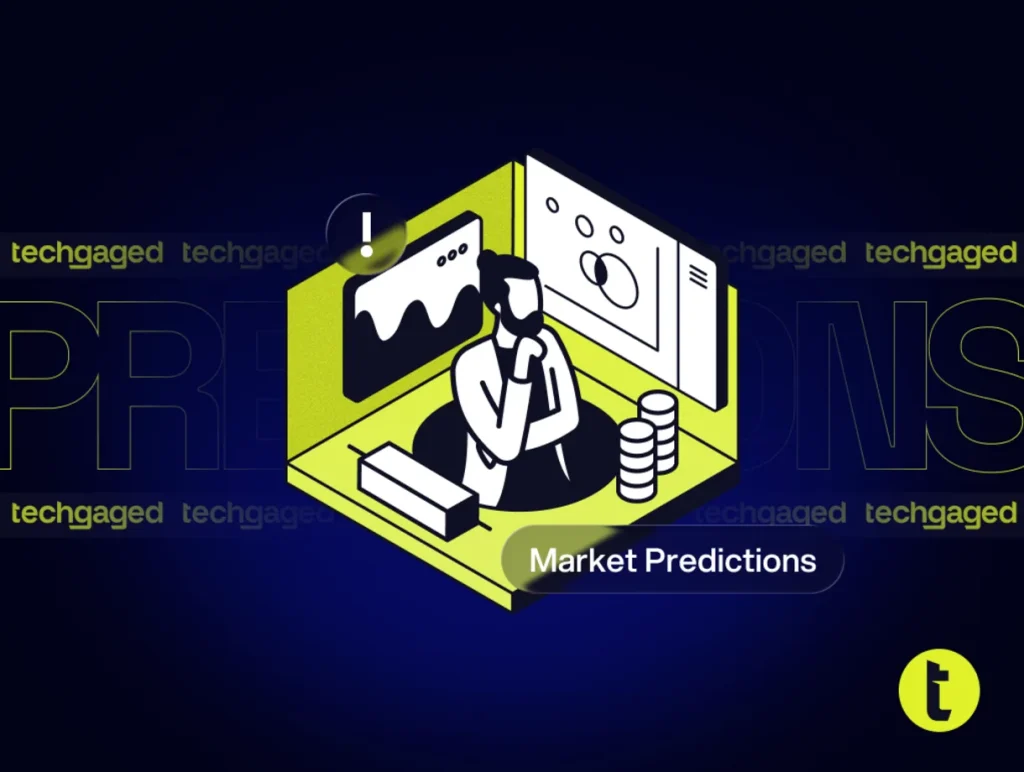
A guru thinking about markets. Source: TechGaged
Financial Experts Ranked by Forecast Accuracy: Who Gets Market Predictions Right?
In Brief
- • Most financial experts struggle to consistently predict markets despite their influence and visibility.
- • Inverse investing strategies emerged as a response to repeated forecasting failures by major financial personalities.
- • AI models are increasingly outperforming human analysts in data-driven financial forecasting and risk assessment.

It seems there’s no escaping financial advice these days. From investors and CEOs to TV personalities and bestselling authors, everyone is offering their two cents on all things finance and the economy, turning market forecasts into entertainment as much as financial guidance. Yet, forecast accuracy is often low.
When your hard-earned capital is on the line, listening to the wrong person (no matter how convincing they sound) can be an incredibly expensive mistake. Bold predictions certainly generate headlines, but too few people stop to ponder how often these financial experts (or “experts”) are actually right.
Some have built entire brands around dramatic and/or controversial market calls. Heck, some even directly contributed to their own inverse strategies, with people doing the exact opposite of their advice. In many cases, the line between financial analysis and personal branding has become increasingly blurred.
Latest Stories

Chainlink Demonstrates Cross-Chain Dividends — Tokenized Shares Need More Than Transfers

Ethereum’s zkAPI Separates AI Billing From Identity — Prompt Privacy Still Has Limits

Ethereum Researchers Explore Rules That Could Reject a Bad Transaction Outcome
This article takes a closer look at the forecast accuracy of some of the most recognizable (and loudest) figures in finance and investing, ranking them based on the long-term performance of their predictions. Here’s what the data says.
Looking for deeper insights into the future of crypto? Explore our Crypto Predictions 2026 guide covering Bitcoin forecasts, expert outlooks, and key market trends.
Measuring the forecast accuracy
The following rankings are based on documented forecast accuracy for each person. We’ve focused on the major hits and misses and approximated
Here’s what that looks like, ranked from lowest to highest:
| Person/strategy | Estimated forecast accuracy |
| Cathie Wood | Low (~35%) |
| Jim Cramer | Low (~37.5%) |
| Peter Schiff | Low (~38%) |
| Robert Kiyosaki | Low to moderate (~43%) |
| Inverse Cramer | Moderate (~62.5%) |
| Inverse Kiyosaki | High (~85%) |
And here is the more detailed look into how each financial expert fared:
Cathie Wood
CEO and founder of ARK Invest, one could say Cathie Wood represents the ultimate financial embodiment of the tech futurist. Unlike many of her peers, Wood’s projections focus on disruptive innovation, including AI, robotics, blockchain, and electric vehicles, to name a few. She is rather proficient at identifying major technological trends, but often far too early or overly optimistic on timing and valuation.
Estimated forecast accuracy: Low (~35%).
Her biggest strength is recognizing where technology is headed before most investors pay attention. Her bullish stance on Tesla during the late 2010s looked absurd at the time, yet eventually became one of the defining investment wins of the decade. At the same time, her long-term conviction in AI and blockchain placed her ahead of much of Wall Street before those sectors exploded into mainstream investment themes.
The issue with Wood’s prognostications is that being early in finance tends to look identical to being wrong. Many of her predictions rely on exponential growth assumptions that collapse under real-world conditions such as rising interest rates, shrinking liquidity, or slower adoption cycles.
For instance, ARK Invest’s flagship funds soared during the ultra-low-rate environment of 2020 and 2021, only to suffer severe drawdowns once speculative growth stocks lost momentum.
Wood’s record suggests that disruptive innovation investing can generate massive wins, but only for investors capable of surviving the volatility and waiting far longer than the original forecast timelines imply. That makes her more valuable as a long-term trend identifier than a short-term forecasting tool.
Jim Cramer
Our long-term tracking of Jim Cramer’s predictions demonstrates that the Mad Money host hits the mark roughly one-third of the time. While he occasionally nails a major macro trend, his broader track record is defined by erratic consistency and notoriously mistimed calls, which is a recurring theme among his fellow forecasters as well.
📊 Jim Cramer Prediction Accuracy (2000–2026)
-
✓
Correct predictions: 3 / 8 (37.5%) -
✕
Short-term forecasting reliability: Low -
✓
Long-term trend spotting: Sometimes strong -
✕
Timing accuracy: Unreliable
Overall accuracy: Low (~37.5%) — occasional big-picture wins, but weak consistency and poor timing
Based strictly on 8 confirmed predictions from TechGaged dataset (2000–2026).
Estimated forecast accuracy: Low (~37.5%)
Beyond the raw numbers, the underlying data highlights a, dare we say, fascinating psychological pattern: Cramer’s issue isn’t a lack of financial acumen, but rather his role as the market’s ultimate narrator.
He is a premier momentum chaser. His most spectacular blunders, such as giving Bear Stearns a clean bill of health right before its 2008 collapse, or hyping up Bitcoin immediately before a staggering $130 billion wipeout, happen because he is a mirror for current market euphoria.
When you audit two and a half decades’ worth of his data, a clear trend emerges: his loudest buy signals frequently serve as peak-sentiment indicators. By the time a stock receives that level of high-energy praise on national television, institutional smart money has usually taken its profits and exited, leaving retail traders to inherit the downside.
This exact dynamic is what gave birth to the entire inverse strategy phenomenon. At the end of the day, Cramer is an entertainer first. His and his network’s priority is to keep your eyeballs glued to the screen, not to safeguard or grow your personal net worth.
Peter Schiff
For more than two decades, Peter Schiff has built his reputation as a notable investment advisor around warnings of debt bubbles, currency debasement, inflation, and eventual financial collapse.
Estimated forecast accuracy: Low (~38%)
To his credit, Schiff correctly warned about the housing bubble and financial excesses leading up to the 2008 crash long before they became obvious to the broader public. That single call established much of his credibility and transformed him into one of the internet’s most recognizable financial contrarians.
But (there’s always one when measuring prediction accuracy), the problem is that Schiff essentially never stopped predicting disaster afterward.
For years, he repeated the message of an impending collapse of the US dollar, runaway inflation, catastrophic stock market declines, and so on. While some of these concerns contained elements of truth (such as debt expansion and monetary policy), markets often moved in the exact opposite direction, and for extended periods.
Look no further than the 2010s and early 2020s. Back then, US equities, technology stocks, and even Bitcoin dramatically outperformed the gold-centric defensive positioning Schiff consistently promoted.
That creates a pattern similar to that found in Robert Kiyosaki’s advice. Schiff frequently identifies genuine weaknesses in the economy, but his forecasts struggle because markets tend to be irrational and growth-oriented far longer than his thesis allows for.
As a result, Schiff functions better as a macro risk commentator than a practical portfolio guide. His analysis can help investors understand systemic fragility, though there’s also the danger of following his outlook too literally. If so, it would have caused many investors to miss one of the strongest bull market periods in modern history.
Robert Kiyosaki
If there were a pundit coin, Robert Kiyosaki’s predictions would almost universally be on the other side. The Rich Dad author is arguably the market’s favorite doomsday prophet. Yet, his track record shows that his entire brand relies on what many like to call the ‘broken clock’ philosophy: he has a solid grasp of big-picture macro issues, but his timing precision is practically nonexistent.
📊 Kiyosaki Prediction Accuracy (1990–2026)
-
✓
Correct predictions: 3 / 7 (~43%) -
✕
Short-term forecasting reliability: Low -
✓
Macro direction: Often correct -
✕
Timing accuracy: Unreliable
Overall accuracy: Low to Moderate (~43%) — strong macro insight, weak timing precision
Based strictly on 7 confirmed predictions from TechGaged dataset (1990–2026). One prediction remains ongoing.
Estimated forecast accuracy: Low to moderate (~43%)
Think about it this way: if you spend every week for years and years screaming that the sky is falling, you’re bound to catch a storm eventually. Of course, it all comes with a catch. The amount of money you burn while sitting in a bunker waiting for financial armageddon is astronomical.
Just look at the numbers. Since 2011, a regular investor who simply parked their cash in a basic, broad-market index fund would have stomped Kiyosaki’s beloved hard assets (gold and silver) by nearly 400%.
To be fair, Kiyosaki isn’t completely off base. He rightfully points out structural fallacies like the terrifying spike in national debt.
The real problem is his one-size-fits-all remedy that revolves around exiting the system entirely. Worse yet, his frantic timing feels carefully engineered to trigger your fight-or-flight survival instincts rather than help you maximize your ROI. At the end of the day, fear is a fantastic tool for selling books and securing clicks, but it’s a terrible game plan for your portfolio.
After all, the current decade shows that panic-selling out of the system was a big blunder for anyone who followed his lead. Doing so meant completely sitting out the most explosive wealth-creation event in modern history, which is the massive digital and AI revolution.
Inverse Cramer
If Jim Cramer hits the mark roughly a third of the time, the math introduces a new equation: what happens if you treat him like a financial compass that always points south? The Inverse Cramer strategy is built on the premise that the TV host is the ultimate lagging indicator. Instead of trying to guess where the market is going, this strategy simply waits for Cramer to scream about a stock, and then immediately places the exact opposite bet.
Estimated forecast accuracy: Moderate (~62.5%)
It’s worth noting that we aren’t talking just about good, clean internet trolling. There is a genuine psychological phenomenon at play here. Once again, we have to give credit where credit is due. Jim Cramer is a top-notch momentum chaser; it’s just that he usually catches trends at the end of their lifecycle.
So, by the time a stock makes it through his production team (very important cogs in the Cramer machine) and into a segment where he is literally slamming a soundboard, retail hype has peaked. The institutional money is already looking for an exit strategy, and Cramer’s enthusiastic viewers provide the perfect liquidity for those big players to dump their shares.
Now, it’s true that betting against Cramer has generated some genuinely eye-popping short-term wins (besides quality memes), like shorting Silicon Valley Bank or buying Bitcoin when he declared it dead. However, this is not an effortless money-printing machine. Turning the strategy into a strict, automated portfolio requires dealing with massive transaction fees and short-selling risks, not to mention the occasional loss when Cramer actually gets a call right.
So, the Inverse Cramer is best used as a tactical reminder. When the media’s excitement hits a fever pitch, it’s usually time to quietly walk toward the exit.
Inverse Kiyosaki
The Inverse Kiyosaki strategy tackles the problem of dealing with a permabear who has been predicting a catastrophic global collapse almost every single week since the Bush administration.
Estimated forecast accuracy: High (~85%)
At its core, the strategy is fairly simple. You ignore the panic, refuse to buy what Kiyosaki is peddling, and keep your capital deployed in the very system he claims is dying. When Kiyosaki yells that the US dollar is “toast” and that you need to hoard silver and gold, the Inverse Kiyosaki approach quietly buys more low-cost index funds and cutting-edge tech equities.
And it works. Kiyosaki’s timing is so vastly premature that he functions as a permanent false alarm. Because the broader markets historically trend upward roughly 75% to 80% of the time over multi-year horizons, an investor who doesn’t exit the system (i.e., remains aggressively invested in broad-market indexes) captures a sizable win rate.
It helps to understand that the global economy and the stock market are designed to grow over the years, fueled by corporate earnings and technological breakthroughs. So, by betting against Kiyosaki’s worldview and staying optimistic and invested, you are aligned with the historical trajectory of the market.
That’s not to say there is no risk. The major one is a genuine black swan event hitting the market at some point. If a massive correction does occur, a pure inverse strategy will take a temporary hit. However, as over a decade of data shows, the massive gains you accumulate by staying invested during these years of false alarms easily absorb the shock of an occasional downturn.
Want to explore the bigger picture behind the numbers? Explore our full cryptocurrency statistics report for deeper insights into market growth, adoption, and blockchain trends.
What these forecasts really tell us
For starters, it’s that financial forecasting is a potent mix of analysis, psychology, storytelling, and in some cases, showmanship. Then, it’s that the discipline has somewhat turned into internet memes and investment products at the same time.
But as the data shows, even the most recognizable names and faces struggle with prediction accuracy. Simply put, they are unable to consistently predict markets with precision. In many instances, broad directional insight matters far less than timing or risk management, putting the ability to adapt when reality changes faster than the original thesis at a premium.
So, is there someone or something you can safely turn to when, say, trying to figure out will Bitcoin go up?
Artificial intelligence just may be the answer. Unlike its human counterparts, AI models can process massive amounts of economic data, market sentiment, earnings reports, and historical trends simultaneously, without bringing in the emotional aspect to the narrative.
Research has already shown that the AI models achieved a 34.7% reduction in forecasting error compared to humans. Moreover, an advisor-grade AI system scored an average of 98.3% on complex financial reasoning tasks. Our mortal brethren had an average of 79.5%.
Now, AI is far from infallible and still vulnerable to unpredictable black swan events. Still, its capability to detect patterns at scale may gradually make traditional personality-driven forecasting feel increasingly outdated and/or unnecessary if you don’t like the flair that often comes hand in hand with it.
In the end, arguably the biggest lesson from decades of market predictions is that no expert consistently knows the future. The investors who perform best are usually not the ones chasing dramatic forecasts. They are disciplined enough to manage uncertainty, while others argue over who called the next crash first.
Methodology: This report cross-references various academic studies, along with independent performance tracking of the mentioned personalities. We focused on the gap between predicted outcomes and actual market performance over 10-year and 20-year windows, where applicable.
Disclaimer: The information provided in this article is for educational and informational purposes only and is based on documented public facts. This is not financial advice. Techgaged does not provide investment recommendations, and the historical performance of any individual mentioned in this piece is not a guarantee of future market results.
FAQs
Why are financial experts often inaccurate?
Financial markets are highly complex, non-linear systems influenced by countless variables, including psychology, geopolitics, technology, and liquidity. Many experts also rely on narratives, personal branding, or emotionally charged predictions that can distort objective analysis.
What is the average accuracy rate of financial experts?
Data suggests that many market forecasters operate around a 47% accuracy rate, which is only slightly below a coin toss.
Why do investors still follow financial gurus despite poor accuracy?
Humans are psychologically drawn to confidence, certainty, and dramatic storytelling. Bold predictions are more emotionally memorable than cautious, data-driven analysis. This makes charismatic experts highly influential even when their records are inconsistent.
Are inverse investing strategies reliable?
Not entirely. While inverse strategies can highlight excessive hype or fear, blindly following them creates its own risks, including timing failures, recency bias, and exposure to genuine market downturns.
How do AI models compare to human financial analysts?
Research shows AI systems can significantly reduce forecasting errors compared to humans by processing large amounts of data without emotional bias or corporate incentives influencing decisions.
What is the biggest weakness of celebrity financial forecasting?
Timing. Many experts correctly identify broad trends or risks but fail to predict when those events will actually impact markets, leading followers to miss years of gains or enter trades too late.
How do you rate this article?
Subscribe to our YouTube channel for crypto market insights and educational videos.





Join our Socials
Briefly, clearly and without noise – get the most important crypto news and market insights first.

Most Read Today
1
Coinbase and Deribit Complete Their Exchange Migration — API Users Have More to Check
2Noah Closes a $38M Seed Round as Stablecoin Payments Move Beyond the Wallet
3Tether and Kazakhstan’s Central Bank Explore a Tenge Stablecoin — A Pilot, Not a Launch
4Celestia’s SP1 Blobstream Deployments Are No Longer Maintained — Some Rollups Need a New Verification Path
5Wall Street’s Blockchain Switch Is Arriving: DTCC Tokenization Service Targets October Launch
Latest






8
Also read
Similar stories you might like.
Crypto News
October Fed Hike Odds Slip to 45% — Crypto Traders Are Watching Closely
Azeez | 2026-09-30
Crypto News
Bitcoin’s Rally Has Reached a Decision Zone — The Next Break Could Be Huge
Azeez | 2026-09-13
Crypto News
This AI Token Is Building Momentum as Attention Shifts Back to AI Sector
Azeez | 2026-09-07

Crypto News
The Bitcoin–Gold Relationship Is Reaching a New Extreme
Azeez | 2026-09-04
Crypto News
Strategy’s Bitcoin Bet Now Comes With Far Less Leverage
Azeez | 2026-08-28

Crypto News
The Next Crypto Investment Wave May Be Bigger Than Bitcoin — Here’s Why
Azeez | 2026-08-15
Crypto News
Hyperliquid Removes A Costly Barrier To Its Data: What Could This Mean For HYPE?
Azeez | 2026-08-14

Crypto News
Ripple CEO Criticizes Strategy’s Bitcoin Model, Stays Bullish On BTC
Rokas | 2026-06-30

Crypto News
BlackRock Has Sold ETH for 7 Straight Days — Is Institutional Sentiment Changing?
Azeez | 2026-06-30
Crypto News
84% of Altcoins in ‘Total Underperformance’, Bitcoin Moving to $58K
Ana | 2026-06-30