







Jim Cramer. Source: TechGaged/Shutterstock
Inverse Cramer Strategy Explained: The Cost of Overconfidence
In Brief
- • Inverse Cramer uses his calls as a contrarian signal, not direct advice.
- • His picks often follow hype, leading to poor timing for retail investors.
- • The strategy is inconsistent and fails without proper analysis and timing.

If you’re the one who likes to go against the grain, what would happen if the loudest and most prominent voice on TV was your go-to contrarian signal?
That’s basically what the Inverse Cramer is all about.
As the face of CNBC’s Mad Money, Jim Cramer’s call to fame came by promising to help retail investors make money. He quickly gained attention for his high-energy, straight-to-the-point picks, often in the format of a “lightning round” where he blasts buy, sell, and hold opinions on stocks.
Latest Stories
Ali Martinez Spots an XRP Breakout Setup as Investors Watch

Avalanche’s NYC Summit Hits Capacity — The Ecosystem Numbers Tell a Bigger Story

Grayscale Files to Rename Litecoin Trust as an ETF: LTC’s Next Phase Begins
While the guy certainly never lacked conviction, analyzing his advice was eye-opening.
Whereas surrendering to fear by following eternal bears (as with Robert Kiyosaki) could lead you to lose wealth through inaction and fear, emulating Cramer’s confidence may be a one-way ticket to becoming exit liquidity.
Looking for deeper insights into the future of crypto? Explore our Crypto Predictions 2026 guide covering Bitcoin forecasts, expert outlooks, and key market trends.
Table of Contents
What is the Inverse Cramer?
The Inverse Cramer is a straightforward financial philosophy: buy whatever Cramer says SELL and sell whatever he says BUY. You can also view it as a contrarian sentiment indicator of sorts that has already achieved a meme-worthy status in both crypto and traditional stock communities.
The Inverse Cramer approach picked up steam on Reddit and then-Twitter in the late 2010s and early 2020s. That’s when retail investors and traders began cataloguing his hits and misses during the explosion of meme stocks.

They quickly figured out that following Cramer’s predictions is no better than a coin flip.
His tenure on Mad Money has also been studied by academics. In fact, research confirmed that the ‘Cramer Effect’ (or Cramer Bounce) is a real thing. His recommendations are akin to attention shocks for individual traders. They often lead to a surge in overnight returns that generally reverse after a period of months.
Then, there’s the Cramer Curse, referring to assets the host is most enthusiastic about that often fizzle out. When combined with several high-profile misses (including his 2023 prediction to dump Bitcoin), it further popularized the Inverse Cramer movement.
The meme-worthy strategy became so huge that an Inverse Cramer ETF ($SJIM) was launched in 2023. Funny enough, the company behind the fund shut it down due to the high costs of running a short fund packed full of high turnover picks.
Long Cramer ETF ($LJIM), which followed his predictions to a T, closed much earlier due to a lack of interest. This could indicate that the contrarian stance on Cramer is much more pervasive.
The Real Cost of Inverse Cramer: Missed Gains Across 5 Major Market Events
Credit where it’s due, Cramer’s been on air for years, and his advice did help many traders see immediate gains. However, this is where the plot (proverbially) thickens.
Although retail may see the host as someone bringing fast insider knowledge, most of his picks are surface-level. Why?
The Mad Money host generally suggests moves that have already been priced in by the institutions and big cats.
Naturally, this leaves retailers at a significant disadvantage because by the time they begin placing calls, the smart money has already moved on to more lucrative opportunities. In crypto terms, listening to Cramer leaves you buying the top.
According to Bryan Lim and Joao Rosario’s paper, the data support this theory. Cramer’s calls represent a positive feedback strategy that relies on assets that saw commendable performance days or weeks ahead of his recommendations.
Thus, Cramer is providing a recap of the winners and summarizing sentiment after the price has exploded, predicting the actual movement.
When you combine this with the attention shock theory postulated by the Cramer Effect research, following Jim Cramer could lead to a mass of investors buying at the height of media hype. This means that while easy, immediate gains are possible, the sentiment generally reverses. Hence, it suggests that the smart money will use the retail spike as exit liquidity.
Fast picks aren’t Cramer’s strong suit. But, despite his ongoing meme status, his prominence on Wall Street and overall longevity allow him to spot long-term trends ahead of the retail market. Academic researchers and our own detailed report on Jim Cramer’s prediction accuracy highlight some impressive hits.
For instance, despite peddling back and forth on NVIDIA through the years, Cramer finally went into bullish mode for the stock in 2024. He was one of the rare figures who championed the company and its future role in the AI era.
Those who were proponents of the inverse Cramer strategy are likely still going through the five stages of grief due to the missed opportunity. Meanwhile, Cramer stans saw massive gains.
Here’s a quick rundown of both Cramer’s accuracy and his strong suits:
📊 Jim Cramer Prediction Accuracy (2000–2026)
-
✓
Correct predictions: 3 / 8 (37.5%) -
✕
Short-term forecasting reliability: Low -
✓
Long-term trend spotting: Sometimes strong -
✕
Timing accuracy: Unreliable
Overall accuracy: Low (~37.5%) — occasional big-picture wins, but weak consistency and poor timing
Based strictly on 8 confirmed predictions from TechGaged dataset (2000–2026).
Let’s sneak a peek at some of Inverse Cramer’s key moments (we did the same for the Inverse Kiyosaki strategy):
2026 Bitcoin recovery
A fresh instance of the Cramer Curse played out in early February 2026 when Bitcoin hovered around $77,000 and was going through an extreme mid-cycle correction.
In an X post framed as commentary, Cramer suggested buyers will swiftly return and propel the coin back toward $82,000. Nonetheless, since the sentiment surrounding cryptocurrencies was declining at the time, Bitcoin fell through its $76,000 support.
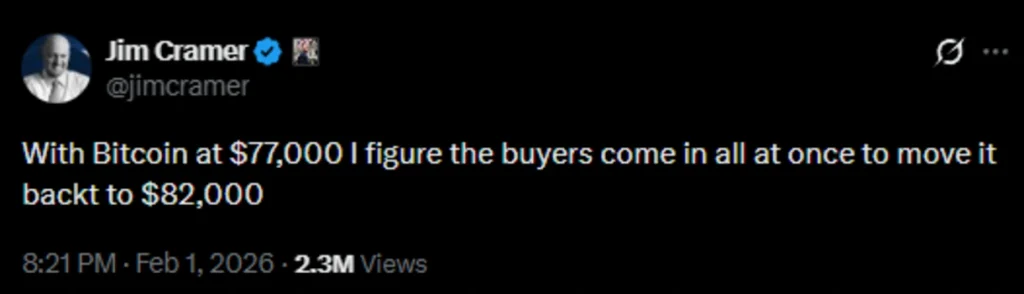
Inverse Cramer proponents who opened short positions likely profited from the strategy, considering that the bullish prediction also missed the downward trend that played out over the next few days when Bitcoin entered freefall toward the $62,000 area.
Want to explore the bigger picture behind the numbers? Explore our full Cryptocurrency Statistics Report for deeper insights into market growth, adoption, and blockchain trends.
Missing the 2023 bull run
Fumbling a liquidity flush can happen to anyone. Yet, in early 2023, the community experienced peak Cramer. That year, the analyst completely missed the historic bull run that propelled Bitcoin past $100,000.
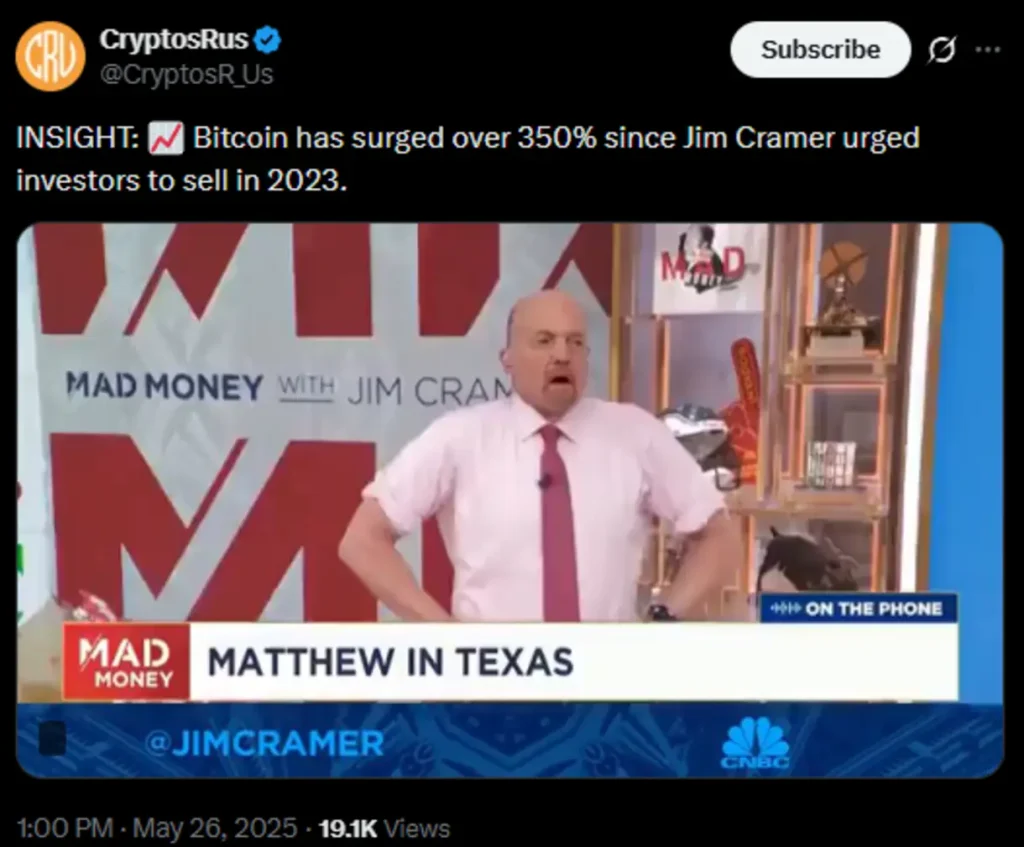
At the time, BTC exchanged hands at approximately $22,500. Cramer saw the slight recovery as a sign of market manipulation by Sam Bankman-Fried. He point-blank suggested viewers sell into the rally.
The rest is history. Those who followed the call missed the opportunity for 350% gains, while the Inverse crowd got closer to early retirement.
Naturally, hindsight is 20/20, so it’s easy to make light of the situation. Cramer’s outlook at the time was likely driven by the FTX crash and growing regulatory scrutiny that eventually dissipated after a wave of US spot ETFs turned into an institutional trend.
Public Meta meltdown of 2022
Meta’s stock set the stage for one of the most emotional and infamous moments for the Inverse Cramer meme.
Facebook rebranded as Meta in 2021, going all in on CEO Mark Zuckerberg’s metaverse pipe dream. As a result, the company saw its costs skyrocket while its revenue assumed an opposite trajectory. The shares instantly fell by 24%. Cramer, being a human-shaped conviction machine, continued pushing the stock on air during its downward spiral.
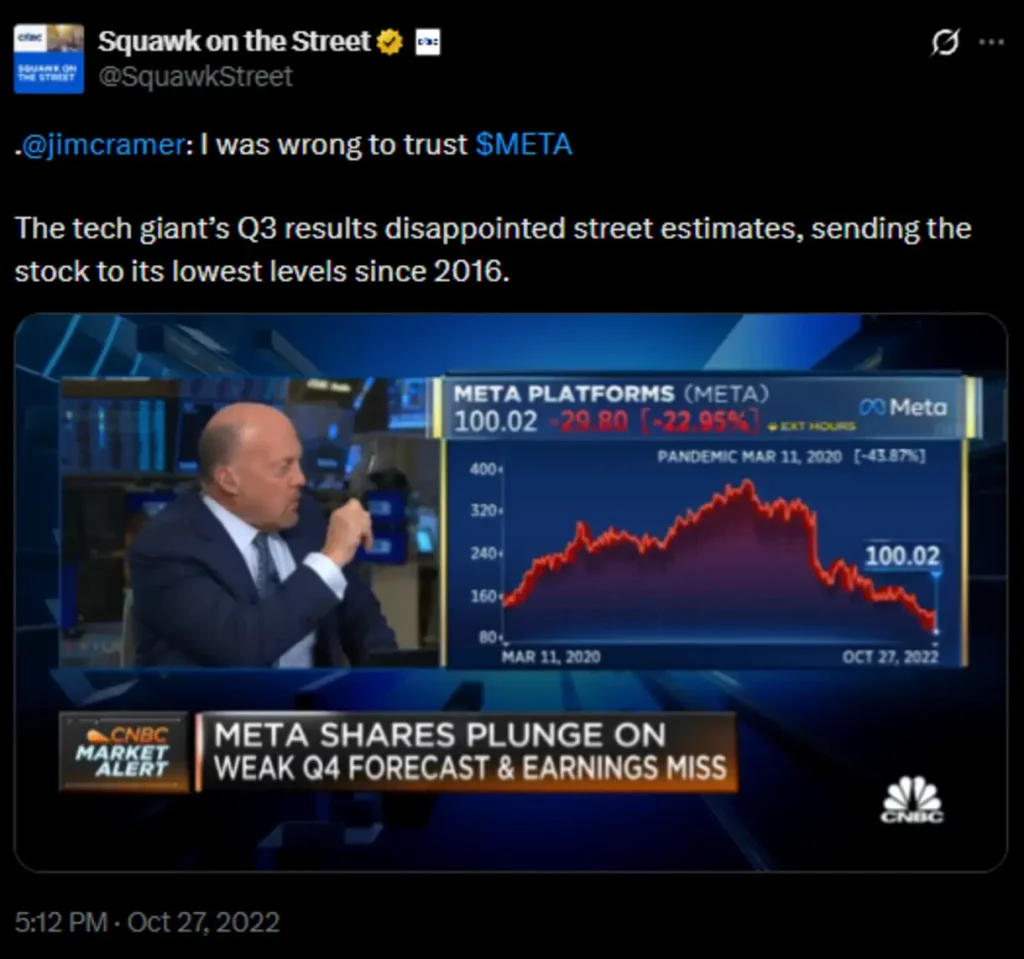
Once the stock was 70% down with no reversal in sight, Cramer broke character on live television. In what was one of his more emotional moments, he tearfully apologized to investors for promoting the stock.
In an ironic twist, his public apology marked the floor for the stock. Perma-contrarian Inverse Cramer crowd saw his show of emotion (and surrender) as a buy signal. The result was the Meta stock making a 400% recovery.
2023 Silicon Valley Bank (SVB) fiasco
In early 2023, Cramer hailed Silicon Valley Bank as one of the best investments of the year. Cramer Curse came down with a vengeance, and within a month, SVB became a highly-publicized banking failure.
To make matters worse, mere days before the First Republic Bank was seized and sold to JPMorgan, Cramer still remained bullish on regional banks, claiming the “fear was misplaced” and that SVB remains safe.
Famous last words, indeed. Capital and startup clients pulled the money from SVB, and the bank sold bonds at a massive loss. Retailers who doubled down likely lost 100% of their capital, while believers of Inverse Cramer avoided exposure to a crumbling sector.
2021 failed Coinbase IPO call
Analysts often get swept up in hype cycles, and Cramer is no exception. During the IPO craze of 2021, the famed TV host was openly bullish on Coinbase, calling for the price of $475 (other analysts and investment banks also set their price targets around $400).
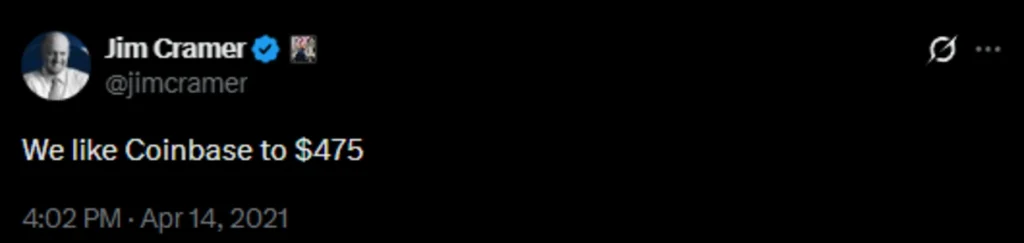
Despite an initial pump from $380 to approximately $420, the stock then fell by over 90%.
Following the Inverse Cramer strategy and shorting would net significant gains over a year, as the stock eventually hit the $40 area in 2022. Those who took Cramer’s bullish attitude as a sell signal would also avoid the fate of becoming exit liquidity for institutional investors.
Why the Inverse Cramer Strategy Fails in Practice
If the Inverse Cramer strategy was a consistent winner, your average X contrarian would be hitting send from his Malibu mansion. The reality is, unfortunately, much more nuanced. Going with the inverses on every call is nothing short of emotional trading camouflaged by a thick coat of paint.
Think of it this way: since Cramer often gets things right, it’s certainly not a strategy you could automate.
More so, relying on it could lead you down a path of believing that the meme itself is a valid replacement for actual math and research.
Yet, where the Inverse Cramer strategy makes good is in recognizing if the hype is reaching its pinnacle, which can help you ascertain the next logical move by a single asset.
A good example would be the Coinbase IPO we just mentioned. The Cramer Curse did indeed strike, but only after the stock added about $40. Thus, it was a clear signal that the hype had reached unhinged levels, which is often followed by inevitable reversal.
The same example outlines a major weakness in the strategy. If you shorted the moment that Cramer made his call, the attention shock would probably liquidate your position before you’d get a chance to profit from the reversal.
Here’s why Inverse Cramer ultimately fails as a legitimate trading strategy:
Risk of becoming a broken clock
The key problem with the inverse strategies is the broken clock syndrome. As is the case with permanent bears like Kiyosaki (who often speaks of massive doomsday scenarios), their predictions are bound to come true at one point.
Similarly, with Cramer, you can become the epitome of the broken clock quite easily, as inverting him will basically lead to you ignoring market realities.
While the Cramer Curse is legendary, he’s a persona who kept his pulse on the market’s heartbeat for decades. Thus, his conviction for secular winners is generally accurate, as he is familiar with the companies that have tangible staying power.
Surrendering to the meme about short-term ETH or BTC moves could make you quick money, sure. But inverting the NVIDIA call would result in approximately 500% in missed gains, which is a disastrous outcome.
Recency bias problem
The assumption that Cramer’s calls are always wrong is no different from being a blind follower.
Why?
Because at this point, you’ve stopped looking at the data objectively and are basically going with the vibes. This leaves you susceptible to the recency bias, where recent information is overemphasized and earlier, more relevant data gets ghosted.
For instance, memes about the Cramer Curse striking Bitcoin in February may have led you to overlook that Cramer has been right about the macro-movements of the US economy.
While the bears were preparing for an imminent crash, Cramer’s ‘soft landing’ theory materialized to a T. On April 14, 2026, he noted on ‘Mad Money’ that many investors missed out on a massive rally simply because they were waiting for a catastrophe that never arrived.
Cramer’s bullish attitude paid off. He had his “I told you so” moment, while the Inverse crowd sat on the bench for the entire event.
Timing issue
With most trading strategies, the issue of timing is front and center. For Inverse Cramer, it’s the most important variable.
Both the Coinbase IPO pump and the Meta catastrophe prove just how fickle the “scheduling” really is. With the former, the Inverse crowd was technically right, but it took some time for the price to reverse. With Meta stocks, Cramer saw the big picture, but failed to accurately predict the initial pullback after the Facebook/Meta rebrand.
In a sense, you can’t account for timing in the strategy. Even when Cramer is wrong, the initial post-announcement price pump could burn you out if you inverse like a madman.
Another example that proves this argument is the Super Micro Computer SMCI drama. As SMCI was exploding amid the wider AI hype, Cramer was advising people to sell based on accounting irregularities.
Inversers may have ridden the wave hard, but eventually, accounting fraud allegations and chip-smuggling indictments caught up. They led to the SMCI stock round-tripping from the glorious $119 back to the low $30s by March 2026.
Cherry-picking bias
There’s this adage that bad news travels faster than good news, and it perfectly applies to Inverse Cramer. On social media, his worst calls are highlighted, the community reposts them, and ridicules his inaccuracy. At the same time, any of his accurate macro calls will disappear in the meme-centered noise.
Cramer’s ability to occasionally look straight through the hype is undoubtedly legendary, but not many traders are aware of this.
For example, he has been outspoken about his skepticism about Rivian. While he acknowledged the company’s potential, he advised against buying tops, citing funding issues. Cramer didn’t fall for the hype about Rivian becoming the next Tesla.
The biggest nail in the coffin for the strategy is the fact that the $SJIM ETF showed mixed results. Again, if betting against Cramer consistently was that accurate, we’d all be laughing on our way to the bank weekly while dunking on Cramer (and thanking him for making it happen).
| Where Inverse Cramer Wins | Where Inverse Cramer Loses |
| Hype-peak buys: Cramer’s most unhinged calls could signal that retail could become exit liquidity for institutions. | Timing risk: Correct inverse calls can get wiped out by the initial attention shock pump before the reversal happens, like Coinbase pumping after Cramer’s call before a collapse. |
| Crypto sentiment calls: Short-term crypto moves are when the Cramer Curse strikes with a vengeance – both his 2023 “sell the rally” call and 2026 Bitcoin recovery miss are textbook examples. | Secular winners: Inverting long-term bullish calls on NVIDIA or Apple could cost inversers significant gains as the strategy punishes accurate macro calls. |
| Banking sector red flags: SVB and Bear Stearns historic misses show that when Cramer doubles down on financials under stress, the inverse signal can be a massive life raft. | Broken clock exposure: Cramer’s ‘soft landing’ thesis and macro economy reads have generally been correct, meaning that inverting could make you miss out on rallies. |
| IPO and meme hype cycles: When Cramer goes all-in on a hot IPO, it could be a reliable signal that smart money is looking for an exit. | Cherry-picking trap: The meme amplifies his worst calls and buries his best moves. |
| Capitulation as a buy signal: His on-air Meta apology proved that Cramer’s surrender could indicate a market floor. | $SJIM reality check: The Inverse Cramer ETF couldn’t stay afloat, meaning the real-world execution of the strategy is a lot messier than the meme would suggest. |
Does Inverse Cramer Actually Work? Data vs Narrative
While it’s certainly a flawed strategy/technique that requires a nuanced approach, the Inverse Cramer works for the same reason most inverse strategies do: you’re betting against financial advice optimized for the highest reach and targeted to the common denominator.
Cramer’s role in the trading ecosystem is to keep casual retailers from switching channels. He’s a gateway drug into financial literacy and the one who makes sure the liquidity at lower levels keeps flowing.
His inaccuracy is ultimately the direct result of his need to fill this role. It’s worth remembering that Cramer operates in a world where attention is the main currency. Of course, something like that is best earned through loud calls and boisterous conviction.
So, how do you make the strategy work?
Well, not inverting him is a good start. Cramer’s advice is a good starting point for further research because the loudest calls are surprisingly one of the most effective hype barometers around.
Use his signals to peek behind the curtain and try to understand why Cramer is saying what he’s saying. The incentive behind his price targets and buy/sell calls actually matters more than the specific advice. It certainly works wonders for accurate positioning in the market that’s often chaotic and uncertain.
Ultimately, no strategy can replace hours of research necessary to turn trading into something more accurate than a coin toss. Certainly, no strategy that started its life as an internet meme.
Disclaimer: The information provided in this article is for educational and informational purposes only and is based on documented public facts. This is not financial advice. Techgaged does not provide investment recommendations, and the historical performance of any individual mentioned in this piece is not a guarantee of future market results.
Frequently Asked Questions
What exactly is the Cramer Effect?
The Cramer Effect refers to a documented financial phenomenon where a stock recommendation on Mad Money triggers a sudden “attention shock” among retail investors. This typically results in a sharp spike in trading volume and overnight returns that generally reverse as the initial hype fades over the following weeks and months.
What was the $SJIM ETF, and why did it close?
The Inverse Cramer Tracker ETF ($SJIM) was a financial product launched in 2023 that systematically shorted Cramer’s stock recommendations. It was liquidated in early 2024 due to a combination of high administrative costs and high-turnover picks. Ultimately, it proved that the high turnover and “attention shock” pumps make mechanical inverting a difficult strategy to maintain.
Why is the Inverse Cramer strategy particularly popular in the crypto community?
The strategy gained legendary status in crypto following several mistimed calls. Among the most notable was Cramer’s January 2023 advice to “sell the rally” when Bitcoin was at $22,500 before it began a historic climb toward $100,000. Because crypto markets are highly sensitive to retail sentiment, his “capitulation” is often viewed by traders as a reliable indicator that a local market floor has been reached.
What are the biggest risks of blindly inverting every Cramer pick?
The primary risk is the “Broken Clock” trap, where a trader ignores genuine market data simply to oppose a media personality. Blindly inverting can lead to catastrophic losses if applied to long-term “secular winners” like NVIDIA or Apple, where Cramer’s macro-conviction has historically outperformed the short-term noise of the Cramer Curse.
Can the Inverse Cramer be used as a legitimate trading tool?
Professional traders rarely use the Inverse Cramer as a direct “buy/sell” button. Instead, they treat it as a Sentiment Thermometer. By observing when his calls reach a peak “unhinged” level of enthusiasm, contrarians use the signal to identify potential price exhaustion and areas where institutional investors might be looking for retail exit liquidity.
How do you rate this article?
Subscribe to our YouTube channel for crypto market insights and educational videos.






Join our Socials
Briefly, clearly and without noise – get the most important crypto news and market insights first.

Most Read Today
1
Clarity Act 2026: Everything You Should Know
2Ethereum’s Q3 Rally Just Hit a Major Milestone: Only One Year Was Stronger
3Bitcoin’s Rally Has Reached a Decision Zone — The Next Break Could Be Huge
4Avalanche’s NYC Summit Hits Capacity — The Ecosystem Numbers Tell a Bigger Story
5Grayscale Files to Rename Litecoin Trust as an ETF: LTC’s Next Phase Begins
Latest





8
Also read
Similar stories you might like.
Crypto News
Bitcoin’s Rally Has Reached a Decision Zone — The Next Break Could Be Huge
Azeez | 2026-09-13

Crypto News
Bitcoin Demand Is Starting to Stabilize — Is Stronger Accumulation Next?
Azeez | 2026-09-11
Crypto News
XRP Joins Bitcoin, Ethereum and Solana in a Major U.S. Listing Framework
Azeez | 2026-09-10

Crypto News
Bitcoin ETF Momentum Takes a Hit — The Next Sessions Could Matter
Azeez | 2026-09-09
Crypto News
This Is the Only Crypto Sector Still Above Bitcoin’s Peak
Azeez | 2026-09-08
Crypto News
This AI Token Is Building Momentum as Attention Shifts Back to AI Sector
Azeez | 2026-09-07
Crypto News
Bitcoin Clears Its Biggest Leverage Test Since 2023
Azeez | 2026-09-07
Crypto News
Bitcoin ETF Demand Is Back — Now the Market Faces Its Next Test
Azeez | 2026-09-06

Crypto News
Morgan Stanley Adds to Its Bitcoin Position for a Fourth Straight Day
Azeez | 2026-09-05

Crypto News
The Bitcoin–Gold Relationship Is Reaching a New Extreme
Azeez | 2026-09-04