
















Cybersecurity breach warning with lock icon on laptop. Source: TechGaged / Shutterstock
$290M Exploit Hits Kelp DAO via Bridge Attack
In Brief
- • $290M exploit hit Kelp DAO via a bridge verification flaw.
- • Attack used compromised nodes and a single-verifier setup.
- • DeFi reacted with fund outflows and tightened security measures.

A $290 million exploit hit Kelp DAO after attackers manipulated LayerZero’s verification process, and early attribution points to North Korea’s Lazarus Group. The attack tricked a verifier into approving a fake cross-chain transaction that released roughly 116,500 rsETH. The fallout spread quickly across decentralized finance (DeFi).
Attack targeted infrastructure, not protocol
In an X post on April 20, LayerZero said the exploit didn’t come from a bug in its protocol but from how Kelp DAO configured its security. The rsETH bridge relied on a 1-of-1 Decentralized Verifier Network (DVN) setup, which means a single verifier had full authority to approve transactions. That created a critical weak point and enabled the subsequent bridge hack.
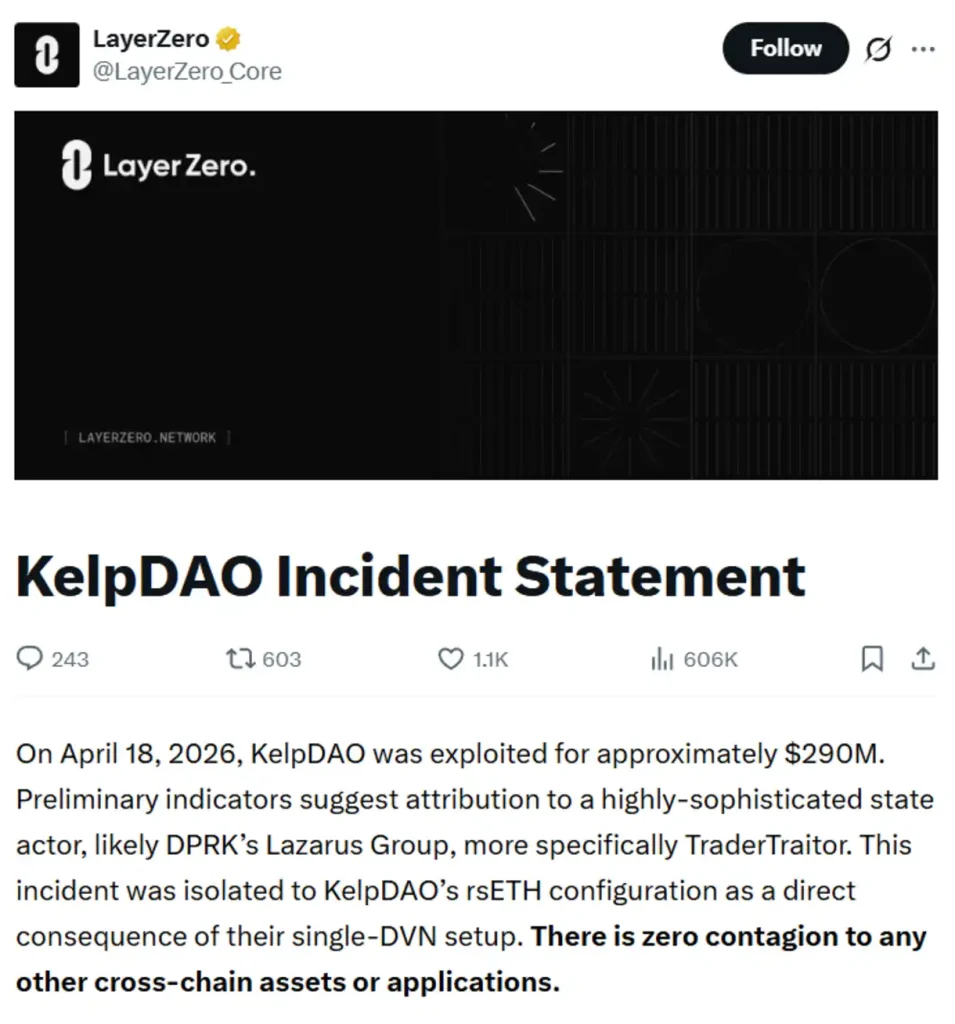
According to LayerZero, attackers compromised two RPC nodes used by its verifier and replaced their software with malicious versions. These nodes selectively fed false data to the verifier and continued to report normal data to monitoring systems, which effectively hid the attack.
Latest Stories
Two Cities Control More Than Half of Solana’s Blocks — A Decentralization Question Emerges

One HYPE Whale Has Been Selling for 2 Weeks — What Could Be Behind It?

From Nearly Nothing to $4B: RWA Perps Are Reshaping Onchain Trading
To complete the exploit, attackers launched a DDoS attack on healthy nodes, forcing the system to fall back on the poisoned ones. Once the failover occurred, the verifier confirmed a transaction that never actually happened. Funds were released, and the malicious software erased itself without a trace.
LayerZero said this type of RPC poisoning represents a new class of attack vector that the industry needs to take seriously.
DeFi impact spreads as risks become clearer
In the aftermath of the attack, Aave (AAVE) froze rsETH markets, total DeFi value locked dropped roughly 7% to $86.3 billion, and around $10 billion flowed out of protocols as users reacted. Several projects paused LayerZero integrations as a precaution, even though the company said there was no contagion beyond Kelp DAO’s setup.
As it happens, LayerZero has long recommended multi-verifier configurations, where multiple independent DVNs must agree before a transaction is approved. In that model, compromising a single verifier wouldn’t be enough to execute an attack, unlike what happened in this case.
This incident effectively turns that recommendation into a hard line. LayerZero said it will no longer support applications running 1-of-1 configurations, which will force projects toward redundancy.
All things considered, this exploit exposed a survivability threshold in DeFi design. Protocols with single points of failure are now easy targets, especially for state-level actors like Lazarus, linked to multiple large-scale exploits this month. In short, DeFi just got a stress test, and not every protocol passed.
How do you rate this article?
Subscribe to our YouTube channel for crypto market insights and educational videos.






Join our Socials
Briefly, clearly and without noise – get the most important crypto news and market insights first.
Most Read Today
1
Solana’s RWA Adoption Hits a Huge Milestone: Bullish?
2Chainlink Hits $34T in Enabled Transactions — The Infrastructure Race Is Heating Up
3This Is the Only Crypto Sector Still Above Bitcoin’s Peak
4Abraxas Makes Another ETH Move — Its Massive Hyperliquid Short Holds the Key
5Clarity Act 2026: Everything You Should Know
Latest





8
Also read
Similar stories you might like.

Crypto News
Chainlink Hits $34T in Enabled Transactions — The Infrastructure Race Is Heating Up
Azeez | 2026-09-08

Crypto News
Ethereum Is Building Something Bigger Than the Crypto Market
Azeez | 2026-09-06

Crypto News
BNB Chain Just Gave Builders More Room — The Next Wave Could Be Coming
Azeez | 2026-09-05

Crypto News
BlackRock Leads the Biggest Bitcoin ETF Inflow Surge of the Week
Azeez | 2026-09-04

Crypto News
A Major Solana Upgrade Targets High-Speed Agent Payments
Azeez | 2026-09-04

Crypto News
Tokenized Gold Is Flowing Into DeFi — Tether Gold Crosses $100M
Azeez | 2026-09-02

Crypto News
A Major Zcash Upgrade Is Changing Wallet Performance
Azeez | 2026-08-31

Crypto News
Smart Money Is Starting to Look at DeFi Again
Azeez | 2026-08-31

Crypto News
Sui User Growth Surges to New Highs — Bullish?
Azeez | 2026-08-30

Crypto News
AQAv2 Launch Could Boost HYPE Revenue by 18% and Fuel Buybacks
Azeez | 2026-08-27