















Crypto trader celebrating. Source: TechGaged / Shutterstock
Can Anyone Actually Predict Cryptocurrency Prices?
In Brief
- • Crypto prices are too volatile and unpredictable to forecast accurately.
- • Analysts estimate probabilities using technical, fundamental, and sentiment analysis.
- • Even AI and experts cannot eliminate uncertainty from crypto markets.

No. Nobody can accurately predict cryptocurrency prices. There’s no such thing as a crypto crystal ball, no crypto tarot or palm reading, and the stars will tell you nothing. But the charts might at least whisper.
Whether what they say will hold up is a different story. There’s also a massive difference between predicting the future price and predicting future price movements. Both rely on probabilities, patterns, and risk management, not exact forecasts, but the former may make more sense than the latter.
And remember, nobody can make any promises, nor can they know where the market will go. All that even the most qualified professionals can do is give their best guess. Let’s see why that is.
Latest Stories

Morgan Stanley Adds to Its Bitcoin Position for a Fourth Straight Day

Zcash Has More Than a Price Story — Here’s What’s Really Changing

BNB Chain Just Gave Builders More Room — The Next Wave Could Be Coming
Table of Contents
Too Dramatic To Predict
The crypto market seems to be working on the principle of “never let them know your next move.” Many are trying, but nobody can predict cryptocurrency prices with definitive accuracy because the market is simply too volatile for it. It’s commonly driven by unpredictable sentiment, news, and rapid shifts in demand, muddying any and all forecasts.
Some of the most dramatic examples of this volatility include Bitcoin crashes and rallies (pulling and pushing the rest of the market with it), memecoin explosions and implosions, as well as sudden and sometimes drastic market reactions to tweets, regulations, hacks, ETF approvals, wars, inflation reports, etc.
Prediction in crypto is less about “knowing the future” and more about measuring probabilities, identifying trends, estimating direction, and managing uncertainty. Instead of exact targets, experts work to determine probability, mostly relying on three methods. Each of these approaches offers directional clues that, together, can point to a likelihood of an event. But even top institutional forecasts have a notoriously low accuracy rate when they’re assigning specific numbers to future prices.
Looking for deeper insights into the future of crypto? Explore our Crypto Predictions 2026 guide covering Bitcoin forecasts, expert outlooks, and key market trends.
Future Direction vs Future Price
According to a 2020 study, crypto price prediction can give “a lending hand” to investors when they’re aiming for higher profits. But they can also support policy decision-making and help financial researchers when studying crypto market behavior.
The authors argued that metrics can’t properly predict the crypto price direction. However, “a cryptocurrency trader or investor may be more interested in the future price direction movement rather than knowing the exact future cryptocurrency price.” This is something to keep in mind when looking into this topic.
Common Mistakes Beginners Make When Predicting Crypto
Investors are the most vulnerable when just entering the market. One of the biggest mistakes beginners make is relying too much (or at all) on influencers, celebrities, viral posts, and online hype. The crypto market is driven by sentiment. A single post from a popular trader can trigger massive buying or selling activity within minutes. But remember that what goes up fast will come down hard. Social media trends are short-lived, powered by emotions, not based on solid analysis. Many newcomers start trades simply because a coin is trending, only to suffer losses when excitement fades, and prices inevitably plummet.
Investors also need to be careful of scam projects that pay for promotions, aiming to raise the hype, so many would buy in, before the founders do a rug pull. Influencers may also manipulate the market to raise the price of a coin they themselves have invested in.

Therefore, emotional trading is a common problem, especially during extreme volatility. Fear of missing out (FOMO) can push investors to buy after prices have already surged, often to unsupportable levels. Then, panic selling during market crashes locks in heavy losses. On the other hand, successful traders typically rely on strategy and risk management, which beginners tend to ignore. They’ll also not take any basic precautions, including diversification, stop-loss orders, or limiting exposure to highly speculative assets. Without proper risk management, a single market swing can wipe out a large portion of your investment. Trying to get rich quick via crypto doesn’t pay off.
Another mistake is thinking that historical patterns will always repeat. It’s true that analysts study previous Bitcoin cycles, halving events, and bull markets, trying to figure out future trends, but the industry is evolving fast. It’s difficult to catch up. Regulations change, institutional investors enter the market, technologies improve, macroeconomic conditions shift, and geopolitical factors affect the market. Simply put, the patterns that worked in previous cycles may act differently in the future. Historical analysis can provide context, but it’s not a roadmap.
Why Cryptocurrency Prices Are So Difficult to Predict
A significant issue when it comes to predicting efforts is that the crypto market behaves so differently compared to traditional finance (TradFi). Analysts and traders can observe and measure specific economic indicators to forecast the behavior of, say, stocks and commodities. Crypto, as seen above, doesn’t have equally measurable metrics. Additionally, there’s a massive difference in the level of regulation within the two trading environments.
Extreme Volatility
This is one of the defining characteristics of the crypto market and often its biggest obstacle when it comes to adoption. Both Bitcoin and major altcoins regularly experience large price swings, moving by hundreds or thousands of US dollars within hours, or by double-digit percentages. What’s more, smaller-cap cryptocurrencies can collapse within a day. It is not uncommon for low-market-cap tokens to gain or lose over 20% in a single day. Leverage trading fuels the volatility further, as traders borrow funds to increase their position sizes. And this is what often happens: prices move sharply and suddenly, liquidations trigger forced buying/selling, which turns into a chain reaction, and finally amplifies market movements even more. It’s adding fuel to the fire.
Market Sentiment Moves Faster Than Fundamentals
It’s common for fear and greed to absolutely dominate short-term trading behavior. This results in price surges during hype cycles, as well as crashes during panic selling. Retail investors add to this behavior as they typically react quite emotionally to headlines in particular. Finally, social media platforms play a major role, influencing billions of dollars in market value overnight. This combination ultimately makes the market even more unpredictable.
Crypto Markets Never Sleep
Unlike TradFi, which operates during regular work hours, crypto trading never stops. The market is fully open 24/7. This is, of course, a unique advantage. However, it also means that traders from across the world participate across different time zones, so major price moves can happen at any moment. Geographic limitations do not exist, so any headlines appearing in one country will have a near-instant and worldwide effect. Therefore, investors are exposed to volatility even when they sleep.
Regulation and Macro Events
Just because they don’t operate within traditional systems doesn’t mean that cryptocurrency prices aren’t sensitive to regulatory and macroeconomic developments. We’ve seen numerous times how quickly and easily these factors can trigger market reactions, including government crackdowns, ETF approvals, inflation reports, interest rate decisions, geopolitical conflicts, and exchange collapses. What’s more, just rumors of stricter regulation or financial instability can create ripples.
All of these contribute to the market unpredictability, which is why analysts rely on several methods to estimate probabilities and trends, instead of aiming for certainty.
Want to explore the bigger picture behind the numbers? Explore our full cryptocurrency statistics report for deeper insights into market growth, adoption, and blockchain trends.
What Influences Cryptocurrency Prices?
There’s nothing simple about the influences on crypto prices. Not only is the market affected by individual elements, but also by the complex combination of economic, geopolitical, regulatory, technological, and psychological factors. And it’s not even mature as a market yet, still developing, pushed and pulled by both real-world developments and online sentiment. Anyone attempting to analyze or predict market behavior should really first understand the main forces behind these movements.
Supply and Demand
Like any financial asset out there, crypto is bound to be influenced by supply and demand. Let’s take Bitcoin as an example. BTC has a fixed supply of 21 million coins, and this scarcity is a significant part of its appeal. Moreover, halvings reduce the number of new coins entering circulation, which historically, at least so far, contributed to increased demand. It also acted as a bullish factor. When investor demand rises faster than available supply, prices usually climb.
Adoption and Utility
Whether a project will actually have long-term value depends on its real-world usefulness and adoption. Those who fail in these two fields fail altogether. But projects with strong payment systems, active blockchain ecosystems, and/or decentralized applications (dapps) often attract more investor interest. They then need to continue evolving to maintain or increase that interest long-term. The teams also strengthen confidence in their projects through developer activity, institutional investment, and partnerships with major companies, among other moves. However, projects with little to no practical utility struggle to preserve value when speculation unavoidably diminishes.
Liquidity and Trading Volume
Cryptos with high trading volume and strong liquidity are usually more stable. This is because large trades have less impact on the market. But smaller coins with thin liquidity, and there are thousands of these out there, are extremely vulnerable to sharp price swings. Even modest buying or selling pressure can cause dramatic shifts.
Media Coverage and Social Trends
The role of media attention and online trends in crypto markets shouldn’t be underestimated. Discussions on platforms like Reddit, X, TikTok, and YouTube, as well as viral comments by more prominent figures, drive investor behavior quickly and significantly. Positive headlines can form buying momentum, while negative headlines can cause panic.
Whale Activity
When large holders, aka whales, make large transactions, this can considerably impact prices. One large sell order can trigger chain reactions in leveraged markets. This, subsequently, results in liquidations and fast price drops. This is why whale movements are watched so closely – they can influence short-term market direction.

The Three Main Methods Used to Predict Cryptocurrency Prices
Due to all this unpredictability and volatility, there isn’t a forecasting method in the world that can guarantee accurate results. Analysts and traders are looking to identify trends, probabilities, and any potential market scenarios, searching for clues that would point to a potential direction. Most crypto forecasting strategies fall into three main categories that examine the market from different perspectives. Experienced investors usually combine all three.
Technical Analysis (TA)
Technical analysis is one of the most widely used methods for predicting short-term crypto price movements. This approach studies historical price charts, trading volume, patterns, and statistical indicators, looking for trends. The core idea is that market behavior typically follows recurring patterns, often driven by investor psychology – though in the case of crypto, it’s not that simple.
Within TA, traders use support and resistance levels, trend lines, moving averages, and candlestick patterns, among other metrics. They use these to evaluate market momentum. Additionally, the Relative Strength Index (RSI) and similar indicators help measure whether an asset is overbought or oversold at that moment. Holding above a major support level during a market pullback could be a bullish signal, showcasing buying strength.
However, unexpected news, regulatory announcements, or large market liquidations can quickly invalidate even the strongest chart patterns.
Fundamental Analysis (FA)
When investors are interested in a project, they utilize fundamental analysis to evaluate its actual strength and long-term potential. So, they don’t study price charts but examine strictly technical factors such as network activity, active users, transaction volume, tokenomics, developer activity, partnerships, utility, etc. This should show if the project indeed has real-world use cases, genuine value, and long-term growth potential.
A blockchain project that is seeing growing adoption and transaction activity, in addition to enjoying strong developer support, seems fundamentally strong. This project could then join other projects and companies in partnerships, inviting institutional investment as well, all of which increases confidence in its future.
But keep in mind that strong fundamentals don’t guarantee success on their own, nor can they always protect the project from market downturns. High-quality projects are also vulnerable during periods of panic or economic uncertainty. Therefore, prices are often equally influenced by technology and utility on the one side and emotion and speculation on the other.
Sentiment Analysis
As seen above, sentiment is a key player in the crypto industry. Positive hype can drive prices upward, while fear can activate rapid market selloffs. Therefore, sentiment analysis attempts to measure market psychology and crowd behavior, because the narrative-driven market leads to emotion-driven prices, at least in the short term. Public sentiment can help investors estimate if the market is turning (overly) optimistic, fearful, or speculative.
Analysts track social media talk, trending hashtags, news coverage, and online discussion across various platforms. The Fear & Greed Index is one of the most commonly used tools, as it helps estimate overall market sentiment. In recent years, AI-powered tracking models have also become popular. But sentiment can shift extremely quickly, so this metric can turn risky.
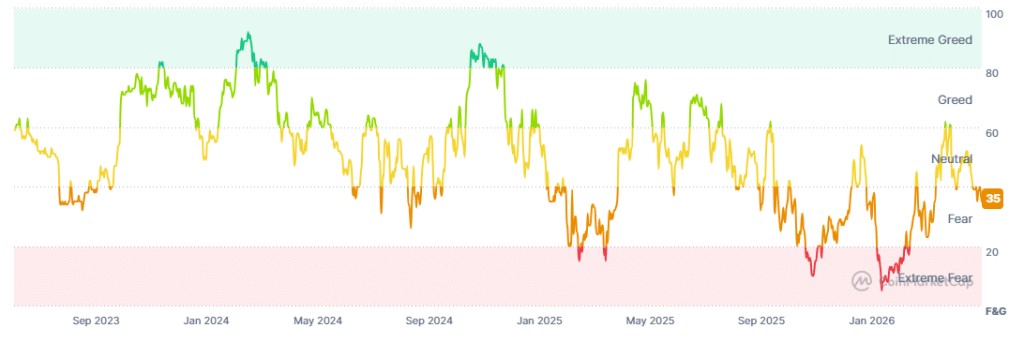
Meanwhile, additional and more precise metrics are needed to measure price movements more accurately. The above-cited paper found that “cryptocurrency prices follow almost a random walk process while few hidden patterns may probably exist in, where an intelligent framework has to identify them in order for a prediction model to make accurate and reliable forecasts.”
The writers conclude that “new sophisticated algorithmic methods, alternative approaches, new validation metrics should be explored” for predicting future crypto price moves.
The Infamous Case of Elon Musk and Market Influence
Quite a few figures have had a strong enough influence to affect the price of a coin, but it’s doubtful anyone has demonstrated the power of social media over crypto markets more clearly than Elon Musk. Over the years, Tesla’s CEO tweets and public comments have acted as catalysts for dramatic price movements, especially when it comes to Dogecoin, dog-related memecoins, and, to a lesser degree, Bitcoin. This is a prime example of how sentiment and viral attention can influence market behavior.
Dogecoin and Social Media Power
Musk has a massive following, with most being hardcore supporters. As he got increasingly interested in crypto, the market participants began entering his fanbase as well, hoping his influence would lead to higher adoption and increasing prices. Musk frequently posted memes, jokes, and comments about Dogecoin – and these caused the meme coin to surge within hours of each interaction. Even just a mention of a coin would lead to a brief and unsustainable price surge, which is admittedly a dangerous situation, opening up discussions about market manipulation. His influence became so significant that traders started monitoring his social media accounts for any potential market-moving statements.

Tesla’s Bitcoin Announcement
In 2021, Tesla said it had purchased Bitcoin and would accept it as payment. The announcement boosted confidence and contributed to a major rally in the crypto market. And yet, sentiment plunged when Tesla suspended BTC payments shortly after, suddenly citing mining-related environmental concerns. This announcement then caused panic selling and price drops. Billions in leveraged positions were liquidated globally. Meanwhile, in May 2026, SpaceX revealed it holds 18,712 BTC worth about $1.45 billion.
Historical Analysis – Can the Past Predict the Future?
Though a part of TA, historical analysis needs a closer look on its own. Many analysts argue that market cycles can provide patterns that could then lead to clues about future price movements. This is why they examine previous bull and bear markets, as well as recovery periods, observing how investor behavior repeats over each cycle.
Bitcoin Cycles and Halvings
Bitcoin’s four-year cycle theory, tied to its halving events, is the most closely watched historical pattern in the industry. Every four years, the number of BTC issued to miners gets halved. And looking at it from the historical point of view, major bull runs followed each halving, leading investors to believe they play a significant role in long-term price growth.
Moreover, this is why traders compare current market conditions to previous post-halving periods. And as we’re approaching the next halving, scheduled for April 2028, we’re soon to enter the pre-halving period. Then the question ‘has the halving been priced in’ will also pop up again, with experts weighing in on at which point exactly the event has affected the market. Many are bound to argue that it happens weeks or months prior to the actual halving.
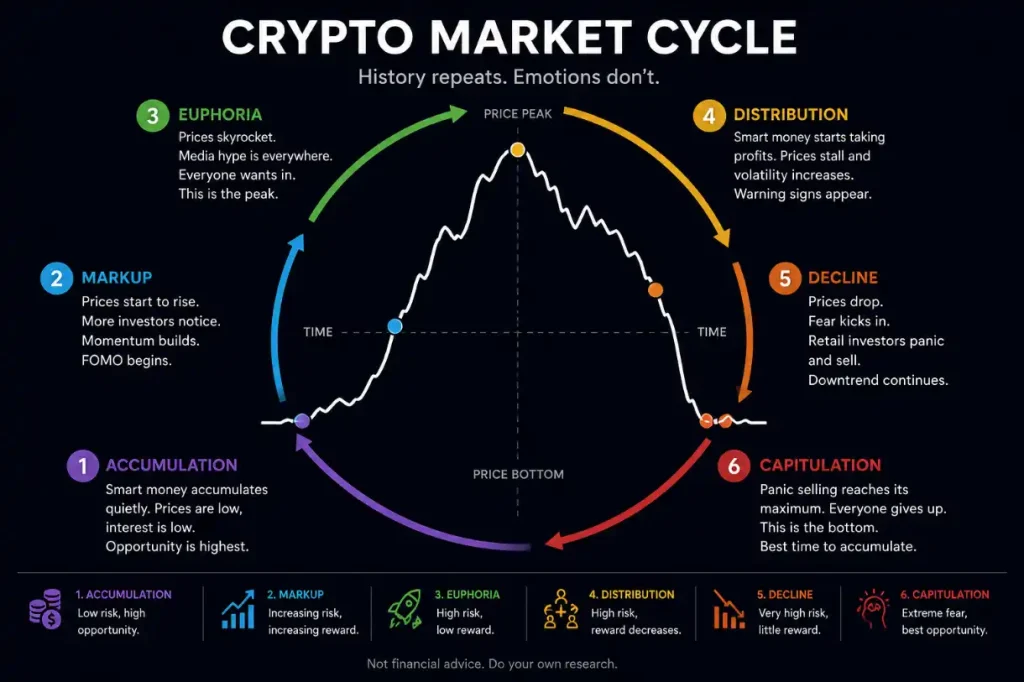
Recurring Patterns
Analysts will also look for recurring behavioral patterns across crypto cycles. During bull markets, retail investors will go through FOMO and will rush to buy after the prices have already jumped. In bear markets often end with capitulation, with panic selling and investor exhaustion pushing prices down. And then recovery begins.
One more thing many wait to see from a historical perspective is altcoin seasons, or periods where speculative interest rises, leading to smaller cryptos outperforming Bitcoin.
The Problem With Historical Comparisons
But – and there’s always a ‘but’ – crypto markets are evolving so fast that it can also be argued that no pattern repeats in exactly the same way. Moreover, there are factors that are strong enough to quickly reshape the market structure, such as institutional involvement, government regulation, technological innovation, and global economic conditions.
Additionally, crypto is moving closer to TradFi, and as they become more connected, older and established patterns are likely to become less reliable. Past performance can provide perspective but not a roadmap.
Can AI Predict Prices?
If history can’t help, should we turn to the future, specifically fast-developing tech? Many investors are now wondering whether artificial intelligence (AI) could do a better job forecasting crypto prices than humans.
How AI Models Analyze Markets
AI has become an increasingly popular tool in crypto forecasting because of its ability to process enormous amounts of data fast and search for patterns within that data. It can analyze historical price movements, social sentiment, social media discussions, news articles, blockchain activity, trading behavior, trading volumes, transaction data, and many more factors all at the same time and all in real time. Therefore, these forecasting models rely on large datasets to pinpoint correlations difficult for human analysts to detect.
Many analysts argue that AI will prove highly valuable for traders and institutions as crypto markets keep generating massive volumes of real-time data every single second. They also find that machine learning models could improve the accuracy of market predictions.
Unlike humans, AI systems can:
- process information almost instantly,
- analyze markets 24/7,
- detect hidden patterns across large datasets,
- and do it all without emotional bias.
Can DL Help?
Research suggests that AI models are often more effective at predicting market direction than forecasting exact prices. According to the above-mentioned study, ”the accurate cryptocurrency price prediction is by nature a significantly challenging and complex problem since its values have very big fluctuations over time following an almost chaotic and unpredictable behavior.” The authors investigated whether deep learning (DL) techniques “may constitute the proper methodology to solve this problem.”
They found that machine learning (ML) models and the DL models used in their experiments achieved almost the same performance scores. “We conclude that these advanced DL models cannot efficiently predict cryptocurrency prices because the utilized datasets with the specific form which we “fed” them to our prediction models, probably follow almost a random walk process and thus not sufficient information lies on them in order to perform accurate and reliable future predictions.”
Overall, the results confirmed that the presented models are inefficient and unreliable crypto price predictors, “probably due to the fact that this problem is a very complicated one,” that even advanced DL techniques “are not able to solve efficiently.”
Why AI Still Cannot Guarantee Accuracy
Despite its growing capabilities, AI comes with major limitations. These systems can’t take into account human emotions, irrational market behaviors, and unexpected events such as exchange collapses, geopolitical conflicts, regulatory crackdowns, social media-driven panic, and even the dreaded “black swan” events, including exchange collapses, security breaches, and financial crises.
Moreover, financial markets constantly evolve, which means that patterns change all the time, and AI needs to be able to swiftly adapt to this. AI models also face the risk of “overfitting.” In this case, algorithms become too dependent on historical data, so when they’re confronted with new or unusual situations, their performance level drops significantly. While AI can improve our ability to analyze and estimate, it can’t remove uncertainty.
Why Even Experts Frequently Get Crypto Predictions Wrong
Predicting cryptocurrency prices is so difficult that even experienced analysts, major institutions, and professional traders get it wrong on a daily basis. Over the years, we’ve seen countless failed BTC price targets and incorrect cycle predictions, not to mention all the unexpected market reversals. Some analysts predicted Ethereum reaching extreme highs only for the market to collapse soon after. Others predicted months more of bear markets only for a recovery to surprise us all.
Why does this happen? In short, many factors are constantly affecting the market at once, and each of these is unpredictable on its own, turning into an erratic bomb when they combine.
How Institutional Investors Forecast Crypto
Institutional investors use more sophisticated methods to analyze crypto markets, compared to retail traders. In addition to price charts, large firms also combine numerous forms of data analysis to evaluate market conditions and manage risk.
In particular, analysts monitor ETF inflows and outflows because these can signal broader investor demand and market confidence. They’ll also rely on on-chain analytics, studying blockchain data such as wallet activity, transaction volume, exchange inflows, and long-term holder behavior. This way, they can see if investors are accumulating or selling assets.
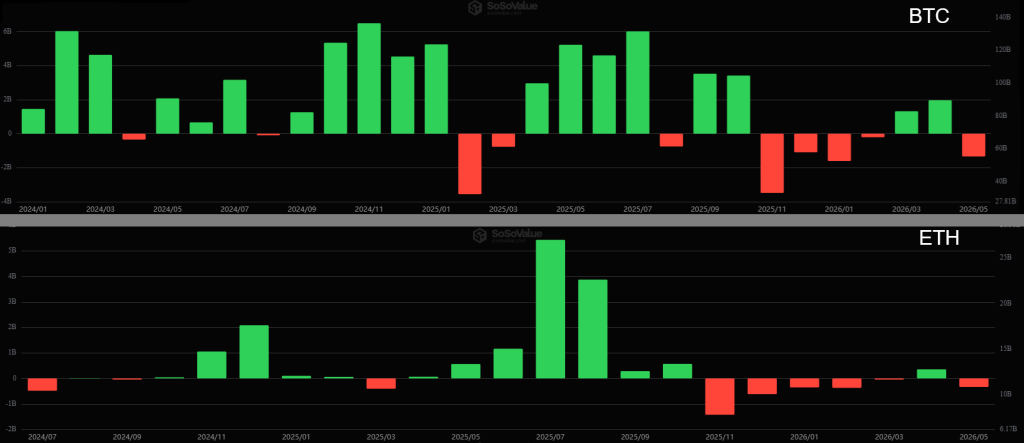
Next up, they’ll monitor derivatives markets, particularly futures contracts, options trading, and funding rates, in order to measure market sentiment, leverage levels, and volatility expectations.
Finally, advanced risk modelling systems enable them to evaluate potential losses under different market scenarios and help them prepare for multiple outcomes.
So, Can Anyone Really Predict Cryptocurrency Prices?
The short answer is no – nobody can predict cryptocurrency prices with any certainty. Crypto markets are swayed by a continually shifting combination of technology, investor psychology, regulation, macroeconomic conditions, and global events. Even the most knowledgeable analysts using the most advanced forecasting models, aided by AI’s ability to identify hidden patterns, can’t fully account for sudden market shocks, news cycles, viral comments, or emotional trading behavior.
However, this doesn’t mean that forecasting is useless and that we should toss it in the bin. Different types of analyses (technical, fundamental, historical cycle, and sentiment) can provide valuable clues about possible market direction, especially when combined. This way, traders and investors can estimate likelihoods, detect trends, and better understand overall market behavior.
Ultimately, successful crypto investing depends less on perfectly predicting prices and more on maintaining discipline and managing risk. Experienced investors will focus on diversification, emotional control, and long-term strategy. They will ignore hype and the illusion of certainty. In a market as volatile and unpredictable as cryptocurrency, understanding market psychology and preparing for uncertainty may be more valuable than any prediction itself.
FAQ
Is crypto price prediction accurate?
Analysts and traders can sometimes identify certain trends and/or probabilities when it comes to potential future price direction. However, it’s not possible to forecast the exact price. The available metrics are quite unreliable due to volatility and unpredictable events.
Which method is best for predicting crypto prices?
There isn’t one single method that can predict possible directions, trends, and possibilities. Instead, most experienced analysts combine technical, fundamental, and sentiment analysis to find patterns and indicators.
Can AI accurately predict Bitcoin prices?
AI is an evolving tool that can inspect a large quantity of data and detect patterns quickly, thus improving market analysis. But it can’t take into account factors like unexpected news, regulatory shifts, or investor psychology.
Why does crypto react so strongly to news and social media?
Crypto markets are highly affected by sentiment, as well as online communities, influencers, and fast information sharing. But investors should be very careful, especially given the prevalence of scam projects promoted by some online personalities.
How do you rate this article?
Subscribe to our YouTube channel for crypto market insights and educational videos.






Join our Socials
Briefly, clearly and without noise – get the most important crypto news and market insights first.

Most Read Today
1
Morgan Stanley Adds to Its Bitcoin Position for a Fourth Straight Day
2Strategy’s Bitcoin Treasury Just Hit Another Massive Milestone
3Stop Losing Crypto: Self-Custody Security, Multisig, and Inheritance
4Zcash Has More Than a Price Story — Here’s What’s Really Changing
5BNB Chain Just Gave Builders More Room — The Next Wave Could Be Coming
Latest





8
Also read
Similar stories you might like.

Crypto News
Morgan Stanley Adds to Its Bitcoin Position for a Fourth Straight Day
Azeez | 2026-09-05

Crypto News
Zcash Has More Than a Price Story — Here’s What’s Really Changing
Azeez | 2026-09-05

Crypto News
Strategy’s Bitcoin Treasury Just Hit Another Massive Milestone
Azeez | 2026-09-05

Crypto News
A Major Solana Upgrade Targets High-Speed Agent Payments
Azeez | 2026-09-04

Crypto News
The Bitcoin–Gold Relationship Is Reaching a New Extreme
Azeez | 2026-09-04

Crypto News
Crypto’s Leadership Is Shifting — Privacy Tokens Are Now in Front
Azeez | 2026-09-03

Crypto News
BitMine’s Biggest ETH Buy in Two Months Brings It Closer to a Major Milestone
Azeez | 2026-09-03

Crypto News
$1 Billion in SOL Bought in Less Than a Year — Bitwise Isn’t Slowing Down
Azeez | 2026-09-03

Crypto News
Multicoin Capital’s Latest HYPE Move Puts Sell Pressure in Focus
Azeez | 2026-09-02
Crypto News
DEX Markets Are Heating Up Again as August Sets a Five-Month High
Azeez | 2026-09-01