


















Ethereum logo on a smartphone with Vitalik Buterin in the background. Source: TechGaged / Shutterstock

Ethereum co-founder Vitalik Buterin has outlined a sweeping vision for the future of the Ethereum Foundation (EF), and revealed that his influence within the organization will continue to decline as the foundation restructures itself for the long term. The comments come as Ethereum (ETH) faces growing competition from rival blockchains prioritizing speed and scalability, whereas internal discussions continue over the network’s identity and strategic direction. According to Buterin, the foundation’s next chapter will focus less on expansion and more on preserving Ethereum’s core principles of decentralization, privacy, security, and censorship resistance.
Ethereum Foundation Shifts Toward Long-Term Independence
In a lengthy post published on May 24, Buterin emphasized that the Ethereum Foundation was never intended to function as the permanent center of the Ethereum ecosystem. As he explained:
“EF is not a ‘center of Ethereum’, rather EF is ‘one node, with a defined purpose, alongside other nodes’. We’ve always said that the EF should be the latter, but many in the Ethereum ecosystem (and even within the EF) wanted us to be the former. Now, we’re taking action to ensure that we will be the latter.”
He noted that the foundation’s board is expanding and that his own authority inside the organization will continue decreasing, which he described as an outcome he actively supports. In his words:
“The board is in the process of expanding, and my own power within the org will continue to decrease, which is honestly what I want.”
According to Buterin, the Ethereum Foundation controls only around 0.16% of the total ETH supply, a fraction of the holdings commonly maintained by foundations behind competing Layer-1 networks. As a result, the organization is narrowing its focus toward activities that directly strengthen Ethereum’s role as an open, censorship-resistant, secure, and privacy-preserving network.
The restructuring will also influence treasury management. Buterin stated that the foundation intends to prioritize longevity over broad spending initiatives, adding that the strategy means the organization will sell less ETH going forward.
“And so today, the EF is choosing to use its remaining resources to pursue longevity over breadth (yes, this means we sell less ETH). The EF focuses *specifically* on those activities critical to the success of ethereum as a censorship/capture-resistant, open, private and secure system, that would not happen otherwise.”
He further stressed that important ecosystem development should increasingly happen outside the foundation itself, allowing independent teams and organizations to attract external capital and contribute to Ethereum’s growth without relying on EF oversight.
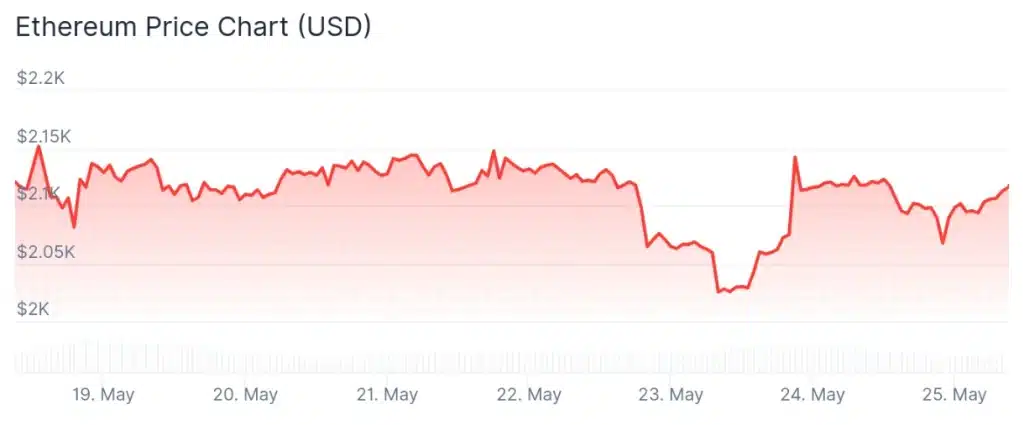
Meanwhile, the price of ETH at press time on May 25 stood at $2,115.55, down 0.1% in the last 24 hours, losing 0.2% over the past week, and accumulating a decline of 8.7% across the month, per the most recent chart information.
Vitalik Rejects The Industry’s Race For Maximum Speed
A major theme of Buterin’s statement was his opposition to the blockchain industry’s obsession with maximizing transaction throughput at the expense of decentralization.
Though some networks advertise targets such as sub-second settlement and millions of transactions per second, Buterin argued that Ethereum pursuing the same strategy would ultimately lead to mediocrity. Instead, he said Ethereum should focus on becoming “deeply impressive” in areas such as security, privacy, reliability, and resistance to censorship.
“I think Ethereum should scale. But I think Ethereum should strive the hardest to be deeply impressive in a different dimension: the CROPS dimension.”
Among the priorities he pointed to were AI-assisted formal checking aimed at producing demonstrably bug-free code, keeping robust consensus mechanisms capable of withstanding extreme network failures, and reducing reliance on intermediaries when users submit transactions.
“Provably bug-free Ethereum. This is a goal that all cybersecurity researchers would have thought is absurd and impossible, up until roughly 6 months ago. Now, it’s on the cusp of being possible, thanks to AI-assisted formal verification.”
According to Buterin, these goals are not at odds with scaling. However, he believes Ethereum’s competitive advantage lies in keeping the principles that originally set apart the network rather than simply trying to become the fastest network in the market.
How do you rate this article?
Subscribe to our YouTube channel for crypto market insights and educational videos.






Join our Socials
Briefly, clearly and without noise – get the most important crypto news and market insights first.
Most Read Today
1
Morgan Stanley Adds to Its Bitcoin Position for a Fourth Straight Day
2Strategy’s Bitcoin Treasury Just Hit Another Massive Milestone
3Stop Losing Crypto: Self-Custody Security, Multisig, and Inheritance
4Zcash Has More Than a Price Story — Here’s What’s Really Changing
5BNB Chain Just Gave Builders More Room — The Next Wave Could Be Coming
Latest





8
Also read
Similar stories you might like.
Crypto News
BitMine’s Biggest ETH Buy in Two Months Brings It Closer to a Major Milestone
Azeez | 2026-09-03

Crypto News
Ethereum Is Unifying Its Transaction Model — The Impact Could Be Huge
Azeez | 2026-08-30

Crypto News
Ethereum Faces One of Its Most Extreme Sell-Side Readings on Binance
Azeez | 2026-08-29

Crypto News
A Rare Ethereum Trend Is Emerging as Long-Term Holders Keep Taking Losses
Azeez | 2026-08-28

Crypto News
The ETH/BTC Ratio Has Printed A Golden Cross For The First Time In 14 Months
Azeez | 2026-08-25

Crypto News
Bitcoin Dominance Holds at 59% as Capital Concentrates Rather Than Rotating Into Altcoins
Azeez | 2026-08-24

Crypto News
Institutional Crypto Demand Is Surging As ETF Inflows Hit Multi-Month Highs
Azeez | 2026-08-23

Crypto News
Ethereum Was At Peak Fear Just Before The Market Turned
Azeez | 2026-08-21

Crypto News
Ethereum’s Largest Client Moves To Chainlink — Investors Are Watching
Azeez | 2026-08-21

Crypto News
BlackRock Clients Are Loading Up On Ethereum — Is Something Big Coming?
Azeez | 2026-08-20