














Aave logo with market chart. Source: TechGaged / Shutterstock
Aave’s Latest Approval Could Change How Users Enter DeFi
In Brief
- •
- • Aave has received regulatory approval to operate in the UK.
- • The move could simplify fiat access to DeFi services.

Aave Labs has secured a key regulatory win in the UK as its subsidiaries Push Labs Ltd. and Push Virtual Assets Ltd. received approval from the Financial Conduct Authority (FCA) to operate as cryptoasset exchange providers. The authorization also allows the group to issue electronic money, which gives Aave a regulated foundation for payments infrastructure and fiat-to-crypto services in one of the world’s largest financial markets. The move signals that Aave is increasingly positioning itself as a bridge between traditional finance and decentralized finance (DeFi).
Aave Pushes Toward Mainstream Adoption
According to Aave Labs’ announcement from May 28, the FCA approvals allow Push to conduct regulated cryptoasset activities in the UK while supporting payment services and stablecoin infrastructure.

Aave founder Stani Kulechov said the approvals will enable users to move fiat directly into the Aave ecosystem through a vertically integrated zero-fee on-ramp. He also highlighted the approval as a complement to Aave’s existing European regulatory strategy, which already includes a MiCA license through the Central Bank of Ireland.
Latest Stories
Three Major Signals Now Point to a New Bitcoin Bull Market

Ethereum Is Unifying Its Transaction Model — The Impact Could Be Huge

Sui User Growth Surges to New Highs — Bullish?

The focus on fiat access reflects a broader challenge facing DeFi. As decentralized applications (dApps) have become easier to use, moving money between traditional banking systems and blockchain networks remains a major barrier for mainstream users.
By controlling more of that infrastructure, Aave appears to be building a pathway for users who may have never interacted with DeFi before.
Regulation, Recovery, Resilience, and Aave V4
The announcement arrives during a busy period for the protocol.
Aave recently published governance discussions around bringing Aave V4 to Avalanche, and supporters argue the new version could help expand on-chain capital markets and attract additional institutional activity.
At the same time, community members continue to point to Aave’s handling of the rsETH-related losses earlier this year as evidence of the protocol’s resilience.
Analyst Jose Fabrega recently highlighted that Aave DAO absorbed about $58 million in treasury losses to protect affected users, whereas governance measures including reduced stkAAVE emissions and paused buybacks have been used to rebuild the protocol’s balance sheet.
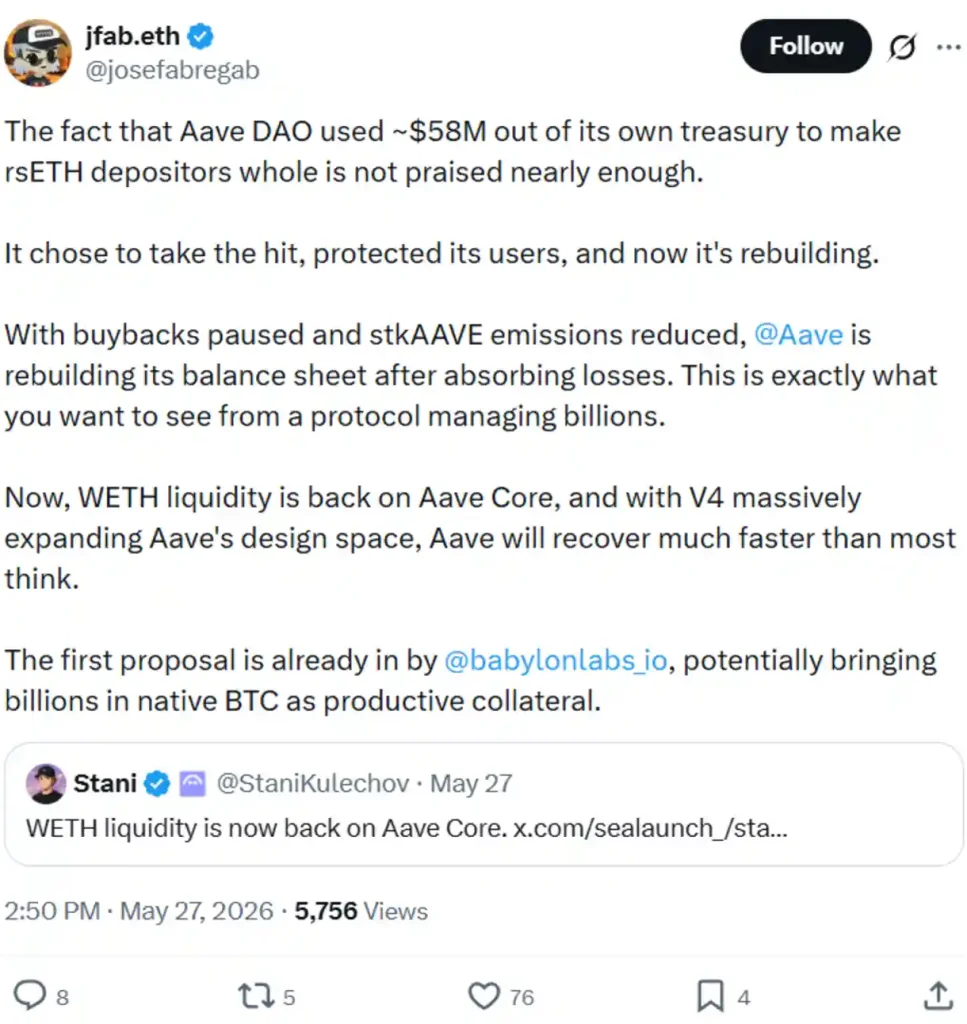
Supporters argue those decisions strengthened confidence in Aave at a time when several DeFi platforms faced criticism over risk management and exploit responses.
The bigger story, however, may be Aave’s growing regulatory footprint. Between UK FCA approval and upcoming V4 expansion plans, the protocol is increasingly pursuing a strategy that combines decentralized infrastructure with regulated financial access.
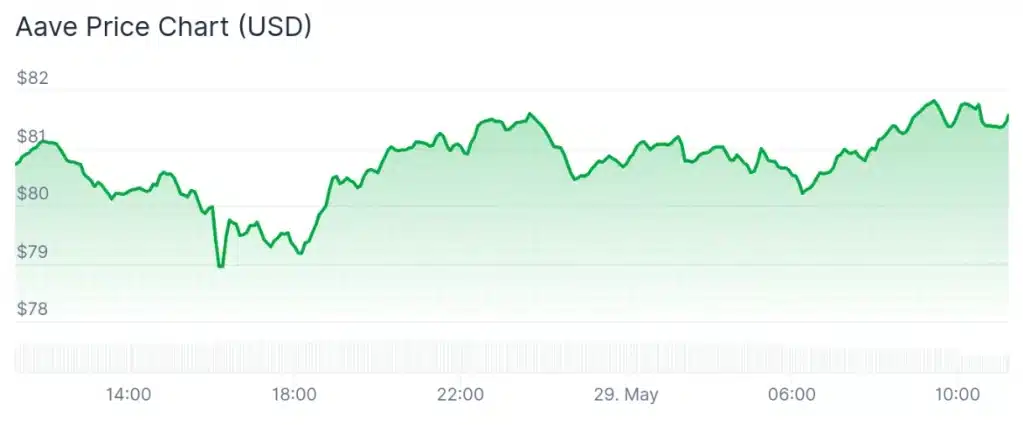
At press time on May 29, Aave’s native token was trading at $81.52, which indicates a 1% gain on the day, a loss of 7.3% across the week, and an accumulated decline of 15.8% over the past month, per the most recent price chart data.
For a sector that has long debated whether regulation helps or hinders innovation, Aave appears to be betting that the next phase of DeFi growth will require both.
How do you rate this article?
Subscribe to our YouTube channel for crypto market insights and educational videos.






Join our Socials
Briefly, clearly and without noise – get the most important crypto news and market insights first.
Most Read Today
1
Protect Personal Savings: Hot and Cold Wallets, Watch Bluetooth Risks
2Chainlink Is Expanding Again — Here’s Where It’s Moving Next
3Open Interest in Crypto: Four Steps to Verify Data and Spot Breakouts
4Ethereum Faces One of Its Most Extreme Sell-Side Readings on Binance
5Three Major Signals Now Point to a New Bitcoin Bull Market
Latest





8
Also read
Similar stories you might like.

Crypto News
Three Major Signals Now Point to a New Bitcoin Bull Market
Azeez | 2026-08-30

Crypto News
Ethereum Is Unifying Its Transaction Model — The Impact Could Be Huge
Azeez | 2026-08-30

Crypto News
Sui User Growth Surges to New Highs — Bullish?
Azeez | 2026-08-30
Crypto News
Strategy’s Bitcoin Bet Now Comes With Far Less Leverage
Azeez | 2026-08-28

Crypto News
A Rare Ethereum Trend Is Emerging as Long-Term Holders Keep Taking Losses
Azeez | 2026-08-28

Crypto News
Bitcoin’s Next Big Test Emerges As $5B In IBIT Options Near Expiry
Azeez | 2026-08-26

Crypto News
Bitwise’s SOL Buying Spree Nears A Major $1B Milestone
Azeez | 2026-08-26

Crypto News
Avalanche Records Strongest Tokenized Stock Growth In 24 Hours
Azeez | 2026-08-26

Crypto News
The ETH/BTC Ratio Has Printed A Golden Cross For The First Time In 14 Months
Azeez | 2026-08-25

Crypto News
XRP Is Up 51% This Week — Its Biggest Weekly Gain in 21 Months
Azeez | 2026-08-24