










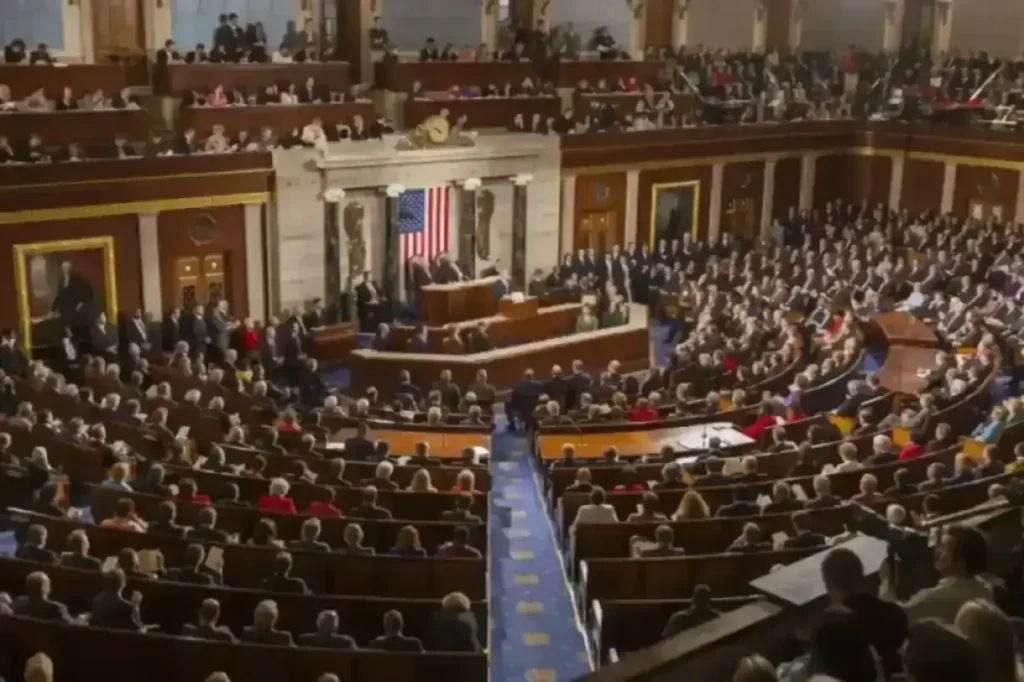
U.S. Senate chamber during a congressional session. Source: TechGaged / Shutterstock

Senator Cynthia Lummis warned that the U.S. is running out of time to secure leadership in digital assets, arguing that Europe and China are already moving ahead as Washington continues debating crypto regulation. In a new statement, Lummis said she spent years building the Clarity Act specifically to stop America from “playing catch up.” The comments arrived just days after the Senate Banking Committee advanced the bill in a key procedural vote.
Cynthia Lummis Pushes Congress to Move Faster
Lummis has become one of the strongest crypto advocates in Congress, and her latest comments show growing urgency around the Clarity Act. As she wrote in an X post on May 19, warning that both Europe and China continue building digital asset frameworks as the U.S. risks falling behind:
“The window to lead on digital assets won’t stay open forever.”
The Clarity Act is designed to define which crypto assets fall under the Securities and Exchange Commission (SEC) oversight and which belong under the Commodity Futures Trading Commission (CFTC). Supporters argue the bill could finally give token issuers and institutional investors a clearer regulatory structure after years of enforcement-driven uncertainty.
This pressure has intensified recently. Recently, the Senate Banking Committee advanced the legislation with bipartisan support, including votes from Democratic senators Ruben Gallego and Angela Alsobrooks. Still, the bill remains politically fragile.

Several lawmakers continue pushing for stronger anti-money laundering language and tighter restrictions tied to political officials involved in crypto ventures. Negotiations around stablecoin yield products and decentralized finance (DeFi) oversight also remain unresolved.
Europe And China Keep Adding Pressure
Lummis framed the issue less as a crypto debate and more as a global competitiveness problem.
Europe already rolled out its Markets in Crypto-Assets (MiCA) framework, giving firms a formal licensing structure across the European Union. China, meanwhile, continues expanding blockchain infrastructure and central bank digital currency experiments even as it maintains restrictions on decentralized crypto trading.
This international backdrop is becoming a bigger talking point in Washington. Treasury Secretary Scott Bessent recently argued the U.S. can’t properly develop digital asset markets without passing market structure legislation, saying the industry needs “safe, sound and smart practices.”
For crypto companies, clearer rules could unlock more institutional participation and reduce legal uncertainty around token classifications and exchange operations. But if Congress fails to move this year, lawmakers risk pushing more capital and development activity outside the United States.
How do you rate this article?
Subscribe to our YouTube channel for crypto market insights and educational videos.






Join our Socials
Briefly, clearly and without noise – get the most important crypto news and market insights first.

Most Read Today
1
XRP Ledger RWA Transfer Volume Hits $7.03B — Up 1,469% in 30 Days
2Cardano DEX Volume Jumps 143% in a Week as DeFi TVL Rebounds
3Mobile Onboarding & Player Experience: Streamlining App UX and Registration Funnels for iGaming Affiliates
4Rain Files for a U.S. National Trust Bank Focused on Stablecoin Infrastructure
5XRPL Stablecoin Supply Hits $1.31B as RLUSD Captures 93% of the Market
Latest







8
Also read
Similar stories you might like.

Blockchain
Wall Street’s Blockchain Switch Is Arriving: DTCC Tokenization Service Targets October Launch
TechGaged | 2026-10-04

Crypto News
Polygon Updates POL’s MiCA White Paper as EU Trading Access Expands
TechGaged | 2026-10-04

Beginners
What a Wallet Address Tells the Person You Sent It To
Rokas | 2026-10-01

Crypto News
October Fed Hike Odds Slip to 45% — Crypto Traders Are Watching Closely
Azeez | 2026-09-30

Crypto News
Bitcoin Whales Reach Highest Holdings Since August — The Setup Changes
Azeez | 2026-09-30

Crypto News
A Fresh Wallet Withdraws 9,132 ETH — Preparing for a Bigger Move?
Azeez | 2026-09-29

Crypto News
Goldman Sachs Connects $100B to Avalanche: AVAX Has a New Institutional Catalyst
Azeez | 2026-09-29
Crypto News
Binance’s Bitcoin Reserves Plunge — Are Late Buyers Finally Feeling FOMO?
Azeez | 2026-09-28

Crypto News
Crypto Keeps Outperforming Stocks and Commodities: The Numbers Tell the Story
Azeez | 2026-09-28

Crypto News
Bitcoin Repeats a Rare Q3 Pattern — Could Q4 Bring Another Explosive Rally?
Azeez | 2026-09-27