









Japanese flag placed in front of stacked gold coins. Source: TechGaged / Shutterstock
Japan’s Crypto Rules Just Took a Sharp Turn on Stablecoins
In Brief
- • Japan approved a new framework for foreign-issued stablecoins.
- • The rules create a regulated path for payment-focused stablecoins inside Japan.
- • Japan is pushing stablecoins deeper into mainstream financial infrastructure.

Japan’s Financial Services Agency (FSA) finalized a major stablecoin regulatory overhaul that opens the country’s payment ecosystem to certain foreign-issued stablecoins for the first time. The updated framework reclassifies trust-type stablecoins from “securities” under Japan’s Financial Instruments and Exchange Act into “Electronic Payment Instruments” under the Payment Services Act. The shift creates a regulated path for assets like USDC-style stablecoins to operate inside Japan’s formal financial system instead of remaining trapped in legal gray zones.
Japan Creates a New Stablecoin Framework
The amendment directly targets foreign trust-type stablecoins issued by overseas trust companies and banks, according to a May 19 report.
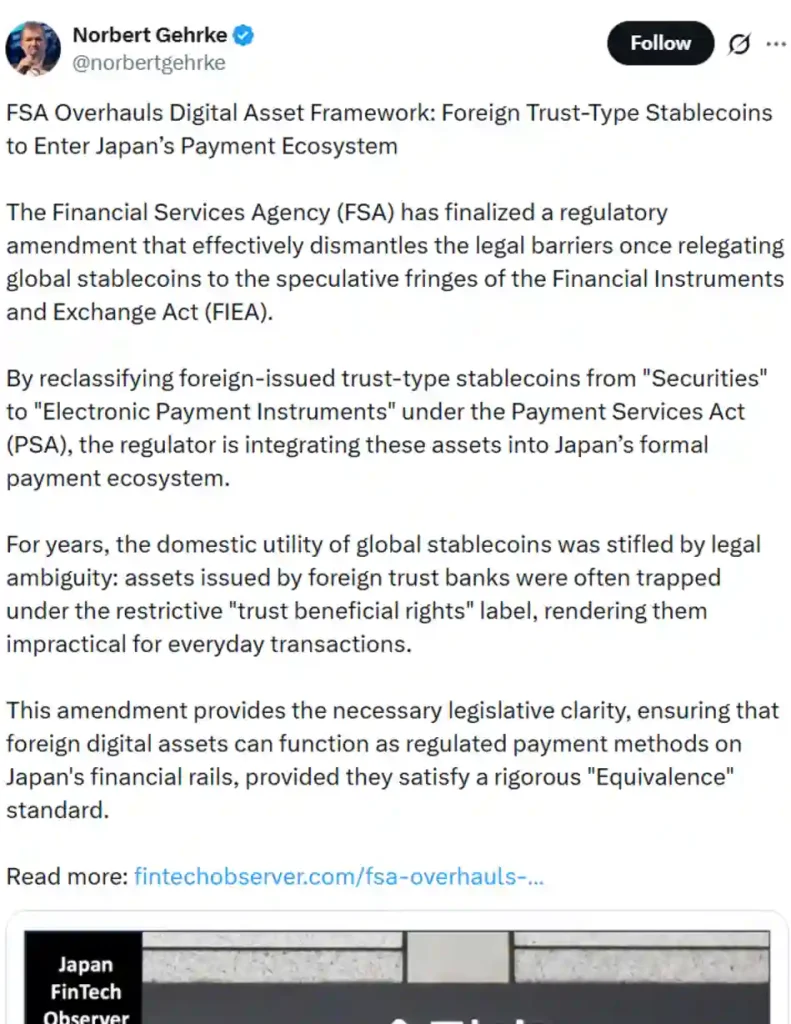
Previously, many of those assets fell under restrictive “trust beneficial rights” treatment, which made them impractical for domestic payments and commercial use.
Latest Stories
Aave Moves to Raise GHO Borrowing Costs as Stablecoin Liquidity Gets Tight

Wall Street’s Blockchain Switch Is Arriving: DTCC Tokenization Service Targets October Launch

Gold Can Now Earn Gold On-Chain — Paxos Labs Opens Bullion Lending With PAXGy
Under the new structure, the FSA carved out a separate regulatory lane specifically for payment-focused foreign stablecoins and excluded investment-oriented trust products from the framework.
The regulator says these assets can now qualify as “Electronic Payment Instruments” if issuers satisfy strict equivalence standards tied to licensing, reserve management, auditing, and anti-crime controls.
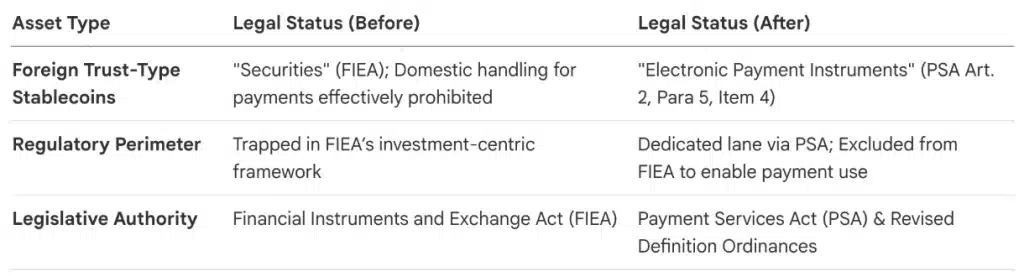
This includes proof that the issuer operates under rules generally equivalent to Japanese banking or payment laws. Foreign issuers must also demonstrate that reserve assets are properly audited and that they can freeze or suspend transactions tied to criminal activities like fraud or money laundering.
Another important requirement involves reserve composition. The FSA says backing assets must match the same currency denomination as the stablecoin itself to reduce foreign exchange risks during redemption events.
Japan Signals Stablecoins are Moving Into Mainstream Finance
The framework takes effect on June 1, 2026, following a public consultation period earlier this year.
The timing is notable because regulators globally are still debating how stablecoins should function inside traditional payment systems. Japan, meanwhile, appears to be moving toward integration and away from isolation.
The amendment also gives domestic exchanges and payment providers a clearer process for listing and supporting foreign stablecoins legally. Japanese intermediaries will initially carry much of the compliance burden by proving that overseas issuers meet the FSA’s equivalence standards.
All things considered, it appears that Japan wants regulated stablecoins operating inside its financial rails, but only under heavy supervision and strict redemption standards.
That approach could give global issuers a template for entering one of Asia’s largest financial markets and offer Japanese users access to more liquid dollar-backed digital assets for payments and settlements.
How do you rate this article?
Subscribe to our YouTube channel for crypto market insights and educational videos.






Join our Socials
Briefly, clearly and without noise – get the most important crypto news and market insights first.

Most Read Today
1
BlackRock Bitcoin Trust Gains Allie Family Office Investment
2AI Traces $387M Bitget Heist to North Korea as 2026 Losses Cross $1B
3Tokenization firm VerifyMe Rebrands to OpenWorld After NASDAQ Debut
4October Fed Hike Odds Slip to 45% — Crypto Traders Are Watching Closely
5ADA ETF Decision Nears — One SEC Date Could Trigger a Market Shakeup
Latest







8
Also read
Similar stories you might like.

Crypto News
Aave Moves to Raise GHO Borrowing Costs as Stablecoin Liquidity Gets Tight
TechGaged | 2026-10-04

Market
BlackRock Bitcoin Trust Gains Allie Family Office Investment
Rokas | 2026-10-03

Industry
Tokenization firm VerifyMe Rebrands to OpenWorld After NASDAQ Debut
Rokas | 2026-10-03
Crypto News
October Fed Hike Odds Slip to 45% — Crypto Traders Are Watching Closely
Azeez | 2026-09-30

Crypto News
Bitcoin Whales Reach Highest Holdings Since August — The Setup Changes
Azeez | 2026-09-30

Crypto News
A Fresh Wallet Withdraws 9,132 ETH — Preparing for a Bigger Move?
Azeez | 2026-09-29

Crypto News
Goldman Sachs Connects $100B to Avalanche: AVAX Has a New Institutional Catalyst
Azeez | 2026-09-29
Crypto News
Binance’s Bitcoin Reserves Plunge — Are Late Buyers Finally Feeling FOMO?
Azeez | 2026-09-28

Crypto News
Crypto Keeps Outperforming Stocks and Commodities: The Numbers Tell the Story
Azeez | 2026-09-28
Crypto News
Bitcoin Repeats a Rare Q3 Pattern — Could Q4 Bring Another Explosive Rally?
Azeez | 2026-09-27