














Monitoring the market on a laptop. Source: Techgaged/Shutterstock.

Real-world asset perpetual futures are rapidly becoming a significant part of decentralized trading.
According to the DeFiLlama RWA Perps dashboard, total open interest has climbed to $4.845 billion, turning what was once a niche market into a meaningful segment of onchain derivatives.
Rapid Growth in a Short Window
The growth trajectory is striking. Open interest remained negligible through late 2025 before rising steadily in early 2026 and accelerating throughout the year.
Latest Stories
Two Cities Control More Than Half of Solana’s Blocks — A Decentralization Question Emerges

One HYPE Whale Has Been Selling for 2 Weeks — What Could Be Behind It?

Bitcoin ETF Momentum Takes a Hit — The Next Sessions Could Matter
At the time of the data, 24-hour trading volume stood at $3.269 billion, up 75.79%, across 802 markets, while estimated protocol fees reached roughly $748,000 over 24 hours.
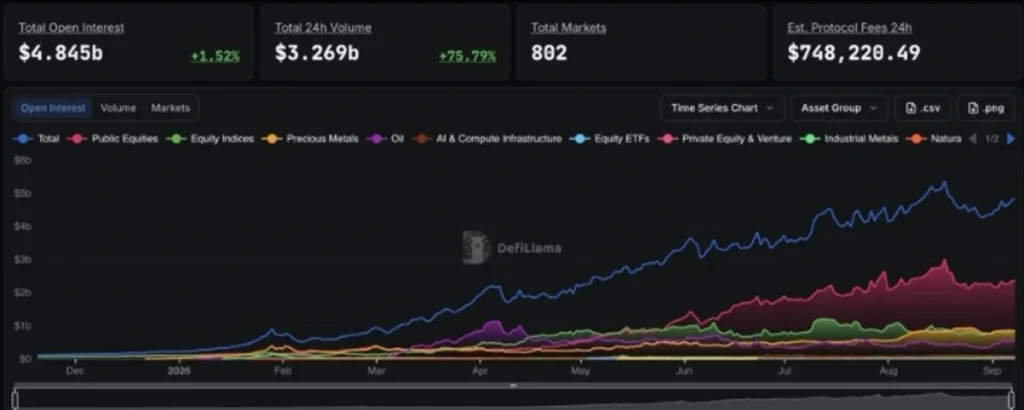
The numbers show that RWA perpetuals are moving beyond experimentation and attracting substantial trading activity.
What’s Behind the Expansion
RWA perpetuals allow traders to gain leveraged or directional exposure to assets such as equities, commodities and market indices while accessing them through blockchain-based trading infrastructure.
The appeal lies in continuous markets, global accessibility and the ability to trade or hedge exposure without relying entirely on traditional financial intermediaries.
The market is also becoming increasingly diverse. Public equities, precious metals, oil and equity indices now account for significant portions of RWA perp activity, showing that demand extends well beyond a single asset class.
The expansion is already visible across new onchain trading venues. In August, Aftermath Perpetuals V2 launched on Sui with markets covering equities, gold, silver, crude oil and the S&P 500, bringing a broader range of traditional assets into an entirely onchain environment.
Why It Matters
The rise of RWA perps represents a shift from simply tokenizing traditional assets to actively trading them onchain.
Traders are now using blockchain infrastructure to express directional views, hedge positions and access leverage across markets that were traditionally separated from crypto.
This trend also reflects the growing convergence between decentralized finance and traditional markets.
As new venues add equities, commodities and indices, the boundary between crypto-native trading and conventional financial markets continues to narrow.
A recent analysis of Hyperliquid’s emergence as a global macro trading hub similarly highlighted how onchain derivatives are expanding beyond cryptocurrencies into oil and other macro assets.
What to Look Forward To
The next stage will depend on whether RWA perps can sustain their rapid growth while building deeper liquidity and attracting more traders.
If volume, open interest and the number of available markets continue expanding, RWA perpetuals could become one of the most important bridges between traditional finance and onchain markets.
Disclaimer:
This article is for informational purposes only and does not constitute financial, investment, or trading advice. The views expressed are based on publicly available data, market observations, and the author’s interpretation at the time of writing. Cryptocurrency markets are highly volatile and unpredictable, and past performance or current technical setups do not guarantee future results. Readers should conduct their own research and consult with a qualified financial advisor before making any investment decisions. TechGaged does not accept liability for any losses incurred based on the information presented.
How do you rate this article?
Subscribe to our YouTube channel for crypto market insights and educational videos.






Join our Socials
Briefly, clearly and without noise – get the most important crypto news and market insights first.
Most Read Today
1
Chainlink Hits $34T in Enabled Transactions — The Infrastructure Race Is Heating Up
2Solana’s RWA Adoption Hits a Huge Milestone: Bullish?
3This Is the Only Crypto Sector Still Above Bitcoin’s Peak
4Abraxas Makes Another ETH Move — Its Massive Hyperliquid Short Holds the Key
5Clarity Act 2026: Everything You Should Know
Latest





8
Also read
Similar stories you might like.
Crypto News
Two Cities Control More Than Half of Solana’s Blocks — A Decentralization Question Emerges
Azeez | 2026-09-09

Crypto News
One HYPE Whale Has Been Selling for 2 Weeks — What Could Be Behind It?
Azeez | 2026-09-09

Crypto News
Bitcoin ETF Momentum Takes a Hit — The Next Sessions Could Matter
Azeez | 2026-09-09

Crypto Guides
Crypto Oracles: 3 Roles Developers Must Secure to Prevent Exploits
Rokas | 2026-09-09

Crypto News
Chainlink Hits $34T in Enabled Transactions — The Infrastructure Race Is Heating Up
Azeez | 2026-09-08

Crypto News
Abraxas Makes Another ETH Move — Its Massive Hyperliquid Short Holds the Key
Azeez | 2026-09-08
Crypto News
Solana’s RWA Adoption Hits a Huge Milestone: Bullish?
Azeez | 2026-09-08

Crypto News
This Is the Only Crypto Sector Still Above Bitcoin’s Peak
Azeez | 2026-09-08

Crypto Guides
Dencun Cut L1 Data Costs: What Optimistic Rollups Mean for EVM Devs
Rokas | 2026-09-08

Crypto News
Avalanche Has Crossed a Major Threshold — The Next Phase Starts Now
Azeez | 2026-09-07