













Blockchain mining and validator infrastructure

Proof of Work secures a blockchain through computing power and electricity; Proof of Stake secures it through capital locked on-chain. Bitcoin still runs on PoW. Ethereum switched to PoS in 2022. The practical trade-off comes down to this: PoW buys security with real-world resource cost, while PoS buys comparable or better security with a fraction of the energy, at the price of new economic complexity.
TL;DR:
Latest StoriesRead all latest stories → A Major Zcash Upgrade Is Changing Wallet Performance
 XRP Ledger’s Institutional Credit Vote Could Change the Game for XRP
 Smart Money Is Starting to Look at DeFi Again
- Securing a PoS network requires acquiring and risking a controlling share of coins, with penalties like slashing deterring malicious activity more effectively than PoW’s electricity waste.
- Bitcoin’s ongoing PoW operation continues to demand a substantial share of U.S. electricity, contributing roughly 0.6 to 2.3 percent of national power use and causing e-waste issues.
- PoW’s security relies on the high costs of hardware and electricity, while PoS depends on the economic stake and honest validator behavior to prevent attacks.
- Future developments will likely include more hybrid models and chain-specific consensus variants, driven by regulatory pressures and differing technical goals.
PoS vs PoW: What Each Term Actually Means
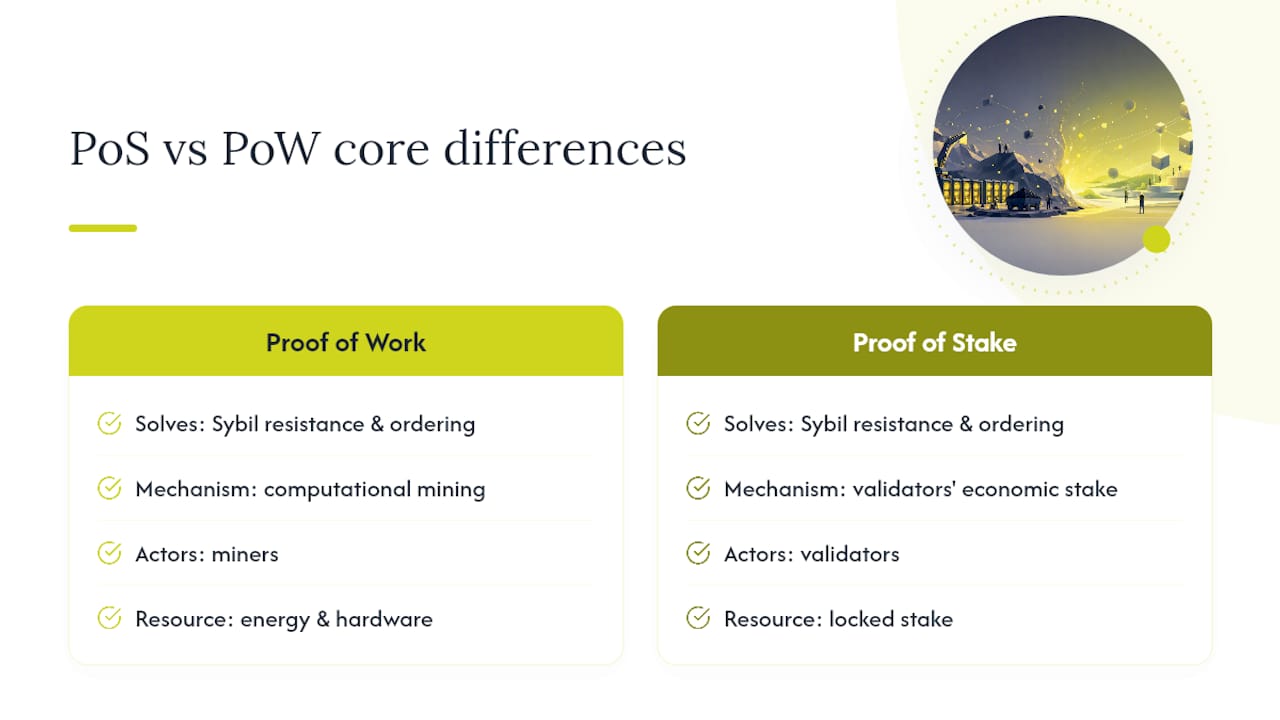
“PoS vs PoW” gets thrown around casually, but the two are solving the same problem, Sybil resistance and transaction ordering, with completely different tools. Proof of Work is the older, better-known standard, and Bitcoin’s mining network is still its flagship implementation. Proof of Stake is the model Ethereum adopted, and it now secures the second-largest blockchain by value.
Understanding Proof of Work
Mining is the mechanism: computers race to solve a cryptographic hash puzzle, and the winner gets to add the next block and collect the block reward. That race is deliberately expensive. Solving the puzzle takes real electricity and specialized hardware, and that cost is the point, because rewriting blockchain history would require redoing all that work faster than everyone else combined.
A few operational realities shape how PoW actually behaves in practice:
- Mining pools let smaller operators combine hashing power and split rewards, which keeps solo mining largely unviable.
- ASICs (application-specific chips) have replaced general-purpose hardware, and economies of scale push mining toward large, well-capitalized operators.
- Energy and hardware costs are the main constraints, alongside e-waste from constantly obsolete ASICs.
- Bitcoin’s throughput stays capped near seven transactions per second, a direct consequence of the block-time and block-size rules that keep the network synchronized.
Understanding Proof of Stake
Staking replaces computation with collateral. Validators lock up cryptocurrency as a bond, and the protocol selects one to propose each block, weighted roughly by stake size. Honest validation earns rewards; provable misbehavior, like signing two conflicting blocks, triggers “slashing,” where a portion of the staked funds is programmatically destroyed as punishment, according to Chain.link’s breakdown of the mechanism.
Running a validator is a different kind of commitment than running a mining rig:
- Validators need reliable, always-on infrastructure; downtime or double-signing risks real financial loss through slashing.
- Ethereum sets a 32 ETH minimum to run a solo validator, though staking pools let smaller holders participate with far less capital, per Ethereum Foundation documentation.
- The barrier to honest participation shifts from capital expenditure to uptime and DevOps discipline.
- PoS trades away energy consumption for new complexity: slashing conditions, validator client management, and stake-concentration risk all require careful design.
PoW vs PoS: Side-By-Side Differences That Matter
Here’s how the two models stack up across the dimensions that actually drive decisions:
- Security basis: PoW security comes from the sunk cost of hardware and electricity; an attacker needs to out-mine the rest of the network. PoS security comes from economic stake; an attacker needs to acquire and risk a controlling share of coins, which slashing can then destroy.
- Decentralization pressure: PoW concentrates around cheap electricity and ASIC manufacturing access. PoS concentrates around large staking pools and exchanges that aggregate smaller holders’ coins.
- Energy use: This is the starkest gap. Ethereum’s move to PoS cut its annual climate footprint by roughly 99.98 percent, according to the Cambridge Centre for Alternative Finance. Bitcoin mining, by contrast, still draws enough power that the EIA estimates U.S. crypto mining alone accounts for roughly 0.6% to 2.3% of national electricity use.
- Performance: PoS chains generally finalize blocks faster and support quicker transaction throughput, since validator selection doesn’t depend on winning a computational race.
- Participant economics: Miners sink money into hardware that depreciates fast. Validators lock up capital that stays productive (earning yield) but is subject to lockup periods and slashing risk instead of equipment obsolescence.
Security and Attack Models: 51% Attacks vs Stake Takeovers
A PoW 51% attack requires renting or owning more than half the network’s hash power, long enough to outpace honest miners and rewrite recent blocks. On Bitcoin, that would cost billions in hardware and ongoing electricity, which is the main reason it hasn’t happened at scale.
A PoS attack looks different: an attacker needs to acquire a controlling share of staked coins. But acquiring that much stake is expensive and visible, and any detected malicious action, like signing conflicting blocks, triggers slashing that destroys the attacker’s own capital. That’s a sharper deterrent than PoW’s “wasted electricity,” because it turns the attack itself into a guaranteed loss rather than a sunk cost.
- PoW recovery after an attack is messy: rolling back blocks and coordinating miners takes time.
- PoS chains often have faster finality guarantees, shrinking the window for profitable reorganization.
- Peer-reviewed modeling from Saleh (2025) finds that under realistic parameters, PoS blockchains can be more secure than equivalent PoW blockchains, especially as network value scales up.
Pro Tip: Don’t judge security by headlines about “which is safer.” Ask which attack is cheaper to execute and easier to detect on the specific chain you’re evaluating. That answer changes with network size and stake distribution.
Energy, Emissions, and Operational Costs
The Merge is the clearest before-and-after case study in crypto’s history. Cambridge’s CCAF report puts Ethereum’s post-Merge climate footprint reduction near 99.98 percent, and it notes that Bitcoin now accounts for the overwhelming majority of remaining “crypto” electricity demand.
Bitcoin mining’s real footprint isn’t just kilowatt-hours. It’s e-waste from constantly replaced ASICs, cooling infrastructure, and demand that migrates toward whichever region has the cheapest power, a pattern the EIA has tracked as mining operations relocate in response to electricity pricing and policy.
- RMI’s analysis recommends renewable energy procurement and measurement tools like the RE Emissions Score to make mining’s grid impact transparent.
- Sustainability modeling projects the industry’s electricity and water footprint could keep growing if mining practices remain unchanged, per MDPI’s 2025 environmental footprint study.
How to Choose Between PoW and PoS
If you’re building or holding, work through this before committing:
- Define the goal. Store-of-value and censorship resistance favor PoW’s battle-tested track record; smart-contract throughput favors PoS.
- Check your energy tolerance. If regulatory or ESG pressure matters to your project, PoS’s footprint is dramatically smaller.
- Assess operational capacity. Can your team run always-on validator infrastructure, or would mining hardware fit your operation better?
- Estimate expected transaction volume. High-throughput applications rarely tolerate PoW’s block-time constraints.
- For holders: weigh staking lockups and slashing risk against your liquidity needs and risk tolerance before staking any position.
Real-World Examples and the Near-Term Outlook
Ethereum’s 2022 Merge is the proof point for PoS at scale: the energy reduction was immediate and massive, and the validator model has held up without a successful stake-based attack. Bitcoin remains committed to PoW, betting that resource-backed security and its established network effect outweigh energy criticism.
Expect more experimentation, not consolidation, over the next few years. Proof-of-authority setups and hybrid designs are already running in enterprise and app-specific chains, and Solana’s approach to consensus shows how alternative chains are pulling ahead in specific niches like tokenized credit. Regulatory pressure on mining’s grid impact, visible in moves like China’s tightened scrutiny on crypto transactions, will keep pushing new projects toward PoS or PoS-adjacent designs.
Why Trust This Analysis
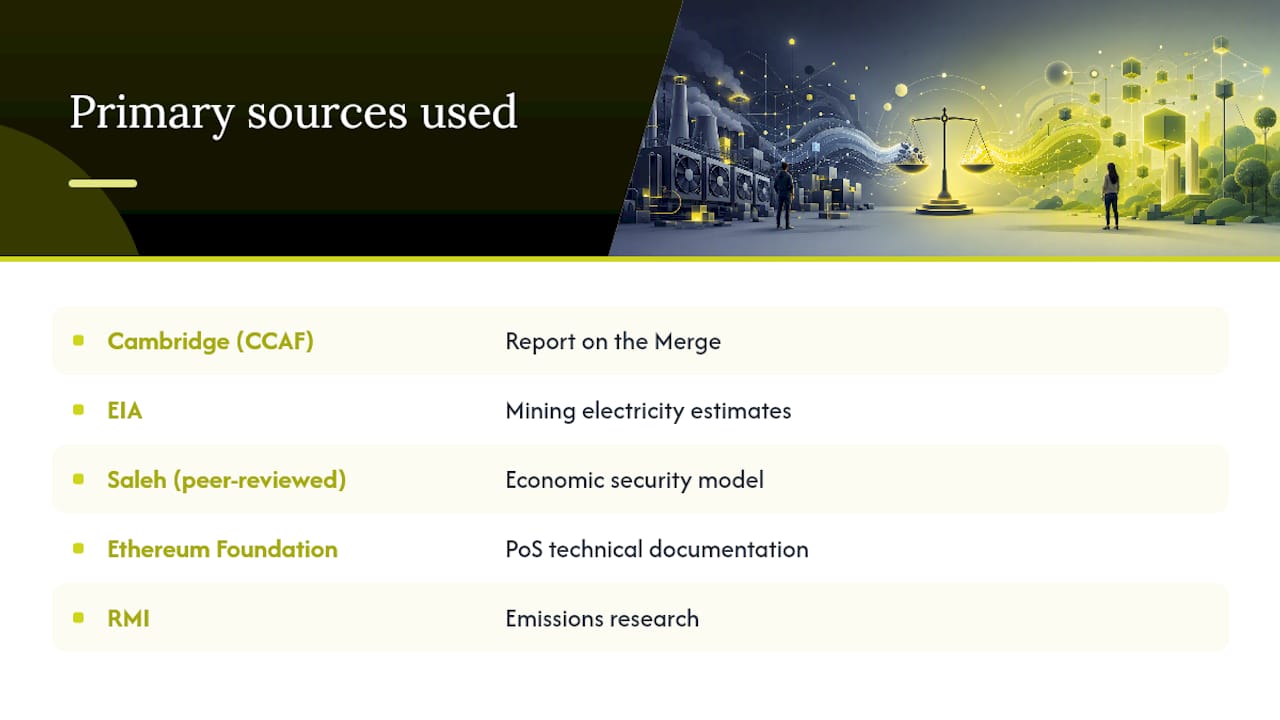
Techgaged draws on primary sources rather than secondhand summaries: Cambridge’s CCAF report on the Merge, the EIA’s mining electricity estimates, Saleh’s peer-reviewed economic security model, Ethereum Foundation’s own PoS documentation, and RMI’s emissions research. That mix of governmental data, peer-reviewed economics, and foundation-level technical docs is what backs every figure in this comparison. For continued coverage of how mining economics and network upgrades evolve, Techgaged tracks the story as it develops, including detailed reporting on mining and electricity demand trends.
Curious how these consensus shifts ripple into market behavior? Techgaged’s ongoing coverage tracks how Bitcoin and Ethereum price action responds to structural changes like these, including recent analysis of Bitcoin’s price movements above key levels. For daily updates on how consensus mechanisms, regulation, and market trends intersect, visit Techgaged’s crypto news hub.
Sources
- CCAF — Ethereum after the Merge report (2026)
- EIA — Cryptocurrency mining and electricity demand (2024)
- Proof-of-Work versus Proof-of-Stake: A Comparative Economic Analysis (Saleh, 2025)
- Ethereum
- RMI — Cryptocurrency’s energy consumption problem
FAQ
Does Bitcoin use PoW or PoS?
Bitcoin uses Proof of Work. Miners compete to solve hash puzzles and add blocks, and that competition remains unchanged since Bitcoin’s launch.
Does Ethereum use PoW or PoS?
Ethereum switched from PoW to Proof of Stake in September 2022, an event known as the Merge. Validators now secure the network by staking ETH instead of mining.
What’s the difference between Proof of Stake and Proof of Work?
PoW secures a blockchain through computational effort and energy expenditure, while PoS secures it through staked capital and penalties like slashing. PoS uses dramatically less energy, cutting Ethereum’s footprint by roughly 99.98 percent after its transition, according to CCAF.
Is Proof of Stake more secure than Proof of Work?
It depends on network conditions, but peer-reviewed modeling from Saleh (2025) finds PoS can be more secure than equivalent PoW systems under realistic parameters, particularly at scale.
How much electricity does Bitcoin mining use?
The EIA estimates U.S. cryptocurrency mining, dominated by Bitcoin, consumes roughly 0.6% to 2.3% of total U.S. electricity.
Recommended
- Sui Is Quietly Building A Bitcoin Powerhouse — The Latest Numbers Tell The Story
- Zcash Just Closed Four Security Gaps — This Could Be A Turnaround For ZEC
- One Blockchain Is Pulling Away In Tokenized Credit — Solana Leads The Pack
- Warning: This new Bitcoin Lightning bug allows attackers to steal your BTC remotely
How do you rate this article?
Join our Socials
Briefly, clearly and without noise – get the most important crypto news and market insights first.





8
Also read
Similar stories you might like.
Crypto News
A Major Zcash Upgrade Is Changing Wallet Performance
Azeez | 2026-08-31

Crypto News
XRP Ledger’s Institutional Credit Vote Could Change the Game for XRP
Azeez | 2026-08-31

Crypto News
Smart Money Is Starting to Look at DeFi Again
Azeez | 2026-08-31

Crypto News
Bitcoin’s Historic August Leaves One Big Question for Q4
Azeez | 2026-08-31

Security
Annual Recovery Test: Seed Phrase Security for Beginners & Pros
Rokas | 2026-08-31

Crypto News
Three Major Signals Now Point to a New Bitcoin Bull Market
Azeez | 2026-08-30

Crypto News
Ethereum Is Unifying Its Transaction Model — The Impact Could Be Huge
Azeez | 2026-08-30
Crypto News
Sui User Growth Surges to New Highs — Bullish?
Azeez | 2026-08-30

Crypto News
This Mystery Whale Isn’t Done Buying HYPE
Azeez | 2026-08-30

Beginners
Open Interest in Crypto: Four Steps to Verify Data and Spot Breakouts
Rokas | 2026-08-31