












Analyst arranging crypto allocation groups

Most individual investors should hold between 1% and 5% of total portfolio value in crypto. This is structured through a core‑satellite model: Bitcoin as the anchor, Ethereum as secondary infrastructure exposure, small altcoin satellites for conviction bets, and a stablecoin buffer for rebalancing. Conservative investors stay near 0.5% to 1%; moderate investors run 1% to 3%; aggressive investors cap out around 5% to 6%. Custody choice and rebalancing discipline matter as much as the number itself.
TL;DR:
Latest StoriesRead all latest stories → Strategy Buys Bitcoin Again After a Two-Month Pause
 Tokenized S&P Hits New All-Time High as Onchain Demand Surges
 DEX Markets Are Heating Up Again as August Sets a Five-Month High
- Crypto allocations should stay within 0.5% to 5% of total portfolios, adjusted for risk appetite, time horizon, and liquidity needs, with custody and rebalancing key considerations.
- A diversified core of Bitcoin and Ethereum serves as stability, while altcoins and stablecoins act as high-conviction, liquidity, and rebalancing tools within the sleeve.
- Rebalancing should be triggered quarterly and when assets drift more than 10-15%, with cash contributions used first to minimize taxable events.
- Holding crypto through regulated ETFs, direct custody, or custodial platforms involves tradeoffs in fees, security, and tax ease, requiring thorough evaluation.
- Crypto’s historical low correlation to stocks and bonds diminishes during market crises, necessitating continuous monitoring of systemic risks and correlation shifts.
Crypto Portfolio Allocation Models You Can Copy Today
There’s no single correct crypto portfolio allocation. There’s a correct one for your risk budget, time horizon, and stomach for volatility. Three templates cover most individual investors, each expressed as a share of total portfolio and as an internal split within the crypto sleeve itself.
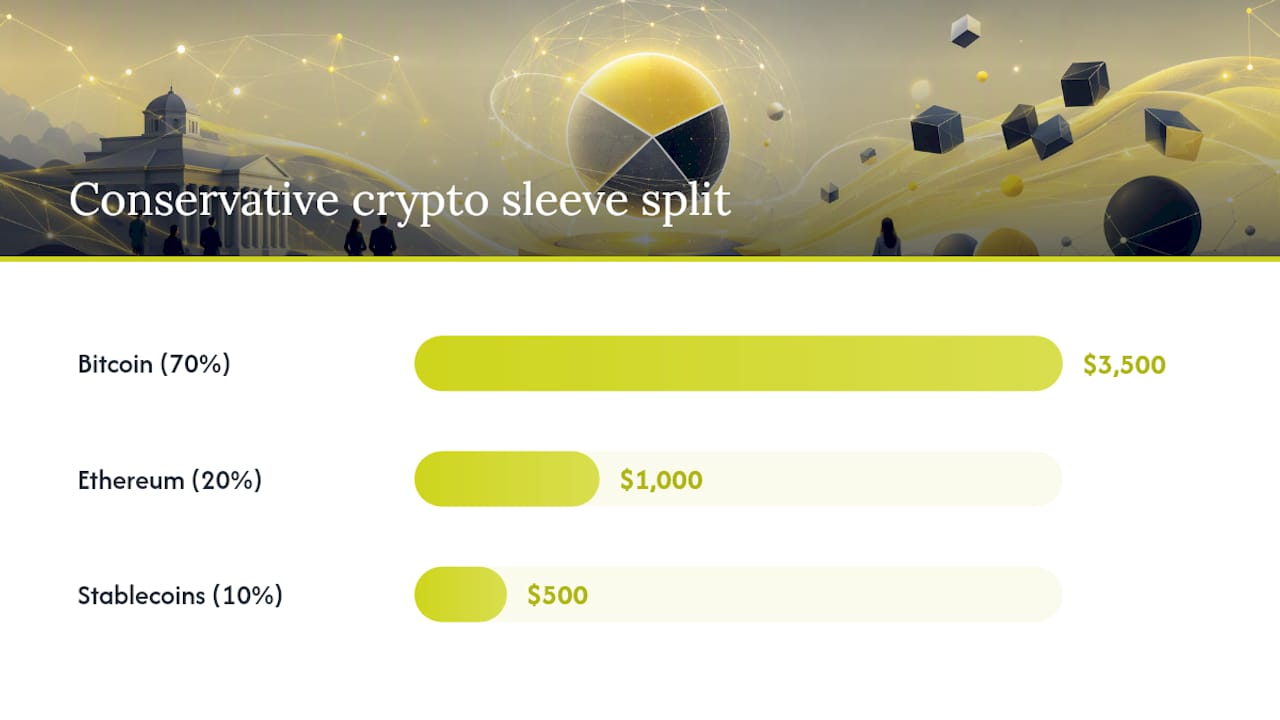
Conservative (0.5%–1% of total portfolio). This fits investors within five years of a major goal, or anyone who wants crypto exposure without it showing up in their sleep patterns. Inside the sleeve: 70% Bitcoin, 20% Ethereum, 10% stablecoins held as dry powder. On a $500,000 portfolio, a 1% allocation means $5,000 in crypto, with roughly $3,500 in Bitcoin and $1,000 in Ethereum. The downside of a full sleeve wideout barely dents total return.
Morgan Stanley treats a sleeve in this range as a pragmatic anchor that can add convexity to a portfolio without threatening its stability.
A worked example makes the tradeoff concrete:
- Conservative template on $250,000: $1,875 in Bitcoin, $625 in Ethereum. A 50% Bitcoin drawdown costs less than one month’s average grocery bill for most households.
- Moderate template on $250,000: $3,438 in Bitcoin, $1,563 in Ethereum, $938 in altcoins. Same drawdown scenario costs roughly $1,700 more.
- Aggressive template on $250,000: $5,625 in Bitcoin, $3,125 in Ethereum, $3,125 in altcoins. The swing is real money, but it’s sized to a sleeve, not the whole portfolio.
One study following a 5% bitcoin allocation, rebalanced monthly inside a 60/40 stock and bond portfolio, found it added roughly 1.7 percentage points of annualized return between January 2018 and May 2026, according to Investments & Wealth Review. That’s the aggressive end of the spectrum, and it came with more volatility in the interim years.
The Core-Satellite Framework Built for Crypto
Core‑satellite investing didn’t originate in crypto. It’s a decades-old equity strategy: hold a diversified core for stability, add targeted satellites for upside. Applied to digital assets, the core becomes a broad basket exposure, usually Bitcoin and Ethereum together, and the satellites become single-asset bets on higher-conviction, higher-risk tokens.
WisdomTree’s research on 2% crypto allocations frames this structure as resilient precisely because it separates the “I want crypto exposure” decision from the “I believe in this specific token” decision.
- 1.5% in the core (Bitcoin and Ethereum combined, weighted toward Bitcoin)
- 0.5% in satellites (two to four altcoins, each capped individually)
The operational case for this structure is as strong as the theoretical one. A diversified core needs infrequent attention. Satellites need active monitoring, and keeping them small limits the damage when one goes to zero, which happens more often in crypto than in equities. Rebalancing gets simpler too: you’re managing one core allocation and a handful of small positions instead of juggling ten different tokens with ten different risk profiles.
Institutions favor this approach for governance reasons as much as return reasons.
How to Decide Your Crypto Percentage: A Checklist
Sizing your crypto portfolio allocation isn’t a guess. It’s a function of five variables you can actually assess.
- Risk budget. How much of your total portfolio can you lose without changing your life plans? Crypto sleeves have gone through 70%-plus drawdowns more than once. Size accordingly.
- Time horizon. Money needed within three years shouldn’t carry more than a token crypto position, if any. Money you won’t touch for a decade can absorb more volatility.
- Liquidity needs. If you might need to sell fast, direct custody with clean exit ramps beats staked positions with lockup periods.
- Existing exposures. Do you already hold crypto-adjacent equities (mining stocks, exchange shares, fintech funds)? Count that toward your total crypto-correlated exposure.
- Conviction and goals. Are you trying to hedge currency debasement, chase asymmetric upside, or just learn the asset class with real money? Each goal points to a different size.
Here’s the worked example. Start with a standard 60/40 stock and bond portfolio worth $400,000: $240,000 in stocks, $160,000 in bonds. The stock and bond ratio barely moves. The portfolio just gained a new source of return that doesn’t move in lockstep with the other two.
Bitcoin, Ethereum, Altcoins, and Stablecoins: What Each One Does
Every asset in a crypto sleeve should have a job. If you can’t name the job, you probably shouldn’t own it.
- Bitcoin (core anchor, 45%–70% of sleeve). Functions as digital scarcity exposure. Its role resembles gold in a traditional portfolio more than it resembles a growth stock, though its volatility is far higher than gold’s has ever been.
- Ethereum (infrastructure exposure, 20%–30% of sleeve). Represents a bet on decentralized application activity rather than pure monetary scarcity. Staking adds a yield component on top of price appreciation, which changes Ethereum’s return profile from pure capital gains to something closer to a dividend-paying growth asset.
- Altcoins (high-beta satellites, 5%–25% of sleeve, capped individually). These carry the highest failure risk and the highest asymmetric upside. Sizing each position to a percentage you’d be comfortable losing entirely isn’t pessimism, it’s math.
- Stablecoins (rebalancing buffer, 5%–10% of sleeve). Held not for yield but for flexibility. Dry powder in a stablecoin position lets you buy dips or fund rebalancing trades without selling other holdings at a bad moment.
Pro Tip: Size each altcoin satellite to match your actual conviction, not your enthusiasm. If you’d be comfortable explaining the position to a skeptical friend in one sentence, it’s sized right. If you need three paragraphs to justify it, it’s probably oversized.
Ethereum’s resilience during periods when other major assets have sold off has drawn attention from market analysts tracking the divergence, reinforcing the case for treating it as a distinct exposure rather than lumping it in with “altcoins” generically.
Diversifying by Market Cap Bucket, Not Coin Count
Owning twelve different tokens doesn’t mean you’re diversified. If eight of them are small-cap tokens that all move together during a risk-off event, you’ve concentrated risk while feeling diversified. Real diversification comes from behavioral buckets, not ticker counts.
- Large-cap (Bitcoin, Ethereum). These move on macro liquidity and institutional flows. Lower relative volatility, higher liquidity, easier to exit in size.
- Mid-cap (established layer-1 and layer-2 protocols with real usage). More correlated with overall crypto sentiment, but with meaningful differentiation based on network activity.
- Small-cap and speculative tokens. These move on narrative, social attention, and thin liquidity. They can 5x or go to zero within a quarter.
- Stablecoins. Not a return driver. A liquidity and rebalancing tool.
For most retail investors, three to five holdings in the mid-cap bucket and two to four in the small-cap bucket is plenty. Beyond that, you’re not adding diversification, you’re adding tracking and tax complexity for no real risk reduction.
A Rebalancing Policy You Can Actually Follow
Rebalancing is where most crypto portfolio strategies quietly fail, not because investors don’t know they should do it, but because they never define when.
Calendar rebalancing (quarterly, semiannually) is simple and prevents emotional decision-making, but it can miss large intra-period swings. Threshold rebalancing (triggered when an asset drifts a set percentage from target) captures volatility more precisely, but requires ongoing monitoring. Backtests on drift-based rebalancing for pure crypto portfolios found threshold triggers often outperform simple time-based rebalancing, with a roughly 15% drift band cited as a commonly effective trigger for all-crypto books.
The practical answer is a hybrid:
- Check quarterly. Review your allocation against targets every three months regardless of market conditions.
- Trigger on drift. If any single asset moves more than 10% to 15% away from its target weight within the crypto sleeve, rebalance immediately rather than waiting for the next quarterly check.
- Use new cash first. Before selling anything, direct new contributions toward underweighted assets. This limits taxable events while still correcting drift.
- Calculate the trade, not the vibe. Determine dollar amounts needed to bring each position back to target weight, then execute as a single batch rather than piecemeal.
- Log every rebalance. Track dates, amounts, and cost basis for tax reporting, especially across multiple exchanges or wallets.
Results vary by portfolio composition. Rebalancing has been shown to meaningfully outperform simple buy-and-hold in pure-crypto portfolios, but the benefit is less consistent once crypto is a small sleeve inside a mixed-asset portfolio, where the drag of taxable events can offset the rebalancing gain.
Pro Tip: If you’re rebalancing inside a taxable brokerage account, run the tax math before you trade. A rebalance that triggers a large capital gain in December might be better executed in January if your income situation changes the following year.
Choosing How to Actually Hold Your Crypto
Getting the percentage right doesn’t matter much if the implementation path adds unnecessary fees, custody risk, or tax headaches. Three broad paths exist, each with real tradeoffs.
Regulated ETFs and ETPs offer the simplest tax reporting and no private-key management, but carry expense ratios and, depending on structure, may not pass through staking yield. The category has grown fast enough that Bitcoin ETFs now hold more assets than gold ETFs, a sign of how much institutional capital has moved into wrapped exposure rather than direct holding.
Direct custody (self-custodied wallets) gives full control and access to staking yield and on-chain activity, but shifts security responsibility entirely onto the investor. Lost keys mean lost assets, permanently.
Custodial exchange or platform holding sits in between: easier than self-custody, but introduces counterparty risk if the platform fails or restricts withdrawals.
Staking, where available, changes the return equation by adding yield on top of price movement, turning select protocols into something closer to a total-return position rather than pure price speculation. When staking is accessed through an ETP wrapper, it can reduce the operational complexity of running validator infrastructure while preserving much of the yield benefit.
Before choosing a path, run through this checklist:
- What are the total annual fees, including expense ratios, trading spreads, and network gas costs?
- How quickly can you exit the position if you need cash?
- Who actually controls the private keys, and what happens if that party is compromised?
- How will this show up on your tax return, and does the provider issue usable tax documents?
- Does the structure give you any voting or governance rights, or is it pure economic exposure?
When Crypto’s Diversification Benefit Disappears
Crypto’s low historical correlation to stocks and bonds is the main argument for including it in a portfolio at all. That correlation isn’t stable, and pretending otherwise is the fastest way to get blindsided.
During systemic market crises, correlation between crypto assets and equities increases sharply, cutting into the diversification benefit precisely when investors need it most.
That’s the core finding from the International Monetary Fund’s analysis of crypto and equity co-movement, and it’s the single most important risk fact in this entire framework. Crypto behaves like an independent asset during calm markets and like a leveraged tech stock during panics. The diversification benefit is regime-dependent, not constant.
Set a maximum combined drawdown you can tolerate across correlated risk assets, not just within the crypto sleeve alone.
Monitoring signals worth tracking on an ongoing basis include exchange deposit and withdrawal flows, funding rates on derivatives exchanges, and on-chain metrics like active addresses or exchange reserve balances. A sustained drop in exchange deposits, for instance, has historically signaled reduced near-term sell pressure and shifting investor conviction.
What Crypto Allocation Actually Costs You Each Year
Expect three categories of cost: product fees, transaction fees, and tax friction, plus a modest but real time commitment.
- ETF/ETP expense ratios typically run higher than traditional equity index funds, reflecting the newer, more specialized custody infrastructure behind them.
- Trading fees vary widely by platform, and spread costs on smaller-cap tokens can be far higher than on Bitcoin or Ethereum.
- Network fees apply to on-chain transfers and rebalancing trades executed via direct custody, and they spike during periods of network congestion.
On taxes, every sale of a crypto asset for profit is generally a taxable event in most jurisdictions, regardless of whether the proceeds are reinvested into another crypto asset or held as cash. Directing new contributions toward underweighted positions instead of selling winners is one of the more reliable ways to rebalance without generating a tax bill, though rules vary by country and investors should confirm specifics with a tax professional familiar with their jurisdiction.
Budget for a quarterly review (roughly 30 to 60 minutes), plus occasional threshold-triggered rebalances that might add two to four additional sessions per year. For most individual investors running a moderate template, that’s four to six total touchpoints annually, not a part-time job.
Techgaged’s Take on Allocation Discipline
Two recent data points change how we think about timing within an allocation, not just the allocation itself. Bitcoin ETF assets have now surpassed gold ETF holdings, signaling a structural shift in how institutional capital accesses this asset class. Separately, Bitcoin deposits on exchanges recently hit an eight-year low, a pattern historically associated with reduced near-term sell pressure.
Techgaged’s ongoing coverage of Bitcoin ETF asset growth relative to gold and declining exchange deposit trends points to the same conclusion from two directions: capital is moving toward regulated wrappers, and available sell-side supply on exchanges is thinning. Neither fact changes your target percentage. Both should inform how you time entries and rebalances within that target. A moderate template executed patiently, using dips to fund underweighted positions, tends to outperform the same template executed all at once.
Hedging a Crypto Sleeve With Derivatives
Derivatives serve a narrower purpose in a retail crypto portfolio than most people assume: they’re a risk-reduction tool, not a leverage tool, when used correctly.
Options allow an investor holding spot Bitcoin or Ethereum to buy protective puts, capping downside on a position without selling it. This costs a premium, similar to insurance, but preserves upside exposure while limiting the worst-case loss during a defined window. Covered calls work the opposite direction, generating income on an existing holding by selling upside potential above a certain price, a reasonable trade-off for investors who believe an asset has limited near-term upside but don’t want to sell.
Futures let investors hedge exposure without touching the underlying spot position, useful for someone who wants to lock in current value ahead of a known cash need without triggering a taxable sale.
The risk with derivatives is that they’re easy to misuse as leverage rather than protection. A protective put costs money and caps some upside; a leveraged futures position amplifies losses if the trade goes wrong. For most individual investors, derivatives belong in a small, clearly defined hedge budget, separate from the core sleeve, and never sized to replace a rebalancing discipline. If you’re not confident explaining the exact scenario a hedge protects against, skip it and rely on position sizing and stablecoin buffers instead.
Stress Testing Your Crypto Allocation Before It’s Tested for You
Scenario analysis means asking specific “what if” questions before the market asks them for you, using numbers instead of assumptions.
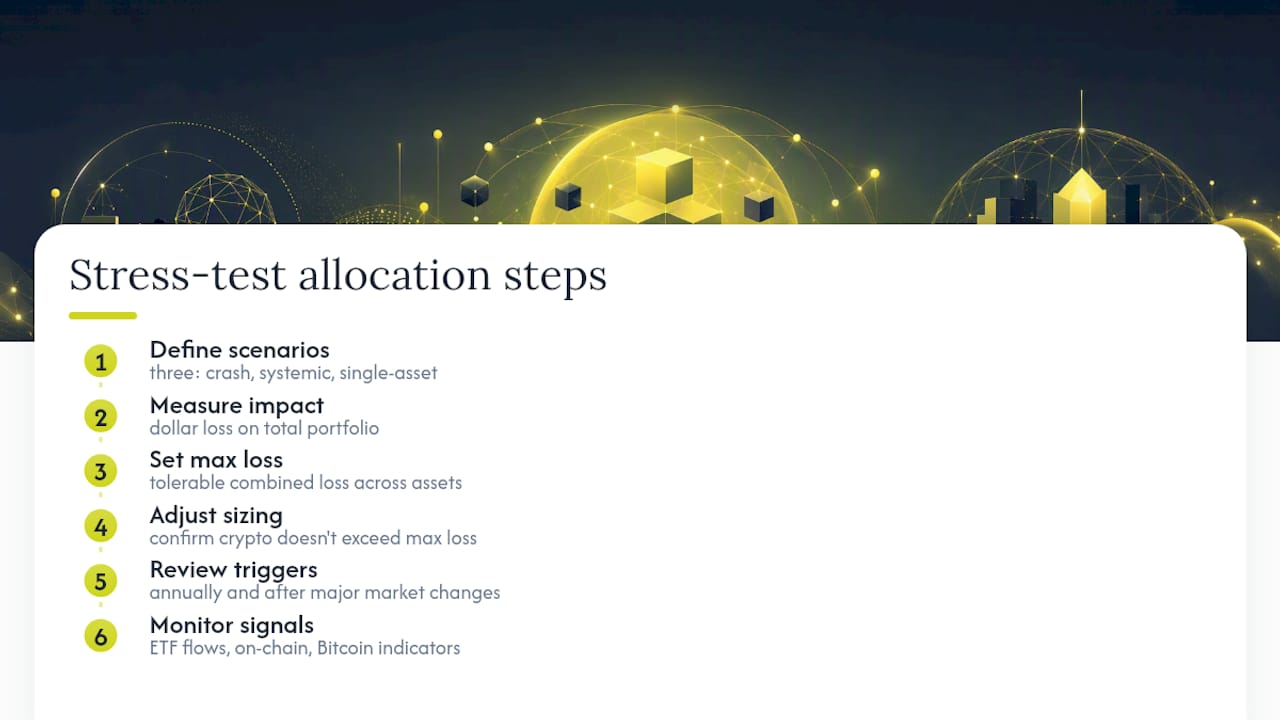
Start with three scenarios. Second, a systemic liquidity crisis where crypto and equities sell off together, consistent with the correlation spike the IMF documented. Third, a single-asset failure where one altcoin holding drops to near zero due to a protocol exploit or project collapse.
For each scenario, calculate the dollar impact on your total portfolio, not just the crypto sleeve.
Set a maximum tolerable combined loss across all correlated risk assets, then work backward to confirm your crypto sizing doesn’t push you past it in a worst-case scenario. Revisit this exercise annually, and immediately after any major structural change in the market, such as a new regulatory regime or a major exchange failure. Stress testing isn’t about predicting which scenario happens. It’s about confirming you can survive any of them without abandoning your strategy at the worst possible moment.
Before finalizing your allocation, it’s worth tracking ongoing market structure shifts, including how altcoin cycles have historically followed specific Bitcoin market indicators, since these patterns can inform when to lean into or trim satellite positions within your existing framework. For the latest reporting on market structure, ETF flows, and on-chain signals that feed directly into these allocation decisions, Techgaged’s ongoing crypto coverage tracks the data points that matter for timing and conviction.
This article is general information, not a substitute for advice from a qualified financial advisor. Consult a qualified financial professional about your own circumstances before acting on anything here.
Sources
- IMF: Crypto prices move more in sync with stocks, posing new risks
- Investing in Crypto: Asset Allocation Considerations | Morgan Stanley
- Bitcoin or beyond? Building your 2% crypto allocation | WisdomTree
- Crypto portfolio allocation: A guide for advisors — Investments & Wealth Review
- Crypto portfolio rebalancing: When to rebalance – CoinCast
FAQ
What if I had invested $1,000 in Bitcoin 10 years ago?
Bitcoin’s price appreciation over the past decade has been dramatic enough that a $1,000 investment made years ago would today represent a life-changing sum for early holders, though the exact return depends heavily on the specific entry and exit dates used. This historical performance illustrates why even a small allocation carries meaningful upside potential, but past returns from Bitcoin’s early adoption phase are not a reliable guide for future performance at its current market size.
How many different crypto coins should I have in my portfolio?
Most individual investors do fine with five to ten holdings total: Bitcoin and Ethereum as the core, plus three to eight altcoins spread across mid-cap and small-cap buckets. More coins than that usually adds tracking complexity and tax reporting work without meaningfully reducing risk.
Is crypto still diversifying if it moves with stocks during a crash?
Crypto’s correlation to equities rises sharply during systemic crises, which temporarily reduces its diversification benefit exactly when investors most want it, according to IMF research. It remains a useful long-term diversifier in calmer market regimes.
Recommended
How do you rate this article?
Subscribe to our YouTube channel for crypto market insights and educational videos.






Join our Socials
Briefly, clearly and without noise – get the most important crypto news and market insights first.
Most Read Today
1
About 1 Billion XRP Unlock Sparks Fresh Market Attention
2Strategy Buys Bitcoin Again After a Two-Month Pause
3Tokenized S&P Hits New All-Time High as Onchain Demand Surges
4DEX Markets Are Heating Up Again as August Sets a Five-Month High
599.98% Less Energy, New Risks: PoS vs PoW for Developers & Stakers
Latest





8
Also read
Similar stories you might like.
Crypto News
Strategy Buys Bitcoin Again After a Two-Month Pause
Azeez | 2026-09-01

Crypto News
Tokenized S&P Hits New All-Time High as Onchain Demand Surges
Azeez | 2026-09-01
Crypto News
DEX Markets Are Heating Up Again as August Sets a Five-Month High
Azeez | 2026-09-01
Crypto News
About 1 Billion XRP Unlock Sparks Fresh Market Attention
Azeez | 2026-09-01

Blockchain
99.98% Less Energy, New Risks: PoS vs PoW for Developers & Stakers
Rokas | 2026-09-01
Crypto News
A Major Zcash Upgrade Is Changing Wallet Performance
Azeez | 2026-08-31
Crypto News
XRP Ledger’s Institutional Credit Vote Could Change the Game for XRP
Azeez | 2026-08-31

Crypto News
Smart Money Is Starting to Look at DeFi Again
Azeez | 2026-08-31

Crypto News
Bitcoin’s Historic August Leaves One Big Question for Q4
Azeez | 2026-08-31

Security
Annual Recovery Test: Seed Phrase Security for Beginners & Pros
Rokas | 2026-08-31