













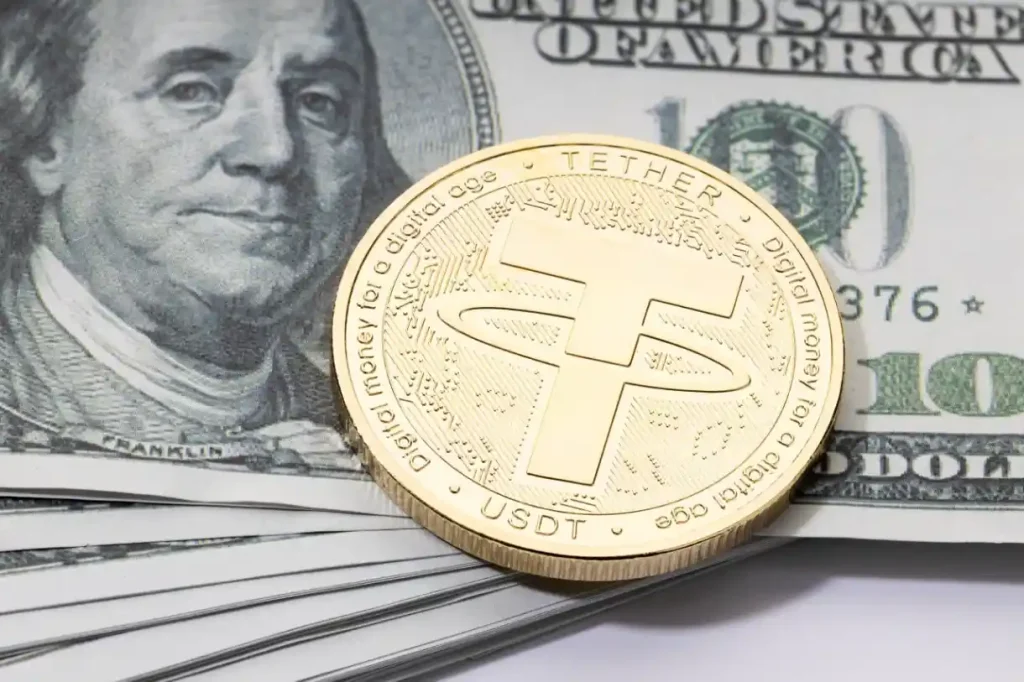
Tether (USDT) coin on U.S. dollar bills. Source: TechGaged / Shutterstock
Georgia Taps Tether for Official Lari Stablecoin Launch
In Brief
- • Georgia plans to launch a national stablecoin with Tether.
- • The project will bring the Georgian lari onto blockchain rails.
- • Officials say the framework aligns with emerging global standards.

Georgia plans to launch an official stablecoin backed by its national currency in partnership with Tether (USDT), in one of the first government-supported efforts to place a sovereign currency directly onto blockchain-based payment rails. The project, called GEL₮, will represent the Georgian lari in digital form and operate under a purpose-built stablecoin regulatory framework. The announcement highlights how governments are increasingly exploring stablecoins as infrastructure for payments and cross-border settlement.
Georgia And Tether Bring the Lari Onchain
According to the announcement published by Tether on May 25, GEL₮ will function as a digital version of the Georgian lari designed to support faster payments, lower transaction costs, near-instant settlement, and programmable financial applications.
Both the Government of Georgia and the National Bank of Georgia are backing the initiative, which is building on several years of regulatory work aimed at creating a comprehensive legal framework for digital assets and stablecoins.
Latest Stories

Chainlink Demonstrates Cross-Chain Dividends — Tokenized Shares Need More Than Transfers

Ethereum’s zkAPI Separates AI Billing From Identity — Prompt Privacy Still Has Limits

Ethereum Researchers Explore Rules That Could Reject a Bad Transaction Outcome
Tether said the project reflects the growing role of stablecoins in global finance. The company noted that its flagship stablecoin, USDT, now carries a market capitalization approaching $190 billion and regularly processes trading volumes that exceed those of major traditional payment networks.
Prime Minister Irakli Kobakhidze described the partnership as part of Georgia’s effort to build a more connected and digitally enabled financial system:
“Together with visionary partners like Tether, Georgia is laying the foundations for a more connected, transparent, and digitally empowered financial world.”
Stablecoin Regulation Moves Closer To U.S. Standards
A notable aspect of the framework is its stated compatibility with emerging U.S. stablecoin legislation, including the GENIUS Act. Officials said Georgia intentionally designed its rules around reserve management, redemption rights, issuer oversight, and anti-money laundering requirements to align with developing international standards.
Tether CEO Paolo Ardoino said stablecoins are increasingly becoming a foundational layer of global finance and argued that regulatory clarity is essential for wider adoption.
“Stablecoins are no longer a niche financial instrument. They are becoming part of the infrastructure layer for global finance. (…) Georgia has moved early to create serious regulatory architecture for digital assets and stablecoins, and that clarity creates the foundation for real innovation and adoption.”
Indeed, the move could strengthen Georgia’s position as a regional hub for digital asset businesses. The country has already implemented systems allowing the settlement of certain tax payments through instant conversion of digital assets into local currency.
Additional details about GEL₮’s rollout timeline and technical implementation are coming later. If successful, the project could provide another example of how governments are beginning to integrate stablecoins into national payment and financial infrastructure.
How do you rate this article?
Subscribe to our YouTube channel for crypto market insights and educational videos.






Join our Socials
Briefly, clearly and without noise – get the most important crypto news and market insights first.

Most Read Today
1
Disconnecting a Crypto Wallet Does Not Revoke Token Approvals: What to Check
2Rising DeFi TVL Does Not Always Mean New Money: How to Read the Data
3Slippage vs. Price Impact: Why a Crypto Swap Can Cost More Than the Fee
4What Happens If a Layer 2 Sequencer Stops? Check the Exit Before Depositing
5A Whale Sent Crypto to an Exchange: How to Check Whether It Signals Selling
Latest






8
Also read
Similar stories you might like.
Crypto News
Rain Files for a U.S. National Trust Bank Focused on Stablecoin Infrastructure
TechGaged | 2026-10-06
Altcoins
XRPL Stablecoin Supply Hits $1.31B as RLUSD Captures 93% of the Market
TechGaged | 2026-10-06

Crypto News
Aave Moves to Raise GHO Borrowing Costs as Stablecoin Liquidity Gets Tight
TechGaged | 2026-10-04
Crypto News
Tether Adds 3.7 Tons of Gold-Backed Assets: Tokenization Enters a New Phase
Azeez | 2026-09-30
Regulation
US Government Moves to Seize $1.76 Million in USDT
Rokas | 2026-07-22
Crypto News
Wall Street Giant BNY Bets Bigger on USDC
Ana | 2026-06-30
Crypto News
SBI Launches Japan’s First Trust-Type Yen Stablecoin
Rokas | 2026-06-25

Crypto News
Ripple Wins Japan Approval For $1.7B RLUSD
Ana | 2026-06-25
Crypto News
Fed Proposal Brings Bank-Style KYC to Stablecoins
Ana | 2026-06-19

Blockchain
Fidelity Enters the $320B Stablecoin Reserve Race With New Fund
Rokas | 2026-06-19