















Strategy logo with Bitcoin tokens. Source: TechGaged / Shutterstock.
Strategy Is Selling Bitcoin Instead Of Buying — Should Investors Be Worried?

Strategy built its reputation on one simple ritual. Buy Bitcoin every week, no matter what. That ritual has stopped.
The Machine In Reverse
For years, Strategy followed a clear playbook. It raised money. It bought Bitcoin. Rising Bitcoin prices lifted the stock.
That lets it raise more money and buy more Bitcoin. This cycle became known as the flywheel. Now the flywheel spins the other way.
Latest Stories
Veysage Introduces First-Position Program With Up to $10,000 in Promotional Value

October Fed Hike Odds Slip to 45% — Crypto Traders Are Watching Closely

Tether Adds 3.7 Tons of Gold-Backed Assets: Tokenization Enters a New Phase
Strategy has sold Bitcoin for four straight weeks. It sold 1,638 BTC one week, then 1,690 BTC the next, both trades landing near $64,000 per coin.

That price sits well below the company’s roughly $75,000 average purchase cost, according to CoinMarketCap.
Peter Schiff Isn’t Holding Back
This isn’t the first time critics have flagged trouble at Strategy. Techgaged reported in December that gold advocate Peter Schiff called it the beginning of the end for MSTR, arguing Saylor sold stock to fund obligations rather than to buy more coins.
Schiff has kept up the pressure since. He also warned in April that Strategy’s own buying could push Bitcoin’s price lower rather than higher, pointing to the company’s shift toward double-digit debt yields as proof investor appetite had already started changing.
A Concentration Risk Nobody Talks About Enough
Strategy’s Bitcoin buying hasn’t just shaped its own balance sheet. It has shaped the entire corporate treasury trend around it.
Techgaged noted in March that Strategy now owns roughly 4% of all Bitcoin in circulation, meaning the broader treasury narrative increasingly depends on one company’s behavior rather than a wide base of buyers.
A pause or reversal at Strategy carries outsized weight for that reason alone.
What The Numbers Actually Show
Strategy’s stock now trades at roughly 0.60 times its net asset value, based on straight market cap comparisons.
That rises closer to 1 times NAV once enterprise value and capital obligations get factored in, The Motley Fool explained.
At a discount to NAV, issuing new stock only shrinks Bitcoin held per share. That makes the original flywheel mechanically impossible to run in reverse gear.
Where Bitcoin Sits on the Chart
As of the latest CoinGecko reading on August 17, 2026 (09:00 UTC), Bitcoin trades at $63,282.65, down 2.6% over the past seven days.
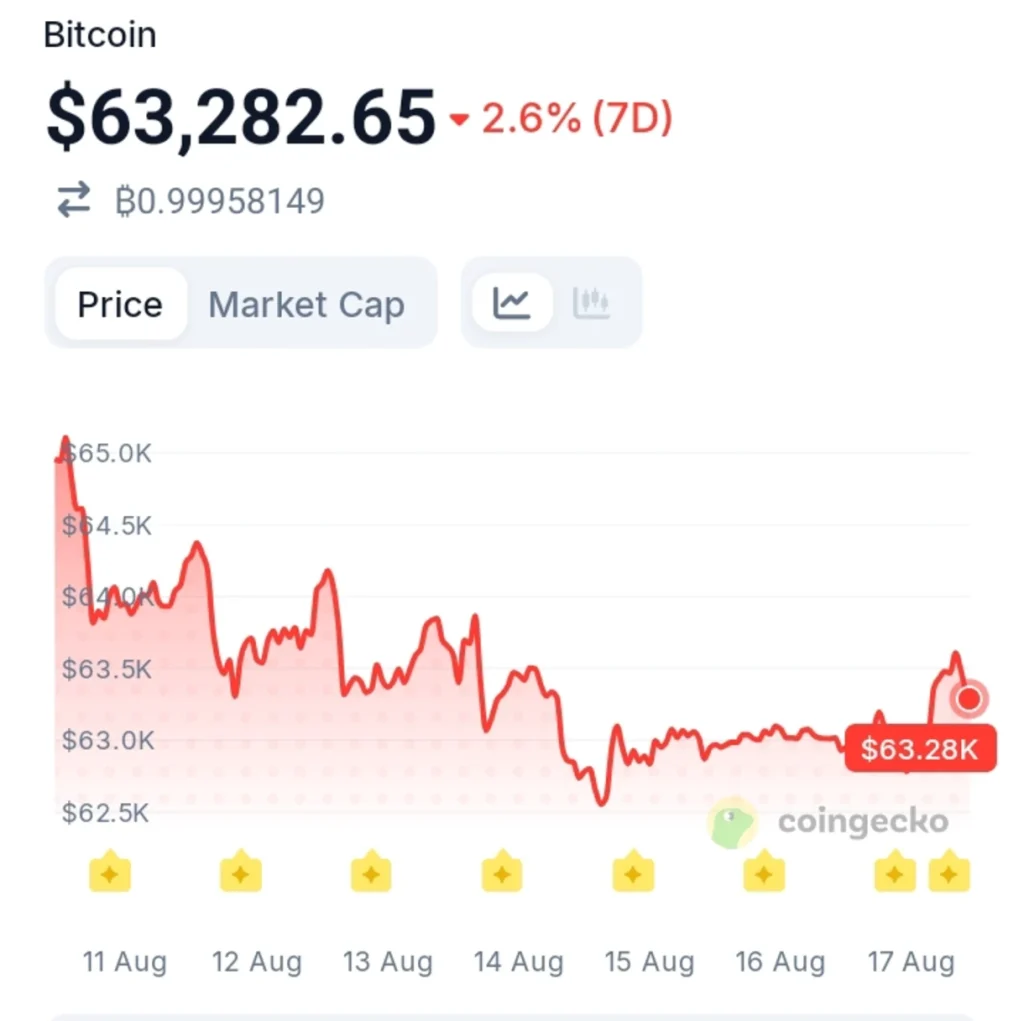
Price fell steadily from highs above $65,000 on August 11 down to lows near $63,000 by mid-month, before ticking back up slightly in the past day.
Whether Strategy resumes buying once its balance sheet stabilizes, or whether this marks a lasting shift away from the model it built, is the question the whole treasury sector is watching for an answer.
Disclaimer:
This article is for informational purposes only and does not constitute financial, investment, or trading advice. The views expressed are based on publicly available data, market observations, and the author’s interpretation at the time of writing. Cryptocurrency markets are highly volatile and unpredictable, and past performance or current technical setups do not guarantee future results. Readers should conduct their own research and consult with a qualified financial advisor before making any investment decisions. TechGaged does not accept liability for any losses incurred based on the information presented.
How do you rate this article?
Subscribe to our YouTube channel for crypto market insights and educational videos.






Join our Socials
Briefly, clearly and without noise – get the most important crypto news and market insights first.
Most Read Today
1
Clarity Act 2026: Everything You Should Know
2DOGE Faces a 28 Billion Coin Resistance Wall as Top Analyst Predicts the Next Leg
3AQAv2 Launch Could Boost HYPE Revenue by 18% and Fuel Buybacks
4Bitcoin Repeats a Rare Q3 Pattern — Could Q4 Bring Another Explosive Rally?
5Crypto’s Leadership Is Shifting — Privacy Tokens Are Now in Front
Latest





8
Also read
Similar stories you might like.

Crypto News
Bitcoin ETF Inflows Hit Seven Straight Days: Is An ‘Uptober’ Rally Taking Shape?
Azeez | 2026-09-29

Crypto News
Binance’s Bitcoin Reserves Plunge — Are Late Buyers Finally Feeling FOMO?
Azeez | 2026-09-28

Crypto News
Bitcoin Repeats a Rare Q3 Pattern — Could Q4 Bring Another Explosive Rally?
Azeez | 2026-09-27

Crypto News
Altcoin Season Indicators Jump as Bitcoin Dominance Stalls: What Changed?
Azeez | 2026-09-26

Crypto News
Bitcoin May Soon Have Private Transfers Without Changing Its Core Rules
Azeez | 2026-09-25

Crypto News
Bitcoin’s $18B Options Expiry Is Coming — A Major Market Move Could Follow
Azeez | 2026-09-24

Crypto News
Bitcoin Leaves Stocks and Gold Behind as a Powerful New Trend Emerges
Azeez | 2026-09-23

Crypto News
Most Altcoin Holders Are Still Losing — Why This Cycle May Have Room to Run
Azeez | 2026-09-23

Crypto News
BlackRock’s Bitcoin Buying Hits Another Level
Azeez | 2026-09-23

Crypto News
Crypto Open Interest Is Surging — Ethereum Stands Out
Azeez | 2026-09-22