








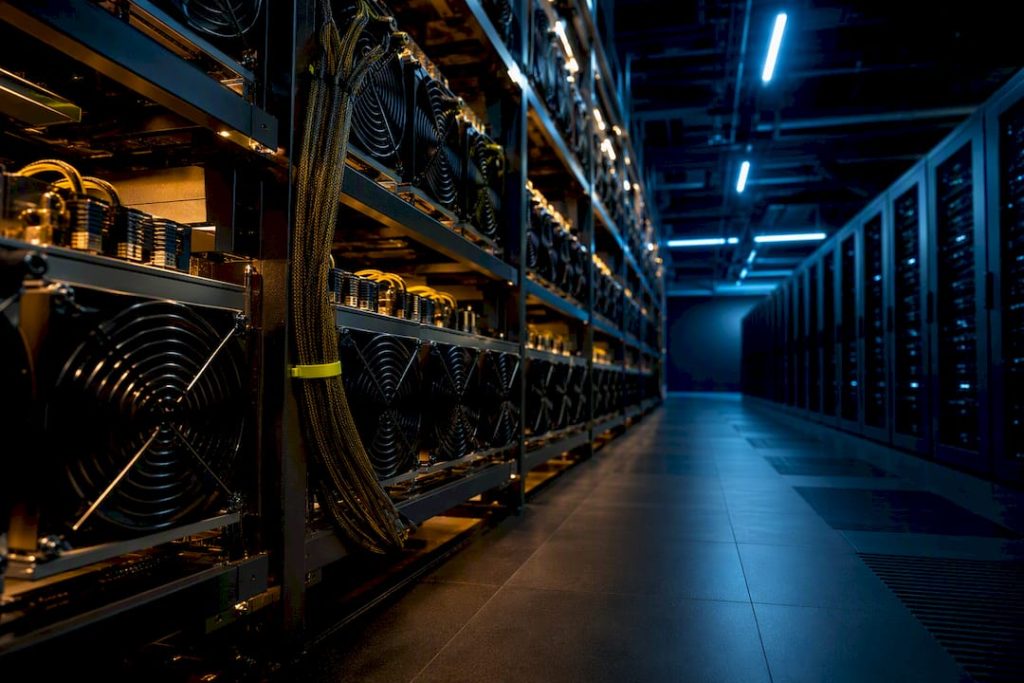
Institutional custody room for tokenized treasury settlement

RWA crypto refers to blockchain tokens that carry onchain claims to off-chain assets, from government debt to gold bars to rental property. In 2026, tokenized treasuries dominate the category, giving investors programmable, yield-bearing exposure that settles instantly instead of the multi-day cycles of traditional finance. The core investor implication is simple: RWAs turn static, paperwork-heavy assets into liquid, composable collateral usable across DeFi.
TL;DR:
Latest StoriesRead all latest stories → 500 Million XRP Leaves Binance: A Major Supply Shift Unfolds
 Bitcoin Is Decoupling From Equities in a Major Market Shift
 Tokenized Gold Is Flowing Into DeFi — Tether Gold Crosses $100M
- Tokenized treasuries dominate the RWA market, offering low-risk yields, instant settlement, and use as high-quality collateral across DeFi.
- Risks mainly stem from off-chain custody, enforceability of legal wrappers, and the reliability of attestations, requiring thorough due diligence.
- Institutional-grade products rely on regulated custodians and proof-of-reserves, with growth driven by compliance standards like ERC-3643 for permissioned tokens.
- By 2026, onchain RWA value has soared over twenty times since 2022, with treasury-backed tokens leading the sector’s expansion.
- Investors should account for jurisdictional restrictions, redemption policies, and the specific asset class (like real estate or commodities) before entry.
How RWA Tokenization Actually Works
Every credible RWA token rests on four layers, and skipping any one of them is where past programs have failed. Understanding this structure matters more than the marketing copy on any issuer’s website, because the token itself is only the visible tip of the arrangement.
- Custody: A regulated custodian (a bank, trust company, or licensed asset manager) holds the actual treasury bill, gold bar, or loan portfolio off-chain.
- Legal wrapper: A special-purpose vehicle (SPV), trust, or fund structure gives token holders an enforceable legal claim on that custodied asset, typically under a specific jurisdiction’s law.
- Token contract: The onchain smart contract represents fractional ownership or a claim on the wrapper, and its permissioning rules decide who can hold and transfer it.
- Oracle and attestation layer: A third party publishes proof that the token supply matches the underlying reserve, usually through periodic attestations or proof-of-reserves reporting.
Primary issuance usually happens through the issuer directly, with net asset value (NAV) updated daily or per business day and redemptions processed against the underlying reserve rather than a secondary market. Permissioning is where the real trade-off shows up. A standard like ERC-3643, known as T-REX, bakes identity verification and transfer restrictions directly into the token contract, which suits regulated securities but limits composability. Plain ERC-20 tokens with issuer admin keys are more flexible for DeFi integration but concentrate power in whoever holds those keys. Most RWA blowups since 2022 traced back to the off-chain legs, not smart contract bugs. Custody gaps, wrapper disputes, and stale reserve reporting caused the losses, not faulty code.
Major RWA Asset Classes and What Each Offers Investors
Not every RWA token behaves the same way, and lumping them together is the fastest way to misjudge risk. Here’s how the major categories actually differ:
- Tokenized treasuries: Represent short-dated government debt or money market positions, offering steady, low-risk yield with 24/7 access and same-day settlement, plus use as high-quality DeFi collateral.
- Tokenized commodities (gold): Custody-backed tokens redeemable for physical metal, with no yield component since the value proposition is price tracking and portability, not income.
- Private credit and structured credit: Higher potential yield tied to loan portfolios or receivables, but investors take on originator quality and underwriting risk that’s much harder to verify than a treasury bill.
- Tokenized real estate: Offers fractional rental income exposure, though legal title nuances vary by structure and secondary market liquidity remains thin compared to public REITs.
- Stablecoins as RWAs: Payment stablecoins like USDT and USDC hold reserves in cash and treasuries but don’t pass yield to holders, while a separate category of yield-bearing RWA products explicitly shares treasury income with token holders.
The distinction between payment stablecoins and yield-bearing treasury tokens confuses newer investors constantly. A stablecoin keeps its dollar peg and pays you nothing directly; a yield-bearing RWA token is built specifically to pass through the return on its underlying reserve.
Infrastructure and Standards Behind RWA Platforms
Ethereum remains the primary chain for institutional RWA issuance, largely because its mature tooling and established custodian relationships give issuers a compliance-friendly base to build on. Networks including Solana, Aptos, BNB Chain, XRPL, and Stellar have picked up meaningful RWA activity too, especially in tokenized credit and payments use cases where speed and low fees matter more than deep DeFi integration.
Two token models dominate the space, and picking between them is a genuine trade-off:
- ERC-3643 (T-REX): Permissioned by design, with identity checks and transfer rules enforced at the contract level, making it the default for institutional securities.
- ERC-20 with admin keys: More composable across DeFi protocols, but relies on the issuer’s own controls rather than protocol-enforced permissioning.
Regulated custodians like BNY Mellon, State Street, and Anchorage increasingly hold the underlying assets backing these tokens, adding a layer of institutional accountability that pure crypto-native products never had. Third-party attestors then verify that token supply matches reserves, usually publishing findings alongside daily NAV updates for treasury products. The frequency and independence of that attestation is arguably the single best signal of how seriously an issuer takes its own claims, more telling than any marketing page describing the token’s features.
2026 Market Snapshot: TVL, Leaders, and Growth Patterns
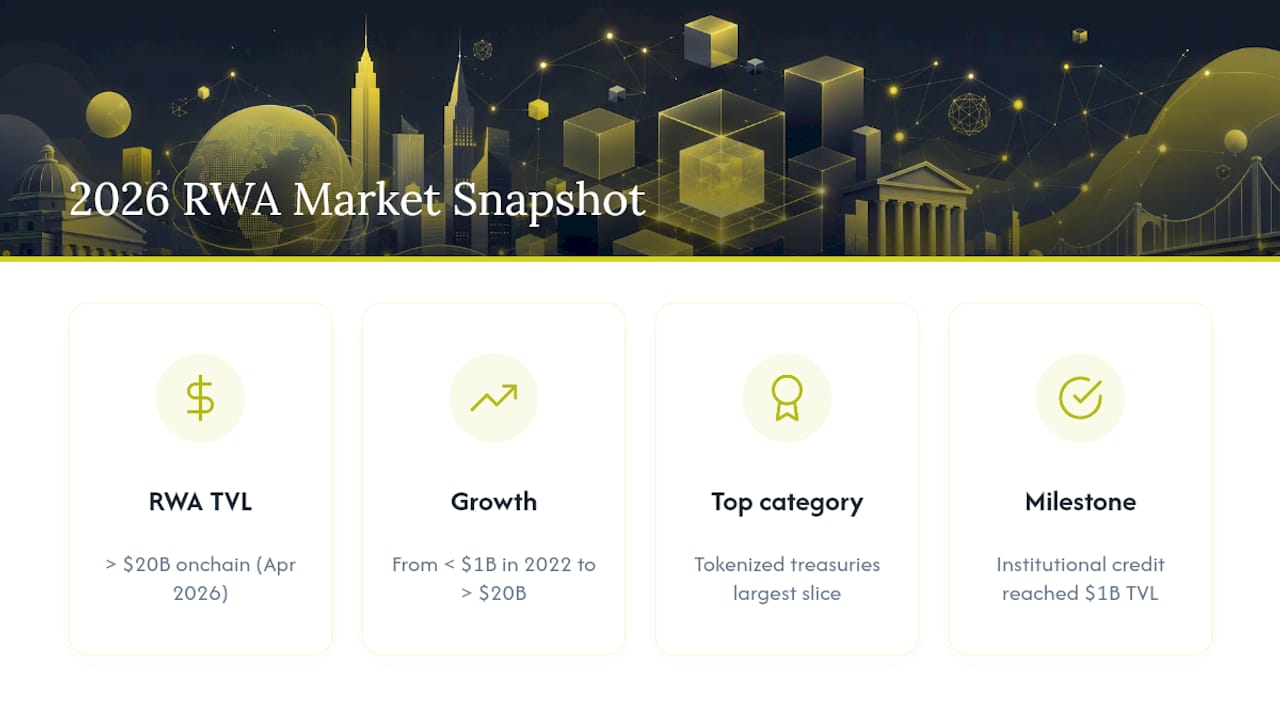
By April 2026, the narrower RWA category covering tokenized treasuries, real estate, commodities, and credit had grown from under $1 billion in 2022 to more than $20 billion onchain, and tokenized treasuries make up the largest single slice of that total.
That growth isn’t evenly distributed across products, and the names matter. BlackRock BUIDL and Circle USYC anchor the institutional treasury category, giving large allocators a regulated, attested wrapper around short-term government debt. Ondo has built a broader platform connecting tokenized treasuries to DeFi rails, positioning itself as infrastructure rather than a single fund. On the commodities side, Paxos Gold (PAXG) and Tether Gold (XAUT) both offer custody-backed, redeemable exposure to physical gold, with no yield attached since the pitch is price tracking, not income. Centrifuge focuses on tokenizing private credit and structured receivables, bringing real-world loan portfolios onchain for institutional borrowers. RealT targets fractional real estate ownership, letting investors buy slices of specific rental properties. Securitize operates as issuance infrastructure, the plumbing many of these tokenized funds actually run on.
Industry trackers note that institutional categories like asset-backed credit have reached the $1 billion TVL mark faster than retail-facing categories, a signal that institutions move fast once regulatory and technical rails are in place. Research also shows tokenized treasuries acted as a digital safe haven during certain market stress episodes, with RWA composition shifting sharply toward externally issued treasury products after 2023. For investors, that combination of institutional pace and safe-haven behavior is exactly why treasuries now anchor the category rather than sitting alongside it as one option among many.
Primary Risks, Red Flags, and a Due-Diligence Checklist
The risks in RWA crypto live almost entirely off-chain, and that’s the opposite of what most new crypto investors expect. A perfectly audited smart contract means nothing if the custodian holding the underlying treasury bill goes dark or the legal wrapper doesn’t hold up in the jurisdiction it claims.
Four risk categories deserve your attention before you buy any RWA token:
- Custody mismatch risk. Ask whether the custodian is independently regulated and whether proof-of-reserves is published on a fixed schedule, not just “on request.”
- Legal-wrapper enforceability. Confirm which jurisdiction governs the SPV or trust and whether token holders have a direct legal claim or merely a contractual promise from the issuer.
- Oracle and attestation reliability. Check how often attestations are published and whether an independent third party, not the issuer itself, performs them.
- Liquidity and redemption risk under stress. Understand what happens to your redemption request if the underlying asset can’t be sold quickly, since most RWA failures since 2022 traced back to exactly this kind of off-chain breakdown rather than a hacked contract.
Before committing capital, demand the issuer’s latest attestation report, the legal opinion backing the wrapper’s jurisdiction, and a clear redemption policy in writing.
Pro Tip: Treat a missing or stale attestation date as a hard stop, not a minor gap. An issuer that can’t produce reserve proof on a regular cadence is asking you to trust a claim it hasn’t bothered to verify itself.
How to Access and Invest in RWAs
Three main routes get you exposure to RWA tokens, and each comes with its own eligibility hurdles. Direct onchain purchases let you buy tokens like PAXG or XAUT with minimal friction, though you’re still responsible for wallet security and verifying the token’s attestation history yourself. Tokenized fund platforms, often built on Securitize’s infrastructure, package institutional-grade products but usually require accredited investor status and jurisdiction-specific KYC. Custodial issuance through exchanges or regulated custodians offers a more familiar onboarding experience, trading some decentralization for compliance handling done on your behalf.
- Accredited investor and KYC gates vary sharply by jurisdiction, and a product open to US institutional buyers may be closed entirely to retail investors elsewhere.
- Self-custody gives full control but puts the burden of key management and wallet security entirely on you.
- Institutional custody trades convenience for a degree of counterparty trust similar to a traditional brokerage relationship.
- Custodial issuer wallets simplify onboarding but mean your access depends on the platform staying operational and compliant.
Redemption timing and tax reporting deserve attention before you buy, not after. Treasury-backed tokens generally redeem faster than private credit or real estate positions, and most jurisdictions treat RWA token gains as taxable events similar to other securities, so keep transaction records from day one.
TechGaged’s Coverage of RWA and Tokenization Trends
Techgaged tracks the RWA sector as part of its broader data-driven coverage of crypto market structure, institutional adoption, and regulatory shifts. Staff reporter Justinas has covered developments ranging from Ethereum’s role as a market-stability anchor to tokenized credit growth on Solana, giving readers grounded context on where onchain asset activity is actually moving.
Techgaged also reported on stablecoin reserve management practices and on federal recognition of crypto assets in mortgage underwriting, both directly relevant to how RWAs intersect with traditional financial infrastructure. That combination of market analysis and regulatory tracking is what readers rely on for informed decisions in a sector that changes weekly.
Regulatory Landscape and Compliance Considerations
Regulation of RWA tokens varies enormously by jurisdiction, and no single global standard governs how a tokenized treasury or tokenized loan portfolio gets classified. In the United States, many RWA products are treated as securities, which pushes issuers toward accredited-investor gates and registered fund structures rather than open retail sale. The European Union’s Markets in Crypto-Assets (MiCA) framework takes a different approach, creating specific categories for asset-referenced tokens that RWA issuers operating in the EU must navigate separately from US rules.
Asia presents an even more fragmented picture, with jurisdictions like Singapore and Hong Kong building sandbox frameworks for tokenized securities while others maintain far stricter limits on crypto-linked financial products. This patchwork means the same RWA token might be freely available to retail investors in one country and restricted to institutions in another, purely based on how local regulators classify the underlying legal wrapper.
For investors, the practical takeaway is to check the issuer’s stated jurisdiction and target investor base before assuming you’re eligible to buy. A token’s onchain availability doesn’t override the legal restrictions baked into its wrapper, and buying around a KYC gate can leave you holding an asset you have no enforceable claim to. Compliance in this sector isn’t a formality bolted onto the token. It’s the mechanism that makes the legal claim behind the token worth anything at all.
RWAs Versus Purely Digital Crypto Assets
The fundamental difference between an RWA token and a native crypto asset like Bitcoin or Ether comes down to what backs its value. Bitcoin’s value derives entirely from onchain scarcity, network effects, and market demand, with no off-chain legal claim behind it. An RWA token’s value is tied directly to a specific off-chain asset, whether that’s a treasury bill, a gold bar, or a rental property, and its price should track that underlying asset closely rather than moving on pure market sentiment.
This changes the risk profile in ways worth internalizing. Native crypto assets carry smart contract risk, network risk, and volatility driven by speculation, but they don’t depend on a custodian or legal wrapper functioning correctly. RWAs add an entire off-chain risk layer on top of the onchain one, trading some of crypto’s volatility for a different kind of counterparty dependency. A tokenized treasury is far less volatile than Bitcoin day to day, but it introduces custody and legal-enforceability questions that a native token never has to answer.
For portfolio construction, this makes RWAs function more like a bridge asset. They bring the settlement speed and composability of crypto rails to instruments that behave like traditional fixed income or commodities, which is precisely why institutional allocators have gravitated toward them faster than toward volatile native tokens.
Impact of RWAs on Crypto Market Stability
Tokenized treasuries have started to change how capital behaves during market stress, and the evidence points in a specific direction. Research on tokenized treasury dynamics found that these products acted as a digital safe haven during certain stress episodes, meaning capital flowed into treasury-backed tokens rather than out of crypto entirely when volatility spiked elsewhere.
That behavior matters for the broader market’s stability profile. Before tokenized treasuries reached meaningful scale, crypto investors seeking safety during a downturn had few onchain options beyond stablecoins, which carry their own de-peg risks, or exiting to fiat entirely. Tokenized treasuries give investors a way to de-risk without fully leaving the crypto ecosystem, keeping capital available for redeployment once conditions stabilize.
At the same time, RWAs introduce a new transmission channel between traditional finance and crypto markets. If treasury markets themselves come under stress, that pressure can now flow directly into DeFi protocols that use tokenized treasuries as collateral, a link that didn’t exist a few years ago. This cuts both ways: it can dampen crypto-specific panic by offering a stable onchain anchor, while also making crypto markets somewhat more sensitive to conditions in traditional bond markets than they were before.
Use Cases and Benefits of RWAs in DeFi
RWAs solve a problem DeFi has struggled with since its early days: a lack of stable, yield-bearing collateral that isn’t itself a volatile crypto asset. Tokenized treasuries now function as high-quality collateral across lending protocols, letting borrowers post treasury-backed tokens instead of volatile assets like Ether to secure loans, which reduces liquidation risk for the entire system.
Yield-bearing RWA tokens also give DeFi users a way to earn steady, treasury-linked returns without leaving onchain infrastructure, appealing to investors who want exposure to traditional fixed income without opening a separate brokerage account. Protocols have started building structured products around these tokens, layering additional yield strategies on top of a treasury base, though each added layer introduces its own smart contract and counterparty risk worth scrutinizing separately.
Private credit tokenization through platforms like Centrifuge extends this further, bringing real-world loan originators onchain to access DeFi liquidity pools directly rather than relying solely on traditional bank lending. This gives smaller borrowers and specialty lenders a funding channel that didn’t exist before, while giving DeFi investors access to credit risk and yield profiles that don’t correlate directly with crypto market cycles. The net effect is a DeFi ecosystem that looks less like a closed loop of speculative tokens and increasingly like a parallel financial system with real economic activity underpinning it.
Historical Development of RWAs in Crypto
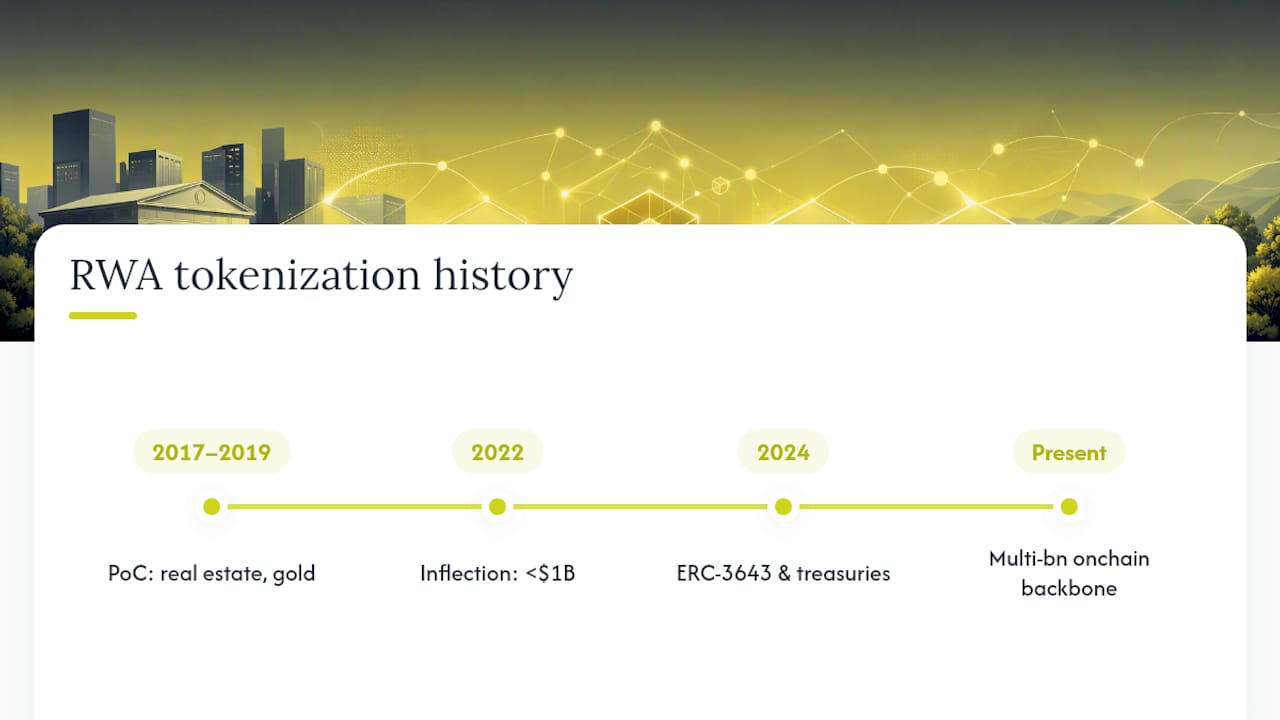
RWA tokenization didn’t start with the institutional wave you see today. Early experiments in the 2017 to 2019 period focused on tokenized real estate and small-scale commodity tokens, mostly as proof-of-concept projects with limited liquidity and minimal regulatory infrastructure. Gold-backed tokens like Paxos Gold and Tether Gold emerged during this period, offering some of the first credible, redeemable RWA products with clear custody arrangements.
The real inflection point came around 2022, when the category held under $1 billion in onchain value, largely because rising interest rates suddenly made tokenized treasuries an attractive yield product compared to near-zero DeFi lending rates during the previous cycle. Institutional issuers took notice, and products like BlackRock’s BUIDL fund brought a level of legitimacy and scale that earlier RWA experiments never achieved.
By 2024, the shift toward externally issued tokenized-treasury products accelerated sharply, a pattern documented in research on tokenized treasury dynamics. Standards like ERC-3643 matured alongside this growth, giving institutions a permissioning framework that satisfied compliance teams in ways earlier open ERC-20 approaches couldn’t. That combination of favorable rates, institutional capital, and better compliance tooling is what pushed RWAs from a niche experiment to the multi-billion dollar backbone of onchain finance you see now. For deeper context on how specific chains and market segments are evolving within this trend, Techgaged’s ongoing coverage tracks these shifts as they happen, including broader Bitcoin adoption data that shows how quickly institutional crypto infrastructure has scaled overall.
If you’re tracking where this capital rotation goes next, Techgaged’s analysis of altcoin season indicators offers useful context on broader market cycles that often intersect with institutional RWA flows. For daily coverage of tokenization news, market moves, and regulatory developments, Techgaged’s news hub tracks these stories as they break.
This article is general information, not a substitute for advice from a qualified financial advisor. Consult a qualified financial professional about your own circumstances before acting on anything here.
Sources
- Digital safe havens: the economics of tokenized treasuries (NBER working paper)
- What Are Tokenized Real-World Assets? | Decrypt
- What are tokenized treasuries? | Chainlink
- ERC-3643 (T-REX) standard
FAQ
What’s the best RWA crypto to consider?
There’s no single “best” RWA token since each serves a different purpose. Tokenized treasuries like BlackRock BUIDL and Circle USYC suit investors wanting low-risk yield, while Paxos Gold or Tether Gold fit those seeking commodity exposure without income.
Is investing in RWA tokens a good idea?
It depends entirely on the specific product and your risk tolerance. Tokenized treasuries carry relatively low risk given their government-debt backing, while private credit or real estate tokens carry higher yield potential alongside more custody and liquidity risk.
Where can I buy RWA tokens?
You can buy certain RWA tokens like PAXG or XAUT directly onchain through supported wallets and exchanges, while institutional products like tokenized treasury funds typically require going through the issuing platform’s KYC and accreditation process.
What are the best RWA platforms to invest through?
Leading platforms include BlackRock’s BUIDL and Circle’s USYC for tokenized treasuries, Ondo for broader treasury-DeFi infrastructure, Centrifuge for private credit, RealT for fractional real estate, and Securitize as issuance infrastructure behind many institutional products.
How do RWA tokens generate yield?
Yield-bearing RWA tokens pass through the return earned by their underlying asset, most commonly short-term government debt, directly to token holders, distinguishing them from payment stablecoins that hold similar reserves but don’t share that yield.
Recommended
How do you rate this article?
Subscribe to our YouTube channel for crypto market insights and educational videos.






Join our Socials
Briefly, clearly and without noise – get the most important crypto news and market insights first.
Most Read Today
1
500 Million XRP Leaves Binance: A Major Supply Shift Unfolds
21%–5% Crypto Allocation: Institutionally Informed, Retail‑Actionable
3Multicoin Capital’s Latest HYPE Move Puts Sell Pressure in Focus
4Tokenized Gold Is Flowing Into DeFi — Tether Gold Crosses $100M
5Bitcoin Is Decoupling From Equities in a Major Market Shift
Latest





8
Also read
Similar stories you might like.
Crypto News
500 Million XRP Leaves Binance: A Major Supply Shift Unfolds
Azeez | 2026-09-02

Crypto News
Bitcoin Is Decoupling From Equities in a Major Market Shift
Azeez | 2026-09-02

Crypto News
Tokenized Gold Is Flowing Into DeFi — Tether Gold Crosses $100M
Azeez | 2026-09-02
Crypto News
Multicoin Capital’s Latest HYPE Move Puts Sell Pressure in Focus
Azeez | 2026-09-02

Beginners
1%–5% Crypto Allocation: Institutionally Informed, Retail‑Actionable
Rokas | 2026-09-02
Crypto News
Strategy Buys Bitcoin Again After a Two-Month Pause
Azeez | 2026-09-01
Crypto News
Tokenized S&P Hits New All-Time High as Onchain Demand Surges
Azeez | 2026-09-01
Crypto News
DEX Markets Are Heating Up Again as August Sets a Five-Month High
Azeez | 2026-09-01
Crypto News
About 1 Billion XRP Unlock Sparks Fresh Market Attention
Azeez | 2026-09-01
Blockchain
99.98% Less Energy, New Risks: PoS vs PoW for Developers & Stakers
Rokas | 2026-09-01