










Smart contract transaction review workstation

The core truth most guides skip: royalties are usually a signaled request through a standard called EIP-2981, not a payment the blockchain forces anyone to make. If you’re a creator, that means treating royalty income as variable and negotiated with each marketplace, not as guaranteed revenue baked into the token itself.
TL;DR:
Latest StoriesRead all latest stories → Morgan Stanley Adds to Its Bitcoin Position for a Fourth Straight Day
 Zcash Has More Than a Price Story — Here’s What’s Really Changing
 BNB Chain Just Gave Builders More Room — The Next Wave Could Be Coming
- Marketplaces can choose whether or not to honor the royalty signal, making secondary resale income uncertain and highly dependent on platform policies.
- Enforcement options like on-chain filters or programmable transfer rules often reduce liquidity and platform compatibility, limiting effective royalty collection.
- Royalties are calculated as a percentage of sale price, with 2.5% suited for high-volume, low-margin collections and 7.5% to 10% fitting premium projects with added utility.
- Tax implications are usually straightforward, but creators must track payments and clarify rights, as sales do not automatically transfer intellectual property.
- Always verify current marketplace royalty policies and community support, especially since platform rules have frequently changed since 2022.
How NFT Royalties Work: Signaling vs. Execution
Every NFT collection with royalty support carries that data at the contract level, usually set when a creator deploys the smart contract or configures it through a minting platform. The number itself, typically a modest percentage, lives in the contract’s code, not on some separate ledger a marketplace consults.
The standard behind almost all of this is EIP-2981, formalized as ERC-2981. It defines a function called royaltyInfo() that any marketplace can call to ask a contract two questions: who gets paid, and how much. That’s the entire job of the standard. It signals intent. It does not touch the actual transfer of funds.
OpenZeppelin’s ERC2981 implementation shows how this plays out in real code. The contract calculates a royalty amount by multiplying the sale price by a stored fee percentage, then returns that figure along with the receiver’s wallet address. A marketplace can read this, honor it, and cut the check, or it can read it and do nothing at all. Nothing in the token’s code stops the sale from completing either way.
That gap matters because of who actually holds the money during a sale:
- Primary sales (creator to first buyer) always pay the creator directly. There’s no enforcement question here.
- Secondary sales (buyer to buyer) route through a marketplace or wallet transfer, and that’s where royaltyInfo() is either honored or ignored.
- Marketplace discretion decides the outcome. Some platforms pay every dollar of the signaled royalty. Others cap it, make it optional for the buyer, or skip it entirely.
- Peer-to-peer transfers bypass royalties completely, since no marketplace logic is even in the loop.
The standard’s authors built it this way on purpose, leaving enforcement to whatever marketplaces chose to build on top of it. That decision is the root of nearly every royalty controversy that followed.
The Royalty Wars: How Marketplaces Changed the Rules
The enforcement gap stayed mostly theoretical until late 2022, when marketplace competition turned it into a real revenue problem for creators. A rival platform launched with zero-fee trading and optional royalties, pressuring the market leader to respond. Within months, the leading marketplace made royalties optional too, letting buyers choose to pay nothing on resale.
That set off what the industry now calls the royalty wars, and Shironeko GG’s analysis documents how the fee competition of 2022 and 2023 spread the optional-royalty model across most major platforms.
The mechanics of the bypass are straightforward:
- Buyers on royalty-optional platforms could simply set their royalty contribution to 0% at checkout.
- Over-the-counter deals, where a buyer and seller settle outside any marketplace interface, never touch royalty logic at all.
- Wrapping a token into a different contract wrapper strips out the original royalty configuration entirely.
- Aggregator tools that route orders across multiple marketplaces often default to the lowest-friction, lowest-royalty path.
Creator royalty income tied to secondary trading declined sharply once major venues stopped requiring royalty payment at checkout, a shift traced directly to marketplace fee competition rather than any change in collector demand.
The practical fallout hit small and mid-size creators hardest. Blue-chip collections with strong brand loyalty still saw partial royalty compliance from collectors who wanted to support the project. Newer or less-established creators often saw royalty revenue drop close to nothing, since anonymous buyers had no reason to opt into a payment nobody could force them to make.
If you’re minting today, verify a marketplace’s current royalty policy before you build any revenue projection around it. Policies have changed multiple times since 2022, and they can change again.
Can You Actually Enforce Royalties On-Chain?
Enforcement is possible, but every method trades away some liquidity or compatibility to get there. Creators who want teeth behind their royalty terms have four main technical paths, and each one asks the market to accept a friction cost in exchange for guaranteed payment.
The Operator Filter Registry was the first widely adopted fix. It works by maintaining an on-chain list of approved marketplace contracts; a token using the filter will block transfers initiated by any marketplace not on that approved list, effectively locking sales to venues that honor royalties. The limitation is obvious once you see it: it only blocks contracts registered as violators, and new bypass routes appear faster than the registry can be updated.
ERC-721C, built by Limit Break, takes a more flexible approach with programmable transfer hooks. Instead of a static blocklist, the contract itself can enforce custom transfer rules, including a requirement that royalties be paid before a transfer finalizes. It’s a stronger mechanism than the Operator Filter Registry, but it requires marketplaces to specifically support the standard, which narrows where a collection can trade.
Metaplex, Solana’s NFT framework, handles this differently through programmable NFTs that can bake enforcement rules directly into the token’s transfer logic at the protocol level, rather than relying on marketplace cooperation after the fact. That structural difference is a big part of why Solana collections have historically had an easier time holding royalty compliance than Ethereum collections leaning on voluntary signaling.
Other workarounds exist, like allowlisting specific marketplace contracts or wrapping tokens with custom transfer logic, but these methods tend to be brittle: they require ongoing maintenance, and a new wrapping technique or manual transfer method can route around them.
Pro Tip: Before adopting any on-chain enforcement tool, ask whether the marketplaces where your community actually trades even support it. A perfectly enforced royalty on a platform nobody uses generates zero dollars.
The trade-off summary is simple even if the engineering isn’t: stronger enforcement generally means fewer compatible venues, and fewer venues usually means thinner liquidity for your collectors.
Modeling Royalty Revenue: The Math Creators Skip
Royalty income follows one formula: royalty per sale equals sale price multiplied by royalty percentage. Aggregate royalty revenue depends on how many resales your collection generates, so turnover matters more than the rate you pick.
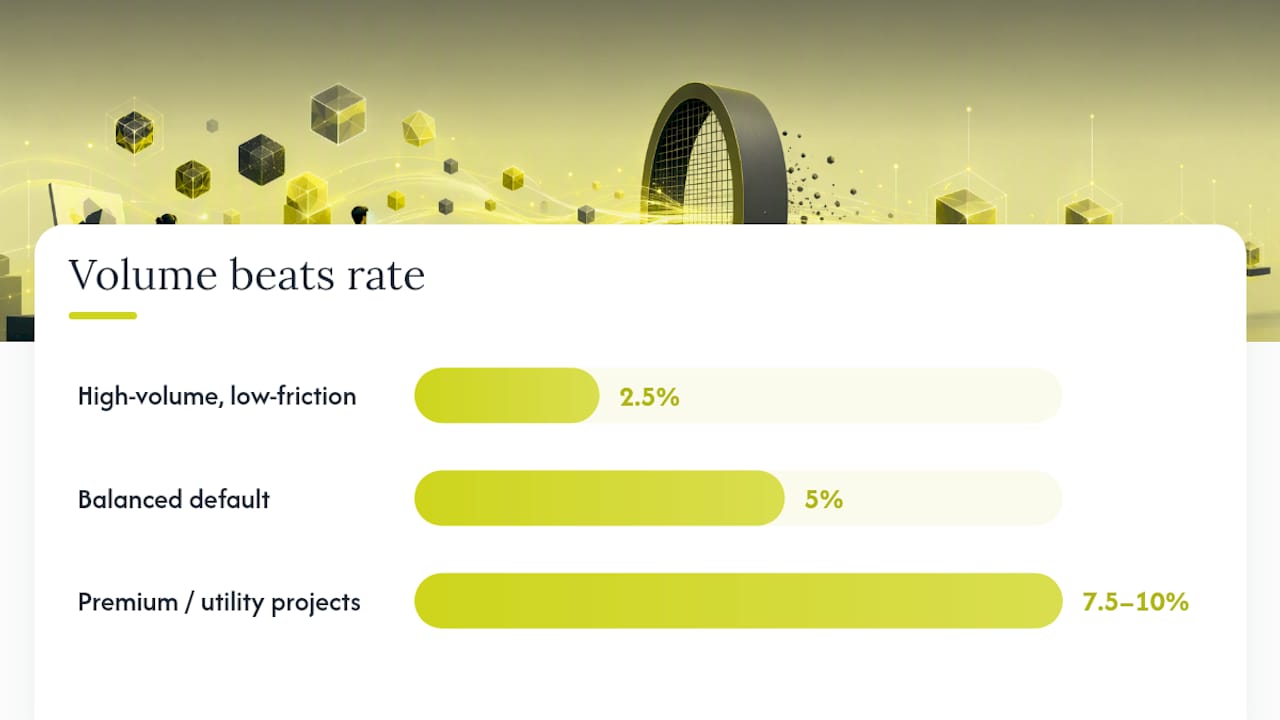
A royalty calculator makes the volume dependence obvious. For example, a collection with many items and a floor price with a moderate royalty rate can generate royalties proportional to how much of the collection resells monthly. Increasing trading activity increases revenue, sometimes outweighing changes in the royalty percentage. Rate matters, but volume usually decides the outcome.
When picking a rate, three benchmarks cover most situations:
- 2.5% suits high-volume, low-friction collections where you’re betting on trading activity to make up for the thin margin per sale.
- 5% is the balanced default most established collections settle on, splitting the difference between collector-friendly pricing and meaningful creator income.
- 7.5% to 10% fits premium or utility-driven projects where the token unlocks ongoing value, like access or physical redemptions, and collectors are less price-sensitive to the resale cut.
Remember that marketplace trading fees stack on top of, not instead of, your royalty deduction. That combined deduction affects how aggressively collectors negotiate resale prices, influencing your own royalty math.
Legal, Tax, and Rights Questions Creators Overlook
Royalty income is taxable in most jurisdictions, and the IRS’s guidance on digital assets makes clear that income from digital asset activity generally falls under standard taxable-income rules for US taxpayers. Whatever country you’re in, assume your local tax authority expects royalty payments reported as income, not treated as some crypto-native exception.
A separate issue trips up creators constantly: selling an NFT almost never transfers the underlying intellectual property rights. Buyers typically get ownership of the token itself, not a license to reproduce, merchandise, or commercially exploit the associated artwork unless the smart contract or an accompanying license explicitly grants that. Read your own minting platform’s terms before assuming what rights transfer at sale.
Practical steps worth taking now:
- Keep a running log of every royalty payment received, including the marketplace, date, and sale price, since exchanges rarely issue clean tax documents for this.
- Consult a tax professional familiar with your specific country’s digital-asset rules rather than assuming another jurisdiction’s treatment applies to you.
- Draft or review the licensing language attached to your collection so buyers know exactly what they’re getting beyond the token.
- Track cross-border sales separately, since a buyer in a different country can trigger different reporting obligations depending on where you’re based.
Cross-border complexity is real. A proposed bill aimed at simplifying crypto taxation signals that even domestic rules are still catching up, so don’t assume any single framework applies universally.
Practical Strategies to Protect Your Royalty Income
- Pick your chain and standard on purpose. If you’re deploying on Ethereum or an EVM-compatible chain, build with EIP-2981 from day one, then check which marketplaces your target audience actually uses before assuming royalties will be honored there.
- Set your rate against expected turnover, not aspiration. A high-flip, low-price collection usually performs better with a 2.5% rate that doesn’t discourage trading, while a slower-moving premium collection can sustain 7.5% or higher.
- Lean on community incentives instead of pure enforcement. Holder-only benefits, gated access, and allowlist perks give collectors a reason to respect royalty norms voluntarily, which often outperforms forcing the issue through code.
- Be upfront about liquidity trade-offs if you enforce on-chain. If you adopt ERC-721C or an operator filter, tell your community exactly which platforms will and won’t support trading, before they discover it themselves after a failed sale attempt.
Pro Tip: A collection with strong community retention and steady trading volume will often out-earn a collection with a higher royalty rate but weak liquidity. Chase turnover before you chase percentage points.
For creators building on Solana, Metaplex’s programmable NFT framework is worth evaluating early since enforcement mechanics there differ structurally from Ethereum’s voluntary signaling model.
How Techgaged Researched This Guide
This explainer was built around primary technical documentation rather than secondhand summaries. That meant reading the EIP-2981 standard text directly, reviewing OpenZeppelin’s reference implementation, and cross-referencing Chainlink’s commentary on how automated royalty payments work in adjacent industries like music tokenization.
Our approach prioritized:
- Primary standards documents over secondhand explainers whenever a technical claim needed verification.
- Marketplace policy statements and documented fee-competition history rather than assumptions about how royalties “should” work.
- Independent economic analysis, including creator economy perspectives, to ground the practical guidance in how creators actually experience this revenue.
Marketplace royalty policies shift often, sometimes within a single quarter, so treat any specific platform’s current terms as something to verify directly rather than take as fixed. For ongoing coverage of how these policies evolve, Techgaged’s reporting archive tracks marketplace and regulatory developments as they happen, and our broader crypto news coverage follows related market shifts, including how tokenized credit markets are developing alongside NFT infrastructure.
Sources
- ERC-2981: NFT Royalty Standard
- contracts/token/common/ERC2981.sol (OpenZeppelin)
- Blockchain in music royalties (Chainlink)
- NFT Royalties Explained: How Creators Earn in 2026 – Shironeko GG
FAQ
Is an NFT still worth anything without royalties?
Yes. An NFT’s value comes from its scarcity, utility, and community demand, not from whether its royalty gets paid on resale. A collection can hold strong market value even on platforms where royalties are optional.
Are NFTs still relevant in 2026?
NFTs remain active in gaming, digital collectibles, and tokenized real-world assets, though the market has matured past the initial speculative boom. Royalty mechanics specifically have shifted toward enforcement tools like ERC-721C as creators push back against the optional-payment model that spread during the royalty wars.
Do NFT royalties pay out real money?
Yes, when a marketplace honors the royalty signal, the creator receives an actual payment, usually in the same cryptocurrency used for the sale. The catch is that payment isn’t guaranteed by the blockchain itself. It depends on the marketplace’s policy and, on some platforms, the buyer’s willingness to pay it voluntarily.
Recommended
How do you rate this article?
Subscribe to our YouTube channel for crypto market insights and educational videos.






Join our Socials
Briefly, clearly and without noise – get the most important crypto news and market insights first.
Most Read Today
1
Morgan Stanley Adds to Its Bitcoin Position for a Fourth Straight Day
2Strategy’s Bitcoin Treasury Just Hit Another Massive Milestone
3Stop Losing Crypto: Self-Custody Security, Multisig, and Inheritance
4Zcash Has More Than a Price Story — Here’s What’s Really Changing
5BNB Chain Just Gave Builders More Room — The Next Wave Could Be Coming
Latest





8
Also read
Similar stories you might like.

Crypto News
Morgan Stanley Adds to Its Bitcoin Position for a Fourth Straight Day
Azeez | 2026-09-05
Crypto News
Zcash Has More Than a Price Story — Here’s What’s Really Changing
Azeez | 2026-09-05
Crypto News
BNB Chain Just Gave Builders More Room — The Next Wave Could Be Coming
Azeez | 2026-09-05
Crypto News
Strategy’s Bitcoin Treasury Just Hit Another Massive Milestone
Azeez | 2026-09-05

Crypto Guides
Stop Losing Crypto: Self-Custody Security, Multisig, and Inheritance
Rokas | 2026-09-05

Crypto News
BlackRock Leads the Biggest Bitcoin ETF Inflow Surge of the Week
Azeez | 2026-09-04

Crypto News
America’s Crypto Future Could Take a Major Turn This Month
Azeez | 2026-09-04
Crypto News
A Major Solana Upgrade Targets High-Speed Agent Payments
Azeez | 2026-09-04

Crypto News
The Bitcoin–Gold Relationship Is Reaching a New Extreme
Azeez | 2026-09-04

Crypto News
Crypto’s Leadership Is Shifting — Privacy Tokens Are Now in Front
Azeez | 2026-09-03