












Hands comparing printed blockchain contract code

A smart contract audit is a structured, evidence-based review of blockchain code and system architecture that finds security and correctness issues before deployment. Run one before any pre-deployment launch, before a contract upgrade, whenever code manages vaults, bridges, or asset flows, ahead of a public token or protocol launch, and again after a security incident to verify fixes. Standards like the SWC Registry catalog known defect classes on the EVM, and for the highest-value logic, formal verification adds a mathematical layer beyond manual review.
Key Takeaways
Smart contract audits work by combining automated tooling, manual review, and remediation verification to catch vulnerabilities before deployment, not after funds are at risk.
| Point | Details |
|---|---|
| Audit before key moments | Run an audit pre-deployment, pre-upgrade, and after any incident affecting vaults or asset flows. |
| No single tool suffices | Combine static analysis, fuzzing, and manual review since each catches different bug classes. |
| Reserve formal verification | Apply formal proofs to the few invariants that absolutely cannot fail, not the entire codebase. |
| Read remediation status closely | Check whether findings are marked Fixed, Partially Fixed, or Acknowledged before trusting a report. |
| Treat audits as ongoing | Feed findings into CI tests and post-deploy monitoring rather than filing the report away. |
Table of Contents
- Why Smart Contract Audits Matter for Blockchain Security
- What Types of Smart Contract Audits Exist?
- How Does the Smart Contract Audit Process Work?
- What Vulnerabilities Do Auditors Look for Most?
- Which Tools Do Auditors Actually Use?
- When Is Formal Verification Worth the Investment?
- What Should a Smart Contract Audit Report Include?
- How Much Does a Smart Contract Audit Cost?
- How Do You Apply Audit Feedback After the Review Ends?
- What Lessons Come From High-Profile Audit Failures?
- Balancing Audit Depth Against Time to Market
- Sources
- FAQ
Why Smart Contract Audits Matter for Blockchain Security
Code deployed to a blockchain is generally immutable, so a bug that ships is a bug that stays live until a patched contract replaces it, if replacement is even possible. That single fact separates smart contract security from ordinary software QA: there’s no overnight hotfix for a drained vault.
Latest Stories

Solana’s Latest Record Could Be The Catalyst Nobody Saw Coming

Gold-Backed RWAs Are Surging — Here’s Where The Money Is Going

Ethereum Whale Drops $10.1 Million — Is Something Big Coming?

DeFi’s history includes exploits reaching into the hundreds of millions of dollars from single logic errors, oracle manipulation, or access-control gaps. Audit firms like CertiK publish sample reports and track record data precisely because trust in this space has to be earned through visible methodology, not assumed.
An audit also produces outcomes beyond bug fixes:
- Investor and user confidence ahead of a mainnet launch
- Documentation that supports regulatory or compliance disclosure
- A governance record showing the team took security seriously before funds were at risk
What Types of Smart Contract Audits Exist?
Pre-deployment audits cover a contract before it ever touches mainnet. Broadest scope, longest lead time.
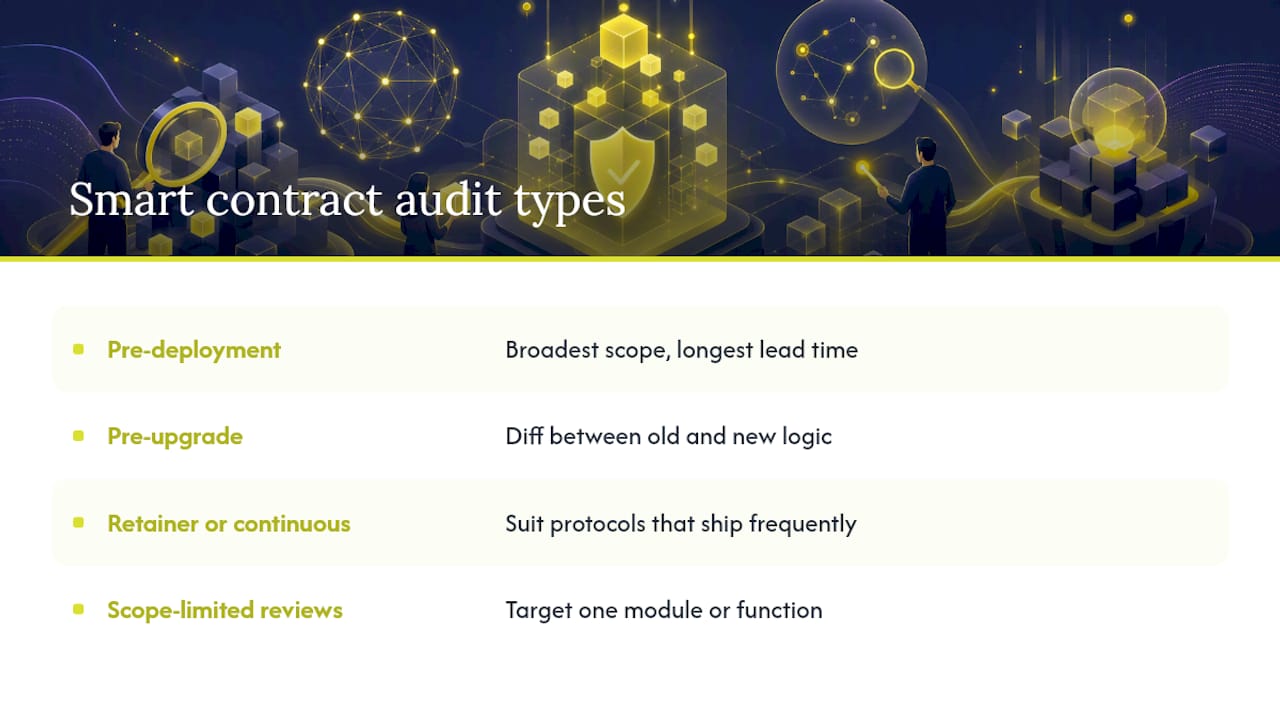
Pre-upgrade audits focus narrowly on the diff between old and new logic, especially for proxy patterns where storage layout mistakes cause real damage.
Retainer or continuous audits suit protocols that ship frequently, trading a flat scope for ongoing coverage.
Scope-limited reviews target one module or function, fast and cheap but blind to everything outside the boundary.
Pro Tip: Match the engagement to what’s actually at risk. A contract holding millions in a vault warrants a full pre-deployment audit; a UI-facing helper contract with no custody role may only need a targeted review.
How Does the Smart Contract Audit Process Work?
Every credible engagement follows roughly the same lifecycle, whether the auditor is a boutique firm or an enterprise shop like ConsenSys Diligence or Trail of Bits.
- Scoping and code freeze. The team locks a commit hash and defines exactly which contracts are in scope.
- Threat modeling and system mapping. Auditors chart asset flows, trust boundaries, and external dependencies like oracles or bridges.
- Automated static analysis. Tools flag known patterns fast, surfacing low-hanging issues before humans spend time on them.
- Fuzzing and property-based testing. Randomized and invariant-driven inputs probe for states manual review might miss.
- Manual line-by-line review. Experienced auditors read the logic against the threat model, since automated tools cannot judge business logic correctness.
- Classification and draft report. Findings get a severity rating, a reproduction case, and a suggested fix.
- Remediation verification and final report. The team patches, the auditor retests, and the report is finalized.
Static analysis, fuzzing, and manual review each catch different bug shapes; no single method covers the full surface, which is why the Chainlink methodology treats them as complementary layers rather than substitutes. Formal verification, where used, targets the small set of invariants that absolutely cannot fail.
Pro Tip: Freeze the code and hand over clean documentation, including a system diagram and known assumptions, before the audit starts. Auditors spending less time reverse-engineering intent translates directly into faster turnaround and fewer clarification cycles.
What Vulnerabilities Do Auditors Look for Most?
Most audit findings fall into a short list of recurring classes, and the SWC Registry and its DASP-era predecessors still frame how firms name and prioritize them.
- Reentrancy — external calls that let an attacker re-enter a function before state updates finish; checked with the checks-effects-interactions pattern.
- Access control gaps — missing or misconfigured permission checks on sensitive functions; verified by mapping every privileged role.
- Oracle manipulation — price feeds that can be skewed within a single transaction; mitigated with time-weighted averages or multiple sources.
- Delegatecall and storage collisions — proxy patterns where upgraded logic misaligns storage slots.
- Integer arithmetic issues — overflow, underflow, or precision loss in financial calculations.
- Upgrade and proxy hazards — uninitialized implementation contracts or unprotected upgrade functions.
- Front-running and MEV exposure — transactions that can be reordered or sandwiched for profit.
- Signature and cryptographic pitfalls — replay attacks or missing nonce checks in signed messages.
A finding’s severity depends less on how exotic the bug is and more on what it touches. A reentrancy bug in a read-only view function is trivia. The same bug in a withdrawal function is a headline.
This taxonomy, drawn from patterns documented in practical audit SOPs, covers most vulnerabilities auditors encounter across EVM chains between 2020 and 2026.
Which Tools Do Auditors Actually Use?
Auditors combine tools because each one only sees part of the picture.
- Slither — static analysis that flags known bug patterns and code smells in seconds.
- Mythril — symbolic execution that explores contract states a static scan would miss.
- Echidna — property-based fuzzing that hammers a contract with randomized inputs to break stated invariants.
- Foundry — a testing framework auditors use to write reproducible proof-of-concept exploits and regression tests.
- Certora and SMTChecker — formal verification engines that mathematically check specific properties hold under all conditions.
Static tools like Slither and Mythril triage fast but miss business logic errors; fuzzers like Echidna find edge cases humans overlook; formal engines prove narrow claims with certainty but don’t scale to an entire codebase. Multi-chain teams also need to account for ecosystem differences: EVM tooling doesn’t transfer directly to Rust-based Solana programs or Cairo contracts on Starknet, each of which has its own analyzer ecosystem.
When Is Formal Verification Worth the Investment?
Formal verification earns its cost when a single invariant failing would be catastrophic: a bridge’s total-supply invariant, a stablecoin’s collateralization ratio, or consensus-level logic where thousands of downstream contracts inherit any flaw.
Provers built around encodings like Cairo-AIR generate certificates showing a compiled program runs to completion under stated assumptions, and a verifier can check that certificate far faster than re-deriving the proof. The catch: soundness and completeness are bounded by how precisely the property gets encoded, and that encoding work is resource-intensive, not a button you press.
Pro Tip: Use formal proofs for the two or three invariants that absolutely cannot break, then layer fuzzing and runtime monitoring around them for everything else. Trying to formally verify an entire protocol usually burns budget faster than it closes risk.
What Should a Smart Contract Audit Report Include?
A report worth paying for reads like a working remediation roadmap, not a wall of jargon.
| Report Section | What It Contains |
|---|---|
| Executive summary | Plain-language overview of scope, risk posture, and headline findings |
| Threat model | Assumptions, trust boundaries, and assets in scope |
| Finding table | Each issue with severity, reproduction steps, and recommended fix |
| Remediation verification | Retest results confirming what changed |
| Out-of-scope notes | What the audit deliberately did not cover |
Remediation status lines matter as much as the findings themselves. Fixed means the retest confirmed the patch works. Partially fixed means the immediate issue is closed but a related risk remains. Not fixed means the team acknowledged the finding but hasn’t shipped a change. Acknowledged means the team accepts the risk without remediation, often for low-severity or low-likelihood issues.
A high-quality report always includes reproducible proof-of-concept cases, a specific commit hash defining scope, and documented retest outcomes, not just a list of vague warnings.
How Much Does a Smart Contract Audit Cost?
Timeline and price scale with complexity, not just lines of code.
- A simple token contract might take one to two weeks and run $5,000 to $15,000.
- A full DeFi protocol with multiple integrations can take a month or more and cost significantly more.
- Multi-chain coverage, formal verification requests, and rushed turnaround all push the price up.
- Remediation assistance and a second retest round add time but usually prevent a costly reaudit later.
Cost tip: documentation, test coverage, and a firm code freeze before kickoff reduce the hours auditors spend just understanding the system, which is often where budgets quietly balloon.
How Do You Apply Audit Feedback After the Review Ends?
An audit report sitting unread in a shared drive protects nobody. The real work starts once findings land.
Triage every finding by severity and assign an owner immediately, even for items marked “acknowledged.” A finding your team accepts today as low-risk might not stay low-risk once total value locked grows tenfold. Revisit acknowledged risks on a schedule, not just at the next audit.
Build regression tests from every proof-of-concept the auditor provided. If a reentrancy bug required a specific call sequence to trigger, that sequence belongs in your permanent test suite so no future refactor reintroduces it silently.

Push static analysis and fuzzing into continuous integration rather than treating them as one-time audit artifacts. Running Slither or Echidna on every pull request catches regressions before they reach a human reviewer, let alone production.
Schedule the remediation verification pass with the same auditor when possible. They already understand the codebase’s context and threat model, which makes a follow-up retest faster and more accurate than starting fresh with a new firm.
Treat the audit as one checkpoint in an ongoing security posture, not a certificate that expires the concern. Pair it with post-deployment monitoring, an incident response plan, and a bug bounty program if the protocol holds meaningful value. Teams that fold audit findings into sprint planning, rather than filing the report away, are the ones that avoid finding the same bug class twice.
What Lessons Come From High-Profile Audit Failures?
Some of DeFi’s largest losses trace back not to the absence of an audit, but to gaps an audit didn’t cover. Bridges have been repeat targets, since they concentrate enormous value in relatively small, complex codebases connecting two different trust models. A single validation flaw in a bridge contract can expose the entire locked reserve.
Several high-profile exploits stemmed from logic that was individually audited but combined with a newly added feature after the fact, outside the original audit’s scope. This is the scope-drift problem: a contract audited in January looks nothing like the contract running in June once governance adds new modules. The SOP guidance on scoping and commit hashes exists precisely because an audit only covers the exact code frozen at that hash, not whatever ships later under the same name.
Oracle manipulation incidents repeatedly show that a contract’s internal logic can be flawless while its external price dependency is the actual weak point, something a narrowly scoped audit can miss if the oracle integration sits outside the defined boundary. Access-control failures, meanwhile, tend to involve a single missed modifier on one function, a reminder that severity doesn’t correlate with complexity. The recurring lesson across incidents: audits reduce risk substantially, they don’t eliminate it, and the gap between “audited” and “safe forever” is exactly where post-deployment monitoring needs to live.
Balancing Audit Depth Against Time to Market
When budgets or timelines get tight, I’d rather see a team formally verify one critical invariant than run a shallow scan across everything. Security works best as an ongoing process, not a one-time checkbox before launch.
Sources
- What a Smart Contract Audit Is, and How to Conduct One | Informa TechTarget
- How To Audit a Smart Contract? – Chainlink
- What Is a Smart Contract Audit? | Hedera
- Smart Contract Audit – CertiK
- Smart Contract Audit SOP (sop-smart-contract-audit.md) — GitHub
- StarkWare / Cairo-AIR verification paper (arXiv)
For ongoing coverage of security incidents and blockchain risk across the industry, Techgaged’s crypto news desk tracks developments like recent wallet security changes and proposed regulation targeting rug pulls and key theft that shape how teams think about audit scope.
FAQ
What Is a Smart Contract Audit?
A smart contract audit is a structured review of blockchain code that combines automated scanning and manual analysis to find vulnerabilities, coding errors, and logic flaws before deployment.
How Much Does a Smart Contract Audit Cost?
Simple token audits often run $5,000 to $15,000 and take one to two weeks; complex protocols with multiple integrations cost more and take longer.
What Is a Smart Audit?
“Smart audit” typically refers to the same process as a smart contract audit: an evidence-based review of contract code and architecture to catch security and correctness issues.
Is Smart Contract Auditing Hard?
It requires specialized skills in blockchain security, static analysis tools, and manual code review, which is why most teams hire dedicated auditors rather than relying solely on in-house developers.
How Long Does an Audit Take?
Simple contracts can be reviewed in one to two weeks, while full protocols with multiple integrations or formal verification requests often take a month or longer.
Recommended
How do you rate this article?
Subscribe to our YouTube channel for crypto market insights and educational videos.






Join our Socials
Briefly, clearly and without noise – get the most important crypto news and market insights first.
Most Read Today
1
Zcash Just Closed Four Security Gaps — This Could Be A Turnaround For ZEC
2Solana’s Latest Record Could Be The Catalyst Nobody Saw Coming
3Ethereum Whale Drops $10.1 Million — Is Something Big Coming?
4Gold-Backed RWAs Are Surging — Here’s Where The Money Is Going
5Sui Is Quietly Building A Bitcoin Powerhouse — The Latest Numbers Tell The Story
Latest





8
Also read
Similar stories you might like.