












Hands adjusting secure crypto compliance device

The Crypto Travel Rule requires virtual asset service providers, or VASPs, and other obliged institutions to collect, verify, transmit, and retain originator and beneficiary data on qualifying virtual-asset transfers. This obligation flows from FATF Recommendation 16, extended to virtual assets in 2019 and tightened further in June 2025. Any exchange, custodial wallet provider, or payment firm handling crypto transfers above a jurisdiction’s threshold needs a functioning Travel Rule program, not just a written policy.
Compliance boils down to five actions:
Latest Stories

Solana ETF Shares Could Soon Go On-Chain — Bitwise Is Exploring A Major Shift

The World’s Largest Sovereign Wealth Fund Is Now Indirectly Exposed To Ethereum: Bullish?

The Next Crypto Investment Wave May Be Bigger Than Bitcoin — Here’s Why
- Collect identifying information on both the sender (originator) and recipient (beneficiary) before or during the transfer.
- Verify that data against KYC records already held on the originator side.
- Transmit the data securely to the receiving VASP using a compatible messaging standard.
- Retain records for the period your jurisdiction’s AML rules require.
- Screen counterparties and transactions against sanctions lists before releasing funds.
Getting operational takes a defined sequence rather than a single policy update. Compliance and engineering teams generally move through this order:
- Identify which transfer flows are in scope (domestic, cross-border, VASP-to-VASP, VASP-to-self-hosted wallet).
- Map internal customer data fields against the required originator/beneficiary fields.
- Choose a messaging approach, typically built on the IVMS101 data model, whether through direct APIs, a relay network, or a protocol like OpenVASP.
- Run a sample end-to-end test covering complete data, missing data, and a sanctions hit before going live.
Pro Tip: Don’t wait for a regulator exam to discover your Travel Rule messaging fails silently when a counterparty VASP uses a different protocol. Build a fallback manual-review queue for failed transmissions before launch, not after.
Key Takeaways
The Travel Rule requires VASPs to collect, verify, transmit, and retain originator and beneficiary data on qualifying virtual-asset transfers, with thresholds and enforcement varying sharply by jurisdiction.
| Point | Details |
|---|---|
| Know your threshold | FATF’s baseline applies a threshold for enhanced data collection commonly near USD/EUR 1,000; the EU applies a zero-threshold standard under Regulation (EU) 2023/1113. |
| Build for missing data | Follow a request, suspend, reject, document sequence, using EBA-style reasonable deadlines as your model. |
| Standardize your messaging | Map data fields to IVMS101 and choose a protocol architecture (direct API, relay, or open standard) before scaling counterparties. |
| Document everything | Examiners expect audit trails covering timestamps, delivery receipts, and exception resolution, not just policy documents. |
| Plan for 2026 to 2030 | FATF’s ongoing consultation signals tiered guidance ahead; monitor FATF, EBA, and FinCEN publications quarterly. |
Compliance leaders should treat a scoped Travel Rule readiness assessment as a near-term priority this quarter, before the next round of FATF guidance narrows the room for interpretation.
If your team is tracking how these obligations intersect with broader market shifts, from stablecoin oversight to exchange expansion into new regions, Techgaged’s ongoing crypto coverage tracks the regulatory and market developments compliance teams need to stay ahead of.
Table of Contents
- What Is the Travel Rule in Crypto and Where Did It Come From?
- Which VASPs and Transfers Fall Under the Travel Rule?
- What Data Must Travel With Every Qualifying Transfer?
- When Does the Travel Rule Apply, and What Happens With Missing Data?
- How Do VASPs Technically Exchange Travel Rule Data?
- What Operational Controls Do Examiners Expect?
- How Does the Travel Rule Differ Across Jurisdictions?
- What Challenges Slow Down Travel Rule Implementation?
- What Regulatory Changes Should Compliance Teams Plan For Through 2026?
- How Do You Build a Travel Rule Compliance Program Step by Step?
- What the Travel Rule Really Tests Isn’t Compliance. It’s Trust Infrastructure
- Where to Find the Primary Travel Rule Rules and Guidance
- Sources
- FAQ
What Is the Travel Rule in Crypto and Where Did It Come From?
The Travel Rule started as a wire-transfer rule, not a crypto rule. FinCEN introduced recordkeeping and transmission requirements for wire transfers in the United States decades before Bitcoin existed, setting a template that required originator and beneficiary information to “travel” with a payment through every institution that touched it.
FATF adopted the same logic into Recommendation 16 for the traditional financial sector, then extended it explicitly to virtual assets in June 2019 through an Interpretive Note that named VASPs as obliged entities for the first time. That single addition turned exchanges, custodial wallet providers, and certain DeFi-adjacent platforms into AML-regulated institutions almost overnight in many jurisdictions.
The policy rationale hasn’t changed much since the wire-transfer era: regulators want payment transparency, sanctions enforcement, and a way to trace funds tied to fraud or terrorist financing without having to unwind an entire blockchain forensically. What has changed is scope and precision. In June 2025, FATF updated Recommendation 16 to standardize the data required in payment messages and set a threshold for enhanced data collection that many jurisdictions use, often around USD/EUR 1,000, asking member countries to prepare implementation plans with a horizon stretching toward 2030.
Timeline at a glance:
- Pre-2012: FinCEN wire-transfer recordkeeping rules establish the “travel” concept in the US.
- 2012: FATF codifies Recommendation 16 for traditional funds transfers.
- 2019: FATF’s Interpretive Note extends R.16 to virtual assets and names VASPs as obliged entities.
- 2023: The EU adopts Regulation (EU) 2023/1113, applying travel-rule obligations to crypto-asset transfers.
- 2024–2025: The EBA finalizes Travel Rule Guidelines; FATF revises R.16 with a standardized USD/EUR 1,000 threshold.
- 2026: FATF opens a public consultation on implementation guidance, with a 2030 readiness signal for members.
Which VASPs and Transfers Fall Under the Travel Rule?
The rule applies whenever a VASP, exchange, custodial wallet provider, or another obliged financial institution is a party to a qualifying transfer. FATF’s baseline framework defines a VASP broadly: any business conducting exchange between virtual assets and fiat, exchange between virtual assets, transfer of virtual assets, safekeeping or administration of virtual assets, or participation in financial services related to an issuer’s offer or sale of a virtual asset.
Four roles matter when mapping obligations:
- Ordering institution: the VASP that initiates the transfer on behalf of the originator.
- Beneficiary institution: the VASP that receives funds on behalf of the recipient.
- Intermediary institution: any VASP that passes the transfer along a chain rather than originating or receiving it.
- Self-hosted (unhosted) wallet: a wallet not controlled by a regulated custodian, which sits outside the direct VASP-to-VASP obligation but often still triggers enhanced due diligence.
A practical scoping checklist looks like this:
- Is a VASP (or another obliged institution) on at least one side of the transfer? If not, the transfer generally falls outside scope.
- Is the transfer non-incidental, meaning it’s a genuine transfer of value rather than an internal ledger movement?
- Does the transfer amount meet or exceed the applicable jurisdictional threshold?
- Is the counterparty a self-hosted wallet, requiring additional verification rather than standard data transmission?
Edge cases generate most of the operational headaches. A transfer between two customers of the same exchange is often exempt because no data needs to “travel” anywhere. A withdrawal to a self-hosted wallet typically still requires the sending VASP to collect and retain originator data, even without a receiving institution to transmit it to. Merchant payment processing and certain card-linked transactions sometimes carry separate exclusions depending on national implementation, so check local guidance before assuming a category is out of scope.
What Data Must Travel With Every Qualifying Transfer?
Regulators expect a defined data set on both sides of a transfer, and the IVMS101 messaging standard has become the de facto reference model for structuring it. IVMS101 gives VASPs a common schema so that data sent by one exchange’s system can be parsed correctly by another’s, regardless of which protocol carries the message.
| Field | Purpose | Example |
|---|---|---|
| Originator full name | Identifies the sender for AML screening | “Maria Torres” |
| Originator account/wallet number | Links the transfer to a specific account | Exchange account ID or wallet address |
| Originator physical address (or date of birth/national ID for individuals) | Confirms identity beyond a name match | “Denver, CO” |
| Beneficiary full name | Identifies the recipient | “James Okafor” |
| Beneficiary account/wallet number | Confirms funds land at the intended destination | Exchange account ID or wallet address |
| Legal entity identifier (LEI) or business registration number | Identifies corporate originators/beneficiaries | LEI code or company registration number |
For legal entities, a business identifier such as an LEI or equivalent registration number substitutes for the date-of-birth field used for individuals. Where national identifiers aren’t available, FATF permits alternative unique identifiers as long as they reliably tie back to a verified customer record.
Pro Tip: Apply data minimization even when regulations don’t explicitly require it. Transmitting only the fields a receiving VASP needs, encrypted in transit and at rest, reduces your breach exposure without weakening your compliance posture.
When Does the Travel Rule Apply, and What Happens With Missing Data?
Thresholds vary sharply by jurisdiction, and that variance is where most cross-border friction originates. FATF’s baseline, following the June 2025 update, sets a USD/EUR 1,000 de minimis for enhanced data requirements on qualifying transfers. The European Union takes a stricter line: Regulation (EU) 2023/1113 applies a zero-threshold standard to crypto-asset transfers involving EU-established providers, meaning even small transfers require full originator and beneficiary data.
Timing matters as much as the threshold itself. The EBA’s Travel Rule Guidelines lay out concrete procedures for what a receiving CASP or PSP should do when required information is missing or incomplete, including risk-based deadlines for requesting the missing fields from the sending institution before deciding whether to process, hold, or reject the transfer.
A workable missing-data decision process runs through four steps:
- Request: Contact the counterparty VASP immediately for the missing field, following the reasonable-deadline window your jurisdiction’s guidance recommends.
- Suspend: Hold the transfer in a pending state rather than releasing funds while the request is outstanding.
- Reject or return: If the data doesn’t arrive within the deadline, or if it’s clearly deficient, return the funds and document the reason.
- Document: Log every step, including timestamps and the specific field gap, for supervisory review.
A common scenario: a beneficiary VASP receives a transfer with a wallet address but no verified name field. Under the EBA’s risk-based approach, the receiving institution should first attempt to obtain the missing name from the ordering institution within a defined window, and only escalate to rejection or enhanced due diligence if that request goes unanswered.
How Do VASPs Technically Exchange Travel Rule Data?
Three architectural patterns dominate current implementations: direct bilateral APIs between VASP pairs, brokered relay networks, and open protocol standards like OpenVASP. None is universally superior. Each trades off setup cost, network reach, and control differently.
- Direct bilateral APIs work well for VASPs with a small, stable set of frequent counterparties, but they don’t scale efficiently once you’re transacting with dozens of unfamiliar institutions.
- Relay networks centralize discovery and message routing through a third-party service, cutting integration overhead but adding a dependency on that relay’s uptime and data-handling practices.
- Open protocols, including OpenVASP-style approaches and messaging platforms like Notabene, standardize the message envelope so any compliant participant can exchange data with any other, which improves interoperability at the cost of requiring broader industry adoption to be useful.
Whichever pattern you choose, engineering teams should build toward a consistent checklist: strong authentication between counterparty systems, encryption for data in transit and at rest, non-repudiation so neither party can later deny sending or receiving a message, and replay protection to stop duplicate transaction submissions. Alignment with ISO 20022 messaging conventions, where feasible, also eases future interoperability with traditional payment rails.
Before production rollout, run a test plan that covers at minimum: a clean transfer with complete data, a transfer with a missing required field, a transfer that triggers a sanctions match, and a transfer to a counterparty VASP using a different messaging protocol than your own.
What Operational Controls Do Examiners Expect?
Regulators don’t just check whether data gets transmitted. They check whether the surrounding compliance infrastructure can prove it happened correctly and consistently. That means onboarding KYC that captures the fields Travel Rule messaging will later need, ongoing customer due diligence rather than a one-time check, sanctions and AML screening run on every qualifying transfer, and retention periods matching your jurisdiction’s AML statute of limitations.
Written policies should cover specific ground rather than general AML language:
- Data governance: who can access originator/beneficiary data, how long it’s retained, and how it’s purged.
- Incident response: what happens if a Travel Rule message is intercepted, corrupted, or misdirected.
- Third-party vendor oversight: due diligence standards for any relay, protocol provider, or messaging vendor handling customer PII on your behalf.
- Escalation procedures: who signs off on suspending or rejecting a transfer over a missing-data dispute.
Audit trails need enough granularity to reconstruct a transaction on request: message timestamps, delivery receipts confirming the counterparty VASP received the data, screening results, and the identity of the staff member who resolved any exception. Canada’s FINTRAC guidance is explicit that VASPs must take “reasonable measures” to obtain missing information and codify that standard in written procedures rather than leaving it to case-by-case judgment.
How Does the Travel Rule Differ Across Jurisdictions?
Global VASPs face a patchwork rather than a single standard, and the differences aren’t cosmetic. A threshold that triggers full data collection in one market might not apply at all in another for the same dollar amount.
| Jurisdiction | Headline requirement | Practical implication |
|---|---|---|
| European Union | Zero-threshold under Regulation (EU) 2023/1113; EBA Guidelines specify missing-data procedures | EU-based VASPs need full data collection on virtually every crypto transfer, with no small-transaction exemption |
| FATF baseline (global) | USD/EUR 1,000 de minimis for enhanced data (2025 revision) | Sets the floor most non-EU jurisdictions reference when drafting local rules |
| United States | Historical BSA wire-transfer recordkeeping precedent; evolving crypto-specific rulemaking | US VASPs should track FinCEN guidance closely as crypto-specific thresholds continue to develop |
| Australia | AUSTRAC requires travel-rule data for non-incidental transfers, with defined missing-data handling | VASPs serving Australian customers need explicit procedures for incomplete-data scenarios, not just a policy statement |
| Canada | FINTRAC mandates name, address, and account/reference numbers with “reasonable measures” to obtain missing data | Codified procedures, not informal judgment calls, are the FINTRAC expectation |
The EU’s zero-threshold approach is the strictest major regime currently in force, and it shapes how many global platforms design their default data-collection flow, since building for the strictest regime and relaxing it regionally is often simpler than maintaining two separate architectures. The historical FinCEN wire threshold gives US compliance teams a reference point for how enforcement treats missing or inaccurate originator data, even as crypto-specific US rulemaking continues to evolve. Regulatory shifts outside these core markets move fast, too. Techgaged’s coverage of China’s tightened crypto transaction scrutiny illustrates how quickly a major market can change its posture, which is exactly the kind of jurisdictional risk multi-market VASPs need to monitor continuously.
What Challenges Slow Down Travel Rule Implementation?
Privacy law friction tops most compliance teams’ list. Transmitting names, addresses, and account numbers across borders can collide with data protection regimes like GDPR, particularly when the receiving VASP sits in a jurisdiction with weaker data-handling standards. Cross-protocol interoperability is the second major pain point: a sending VASP using one messaging standard and a receiving VASP using another often means manual reconciliation or outright transaction delays.

Identifying self-hosted wallet addresses reliably remains technically unsolved in any universal sense; heuristics exist, but none guarantee accuracy. Smaller VASPs face a cost burden disproportionate to their transaction volume, since building or licensing compliant messaging infrastructure carries largely fixed costs regardless of company size. RUSI’s analysis of the FATF consultation process makes this point directly: guidance needs to be workable for lower-capacity jurisdictions and smaller providers, not just tier-one exchanges with dedicated compliance engineering teams.
Mitigations that hold up under supervisory scrutiny generally share a few traits:
- A risk-based approach that applies enhanced scrutiny to higher-risk transfers rather than uniform maximum friction on every transaction.
- Staged rollouts that prioritize your highest-volume counterparty corridors first, rather than attempting simultaneous global coverage.
- Federated relay adoption, which spreads interoperability costs across a shared network instead of forcing every VASP to build bilateral integrations.
- Sandboxed test environments that let you validate message handling with counterparty VASPs before any live customer funds are involved.
Pro Tip: When vetting a Travel Rule vendor or protocol partner, insist on seeing their incident history for failed or misdirected messages, not just their feature list. A vendor’s response time during a real data-handling failure tells you more than any sales deck.
What Regulatory Changes Should Compliance Teams Plan For Through 2026?
FATF’s June 2026 consultation on payment transparency guidance signals that the revised Recommendation 16 is still being operationalized, not finalized in practice. The stated horizon for broader member-country implementation stretches toward 2030, giving compliance teams a multi-year runway, but the direction of travel is clear: standardized data fields, tighter alignment checks, and closer scrutiny of fraud and error handling in payment messages.
RUSI’s commentary on the consultation process is worth taking seriously if your VASP operates in or serves lower-capacity markets. The research argues that guidance needs to remain “fit for purpose” for smaller providers, which suggests future FATF output may include tiered expectations rather than a single uniform standard. That’s a meaningful planning signal: don’t assume the strictest interpretation of every future rule will apply equally to a five-person startup exchange and a multinational custodian.
A practical planning checklist for the next 12 to 18 months:
- Scenario-plan for stricter verification standards on the USD/EUR 1,000 threshold transfers, since enhanced data requirements are already the direction FATF has committed to.
- Run cross-border alignment tests with your major counterparty VASPs to confirm message compatibility survives future protocol updates.
- Increase investment in data governance infrastructure now, since retrofitting retention and access controls under regulatory pressure is more expensive than building them proactively.
- Monitor EBA, FinCEN, and FATF publications on a quarterly cadence rather than annually, given how frequently guidance has shifted since 2023.
How Do You Build a Travel Rule Compliance Program Step by Step?
Reaching genuine compliance, not just policy-on-paper compliance, follows a sequence that spans legal, compliance, engineering, and operations teams working in a defined order.
- Scoping and gap analysis: Legal and compliance jointly map which transfer flows, jurisdictions, and thresholds apply to your specific business model.
- Policy updates: Compliance drafts or revises written procedures covering data governance, missing-data handling, and vendor oversight, with legal sign-off before publication.
- Data mapping: Engineering maps existing KYC and account data fields against the required IVMS101 schema, flagging any gaps that need new data collection at onboarding.
- Protocol selection: Engineering and compliance jointly evaluate messaging approaches (direct API, relay, open protocol) against your counterparty network and cost constraints.
- Integration and testing: Engineering builds the integration and runs a synthetic test plan covering complete transfers, missing-data cases, and simulated sanctions hits before any production traffic touches the system.
- Audits and continuous monitoring: Operations and compliance jointly own ongoing transaction monitoring, periodic internal audits, and readiness for supervisory examination requests.
Ownership matters as much as sequence. Legal typically signs off on interpretation of jurisdictional scope; compliance owns policy content and missing-data escalation rules; engineering owns message integrity, encryption, and test coverage; operations owns day-to-day exception handling once the system is live. A sample test plan worth running before go-live includes at least one synthetic transfer per in-scope flow type, a deliberately incomplete transfer to confirm your missing-data workflow triggers correctly, and one transfer matching a test sanctions entry to confirm screening actually blocks release.
What the Travel Rule Really Tests Isn’t Compliance. It’s Trust Infrastructure
The Travel Rule gets framed almost entirely as a compliance burden, and that framing misses the more interesting story underneath it. What FATF and the EU are actually building, transfer by transfer, is a trust layer for an asset class that was designed, at least rhetorically, to route around exactly that kind of institutional trust infrastructure. That tension doesn’t resolve cleanly, and pretending it does is why so many compliance programs feel bolted on rather than integrated.
The zero-threshold EU approach and the more permissive FATF baseline represent a real philosophical disagreement, not just a technical calibration difference. One camp treats every crypto transfer as inherently higher risk than a bank wire of equivalent size; the other treats crypto as deserving the same threshold-based proportionality that traditional finance has used for years. Multi-jurisdictional VASPs are stuck building for the stricter regime by default, which quietly pushes the EU’s zero-threshold logic into becoming a de facto global standard regardless of what other regulators formally require.
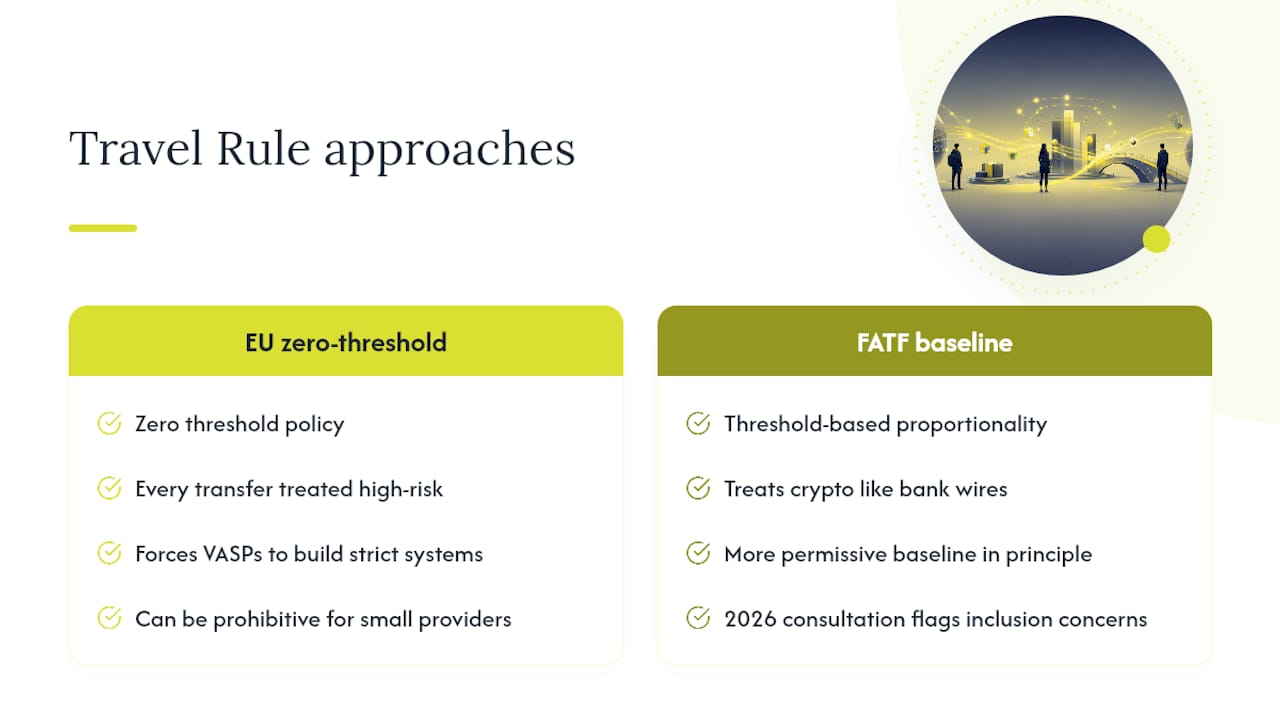
The financial inclusion argument that RUSI and others keep raising in the FATF consultation process deserves more weight than it typically gets in compliance circles. A verification standard calibrated for a well-capitalized exchange in a G20 market can be functionally prohibitive for a smaller provider serving an underbanked region, and that’s not a hypothetical, it’s the explicit concern driving the 2026 consultation. Compliance teams that treat the Travel Rule purely as a checklist to satisfy examiners are missing the part of this story that will actually determine how the rule evolves over the next several years.
Where to Find the Primary Travel Rule Rules and Guidance
- FATF Recommendation 16 update (June 2025): the current global baseline standard and threshold framework.
- Regulation (EU) 2023/1113: the binding EU legal text establishing zero-threshold crypto-asset transfer obligations.
- FinCEN wire-transfer advisory: historical US recordkeeping precedent relevant to enforcement expectations.
- AUSTRAC Travel Rule overview: Australian implementation guidance and missing-data expectations.
- FINTRAC Travel Rule guidance: Canadian requirements for electronic funds and virtual currency transfers.
- FATF’s 2026 consultation announcement: ongoing guidance development compliance teams should track.
These are source documents worth citing directly in internal policies and audit files rather than relying on secondary summaries.
This article is general information, not a substitute for advice from a qualified financial advisor. Consult a qualified financial professional about your own circumstances before acting on anything here.
Sources
FAQ
What Is the Travel Rule in Crypto?
The Crypto Travel Rule requires VASPs to collect, verify, transmit, and retain identifying originator and beneficiary information for qualifying virtual-asset transfers, mirroring the original wire-transfer rule that FATF extended to crypto in 2019.
Does the Travel Rule Apply to Cryptocurrency?
Yes. FATF’s 2019 Interpretive Note explicitly extended Recommendation 16 to virtual assets, and jurisdictions including the EU, the US, Australia, and Canada now enforce crypto-specific Travel Rule obligations on VASPs.
What Are the Limits for Crypto Travel Rule Thresholds?
FATF’s baseline sets a USD/EUR 1,000 de minimis threshold for enhanced data requirements, but the European Union applies a zero-threshold standard to crypto-asset transfers involving EU-established providers, so the actual limit depends on jurisdiction.
Does the 30-Day Rule Apply to Crypto?
The rule typically refers to tax wash-sale style rules in specific countries and is unrelated to the Travel Rule, which governs data transmission on transfers rather than tax treatment of asset sales; check your local tax authority for wash-sale-style guidance separately.
What Happens if a VASP Doesn’t Comply With the Travel Rule?
Non-compliance can trigger regulatory penalties, forced transaction holds, license restrictions, or enforcement action, since regulators including the EBA have published explicit procedures for handling missing or incomplete transfer data that VASPs are expected to follow as a supervisory baseline.
Recommended
How do you rate this article?
Subscribe to our YouTube channel for crypto market insights and educational videos.






Join our Socials
Briefly, clearly and without noise – get the most important crypto news and market insights first.
Most Read Today
1
Quantum Threat to Crypto: What Holders Must Do Now
2Chainlink Holders Hit A Record High — Could Price Finally Catch Up?
3The Next Crypto Investment Wave May Be Bigger Than Bitcoin — Here’s Why
4Solana ETF Shares Could Soon Go On-Chain — Bitwise Is Exploring A Major Shift
5The World’s Largest Sovereign Wealth Fund Is Now Indirectly Exposed To Ethereum: Bullish?
Latest





8
Also read
Similar stories you might like.

Crypto News
Solana ETF Shares Could Soon Go On-Chain — Bitwise Is Exploring A Major Shift
Azeez | 2026-08-15

Crypto News
The World’s Largest Sovereign Wealth Fund Is Now Indirectly Exposed To Ethereum: Bullish?
Azeez | 2026-08-15

Crypto News
The Next Crypto Investment Wave May Be Bigger Than Bitcoin — Here’s Why
Azeez | 2026-08-15

Crypto News
Chainlink Holders Hit A Record High — Could Price Finally Catch Up?
Azeez | 2026-08-15

Security
Quantum Threat to Crypto: What Holders Must Do Now
Rokas | 2026-08-15

Crypto News
XRP Activity Is Surging — But Its User Base Is Telling A Different Story
Azeez | 2026-08-14

Security
Sandwich Attack: How Traders Stop MEV Extraction
Rokas | 2026-08-14

Crypto News
A Historic Bitcoin Supply Squeeze Is Taking Shape: What Comes Next?
Azeez | 2026-08-14

Crypto News
One-Third Of Ethereum Is Now Staked — The Impact Could Be Bigger Than It Looks
Azeez | 2026-08-14

Crypto News
Hyperliquid Removes A Costly Barrier To Its Data: What Could This Mean For HYPE?
Azeez | 2026-08-14