















⚠️ Risk Disclaimer & High-Risk Warning: Trading cryptocurrency derivatives, including perpetual futures and leveraged contracts, involves substantial financial risk and is not suitable for all investors. Applying leverage amplifies both potential profits and potential losses, which can lead to the rapid and total loss of your deposited capital. Content provided on Techgaged is strictly for educational and informational purposes only and should not be construed as financial, investment, or trading advice. Always conduct your own research (DYOR) and consult with a licensed financial advisor before entering high-risk derivative markets.
Perpetual futures are derivative contracts that let traders bet on an asset’s price with no expiration date, held in check by a recurring payment called the funding rate. That single mechanism, funding, is what separates perps from every other derivative on the market. There’s no delivery date, no forced rollover, and no settlement day to plan around.
A few things matter before you place a single trade. First, perpetual contracts can be held indefinitely, but every few hours longs and shorts exchange a funding payment that pulls the contract price back toward the spot market. Second, this design has made perps the dominant instrument in crypto derivatives, with daily trading volumes exceeding $100 billion across major exchanges. Third, the idea isn’t new: economist Robert Shiller floated the concept of a perpetual claim in the early 1990s, and it took a crypto developer named Alexey Bragin, working with the exchange BitMEX, to actually build one that traders could use.
Latest Stories

Chainlink Demonstrates Cross-Chain Dividends — Tokenized Shares Need More Than Transfers

Ethereum’s zkAPI Separates AI Billing From Identity — Prompt Privacy Still Has Limits

Ethereum Researchers Explore Rules That Could Reject a Bad Transaction Outcome
Here’s what that means in practice:
- No expiry, no rollover. You can hold a perpetual futures position for years without ever closing it out for a new contract month.
- Funding replaces convergence. Instead of price and spot meeting naturally at expiration, a periodic payment between longs and shorts keeps the two aligned.
- Leverage is the draw and the danger. Perps typically allow far higher leverage than spot trading, which is why liquidation risk is the first thing every new trader needs to understand.
- Regulatory status varies by market. The CFTC has noted the structure works best for assets with continuous, deep liquidity, and legality depends heavily on jurisdiction and whether the offering platform is regulated.
Key Takeaways
Perpetual futures combine indefinite duration with a funding-rate mechanism that anchors contract price to spot, making leverage management and funding-cost tracking the two most critical skills for any trader.
| Point | Details |
|---|---|
| Funding rate is the core mechanism | Periodic payments between longs and shorts pull perpetual price back toward the spot index. |
| Mark price triggers liquidation | Exchanges use a smoothed mark price, not last trade price, to calculate your liquidation point. |
| Leverage cuts both ways | Higher leverage narrows the price move needed to wipe out your margin entirely. |
| Contract type shapes your exposure | Linear contracts settle in stablecoins; inverse contracts settle in the underlying crypto asset. |
| Check funding history before holding long term | A position held through weeks of positive funding can lose value even if price moves in your favor. |
Where to Read More on Perpetual Futures
- Cornell’s analysis of perpetual futures and cryptocurrency breaks down market sizing and why perps came to dominate crypto derivatives volume.
- The CFTC’s one-pager on perpetual contracts offers the clearest regulatory framing of product suitability and oversight considerations.
- Academic research on perpetual futures fundamentals works through the pricing theory behind no-arbitrage limits and documents real-world spot deviations.
- The iShares explainer on perpetual futures covers the mechanics from a traditional asset-manager’s perspective, useful for comparing perps to conventional derivatives.
- Coinbase’s perpetual futures guide walks through exchange-level mechanics including funding calculation and mark price use in practice.
- The Wikipedia entry on perpetual futures documents the historical timeline from Shiller’s original proposal through Bragin’s crypto adaptation and BitMEX’s 2016 launch.
For ongoing coverage of how perpetual futures activity shifts alongside broader market trends, including Bitcoin derivatives volume swings that often precede major price moves, Techgaged tracks these developments as they happen.
This article is general information, not a substitute for advice from a qualified financial advisor. Consult a qualified financial professional about your own circumstances before acting on anything here.
Table of Contents
- What Are Perpetual Futures and How Do They Work?
- Linear vs. Inverse Contracts: Picking the Right Structure
- Key Terms Every Perpetual Futures Trader Needs to Know
- What Are the Risks of Trading Perpetual Futures?
- How Perpetual Futures Differ from Traditional Futures
- Why Perpetual Futures Dominate Crypto Derivatives Trading
- How to Open and Manage a Perpetual Futures Position
- The Data Behind Perpetual Futures: Volume, Funding, and Regulatory Context
- Sources
What Are Perpetual Futures and How Do They Work?
The funding rate is the engine that makes a perpetual contract behave like the underlying asset without ever expiring. Every funding interval, typically every eight hours on most exchanges, traders on one side of the market pay traders on the other. When the perpetual contract trades above the spot price, longs pay shorts. When it trades below spot, shorts pay longs. That payment flow creates a financial incentive to push the derivative price back toward its reference asset.

This isn’t a fee collected by the exchange. It’s a peer-to-peer transfer between traders holding opposite positions, and it’s calculated based on the size of your position, not your account balance.
Two other prices matter just as much as funding: mark price and index price. The index price is usually a weighted average of spot prices from several major exchanges, built to resist manipulation on any single venue. The mark price is a smoothed version of that index, often blended with the perpetual’s own order book, and it’s what exchanges actually use to calculate your unrealized profit and loss and, critically, your liquidation point. Coinbase’s own explainer walks through how mark price protects against a temporary price spike on one exchange triggering unnecessary liquidations across the platform.
Here’s a simplified numeric example. Suppose you hold a long position on a perpetual contract, and the funding rate for that period is a small fraction of your position size. You would pay a proportionate amount to the short side of the market at that funding interval. Annualized, these repeated funding payments can add up to a significant cost for holding a long position during periods of persistently positive funding.
During periods of extreme bullish sentiment, funding rates can spike well beyond typical ranges, which is why long-term holders sometimes bleed value even while the underlying asset is technically rising. There’s also no guarantee that a perpetual’s price converges neatly with spot at any particular moment. Academic analysis of perpetual futures pricing shows that deriving a no-arbitrage price for a contract with no fixed maturity is mathematically harder than for dated futures, and real-world deviations between perp and spot prices in crypto markets have at times been sizable.
Linear vs. Inverse Contracts: Picking the Right Structure
Not all perpetual futures are built the same way, and the difference changes how your profit and loss actually behaves.
Linear contracts, usually margined in a stablecoin like USDT or USDC, are the more intuitive option for most traders. Your collateral and your P&L are both denominated in dollars, so a $500 gain on a Bitcoin perp shows up as $500 in your stablecoin balance. Inverse contracts, often called coin-margined, use the underlying cryptocurrency itself as collateral. If you’re trading a Bitcoin inverse perpetual, your margin and your gains are denominated in BTC, which means your dollar-equivalent P&L moves nonlinearly as Bitcoin’s price changes.
Typical specs across major exchanges look like this:
- Funding cadence: most commonly every 8 hours, though some platforms have moved to more frequent 1-hour or 4-hour schedules.
- Maintenance margin: the minimum equity required to keep a position open, usually a small percentage of notional value.
- Initial margin: the amount required to open the position, directly tied to your chosen leverage.
- Max leverage: ranges widely, from conservative 10x caps on some regulated platforms to 100x or higher on offshore exchanges.
- Tick and lot sizes: vary by asset and exchange, and they determine your minimum price increment and order size.
Pro Tip: If you’re already holding spot Bitcoin and want to hedge without touching your stack, an inverse contract lets you keep your collateral in the same asset you’re hedging. If you’d rather isolate your trading capital from crypto price swings entirely, a stablecoin-margined linear contract keeps your margin value steady regardless of what the underlying does.
Key Terms Every Perpetual Futures Trader Needs to Know
Reading an exchange’s trading screen without knowing this vocabulary is how new traders get liquidated by surprise. Here’s the shortlist that actually matters day to day.
| Term | What It Means |
|---|---|
| Funding rate | Periodic payment between longs and shorts that anchors perp price to spot. |
| Basis | The gap between perpetual price and index price, expressed as a premium or discount. |
| Mark price | Smoothed reference price used for P&L and liquidation calculations. |
| Index price | Weighted average of spot prices across multiple exchanges. |
| Initial margin | Capital required to open a leveraged position. |
| Maintenance margin | Minimum equity needed to avoid liquidation. |
| Notional exposure | Total value of the position, calculated as size multiplied by price. |
| Liquidation price | The mark price at which your position is automatically closed. |
| Insurance fund | Exchange-held reserve that covers losses when liquidations can’t be filled at the expected price. |
| Auto-deleveraging (ADL) | Forced closure of profitable opposite positions when the insurance fund is insufficient. |
The distinction between mark price and last-traded price trips up more beginners than almost anything else. Your liquidation is triggered by mark price movement, not by the last price shown in the order book, specifically so a single thin trade on a low-liquidity order book can’t wipe out your position unfairly.
What Are the Risks of Trading Perpetual Futures?
Leverage is the first risk anyone mentions, and for good reason. A 20x leveraged position moves your account balance 20 times faster than the underlying asset, which means a 5% adverse move against you can wipe out your entire margin. That’s liquidation, and it happens automatically once your mark price crosses your maintenance threshold, with no negotiation and often no warning beyond an exchange notification.
Funding rate drain is the quieter risk, and it punishes patience rather than recklessness. Holding a long position through a sustained period of positive funding, common during strong bull runs, can cost you double-digit annualized percentages even if the price barely moves in your favor.
Beyond your own position, there’s venue risk to consider:
- Exchange solvency and custody risk. Your collateral sits with the exchange, not in your own wallet, unless you’re trading on a decentralized platform.
- Insurance fund depletion. During extreme volatility, if losses outpace what the insurance fund can absorb, the exchange resorts to auto-deleveraging, force-closing profitable positions on the other side of the trade to cover the gap.
- Liquidity concentration. A handful of exchanges handle the bulk of perpetual futures volume, meaning a problem at one venue can ripple through the wider market’s price discovery.
- Cascading liquidations. Because perps are leveraged, a sharp move can trigger a chain reaction where forced liquidations push price further, triggering more liquidations.
Practical mitigation isn’t complicated, but it requires discipline. Size positions so a single liquidation doesn’t meaningfully damage your account. Choose leverage conservatively, well below the exchange maximum, and keep a margin buffer above the minimum maintenance requirement rather than running your account at the edge. Placing a stop-loss well before your liquidation price gives you an exit on your own terms instead of the exchange’s.
Pro Tip: Before opening a position you plan to hold for more than a few days, check the funding rate’s recent history rather than just the current number. Multiply the average rate by the number of funding periods you expect to hold through, and treat that as a real cost of the trade, the same way you’d account for a spread or a commission.
How Perpetual Futures Differ from Traditional Futures
Traditional futures contracts expire on a fixed date and settle either in cash or physical delivery. That forces a decision: close the position, take delivery, or roll it into the next contract month, each of which introduces its own transaction cost and basis risk as the old and new contracts trade at different prices.
| Feature | Perpetual Futures | Traditional (Dated) Futures |
|---|---|---|
| Expiration | None | Fixed date, monthly or quarterly |
| Price alignment | Funding rate payments | Natural convergence at expiry |
| Rollover required | No | Yes. To maintain exposure |
| Trading hours | 24/7 in crypto markets | Often limited to exchange hours |
| Liquidity structure | Concentrated in one contract | Split across multiple expiry months |
That last row matters more than it looks. Traditional futures split trading interest across several contract months, thinning out liquidity in any single one. Perpetuals concentrate every trader, every horizon, into one contract, which is a large part of why crypto perps built the deep order books they have today.
Why Perpetual Futures Dominate Crypto Derivatives Trading
The scale here is hard to overstate. Cornell’s analysis of the crypto derivatives market found daily trading volume in perpetual futures regularly exceeds $100 billion, dwarfing spot trading volume on many days. That dominance didn’t happen by accident.
Crypto markets never close, and perpetuals were built for exactly that kind of market. Removing a fixed expiration date means no forced rollover events, no scheduled liquidity gaps around settlement, and no need to coordinate trading around exchange hours the way commodity or equity futures traders do.
There’s a structural split worth understanding between centralized and decentralized venues:
- Centralized exchanges (CEX) hold custody of your collateral, offer deep order books, and typically provide the highest available leverage and the tightest spreads.
- Decentralized exchanges (DEX) let you retain custody of your funds through a connected wallet, settle trades on-chain or through a hybrid order book, and have grown rapidly as wallet providers integrate perpetual trading directly into their existing products.
The custody trade-off is real. CEX platforms offer convenience and liquidity at the cost of counterparty risk, since your funds sit under someone else’s control. DEX platforms hand that control back to you but often come with thinner order books and higher slippage on large trades.
How to Open and Manage a Perpetual Futures Position
Getting started with perpetual futures trading rewards preparation far more than instinct. Here’s a sequence worth following before you commit real capital.
- Pick your reference market and contract type. Decide whether you want stablecoin-margined exposure or coin-margined exposure based on what you’re already holding.
- Check the funding rate history. A contract with consistently high positive funding tells you the market is crowded with longs, which raises your cost of carry.
- Set your leverage before you set your size. Lower leverage first, then calculate the position size that fits your risk tolerance, rather than maximizing size and letting leverage fall wherever it lands.
- Calculate your liquidation price. Most exchange interfaces show this before you confirm the order. Know the exact percentage move that would wipe you out.
- Choose your order type. A limit order gives you price control; a market order guarantees execution but can suffer slippage during volatile moments.
- Place a stop-loss immediately after entry. Set it comfortably above your liquidation price so a stop-loss triggers on your terms, not the exchange’s.
Once the position is live, management is ongoing rather than a one-time task:
- Track funding payments against your position size at each interval, not just at the end of the week.
- Rebalance leverage if the position moves meaningfully in your favor, locking in a lower liquidation risk.
- Consider partial closes at predetermined profit targets rather than holding for an all-or-nothing exit.
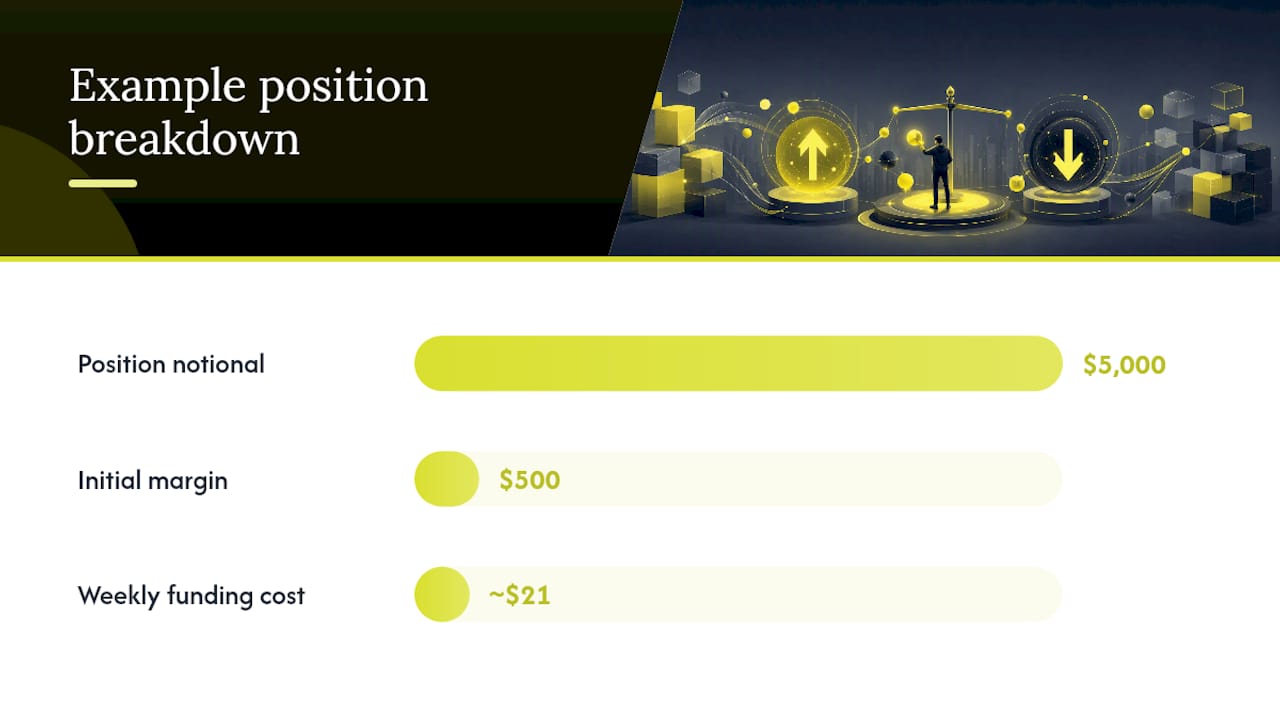
A quick example: you open a $5,000 long position on a linear Bitcoin perpetual at 10x leverage, meaning $500 of your own margin controls the full notional. If Bitcoin drops roughly 9 to 10% against you, your maintenance margin is breached and the position liquidates, wiping out your $500. Meanwhile, if the funding rate averages 0.02% per 8-hour period over a week you hold the position, that’s 21 payments totaling roughly 0.42% of your notional, about $21, paid out of your position’s value regardless of price direction.
Pro Tip: Run a weekly risk audit on any open perpetual position: recheck your liquidation price against current volatility, confirm your funding cost hasn’t crept above what you budgeted, and reassess whether the trade thesis still holds. Persistently negative funding on a contract you’re short, or positive funding on one you’re long, can actually be read as a timing signal for carry trades if the basis is wide enough to justify the risk.
From Shiller’s Idea to BitMEX and Beyond
The theoretical foundation for perpetual futures predates crypto entirely. Economist Robert Shiller proposed the concept in the early 1990s as a way to create tradable claims on assets or indices that lacked a natural futures market, illiquid real estate indices, for instance, where a traditional dated futures contract never found traction.
- Shiller’s original proposal focused on non-crypto use cases and never saw widespread real-world adoption in traditional finance.
- Developer Alexey Bragin adapted the idea for crypto around 2011, building an inverse perpetual swap structure suited to Bitcoin’s volatility and lack of a centralized reference market.
- BitMEX launched its perpetual swap product in 2016, popularizing the format and cementing the funding-rate mechanism as the industry standard.
- Since then, the model has expanded into decentralized finance, with on-chain perpetual exchanges and wallet-integrated trading extending the format beyond centralized order books entirely.
The Data Behind Perpetual Futures: Volume, Funding, and Regulatory Context
The numbers back up the claim that perpetuals aren’t a niche product. Daily trading volume in crypto perpetual futures regularly tops $100 billion, a scale that puts the instrument ahead of spot trading on many major exchanges during active market periods.
| Metric | Typical Range or Behavior |
|---|---|
| Daily crypto perp volume | Exceeds $100 billion on active trading days |
| Standard funding cadence | Every 8 hours (some venues use 1 to 4 hour intervals) |
| Typical funding rate range | Roughly -— to — per interval in calm markets |
| Extreme funding rate spikes | Can exceed 0.1% per interval during high volatility |
On the theoretical side, research on perpetual futures pricing found that no-arbitrage bounds are harder to establish for a contract without a maturity date, and that observed deviations between perpetual and spot prices have historically been larger in crypto markets than in comparable traditional currency markets, though this gap has narrowed as trading infrastructure matured and liquidity deepened.
On the regulatory side, the CFTC’s guidance makes a specific and important point: perpetual contract design works best for assets with deep, continuous, 24/7 liquidity, and it explicitly isn’t a one-size-fits-all product suited to every asset class. Whether perpetual futures are legal to trade depends entirely on your jurisdiction and whether the platform offering them operates under regulatory oversight. In the United States, retail access to crypto perpetual futures has been limited on many popular offshore platforms, and traders should confirm a platform’s registration status before depositing funds, since operating without proper licensing carries legal exposure for both the platform and, in some cases, the trader.
When Perpetual Futures Make Sense, and When They Don’t
Perpetual futures reward traders who treat funding rate as a cost of doing business, not an afterthought. The traders who get burned aren’t usually the ones who misunderstand leverage, most people grasp that 20x leverage is risky in the abstract.
The honest answer on when perps make sense: they’re a strong fit for short-term directional bets, hedging an existing spot position without selling it, and basis trades between perp and spot pricing. They’re a poor fit for buy-and-hold conviction plays, where the funding drag on a multi-month position can rival or exceed the gains from being right about direction. Spot exposure or a longer-dated option often serves that second use case better.
The mistake Techgaged sees most often isn’t reckless leverage. They see traders who never look at the funding rate chart before entering, then act surprised when a “correct” directional call still loses money to carrying costs. If you’re new to this, paper-trade on a demo account through at least two full funding cycles before risking real capital, and track your hypothetical funding costs alongside your hypothetical P&L. That habit alone filters out a large share of the mistakes that sink new perpetual futures traders.
Sources
- Perpetual Futures Contracts and Cryptocurrency
- Perps – One Pager (CFTC)
- Fundamentals of Perpetual Futures (arXiv)
- What Are Perpetual Futures? | Coinbase
Recommended
How do you rate this article?
Subscribe to our YouTube channel for crypto market insights and educational videos.






Join our Socials
Briefly, clearly and without noise – get the most important crypto news and market insights first.

Most Read Today
1
XRP Ledger RWA Transfer Volume Hits $7.03B — Up 1,469% in 30 Days
2Cardano DEX Volume Jumps 143% in a Week as DeFi TVL Rebounds
3Fidelity Treasury Exposure Goes Onchain Through Singapore-Licensed DigiFT
4Rain Files for a U.S. National Trust Bank Focused on Stablecoin Infrastructure
5XRPL Stablecoin Supply Hits $1.31B as RLUSD Captures 93% of the Market
Latest





8
Also read
Similar stories you might like.