



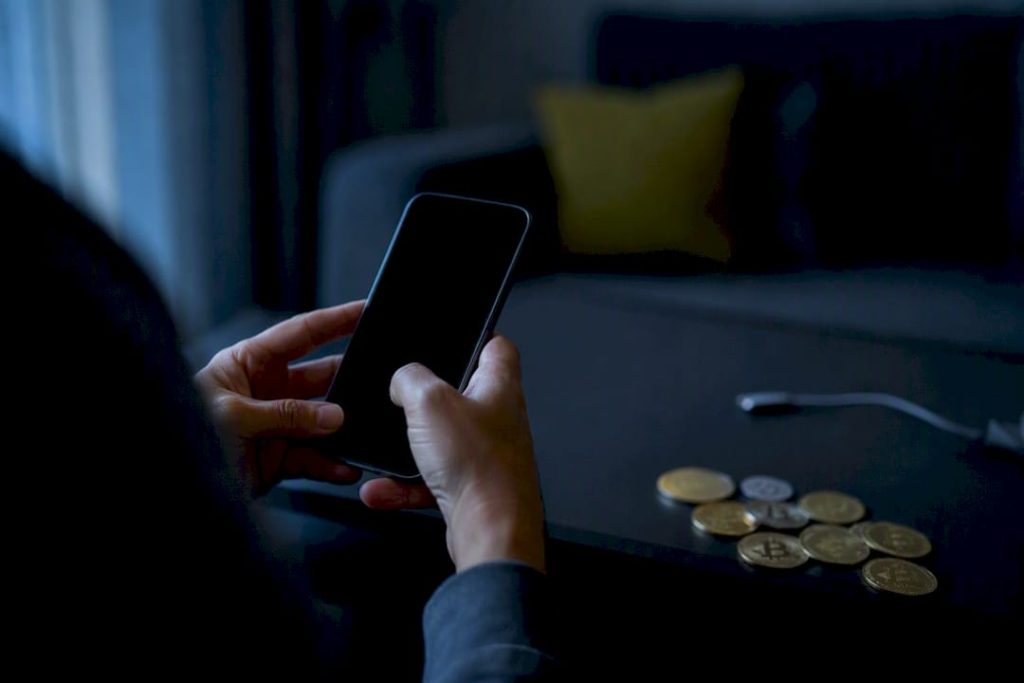
Hands holding smartphone with crypto tokens nearby

A rug pull is a crypto exit scam where project developers drain liquidity, disable selling, or simply vanish with investor funds, leaving token holders with something worthless. If you suspect one is happening to a token you hold, speed determines whether you have any recovery options at all.
Act in this order:
Latest Stories
Ethereum Was At Peak Fear Just Before The Market Turned
One Bitcoin Trend Is Beginning To Look Strikingly Familiar
Hyperliquid to the U.S. — What Does CZ Really See?
- Stop trading immediately. Don’t buy more to “average down” or panic sell into a dead pool.
- Snapshot everything. Save the contract address, transaction hashes, and screenshots of the liquidity pool before the project’s website or social channels disappear.
- Revoke token approvals tied to that contract, then move unaffected assets to a fresh wallet.
- Check if funds moved to a centralized exchange. If so, contact that exchange’s support team immediately with transaction hashes.
Pro Tip: Screenshot the block explorer page the moment you notice something wrong. Rug pull websites and social accounts often disappear within hours, and that evidence is what investigators and exchanges need to act.
Recovery is uncommon once funds leave traceable wallets, but the FBI’s Internet Crime Complaint Center notes that fast, detailed reports with transaction hashes and timelines materially improve the odds of action from law enforcement and exchanges.
Key Takeaways
Rug pulls succeed by combining fabricated trust with a timed exit, so verifying contract ownership and liquidity locks before you buy is the single most effective defense.
| Point | Details |
|---|---|
| Check ownership first | Confirm renounceOwnership status and admin functions before trusting any contract. |
| Watch holder concentration | A handful of wallets holding most of the supply signals dump risk. |
| Move fast if rugged | Report to IC3 with transaction hashes and contact exchanges immediately if funds moved there. |
| Avoid fake recovery services | Only use official reporting channels; paid “recovery” offers are typically a second scam. |
For ongoing coverage of market manipulation, regulatory responses, and emerging token risks, TechGaged tracks developments like the rise in altcoin search interest that often precedes speculative token launches, and broader market cycle analysis worth reading before you chase the next memecoin spike.
Table of Contents
- Types of Rug Pulls and the Tactics Behind Them
- How Do Rug Pulls Actually Work On-Chain?
- What Red Flags Signal a Possible Rug Pull?
- How Do You Check If a Token Is a Rug Pull?
- What Should You Do Immediately After Getting Rug Pulled?
- How Can You Avoid Rug Pulls Before You Invest?
- How Do Authorities Handle Rug Pull Reports?
- Useful Resources for Verifying and Reporting Rug Pulls
- Sources
- FAQ
Types of Rug Pulls and the Tactics Behind Them
Not every rug pull looks the same. Recognizing the pattern matters more than memorizing a single definition, because scammers reuse a handful of structural playbooks.
- Hard rug pull: The token contract itself contains malicious code, like a hidden function that lets the deployer mint unlimited tokens or drain the liquidity pool outright.
- Soft rug pull: No malicious code required. The team simply holds a massive token allocation and dumps it gradually, tanking the price while looking “legitimate” on-chain.
- Liquidity pull: Developers withdraw the paired assets (often ETH or BNB) from the liquidity pool, instantly collapsing the token’s tradable value.
- Honeypot: Buyers can purchase the token but the contract blocks or taxes sells at 100%, trapping funds by design.
- Phantom team: Founders use stock photos, fake LinkedIn profiles, or stolen identities, then disappear once funds are collected.
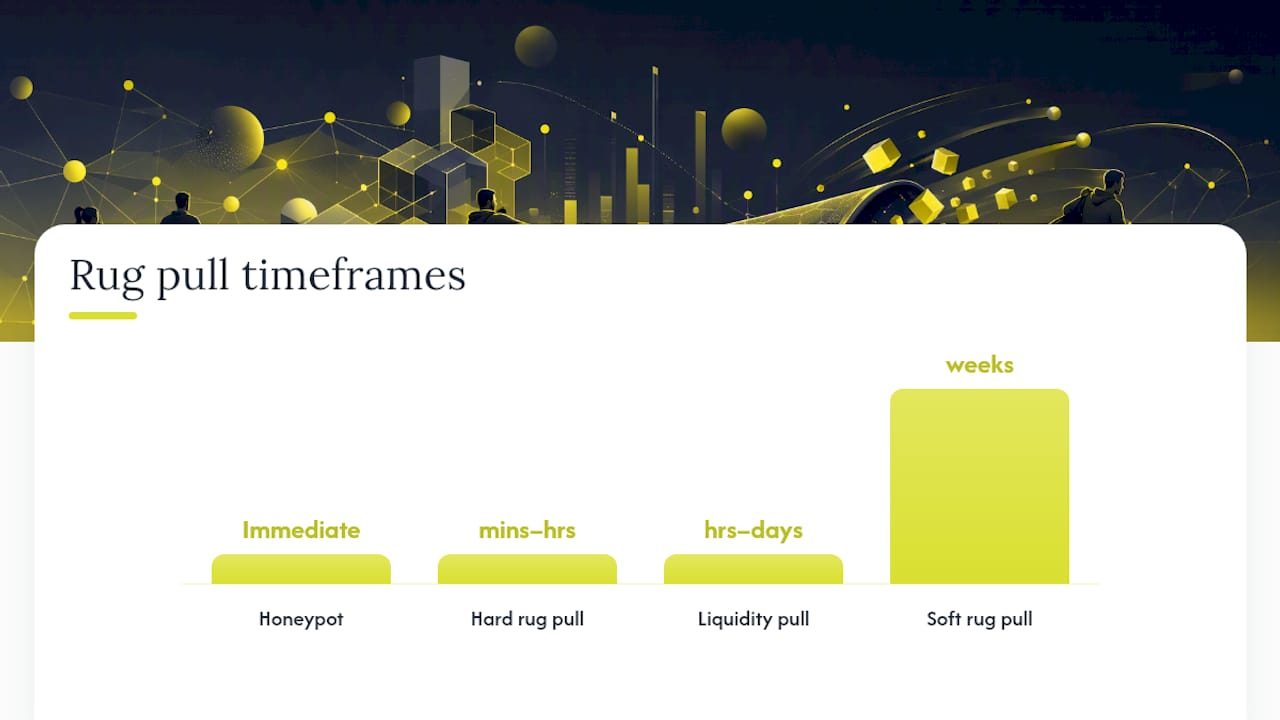
Hard rug pulls and liquidity pulls tend to happen fast, often within hours or days of launch. Soft rug pulls unfold over weeks as insiders quietly offload holdings. Coinbase’s breakdown of these categories is a useful reference point when you’re trying to classify what just happened to a token.
| Type | Typical timeframe |
|---|---|
| Hard rug pull | Minutes to hours after launch |
| Liquidity pull | Hours to a few days |
| Soft rug pull | Weeks, as insiders offload gradually |
| Honeypot | Immediate, on first sell attempt |
How Do Rug Pulls Actually Work On-Chain?
Every rug pull exploits the same underlying feature: someone retains privileged control over a contract or its liquidity, and buyers don’t realize it until it’s too late.
Liquidity pools work by pairing a new token with an established asset like ETH, held in a smart contract that facilitates trading. Whoever controls the liquidity provider (LP) tokens for that pool can withdraw the paired assets at any time, unless those LP tokens are locked or burned. A contract’s “owner” address often retains admin privileges, too, things like the ability to mint new tokens, freeze trading, or blacklist wallets. Developers are supposed to call renounceOwnership to give up that control, but plenty never do, or they quietly redeploy a backup contract with the same privileges.
Some contracts hide a mint function that lets the owner inflate supply and dump it on unsuspecting buyers. Others impose transfer restrictions that let the deployer buy freely but block everyone else from selling, the classic honeypot setup.
A locked liquidity pool sounds reassuring, but a project can still get rugged if the contract owner retains a privileged key that bypasses the lock entirely.
Security audits check for known vulnerability patterns, but they don’t guarantee a team won’t rug their own project after passing review. Audits examine code, not intent.
Pro Tip: Never trust “audited” as a synonym for “safe.” Ask which firm performed the audit, read the actual report, and check whether it covers the exact contract address currently deployed.
What Red Flags Signal a Possible Rug Pull?
Most rug pulls broadcast warning signs before the collapse. The trouble is that hype drowns them out. Run through this in under sixty seconds before you commit any capital:
- Search the team’s names and photos. Do real profiles, prior projects, or public appearances exist?
- Open the contract on a block explorer and check if it’s verified.
- Look at token holder distribution. Is one wallet holding more than 50%?
- Check whether liquidity is locked, and for how long.
- Look for any large, recent transfers out of the liquidity pool or team wallets.
Beyond that quick scan, watch for these recurring crypto scam red flags:
- Anonymous or unverifiable founders with no track record.
- Promises of guaranteed or unrealistic yields (anything advertising fixed triple-digit APY should trigger suspicion).
- Heavy influencer promotion with little substantive product discussion.
- Constant pressure language: “buy now before it’s too late,” countdown timers, artificial scarcity.
- A contract that isn’t verified or an audit that doesn’t match the deployed code.
Pro Tip: Never approve unlimited token allowances. Start with a small test buy and a small test sell before committing real capital, and treat any wallet approval prompt the way you’d treat handing someone your password.
How Do You Check If a Token Is a Rug Pull?
A thorough check takes about ten minutes and follows a consistent sequence:
- Locate the token’s contract address from the project’s official site or the DEX listing.
- Open that address on a block explorer and confirm the source code is verified.
- Review the holder distribution chart. A handful of wallets controlling most of the supply is a serious warning sign.
- Examine liquidity pool deposits and withdrawals for unusual patterns, especially recent large removals.
- Search the contract for
renounceOwnershipstatus and any active admin or minting functions. - Trace large outgoing transactions from the deployer or team wallets.
Several tools make this workflow faster:
- Etherscan and BscScan remain the standard block explorers for Ethereum and BNB Chain contracts, showing verified code, holder lists, and transaction history.
- DEX aggregator explorers display liquidity pool depth and recent trading activity in real time.
- Token-sniffer-style scanners flag common honeypot and mint-function patterns automatically, though they shouldn’t replace manual review.
- Revoke.cash lets you see and cancel active token approvals tied to your wallet.
| Check | Where to look | What it tells you |
|---|---|---|
| Verified source code | Etherscan/BscScan contract tab | Whether the code matches what’s claimed |
| Holder concentration | Token holders chart | Risk of a coordinated dump |
| Liquidity status | DEX pool page | Whether liquidity is locked or withdrawable |
| Owner privileges | Contract read functions | Whether admin control was renounced |
When something looks off, screenshot the contract page, the holder chart, and any LP withdrawal event, then save transaction hashes as plain text alongside the images.

What Should You Do Immediately After Getting Rug Pulled?
Once you’ve confirmed a rug pull, your priority shifts from prevention to damage control and documentation.
- Move any unaffected assets to a new wallet and revoke lingering approvals tied to the compromised contract.
- Export timestamped screenshots and CSV transaction histories before any relevant pages go offline.
- Record every transaction hash, wallet address, and piece of promotional material (Telegram messages, tweets, website archives).
- File a report with the IC3, including hashes and a clear timeline, and check for a national cybercrime unit if you’re outside the U.S.
- If funds moved through a centralized exchange, contact that exchange’s compliance team right away.
Victims lost an estimated $6 billion to DeFi exit scams and memecoin rug pulls in 2025 alone. Recovery is rare once funds sit in wallets that never touch a cooperating exchange, but reporting quickly with traceable hops through a centralized platform meaningfully improves the odds of a freeze before cash-out.
How Can You Avoid Rug Pulls Before You Invest?
Durable protection comes from habits, not one-time checks. Build these into every token evaluation:
- Verify the team’s identity through independent sources, not just what the project’s own site claims.
- Read the actual audit report, not just the badge, and confirm it covers the live contract address.
- Confirm liquidity is locked, check the lock duration, and verify who controls the lock.
- Review token allocation and vesting schedules for outsized insider holdings.
- Check for genuine open-source development activity and active, organic community discussion rather than bot-driven hype.
At the portfolio level, size memecoin and low-cap positions as money you can afford to lose entirely, use a hardware wallet for anything beyond small experimental amounts, and spread exposure across protocols with different risk profiles instead of concentrating in speculative new launches.
Pro Tip: Treat approvals like passwords. Grant limited allowances instead of unlimited ones, and revoke them the moment you’re done interacting with a contract.
How Do Authorities Handle Rug Pull Reports?
Agencies can trace funds and, in some cases, prosecute operators, but recovering your actual money is a separate and much harder problem.
In the U.S., the IC3 is the standard first stop, and the Department of Justice has pursued cross-border crypto fraud cases when investigators can identify and locate operators. A useful report includes transaction hashes, wallet addresses, a clear timeline, and any team communications you saved.
| What law enforcement can do | What it usually cannot do |
|---|---|
| Trace on-chain fund movement | Guarantee fund recovery |
| Pursue identified operators | Reach anonymous, offshore developers |
| Coordinate with cooperating exchanges | Force uncooperative foreign exchanges to act |
Never pay a third party promising guaranteed “recovery” of stolen crypto. That’s almost always a second scam layered on the first. Stick to official channels, and stay current on regulatory responses like New York’s proposed rug pull legislation.
Why Vigilance Beats Confidence in Crypto
Experienced investors fall for rug pulls too, usually because a project checked enough boxes to feel safe. That’s exactly how phantom teams and honeypots survive. Repeated skepticism, not one-time due diligence, is what actually protects your capital. Follow on-chain analytics and trusted reporting from outlets like Techgaged to catch early signals before the crowd does.
Useful Resources for Verifying and Reporting Rug Pulls
Keep these bookmarked before you ever click “connect wallet” on a new token:
- Etherscan and BscScan for contract verification, holder charts, and transaction history.
- Revoke.cash for reviewing and canceling token approvals tied to your wallet.
- IC3.gov for filing official fraud reports with transaction hashes and timelines.
- Chainalysis research for broader on-chain manipulation trends and deployer-based rug detection.
Save every screenshot and transaction hash before a project’s site or social accounts disappear.
This article is general information, not a substitute for advice from a qualified financial advisor. Consult a qualified financial professional about your own circumstances before acting on anything here.
Sources
- Exit scam — Wikipedia
- What is a rug pull and how to avoid it? | Coinbase
- Cryptosafety
- 2025 IC3 Annual Report | FBI IC3
FAQ
How Do I Check If a Coin Is a Rug Pull?
Check the contract on a block explorer like Etherscan or BscScan for verified code, review holder concentration, confirm whether liquidity is locked, and look for active admin or minting functions tied to the owner address.
What Is a Rug Pull in Crypto?
A rug pull is a crypto exit scam where project developers drain liquidity, dump their token holdings, or abandon the project entirely, leaving investors holding worthless tokens.
Can You Recover Money From a Rug Pull?
Recovery is possible but uncommon, and depends heavily on whether stolen funds pass through a centralized exchange that can freeze assets after a fast, well-documented report.
How Can I Avoid Rug Pulls in Crypto?
Verify the team’s identity, confirm locked liquidity and its duration, check token allocation for outsized insider holdings, and never approve unlimited token allowances on unverified contracts.
Recommended
How do you rate this article?
Subscribe to our YouTube channel for crypto market insights and educational videos.



Join our Socials
Briefly, clearly and without noise – get the most important crypto news and market insights first.
Most Read Today
1
Ripple CLO Hints At CLARITY Act As XRP Holders Watch Closely
2BlackRock Clients Are Loading Up On Ethereum — Is Something Big Coming?
3AI in Blockchain: How Trust and Automation Converge
4Ethereum’s Largest Client Moves To Chainlink — Investors Are Watching
5Hyperliquid to the U.S. — What Does CZ Really See?
Latest
8
Also read
Similar stories you might like.
Crypto News
Bitcoin Volatility Hits A Rare Extreme — A Bigger Move Could Be Coming
Azeez | 2026-08-18
Crypto News
Bitcoin Reaches 20-Month Low, Rebounds From Sub-$60K Dip, Altcoins Stay Largely Red
Ana | 2026-06-25
Altcoins
Bitcoin Defends $62K After Brutal Crypto Sell-Off
Ana | 2026-06-24
Altcoins
Ethereum Foundation Announces Major Shake-Up and Budget Cuts
Ana | 2026-06-24
Crypto News
Senate Says Crypto Tax Rules May Arrive Sooner Than Expected
Ana | 2026-06-24
Blockchain
Congress Moves to Block Fed CBDC Until 2030
Rokas | 2026-06-24
Crypto News
Trump Official Tries to Break Crypto Bill Deadlock
Rokas | 2026-06-24
Altcoins
Bitcoin Falls Toward $62K as Crypto Liquidations Top $716 Million
Ana | 2026-06-23
Crypto News
$1.78 Trillion Franklin Templeton Launches Dedicated Crypto Division
Ana | 2026-06-23

Altcoins
Trump Pushes Quantum Race as Crypto Eyes Q-Day
Ana | 2026-06-23