












Hands trading cryptocurrency with hardware wallet

Use a centralized exchange (CEX) when you need fiat on-ramps, deep order-book liquidity, or customer support. Use a decentralized exchange (DEX) when you need self-custody, permissionless access to new tokens, or you’d rather not hand your assets to a company. The split comes down to custody: a CEX holds your funds in custodial wallets and matches trades off-chain, while a DEX runs on smart contracts that let you trade straight from your own wallet.
That difference shapes everything else. Ethereum-based DEXs alone carry billions in total value locked (TVL), and CEXs still process the bulk of global 24-hour spot volume. Neither model wins outright.
Latest Stories

BNB Just Flashed a Whale Accumulation Signal Not Seen Since the Last Pump
Three Korean Banks In One Year — Is Ripple Setting XRP Up For Liftoff?

BitMine Won’t Stop Buying Ethereum — Tom Lee Now Eyes 5% Of Total Supply
- Choose a CEX for fiat deposits, margin trading, or high-volume pairs with tight spreads.
- Choose a DEX for self-custody, new token listings, or avoiding identity verification.
- Use both if you trade actively across multiple chains and DeFi protocols.
Pro Tip: Keep a small “hot” balance on a CEX for fiat conversions and route everything else through a DEX wallet you control. It limits your exposure to any single point of failure.
| Point | Details |
|---|---|
| Custody defines risk | CEXs hold your funds; DEXs let you keep control, shifting risk from the company to the smart contract. |
| Fees vary by mechanism | CEX fees run 0–0.20% plus withdrawal costs; DEX costs add LP fees, protocol fees, and gas. |
| Hybrid use is common | Many active traders use a CEX for fiat and a DEX per chain for on-chain trades. |
Key Takeaways
The right exchange choice depends on custody preference, trade size, and whether you need fiat access, not on which model is objectively “better.”
| Point | Details |
|---|---|
| Custody determines risk type | CEXs carry custodial and operational risk; DEXs carry smart-contract and slippage risk. |
| Fees depend on chain and size | CEX fees run 0–0.20%; DEX costs add LP fees plus gas that varies sharply by network. |
| Hybrid stacks are common practice | Experienced traders often use a CEX for fiat and a DEX per chain for on-chain trades. |
| Check the specific venue | Audit status, TVL, and incident history matter more than the CEX or DEX label alone. |
Table of Contents
- What Is the Difference Between a CEX and a DEX?
- How Do Trades Actually Get Executed?
- Which Model Carries More Custody and Privacy Risk?
- Which Features Matter Most for Your Trading Goals?
- How Much Do Fees and Slippage Really Cost You?
- Should You Use a CEX or a DEX for This Trade?
- Which Platforms Actually Handle These Trades?
- How Does Regulation Affect Where You Can Trade?
- What Do Liquidity and Security Trends Look Like Right Now?
- Why I Treat CEX and DEX as Complementary, Not Competing
- Get Sharper Crypto Analysis Before Your Next Trade
- Sources
- FAQ
What Is the Difference Between a CEX and a DEX?
A CEX is a company. It runs the order book, holds your deposits in its own wallets, and settles trades on its internal ledger before anything touches a blockchain. A DEX is not a company in the same sense. It’s a set of smart contracts that swap tokens on-chain while you retain custody of your assets the entire time.
The practical difference shows up the moment you sign up. Opening a CEX account usually means an email, a password, and identity verification before you can deposit cash. Opening a DEX means connecting a wallet you already control, no account required.
- CEX example: Depositing dollars, buying Bitcoin, and letting the exchange custody it.
- DEX example: Connecting a wallet and swapping ETH for a newly launched token minutes after it lists.
| Feature | CEX | DEX |
|---|---|---|
| Custody | Exchange holds funds | You hold funds |
| Trade matching | Off-chain order book | On-chain smart contract or AMM |
| Access | Account and KYC required | Wallet connection only |
How Do Trades Actually Get Executed?
A CEX runs a matching engine, the same core technology behind traditional stock exchanges. Buy and sell orders sit in an order book, and the engine pairs them the instant prices align. Settlement happens on the exchange’s internal database, which is why trades execute in milliseconds and cost nothing in gas.
A DEX works differently depending on its design. Automated market makers (AMMs) price assets using a liquidity pool and a formula, most commonly the constant-product model popularized by early AMM protocols, rather than matching two individual orders. You trade against the pool, not another trader. Some DEXs instead run on-chain order books, and aggregators route your order across multiple pools to find the best price. Picture two lanes: a CEX order goes straight to a central engine and settles instantly; a DEX order gets broadcast to the chain, priced against a pool or matched on-chain, and confirmed once the network validates the block.
That structural gap explains most of the speed and cost differences traders notice.
- CEX trades settle almost instantly with no gas cost, but you’re trusting the company’s internal ledger.
- DEX trades depend on network congestion. A busy chain means slower confirmation and higher fees.
- AMMs can suffer price impact on large trades against shallow pools, which is where slippage comes from.
- Order-routing aggregators split trades across multiple pools to reduce that impact.
Pro Tip: For any DEX swap over a few hundred dollars, run it through an aggregator first. Splitting a large order across two or three pools often beats dumping it into one, especially on lower-liquidity pairs.
Which Model Carries More Custody and Privacy Risk?
Every exchange carries risk, just a different kind. CEXs face custodial risk, meaning a hack of the platform’s central wallet or an insolvency event can freeze or wipe out user funds, plus the risk of regulatory shutdown. DEXs face smart-contract risk: a bug in the code, an economic exploit, or a malicious token contract can drain a pool even though no company ever touched your money.

Privacy runs in the opposite direction. A CEX requires KYC, meaning your identity is tied to every transaction and available to the exchange and regulators. A DEX asks for nothing but a wallet address, though that address is still visible on-chain, so privacy is pseudonymous, not anonymous.
Before depositing on a CEX or approving a smart contract on a DEX, check:
- Audit status and which firm performed it
- Public incident history and how it was resolved
- Whether user funds are insured or held in cold storage
- Multisig or governance controls on major decisions
Custodial platform behavior varies widely even among major operators, which is part of why deposit balances on centralized platforms have shifted over the past several years, with exchange BTC holdings recently hitting an eight-year low.
Pro Tip: Never approve unlimited token spending on a DEX contract. Set a specific allowance and revoke it once the trade is done.
Which Features Matter Most for Your Trading Goals?
CEXs typically bundle fiat on-ramps, limit and margin orders, futures, and live customer support into one dashboard. That matters if you’re converting a paycheck into crypto or running leveraged positions with a support line to call when something breaks.
DEXs skip the middleman entirely, trading fiat convenience for composability and permissionless access:
-
Wallet-connect trading with no account or approval process
-
Direct integration with other DeFi protocols (lending, yield, staking)
-
Permissionless listings, meaning anyone can create a trading pair
-
On-chain analytics tools showing pool depth and holder activity in real time
-
No native fiat rails, so you still need a CEX or third-party ramp to cash out
-
Interface complexity that can trip up newer traders unfamiliar with gas and slippage settings
How Much Do Fees and Slippage Really Cost You?
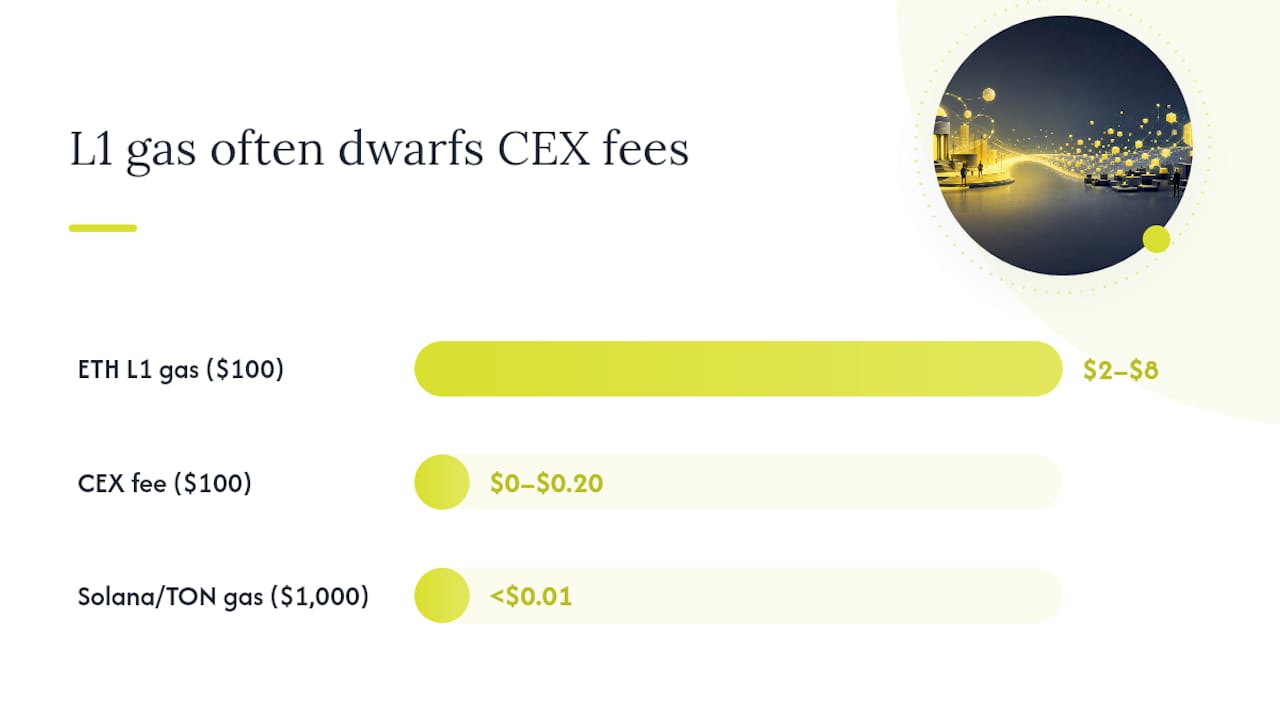
Total trading cost breaks into three pieces regardless of venue: the platform’s own fee, network cost, and slippage from price impact. CEX maker/taker fees typically sit between 0% and 0.20%, plus a markup baked into withdrawal fees. DEXs charge a liquidity provider fee plus gas and any protocol fee, varying by network and trade size.
Liquidity providers take on impermanent loss, the gap between holding two tokens versus supplying them to a pool when their prices diverge. LPs typically come out ahead in high-volume, low-volatility pairs like stablecoin pools, and typically lose ground when one asset in the pair swings hard.
A rough comparison: a $100 swap on Ethereum layer 1 during normal congestion might cost $2 to $8 in gas alone, on top of the LP fee, making small trades inefficient. A $1,000 swap on a faster chain like Solana or TON often costs a fraction of a cent in network fees, leaving the LP fee as the main cost. Scale and chain choice change the math completely.
- Add up the base fee (maker/taker or LP fee).
- Add gas or protocol fees for that specific chain.
- Estimate slippage based on pool depth or order book thickness.
- Compare the total against the same trade on an alternate venue or chain.
Layer-2 networks and cheaper blockspace have meaningfully lowered on-chain gas costs compared to a few years ago, changing this calculus in favor of DEXs for smaller trades.
Pro Tip: For very small trades on Ethereum L1, CEXs are generally more cost-effective due to gas fees. Save DEX swaps for larger trades or chains with cheap gas.
Should You Use a CEX or a DEX for This Trade?
CEX pros: fiat access, deep liquidity on major pairs, support, advanced order types. CEX cons: custodial risk, KYC requirements, possible withdrawal limits or freezes.
DEX pros: self-custody, permissionless access, early listings, composability with DeFi. DEX cons: no fiat rails, gas costs, smart-contract risk, steeper learning curve.
Run through this before placing the trade:
- Do you need to convert fiat currency? If yes, start on a CEX.
- Is the token brand-new or unlisted on major platforms? A DEX is likely your only option.
- Do you want custody of your assets, or is convenience the priority?
- Is your trade size large enough that gas fees are a rounding error?
Watch for red flags on any platform: no published audit, unusually long withdrawal delays, a pool with tiny TVL relative to trade size, or a token contract nobody can independently verify.
Which Platforms Actually Handle These Trades?
Coinbase and Kraken are common entry points for converting fiat into crypto with regulated on/off ramps. Binance offers some of the deepest order-book liquidity for major pairs and derivatives. Uniswap remains a default for on-chain token swaps and day-one listings on Ethereum. SushiSwap extends similar AMM functionality across multiple chains. PancakeSwap does the same on BNB Chain, often with lower gas costs. No single platform here is the automatic best choice. The right one depends entirely on the job: fiat conversion, deep liquidity, or grabbing a token the moment it launches.
How Does Regulation Affect Where You Can Trade?
KYC and AML rules on CEXs are tightening, not loosening, heading into 2026, and enforcement increasingly targets platforms directly rather than individual users. That means access can change fast: China has recently tightened scrutiny on crypto transactions, and similar moves are showing up elsewhere.
DEX smart contracts themselves are harder to regulate directly, but regulators increasingly focus on the on/off ramps and centralized front-ends that connect to them, not the underlying code. Proposed legislation targeting rug pulls and private key theft shows where enforcement energy is heading: consumer protection at the edges, not the protocols themselves.
Rules vary sharply by country. Check your local regulation before trading on either model, since what’s permitted in one jurisdiction may be restricted in another.
What Do Liquidity and Security Trends Look Like Right Now?
DEX trading volume has grown steadily as a share of total spot volume, and Ethereum remains a hub for specialized DEX protocols built for stablecoin swaps and MEV protection. CEX fees still cluster in the 0% to 0.20% range, while DEX costs depend heavily on chain choice. Security incidents split cleanly by category: operational and custodial failures hit CEXs, while code exploits and economic-design flaws hit DEXs.
Pro Tip: Before every large trade, glance at recent TVL and incident history for the specific venue, not just the category. A protocol’s track record changes faster than its reputation.
Why I Treat CEX and DEX as Complementary, Not Competing
Most experienced traders I’ve studied don’t pick a side. They run a hybrid stack: a CEX for fiat conversion and core holdings, plus a DEX per chain for on-chain trades and DeFi strategies. That’s the approach I’d defend, because the two models solve different problems rather than competing for the same job. Betting everything on one model ignores the actual risk profile each one carries. For deeper coverage of exchange security and platform risk, Techgaged’s ongoing reporting is worth tracking as this space evolves.
Get Sharper Crypto Analysis Before Your Next Trade
Comparing CEX and DEX risk is only half the picture. Market conditions, regulatory shifts, and liquidity trends change weekly, and they change how that comparison plays out for your specific trade. Techgaged’s ongoing crypto coverage tracks these shifts as they happen, from exchange consolidation to on-chain liquidity data, so you’re not making custody decisions on stale information.
Sources
This article is general information, not a substitute for advice from a qualified financial advisor. Consult a qualified financial professional about your own circumstances before acting on anything here.
FAQ
Which Is Better, CEX or DEX?
Neither is universally better. A CEX suits fiat conversion and high-liquidity trading, while a DEX suits self-custody and permissionless access to new tokens.
Is Coinbase a CEX or a DEX?
Coinbase is a centralized exchange (CEX). It holds user funds in custodial wallets and matches trades through its own order book.
Is XRP a DEX Coin?
No. XRP is a native asset of the XRP Ledger network and trades on both centralized exchanges and decentralized platforms; it isn’t a DEX itself.
What Are the Risks of Using a CEX?
The main risks are custodial: a hack of the platform’s central wallet, insolvency, withdrawal freezes, or regulatory shutdown affecting your access to funds.
How Do I Choose Between a CEX and a DEX for a Trade?
Ask whether you need fiat access, how large the trade is, and whether you prioritize custody over convenience. Those three questions settle most decisions.
Recommended
How do you rate this article?
Subscribe to our YouTube channel for crypto market insights and educational videos.






Join our Socials
Briefly, clearly and without noise – get the most important crypto news and market insights first.
Most Read Today
1
Bitcoin Volatility Hits A Rare Extreme — A Bigger Move Could Be Coming
2Smart Contract Audits: What Teams Need to Verify Code
3Sui Is Quietly Building A Bitcoin Powerhouse — The Latest Numbers Tell The Story
4BNB Just Flashed a Whale Accumulation Signal Not Seen Since the Last Pump
5BitMine Won’t Stop Buying Ethereum — Tom Lee Now Eyes 5% Of Total Supply
Latest





8
Also read
Similar stories you might like.

Crypto News
BNB Just Flashed a Whale Accumulation Signal Not Seen Since the Last Pump
Azeez | 2026-08-18
Crypto News
Three Korean Banks In One Year — Is Ripple Setting XRP Up For Liftoff?
Azeez | 2026-08-18

Crypto News
BitMine Won’t Stop Buying Ethereum — Tom Lee Now Eyes 5% Of Total Supply
Azeez | 2026-08-18
Crypto News
Bitcoin Volatility Hits A Rare Extreme — A Bigger Move Could Be Coming
Azeez | 2026-08-18

Crypto Guides
Smart Contract Audits: What Teams Need to Verify Code
Rokas | 2026-08-18
Crypto News
Solana’s Latest Record Could Be The Catalyst Nobody Saw Coming
Azeez | 2026-08-17

Crypto News
Gold-Backed RWAs Are Surging — Here’s Where The Money Is Going
Azeez | 2026-08-17

Crypto News
Ethereum Whale Drops $10.1 Million — Is Something Big Coming?
Azeez | 2026-08-17
Crypto News
Strategy Is Selling Bitcoin Instead Of Buying — Should Investors Be Worried?
Azeez | 2026-08-17

Crypto Guides
AML for Crypto: A Compliance Playbook for 2026
Rokas | 2026-08-17