















Tether (USDT) coin on U.S. dollar bills. Source: TechGaged / Shutterstock
How Stablecoins Became a $320 Billion Treasury Powerhouse
In Brief
- • Stablecoin supply has surpassed $320 billion and continues growing.
- • Issuers like Tether and Circle are becoming major Treasury market participants.
- • Stablecoins are increasingly used beyond crypto trading and speculation.

The supply of dollar-pegged stablecoins has climbed above $320 billion, bringing blockchain-based digital dollars closer than ever to the largest government money market funds in the U.S. New data published by digital asset platform Grayscale shows stablecoin supply now approaching the scale of major cash-management products operated by Fidelity, Vanguard, and JPMorgan. The trend highlights how stablecoins have evolved from a crypto trading tool into a growing force within U.S. Treasury markets.
Stablecoin Supply Reaches New Highs
According to a May 20 report by Grayscale, total stablecoin supply recently surpassed $320 billion, compared with about $450 billion managed by Fidelity’s Government Money Market Fund (SPAXX), currently the largest government money market fund in the U.S.
The chart shows stablecoin growth accelerating sharply since 2024 after recovering from the crypto market downturn of 2022 and 2023. Supply now sits within striking distance of major government money market funds (MMFs) managed by Vanguard and JPMorgan, and each oversee approximately $380 billion in assets.
Latest Stories

Solana’s Inflation Curve Gets a Major Overhaul After Community Vote

Ethereum Faces One of Its Most Extreme Sell-Side Readings on Binance

Chainlink Is Expanding Again — Here’s Where It’s Moving Next
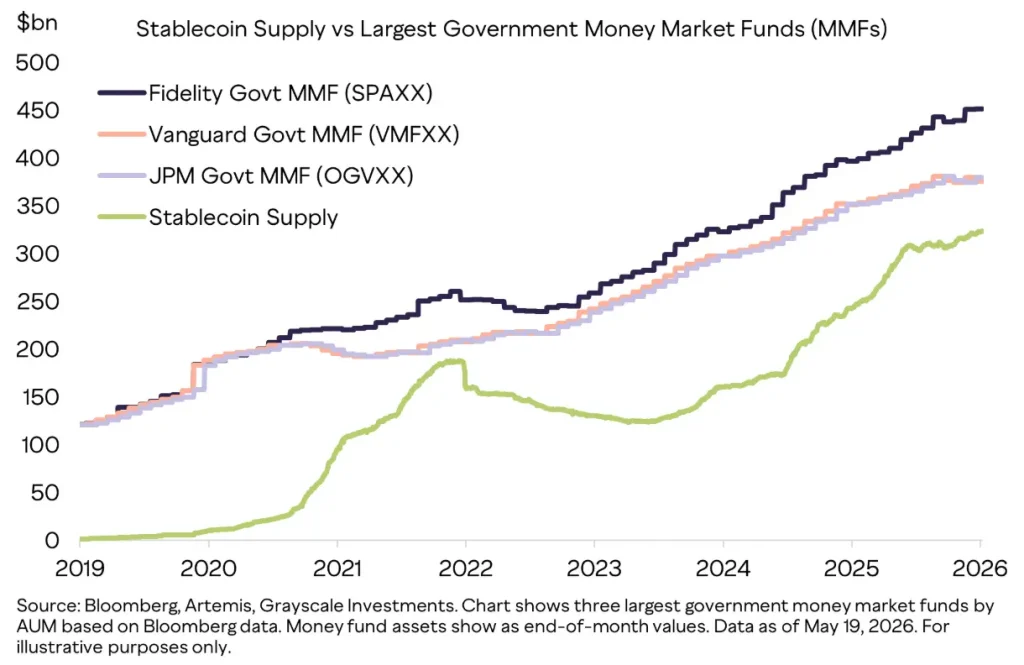
Stablecoins and government MMFs increasingly rely on similar underlying assets. Both seek stability by holding highly liquid government-backed instruments like short-term U.S. Treasury bills and repurchase agreements.
This similarity has become even more pronounced following the passage of the GENIUS Act, which established reserve, transparency, and auditing requirements for U.S. stablecoin issuers.
Tether and Circle Gain Influence in Treasury Markets
As stablecoin adoption grows, issuers such as Tether (USDT) and Circle (USDC) are becoming increasingly important participants in U.S. money markets.
Unlike MMFs, however, stablecoins generally don’t distribute yield directly to holders. Instead, issuers retain income generated from reserve assets, making higher interest-rate environments particularly profitable for stablecoin businesses.
The growth also reflects expanding use cases beyond crypto trading. Stablecoins are increasingly being used for cross-border payments, settlements, remittances, decentralized finance (DeFi) applications, and tokenized asset markets.
For crypto investors, rising stablecoin supply is often viewed as a sign of increasing liquidity entering digital asset markets. More generally, it signals that blockchain-based financial infrastructure is becoming a meaningful competitor to traditional cash-management systems.
Though stablecoins remain smaller than the largest MMFs today, the gap is narrowing rapidly, underscoring their growing role in both crypto markets and the wider financial system.
How do you rate this article?
Subscribe to our YouTube channel for crypto market insights and educational videos.






Join our Socials
Briefly, clearly and without noise – get the most important crypto news and market insights first.

Most Read Today
1
Protect Personal Savings: Hot and Cold Wallets, Watch Bluetooth Risks
2Chainlink Is Expanding Again — Here’s Where It’s Moving Next
3Ethereum Faces One of Its Most Extreme Sell-Side Readings on Binance
4Metaplanet Moves 3,000 BTC in 24 Hours — What Are They Planning?
5Solana’s Inflation Curve Gets a Major Overhaul After Community Vote
Latest





8
Also read
Similar stories you might like.
Crypto News
Strategy’s Bitcoin Bet Now Comes With Far Less Leverage
Azeez | 2026-08-28

Crypto News
A Rare Ethereum Trend Is Emerging as Long-Term Holders Keep Taking Losses
Azeez | 2026-08-28

Crypto News
Bitcoin’s Next Big Test Emerges As $5B In IBIT Options Near Expiry
Azeez | 2026-08-26

Crypto News
Bitwise’s SOL Buying Spree Nears A Major $1B Milestone
Azeez | 2026-08-26

Crypto News
Avalanche Records Strongest Tokenized Stock Growth In 24 Hours
Azeez | 2026-08-26

Crypto News
The ETH/BTC Ratio Has Printed A Golden Cross For The First Time In 14 Months
Azeez | 2026-08-25

Crypto News
XRP Is Up 51% This Week — Its Biggest Weekly Gain in 21 Months
Azeez | 2026-08-24
Crypto News
Zcash Has Delivered A 121% Rally Since June — Social Interest Is Finally Returning
Azeez | 2026-08-23

Crypto News
Crypto Sentiment Flips — Another Major Market Shift May Be Underway
Azeez | 2026-08-22

Crypto Guides
What Is a Rug Pull in Crypto, and What Should You Do Right Now?
Rokas | 2026-08-21