















Tether Plots Bitcoin Empire, Backs Mega Merger – What Users Gain From DealSource: TechGaged / Shutterstock
Bitcoin Developers Work on Post-Quantum Security Upgrade
In Brief
- • Quantum risk targets exposed wallet keys, not Bitcoin itself.
- • Around 6.5M BTC could be vulnerable but mostly fixable.
- • Developers are already working on quantum-resistant upgrades.

A new research paper from Presidio Bitcoin is pushing the conversation around Bitcoin (BTC) and quantum computing into sharper focus. The report, titled ‘Bitcoin’s Quantum Readiness,’ outlines how the network could handle future threats from advanced quantum machines. Though the risks are real, the takeaway is that Bitcoin is not as fragile as some narratives suggest.
Quantum threat targets keys, not Bitcoin itself
The paper makes an important distinction. Even if so-called cryptographically relevant quantum computers (CRQCs) arrive, they would not break Bitcoin’s core system, such as consensus or supply rules.

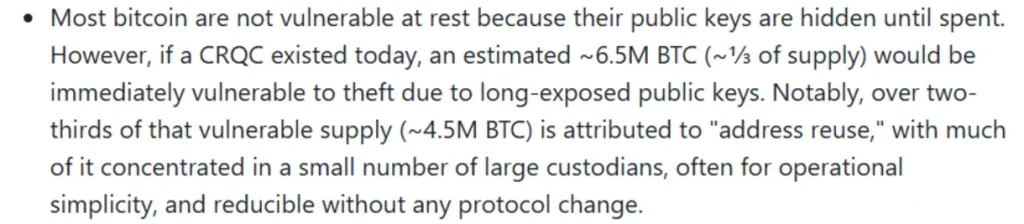
Instead, the main risk lies in targeted theft. Specifically, coins tied to addresses with exposed public keys could be vulnerable. The report estimates that around 6.5 million BTC, roughly one-third of total supply, could be at risk under such a scenario.
Latest Stories

Solana’s Inflation Curve Gets a Major Overhaul After Community Vote

Ethereum Faces One of Its Most Extreme Sell-Side Readings on Binance

Chainlink Is Expanding Again — Here’s Where It’s Moving Next
A large portion of that comes from address reuse, often linked to major custodians and institutions. However, this is considered a fixable issue. Simply moving funds to fresh addresses with hidden public keys significantly reduces exposure without requiring protocol changes.
As a reminder, the quantum narrative has come into focus in the crypto community concerned about the potential catastrophe that advances in this area could bring to blockchain, particularly after Cointelegraph’s article ‘Nobody knows if quantum secure cryptography will even work.’
Commenting on the article’s key points, Dr. Edoardo Persichetti, FAU Associate Professor, co-author of the NIST-standardized HQC, General Chair of EUROCRYPT 2026, and advisor at qLABS, explained that we might not have enough time to wait for a perfect solution. As he told TechGaged:
“Threat model is not symmetric: adversaries engaged in ‘harvest now, decrypt later’ operations are already collecting encrypted traffic today. (…) Waiting for mathematical certainty that can never fully arrive because no public-key scheme is unconditionally secure is not a rational strategy. It is an excuse for inaction.”
Bitcoin’s upgrade path is already taking shape
Indeed, developers are not waiting for quantum breakthroughs to act. The report by Presidio Bitcoin highlights ongoing work on post-quantum cryptography, which would replace current signature schemes with quantum-resistant alternatives.
One likely direction involves hash-based signatures such as SHRINCS and SHRIMPS, which rely on cryptographic primitives already used in Bitcoin. Though these solutions come with trade-offs like larger data sizes, they offer a practical path forward.
There are also proposals for new transaction formats that allow dual spending paths. This means users could transact normally today, keeping a quantum-safe fallback option ready if needed.
At the same time, developer attention is rising fast. Discussions around quantum-related topics on Bitcoin’s main development forums have surged from about 5% in 2024 to roughly 50% in 2026, signaling a clear shift in priorities.
The report also challenges another common concern: migration speed. According to its estimates, most of Bitcoin’s value could move to quantum-safe addresses within weeks if needed, which suggests the network can adapt quickly under pressure.
Still, some open questions remain, particularly around legacy coins that are never upgraded. Whether those funds remain spendable or face restrictions could become one of the most contentious debates in Bitcoin’s future.
For now, Bitcoin’s approach to quantum risk is cautious and incremental, but already well underway.
How do you rate this article?
Subscribe to our YouTube channel for crypto market insights and educational videos.






Join our Socials
Briefly, clearly and without noise – get the most important crypto news and market insights first.

Most Read Today
1
Protect Personal Savings: Hot and Cold Wallets, Watch Bluetooth Risks
2Chainlink Is Expanding Again — Here’s Where It’s Moving Next
3Ethereum Faces One of Its Most Extreme Sell-Side Readings on Binance
4Metaplanet Moves 3,000 BTC in 24 Hours — What Are They Planning?
5Solana’s Inflation Curve Gets a Major Overhaul After Community Vote
Latest





8
Also read
Similar stories you might like.

Crypto News
Metaplanet Moves 3,000 BTC in 24 Hours — What Are They Planning?
Azeez | 2026-08-29

Crypto News
Strategy’s Bitcoin Bet Now Comes With Far Less Leverage
Azeez | 2026-08-28

Crypto News
A Rare Ethereum Trend Is Emerging as Long-Term Holders Keep Taking Losses
Azeez | 2026-08-28

Crypto News
U.S. Government Moves Part of Alameda BTC, Reviving Fears of a Major Liquidation
Azeez | 2026-08-27

Crypto News
Fidelity Clients Keep Buying Bitcoin As Nine-Day Streak Continues
Azeez | 2026-08-27

Crypto News
Bitcoin’s Next Big Test Emerges As $5B In IBIT Options Near Expiry
Azeez | 2026-08-26

Crypto News
Bitwise’s SOL Buying Spree Nears A Major $1B Milestone
Azeez | 2026-08-26

Crypto News
Avalanche Records Strongest Tokenized Stock Growth In 24 Hours
Azeez | 2026-08-26

Crypto News
The ETH/BTC Ratio Has Printed A Golden Cross For The First Time In 14 Months
Azeez | 2026-08-25

Crypto News
More Than Half Of BlackRock’s Recent Bitcoin Buying Came In One Week
Azeez | 2026-08-25