















Aave (AAVE) logo over crypto trading chart. Source: TechGaged / Shutterstock
Aave Rescue Sparks $240M DeFi Alliance After rsETH Exploit
In Brief
- • Aave recovery effort tops ~$240M in pledged support.
- • Multiple DeFi players coordinate via “DeFi United” after rsETH exploit.
- • Marks rare cross-protocol response to systemic risk in DeFi.

A coordinated recovery effort is taking shape across decentralized finance (DeFi) after the rsETH exploit, with ecosystem players committing capital to stabilize Aave (AAVE). Early disclosures show tens of thousands of Ethereum (ETH) pledged, with more contributions pending governance approvals. The initiative signals a rare, large-scale coordination across protocols to address systemic risk.
Ecosystem rallies behind Aave after rsETH exploit
Aave service providers and ecosystem partners have launched DeFi United, a recovery initiative designed to restore the backing of rsETH following the April 18 exploit. The plan aggregates capital from DAOs, foundations, and individual contributors, with total disclosed commitments reaching over 102,000 ETH, or about $240 million, according to on-chain tracking.
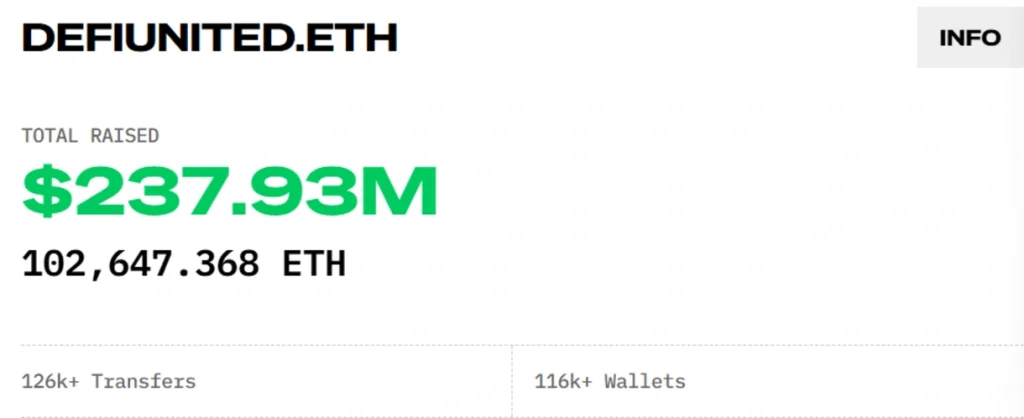
Major contributions include proposed allocations from Artibutrum DAO (30,765 ETH), Mantle (30,000 ETH), Aave DAO (25,000 ETH), and Ether.Fi (5,000 ETH), alongside a 2,500 stETH commitment from Lido. Several of these allocations remain subject to DAO votes, including governance decisions on Arbitrum and other participating protocols.
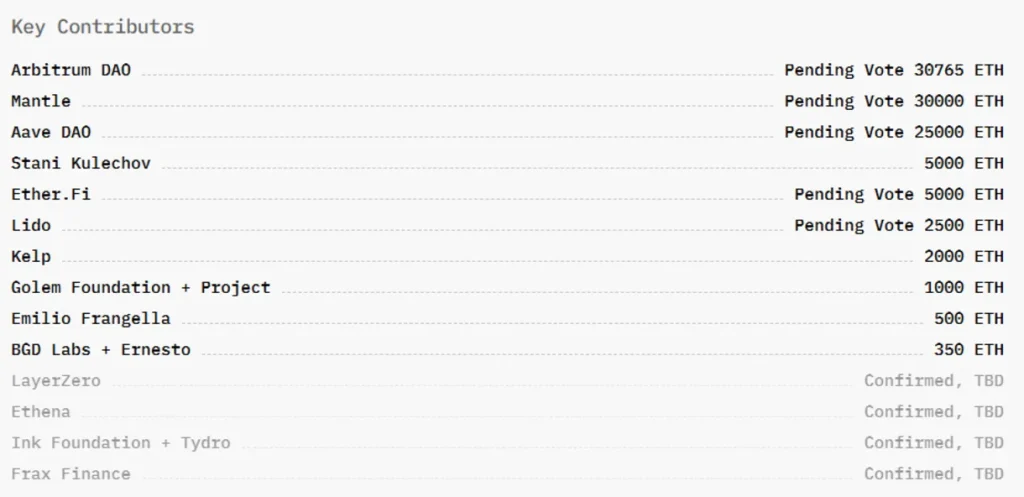
Additional confirmed or indicative contributors include Aave founder and CEO Stani Kulechov, Golem Foundation, BGD Labs, and individual backers, whereas groups like LayerZero, Ethena, Ink Foundation, and Frax Finance are involved with undisclosed amounts.
Recovery plan hinges on governance and technical steps
The recovery effort depends on a mix of governance approvals and technical execution across multiple protocols. This includes reopening rsETH withdrawals via KelpDAO and coordinating with infrastructure providers to release or redistribute affected funds.
Aave contributors say users can now view estimated compensation through a dedicated recovery interface, marking an early step toward distributing funds back to impacted participants.
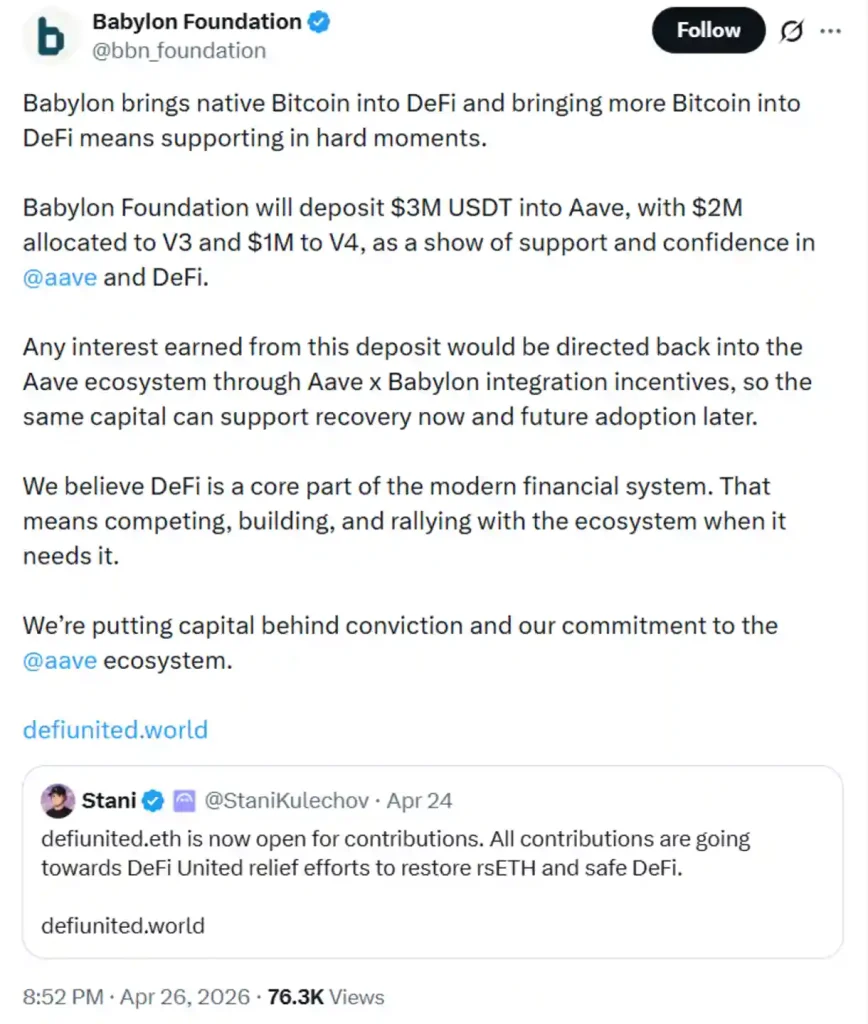
Separately, Babylon Foundation has pledged $3 million in USDT liquidity to Aave, reinforcing confidence in the protocol while directing potential yield back into ecosystem incentives.
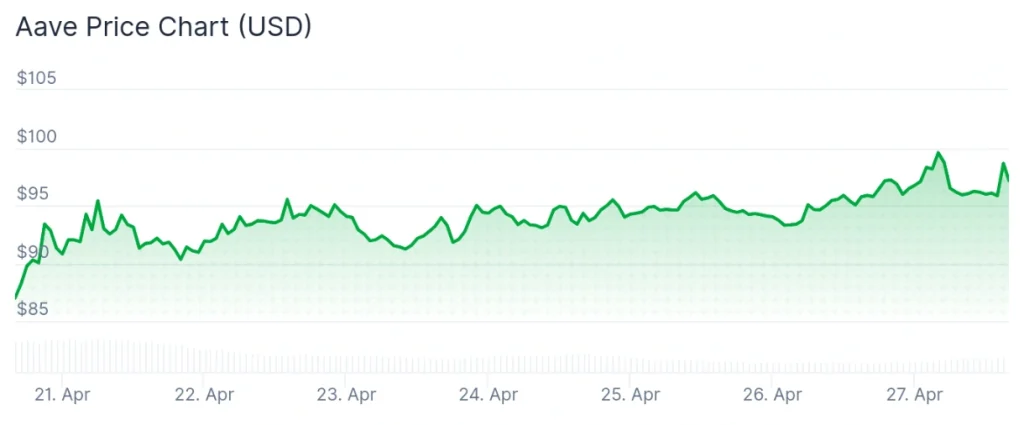
Meanwhile, Aave’s native token is recovering too, and was at press time on April 27 changing hands at the price of $97.21, up 1.4% in the last 24 hours, gaining 8.9% over the past seven days, and reducing to 0.1% its loss from across the month, per the latest chart data.
Though the plan is still taking shape, the scale of working together stands out. If executed successfully, it could set a example for how DeFi handles big failures, moving from isolated responses toward shared, industry-wide safety nets.
How do you rate this article?
Subscribe to our YouTube channel for crypto market insights and educational videos.






Join our Socials
Briefly, clearly and without noise – get the most important crypto news and market insights first.
Most Read Today
1
Dogecoin’s Path to $0.50 in 2026: What Would Actually Need to Happen
26.9 Million BTC Including Satoshi’s Are Now Exposed to Quantum Attacks — Here’s Why
3Bitcoin Rally May Be a Bull Trap, Analyst Warns
4Goldman Sachs Holds $108M SOL Across Six ETFs, Strengthening Institutional Case for Solana
5The Osaka Countdown: Will the April 28 Upgrade Push BNB Past Resistance?
Latest





8
Also read
Similar stories you might like.

Altcoins
Bitcoin Surge Turns Brutal as $140M Shorts Liquidated
Ana | 2026-04-27

Blockchain
Western Union Plans USDPT Stablecoin Launch in May
Ana | 2026-04-27

Market
Is It a Good Time to Buy Crypto Right Now?
Sead | 2026-04-27

Altcoins
Trump Says He Will Sign CLARITY Act “Immediately”
Rokas | 2026-04-27

Bitcoin
Bitcoin Rally May Be a Bull Trap, Analyst Warns
Rokas | 2026-04-27

Altcoins
Solana DEX Dominance Continues to Outpace Ethereum — But the Full Story Is More Complicated
Azeez | 2026-04-25

Altcoins
April’s Crypto Hack Crisis: $606M Drained in Just 18 Days
Azeez | 2026-04-25
Altcoins
Bitcoin Nears $80K as Ceasefire Boosts Crypto Sentiment
Ana | 2026-04-25

Altcoins
Kelp DAO Exploit Funds Moved to Bitcoin as DeFi Rescue Begins
Ana | 2026-04-24

Blockchain
On-Chain Businesses Hit $587M Revenue as DeFi Matures
Ana | 2026-04-24