















Crypto network and digital payments concept on smartphone. Source: TechGaged / Shutterstock
On-Chain Businesses Hit $587M Revenue as DeFi Matures
In Brief
- • On-chain businesses generated $587M+ in Q1 2026 revenue.
- • Hyperliquid and Sky led growth in trading and credit.
- • Signals DeFi shifting toward sustainable, fee-driven business models.

On-chain businesses generated $587.9 million in revenue in the first quarter of 2026, marking a clear shift in how value is created across the crypto ecosystem. The data was compiled by CoinShares and Token Terminal. It represents a growing class of blockchain-native platforms that are moving beyond speculation and into consistent, fee-driven income.
Revenue concentrates among top platforms
According to the CoinShares’ report published on April 23, the bulk of that $587.9 million came from a small group of dominant protocols, primarily in trading and stablecoin infrastructure. Platforms like Hyperliquid (HYPE) and Sky (SKY) led the quarter with strong demand for derivatives trading and on-chain credit systems.
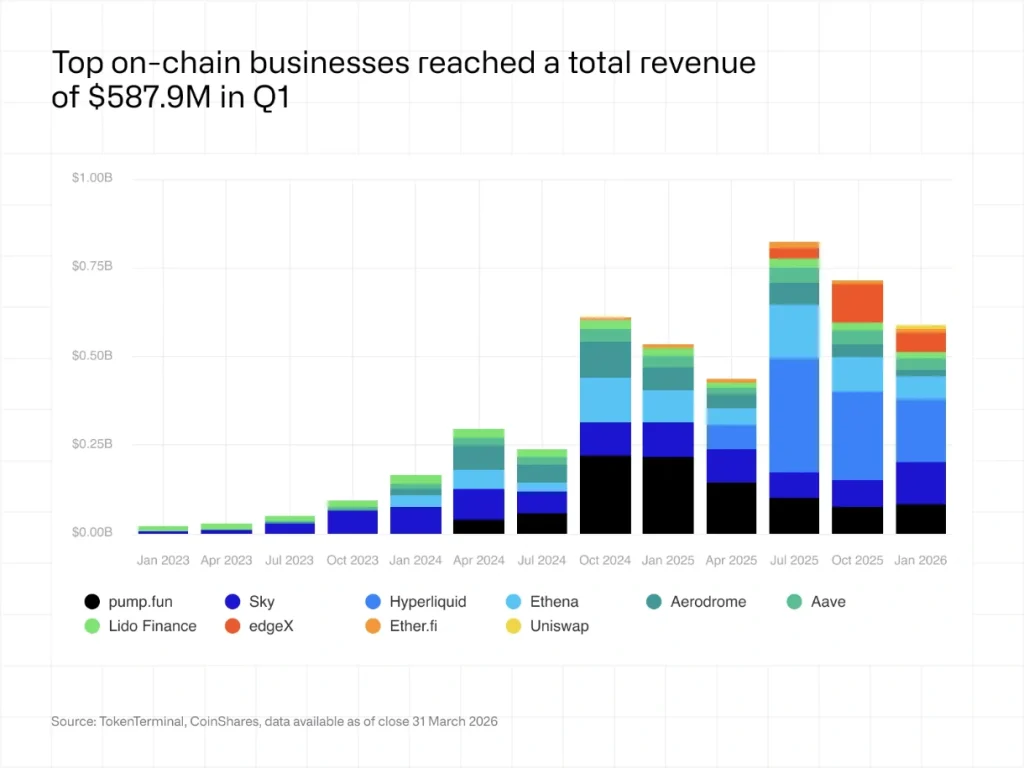
Hyperliquid alone generated significant revenue through trading activity, showing how vertically integrated platforms can capture value directly from user flows. Meanwhile, Sky’s model blends on-chain borrowing fees with exposure to off-chain yield, making it a hybrid case within the broader category.
Latest Stories
Chainlink Hits $34T in Enabled Transactions — The Infrastructure Race Is Heating Up

Abraxas Makes Another ETH Move — Its Massive Hyperliquid Short Holds the Key

Solana’s RWA Adoption Hits a Huge Milestone: Bullish?
Other contributors include decentralized exchanges and staking platforms such as Uniswap (UNI), Aave (AAVE), and Lido (LDO). Despite the diversity of use cases, the underlying revenue model remains consistent: fees from trading, borrowing, and asset usage.
From narrative to measurable business models
This quarter’s data reinforces a broader structural shift often referred to as “Hybrid Finance.” Instead of isolated crypto-native activity, blockchain infrastructure is increasingly intersecting with traditional financial systems.
Stablecoins now sit at nearly $300 billion in supply, tokenized funds are expanding rapidly, and commodities like gold are being issued on-chain. Within that environment, on-chain businesses act as the monetization layer, converting activity into revenue.
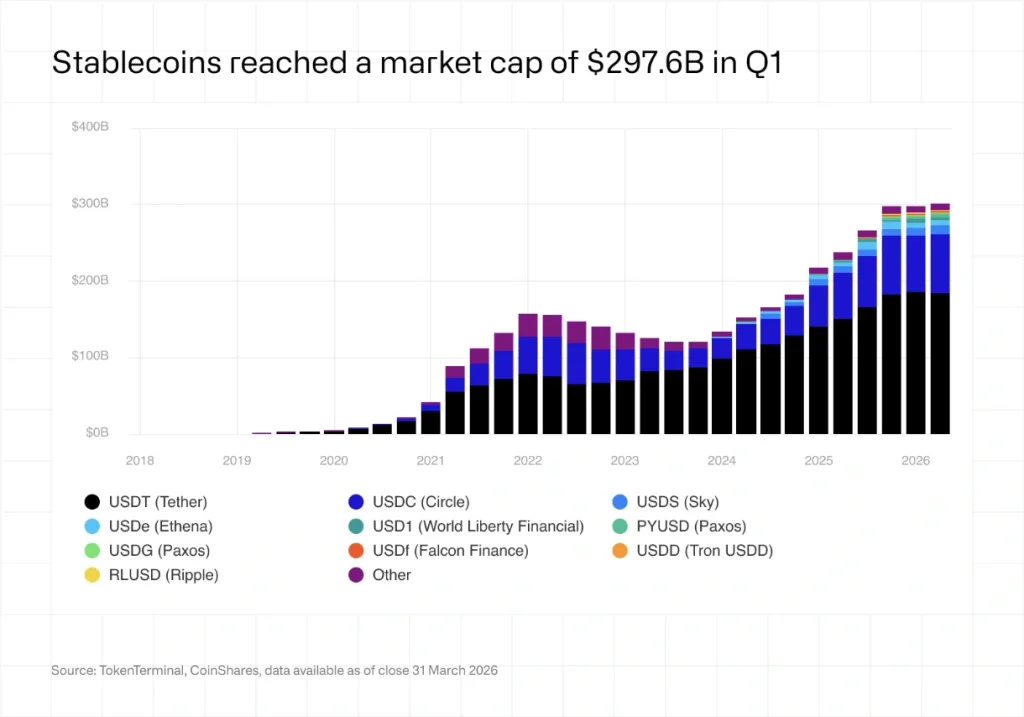
Unlike base-layer blockchains, which rely on transaction fees, these applications generate income directly from user behavior. This makes their economic profiles more comparable to traditional financial services companies, where revenue scales with volume and usage rather than simple network activity.
As more assets and users move on-chain, the platforms facilitating that activity can capture the largest share of value. Q1’s $587.9 million figure is a signal that on-chain businesses are becoming sustainable, revenue-generating entities in their own right, with models that increasingly resemble the financial institutions they aim to disrupt.
How do you rate this article?
Join our Socials
Briefly, clearly and without noise – get the most important crypto news and market insights first.

Most Read Today
1
Chainlink Hits $34T in Enabled Transactions — The Infrastructure Race Is Heating Up
2Solana’s RWA Adoption Hits a Huge Milestone: Bullish?
3This Is the Only Crypto Sector Still Above Bitcoin’s Peak
4Abraxas Makes Another ETH Move — Its Massive Hyperliquid Short Holds the Key
5Clarity Act 2026: Everything You Should Know
Latest





8
Also read
Similar stories you might like.

Crypto News
Chainlink Hits $34T in Enabled Transactions — The Infrastructure Race Is Heating Up
Azeez | 2026-09-08

Crypto News
Abraxas Makes Another ETH Move — Its Massive Hyperliquid Short Holds the Key
Azeez | 2026-09-08

Crypto News
This Is the Only Crypto Sector Still Above Bitcoin’s Peak
Azeez | 2026-09-08

Crypto News
This AI Token Is Building Momentum as Attention Shifts Back to AI Sector
Azeez | 2026-09-07

Crypto News
Bitcoin Clears Its Biggest Leverage Test Since 2023
Azeez | 2026-09-07

Crypto News
XRP Trading Volume Surges to a February High — Something Is Changing
Azeez | 2026-09-07

Crypto News
Solana Is Processing More Than the Rest — What Comes Next Could Be Bigger
Azeez | 2026-09-06

Crypto News
Ethereum Is Building Something Bigger Than the Crypto Market
Azeez | 2026-09-06

Crypto News
Morgan Stanley Adds to Its Bitcoin Position for a Fourth Straight Day
Azeez | 2026-09-05

Crypto News
Zcash Has More Than a Price Story — Here’s What’s Really Changing
Azeez | 2026-09-05