













Sui image on a digital device with market chart behind. Source: TechGaged / Shutterstock.
Sui Recovers From Outage Cluster — Will the Market Look Past It?
In Brief
- • Sui reached a record 1,539 TPS, showcasing its scalability.
- • Network outages weighed on sentiment, helping push SUI down 14.7% on the week.
- • Reliability is now the focus as investors watch for a stable recovery.

Sui is making headlines for two very different reasons this week — and how the market weighs them against each other will say a great deal about how seriously it now takes network reliability as a valuation input.
On one side: $SUI just hit a new yearly high of 1,539 transactions per second at 02:00 UTC on May 30, 2026, according to Sui Community — a throughput milestone that places it among the fastest production blockchains in operation.
On the other: the certification-per-second chart covering May 28–30 tells a more complicated story of a network that surged, stalled, recovered, stalled again, and is only now finding consistent footing. Both data points are real.
Latest Stories
Crypto Open Interest Is Surging — Ethereum Stands Out

Something Is Changing on Avalanche: Network Fees Just Hit a Weekly High

Solana Is Becoming a Key AI Payment Network: A Bigger Shift Is Unfolding
The question is which one the market decides to remember.
What the Price Is Already Pricing In
The CoinGecko 7-day chart captured at approximately 08:00 UTC on May 31, 2026 shows the market has not waited for a verdict — it has already delivered one.
SUI opened the week near $1.05 on May 25, held above $1.00 through May 26, then broke down decisively from May 27 onward in a decline that has been unrelenting and structurally clean.
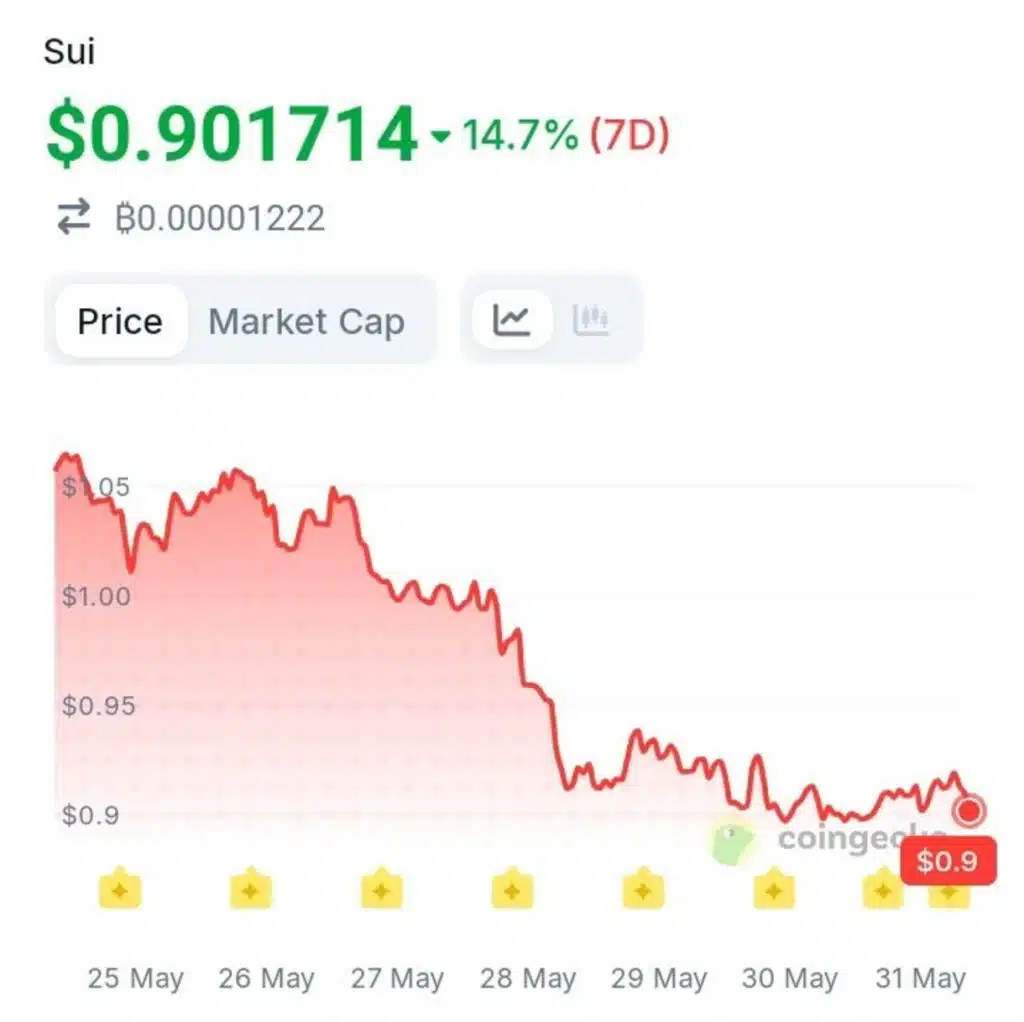
No meaningful bounces, no accumulation base, just a sustained step-down through $1.00, $0.95, and into the $0.90 handle where it now trades at $0.9017, down 14.7% on the week.
The psychological $1.00 level, which SUI had been defending for several days, gave way without a fight around May 28 — precisely the window in which the first congestion-driven cert/sec collapse appeared on the network monitoring charts.
That timing is not coincidental. The market connected the outage to the price before most analysts had finished writing about it.
A protocol that hits a yearly throughput record on the same week its price drops 14.7% is sending a conflicted signal. The 1,539 TPS headline captured attention. The outage cluster captured the bid.
A network that hits 1,539 TPS one day and stalls the next is not a failed network. But it is one that has not yet proven it can do both reliably at the same time.
What the Outage Chart Actually Shows
The shared object transaction chart spanning May 28, 08:00 through May 30, 00:00 UTC is not the picture of a smoothly scaling network.
Cert/sec activity — the certification throughput that underpins Sui’s consensus — spiked sharply on May 28, reaching above 100 certs/sec before dropping abruptly to near zero around May 28 16:00.
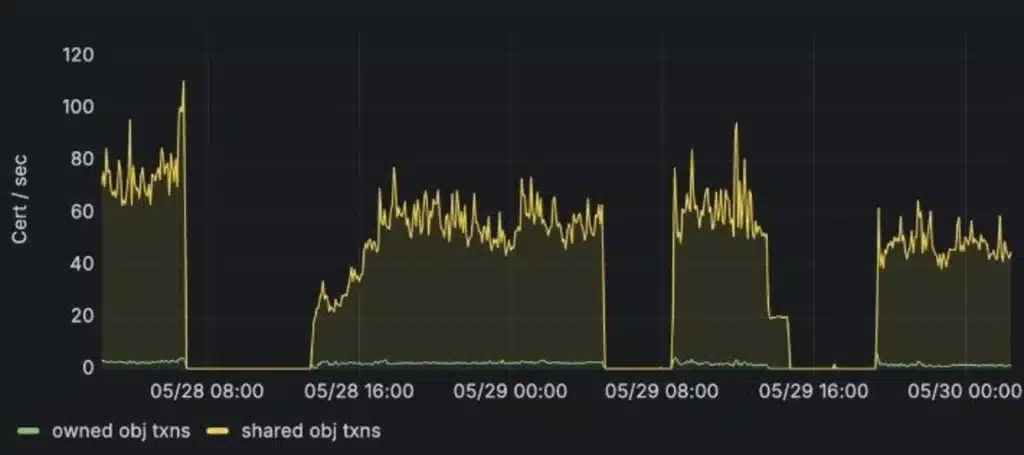
A second recovery period pushed throughput back into the 60–90 range through May 29 morning, followed by another cliff-edge drop around May 29 16:00 before a more gradual return through the overnight session.
The pattern is consistent with a network experiencing repeated congestion-triggered degradation rather than a single isolated incident — shared object transaction demand repeatedly overwhelming the network’s ability to sustain throughput without interruption.
Owned object transactions, shown in green, remained negligible throughout — confirming that the stress was concentrated specifically in shared object processing, which is where Sui’s most complex DeFi and gaming interactions live.
The 1,539 TPS Number Deserves Its Moment
Context matters here. The 1,539 TPS milestone — a new yearly high recorded at the same moment the network was recovering from its congestion cluster — is not a trivial achievement.
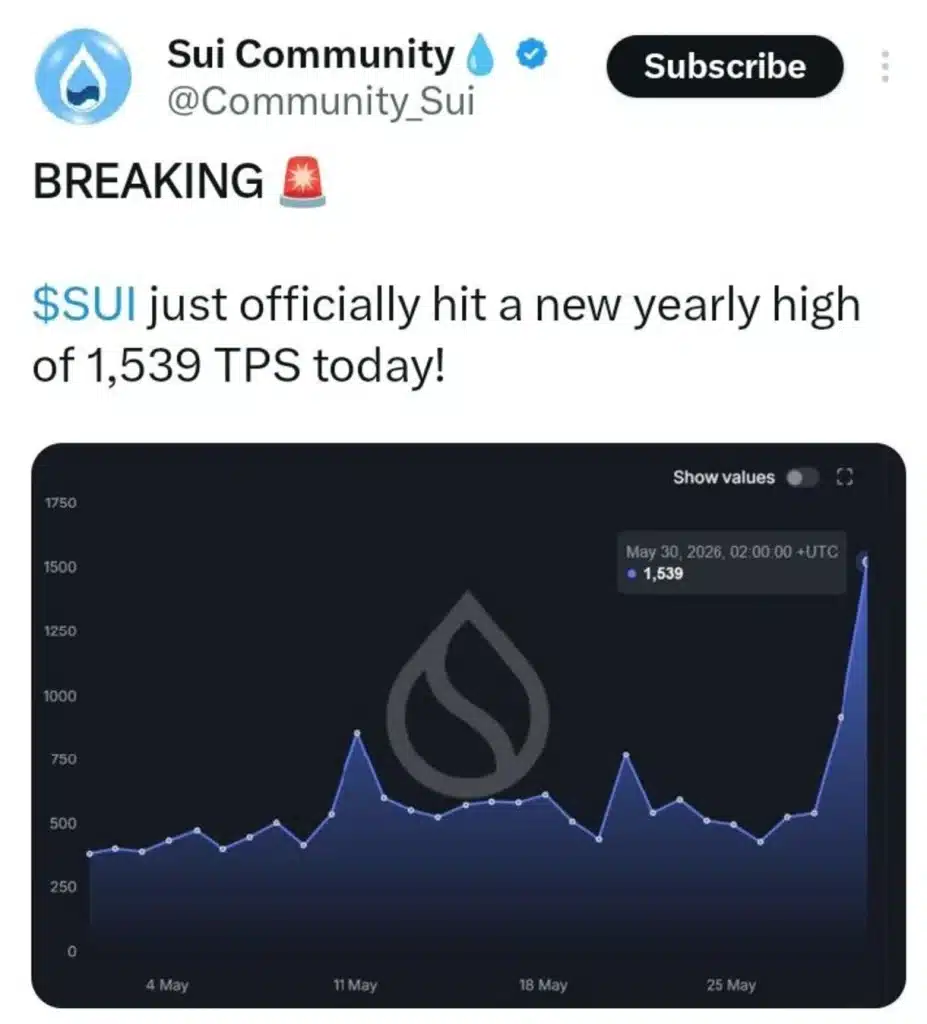
Ethereum mainnet processes roughly 15–30 TPS. Solana, Sui’s most direct competitor, averages 2,000–3,000 TPS in sustained conditions but has its own outage history that the market has repeatedly forgiven.
Sui’s object-centric architecture was purpose-built for the kind of parallelised throughput that made the 1,539 TPS reading possible — it is not luck.
But unlocking that ceiling consistently, without the congestion-driven stalls visible in the cert/sec data, is the engineering problem Mysten Labs now needs to solve publicly and credibly.
What the Market Tends to Forgive
Solana’s outage history did not prevent it from becoming a top-five asset by market cap. Ethereum’s gas crisis periods did not derail its institutional adoption trajectory.
What those networks had in common was a clear technical narrative for why the problems were solvable and visible progress toward solving them.
Sui’s 1,539 TPS milestone, arriving in the same week as the outage cluster, is a double-edged data point — it confirms the ceiling is high, but the floor remains unproven under sustained demand.
The market will likely look past the outage if the throughput record holds and the stall pattern does not repeat.
What it will not look past is a protocol that repeatedly demonstrates it can sprint but cannot yet run.
The next two weeks of on-chain performance data may matter more for Sui’s price trajectory than any partnership announcement or exchange listing on the horizon.
Disclaimer:
This article is for informational purposes only and does not constitute financial, investment, or trading advice. The views expressed are based on publicly available data, market observations, and the author’s interpretation at the time of writing. Cryptocurrency markets are highly volatile and unpredictable, and past performance or current technical setups do not guarantee future results. Readers should conduct their own research and consult with a qualified financial advisor before making any investment decisions. TechGaged does not accept liability for any losses incurred based on the information presented.
How do you rate this article?
Subscribe to our YouTube channel for crypto market insights and educational videos.






Join our Socials
Briefly, clearly and without noise – get the most important crypto news and market insights first.
Most Read Today
1
XRP Takes Center Stage in a Gold-and-Oil Sovereign Reset Scenario
2Bitcoin Passes a Major Historical Test — A New Phase May Be Emerging
3Zcash ETF Shares Are About to Triple — Grayscale Sets the Date
4Crypto Open Interest Is Surging — Ethereum Stands Out
5Something Is Changing on Avalanche: Network Fees Just Hit a Weekly High
Latest





8
Also read
Similar stories you might like.
Crypto News
ZEC Keeps Setting New Highs — Even With Its Biggest Concern Still Alive
Azeez | 2026-09-19

Crypto News
This New Discovery Shows That Ethereum Market May Be Entering a New Territory
Azeez | 2026-09-15

Crypto News
One HYPE Whale Has Been Selling for 2 Weeks — What Could Be Behind It?
Azeez | 2026-09-09

Crypto News
Cardano Is Still 94% Below Its Peak — What Went Wrong With ADA?
Azeez | 2026-08-16

Crypto News
A Historic Bitcoin Supply Squeeze Is Taking Shape: What Comes Next?
Azeez | 2026-08-14

Crypto News
One-Third Of Ethereum Is Now Staked — The Impact Could Be Bigger Than It Looks
Azeez | 2026-08-14
Altcoins
Bitcoin Defends $62K After Brutal Crypto Sell-Off
Ana | 2026-06-24

Altcoins
Bitcoin Is Bleeding Again, but $60K Still Holds
Ana | 2026-06-19

Altcoins
Bitcoin Slips to $65K as Crypto Rally Cools
Ana | 2026-06-17
Altcoins
Bitcoin Bulls Celebrate, But Warning Signs Remain
Rokas | 2026-06-16