















XRP Ledger sign with coins and trading charts. Source: TechGaged / Shutterstock
Ripple Maps Out Quantum-Resistant Future For XRP Ledger
In Brief
- • Ripple plans quantum-resistant upgrades for the XRP Ledger by 2028.
- • Roadmap includes hybrid signatures and phased deployment.
- • Aims to prepare before quantum threats become practical.

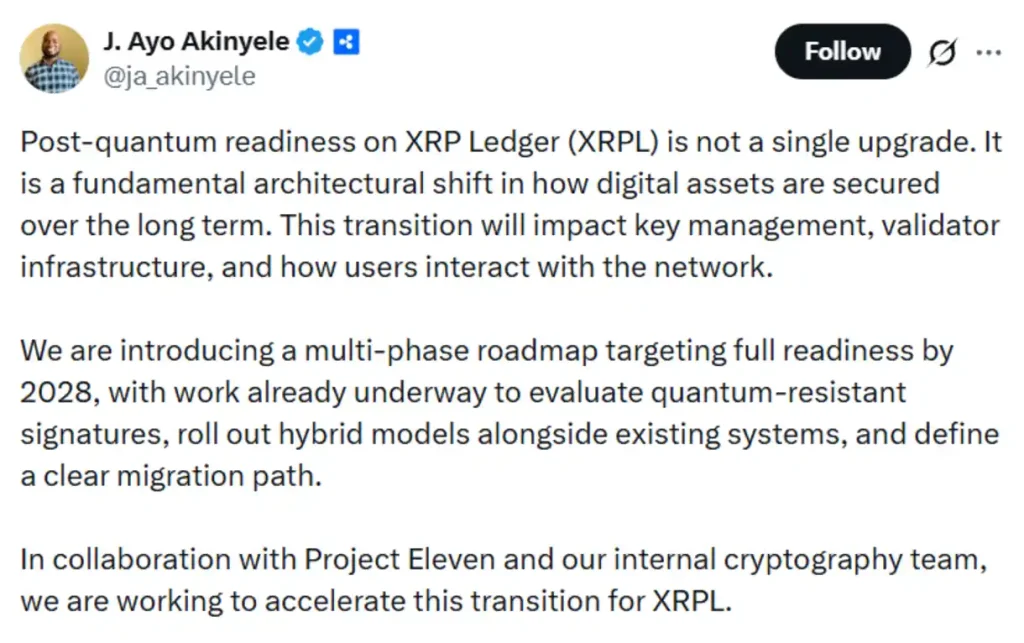
Ripple has released a multi-phase roadmap to make the XRP Ledger resistant to quantum computing attacks, targeting full readiness by 2028. The move follows new research showing that the cryptography securing most blockchains today could eventually be broken by advanced quantum systems. Assets are not at risk today, but the timeline for preparation is now being pulled forward.
What Ripple is actually building
As a reminder, Dr. Edoardo Persichetti, FAU Associate Professor, co-author of the NIST-standardized HQC, General Chair of EUROCRYPT 2026, and advisor at qLABS, explained that we might not have enough time to wait for a perfect solution. As he told TechGaged:
“Threat model is not symmetric: adversaries engaged in ‘harvest now, decrypt later’ operations are already collecting encrypted traffic today. (…) Waiting for mathematical certainty that can never fully arrive because no public-key scheme is unconditionally secure is not a rational strategy. It is an excuse for inaction.”
The risk comes from how blockchain security works. Wallets and transactions rely on cryptographic signatures that are effectively unbreakable with current computing power, but quantum machines could eventually solve these problems far more efficiently.
Ripple has structured its plan, shared on April 20, as a gradual transition.
Early phases focus on research, planning, testing post-quantum signature schemes, and evaluating algorithms recommended by NIST. Later stages introduce hybrid systems where new quantum-resistant signatures run alongside existing ones, allowing developers and validators to adapt without disrupting the network.
The roadmap contains four phases. It starts with “Q-Day readiness,” or contingency planning for a worst-case “Q-Day” scenario, and moves into testing and experimentation through 2026. It then transitions into controlled deployment before a full rollout targeted for 2028.
One structural advantage for the XRP Ledger is native key rotation. Users can update cryptographic keys without moving funds to new addresses, which simplifies migration compared to networks that require full wallet transfers.
What this means for XRP holders
There is no immediate risk. Current quantum hardware is still far from capable of breaking blockchain encryption at scale, with today’s systems operating far below the threshold needed for a real attack.
The more relevant concern is long-term. The “harvest now, decrypt later” model means attackers could collect public key data today and attempt to crack it years down the line when the technology catches up.
Ripple’s timeline reflects that reality. By targeting 2028, the goal is to complete the transition before quantum threats become practical, giving the network time to coordinate changes across developers, validators, institutions, and other stakeholders.
Other blockchains are exploring similar solutions, but most are still in earlier stages. The XRP Ledger is already testing implementations, which puts it slightly ahead in execution. The direction is clear, and the industry is beginning to treat quantum risk as a real, if distant, constraint.
How do you rate this article?
Subscribe to our YouTube channel for crypto market insights and educational videos.






Join our Socials
Briefly, clearly and without noise – get the most important crypto news and market insights first.

Most Read Today
1
Morgan Stanley Adds to Its Bitcoin Position for a Fourth Straight Day
2Strategy’s Bitcoin Treasury Just Hit Another Massive Milestone
3Stop Losing Crypto: Self-Custody Security, Multisig, and Inheritance
4Zcash Has More Than a Price Story — Here’s What’s Really Changing
5BNB Chain Just Gave Builders More Room — The Next Wave Could Be Coming
Latest





8
Also read
Similar stories you might like.

Crypto News
BNB Chain Just Gave Builders More Room — The Next Wave Could Be Coming
Azeez | 2026-09-05
Crypto News
BlackRock Leads the Biggest Bitcoin ETF Inflow Surge of the Week
Azeez | 2026-09-04

Crypto News
A Major Solana Upgrade Targets High-Speed Agent Payments
Azeez | 2026-09-04

Crypto News
500 Million XRP Leaves Binance: A Major Supply Shift Unfolds
Azeez | 2026-09-02
Crypto News
About 1 Billion XRP Unlock Sparks Fresh Market Attention
Azeez | 2026-09-01
Crypto News
A Major Zcash Upgrade Is Changing Wallet Performance
Azeez | 2026-08-31
Crypto News
XRP Ledger’s Institutional Credit Vote Could Change the Game for XRP
Azeez | 2026-08-31

Crypto News
Sui User Growth Surges to New Highs — Bullish?
Azeez | 2026-08-30

Crypto News
XRP Whales Are Moving — Binance Records Largest Outflow in Six Months
Azeez | 2026-08-27

Crypto News
AQAv2 Launch Could Boost HYPE Revenue by 18% and Fuel Buybacks
Azeez | 2026-08-27