














A person holding a stack of cryptocurrency tokens. Source: TechGaged
How Many Cryptocurrencies Fail?
In Brief
- • Crypto project failures exploded in 2025 as millions of new tokens flooded the market.
- • Most newly created cryptocurrencies never gain lasting traction or real-world usage.
- • Easy token creation and memecoin speculation continue reshaping the crypto landscape.

Want to explore the bigger picture behind the numbers? Explore our full cryptocurrency statistics report for deeper insights into market growth, adoption, and blockchain trends.
By the end of 2025, 11.6 million crypto projects had died. The number landed in a single year, and it dwarfs every previous year on record combined.
CoinGecko’s data tells the story most cleanly. Five years ago, project failures barely cracked four digits. By the close of 2025, the count had climbed into the eight figures. The fourth quarter alone wiped out 7.7 million tokens.
Latest Stories
Binance’s Bitcoin Reserves Plunge — Are Late Buyers Finally Feeling FOMO?

Gold Falls to a Seven-Week Low as Markets React to Changing Rate Expectations

Crypto Keeps Outperforming Stocks and Commodities: The Numbers Tell the Story
Most never had a real shot. They launched on a memecoin launchpad, traded for a few hours or a few days, and disappeared. A few were jokes that briefly caught fire. Plenty were scams dressed up as projects.
So how many cryptocurrencies are still alive today, and how many have already gone quietly into the dirt? Here’s the data, straight from the trackers, alongside the cases demonstrating what failure looks like in crypto.
How many coins are there?
This is a tough one. As of 13 May 2026, the count depends entirely on which tracker you trust and how you define “cryptocurrency.” Anyone with a wallet and a few dollars can mint a token in minutes, and each platform sets its own bar for what’s worth listing.
CoinMarketCap currently lists around 8,400–10,000 actively tracked cryptocurrencies.
CoinGecko tracks roughly 17,400 cryptocurrencies.
New listings show up daily and old ones fade away once they stop trading. The image below shows part of the listings page for May 13. Each new coin is tagged by chain and Fully Diluted Valuation (FDV). FDV is the price-times-total-supply figure, the project’s theoretical market cap if every token were already in circulation.
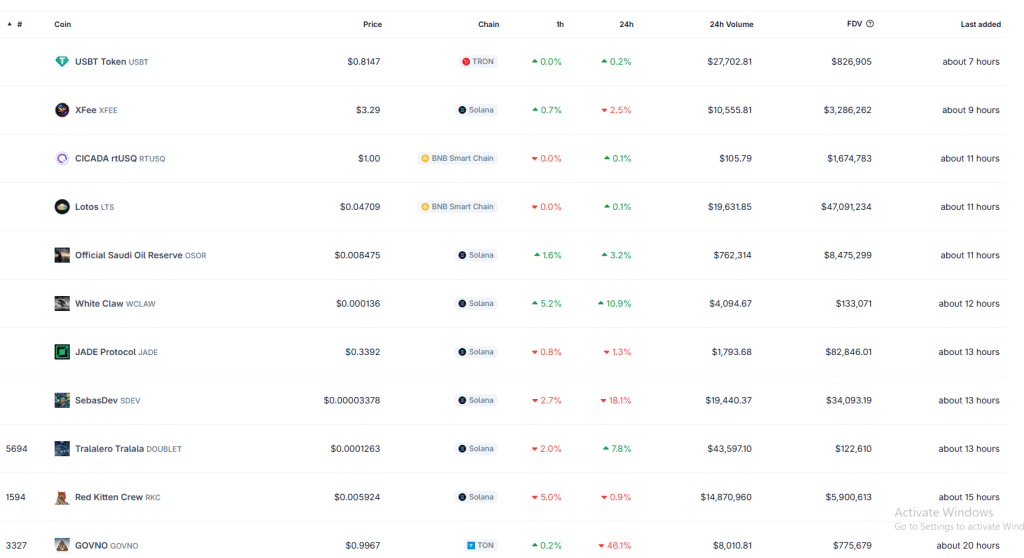
Throw in automatically generated tokens, abandoned coins, scam contracts, and projects that never reached a major tracker, and the on-chain estimates run into the tens of millions.
How many crypto projects are still alive?
The best guess by mid-May 2026 puts the figure somewhere between 17,000 and 17,500 crypto projects trading with enough volume to count as alive.
For example, CoinGecko says it is currently tracking about 17,400 active cryptocurrencies, while also noting that it removes inactive and dead projects from its main listings.
There is no exact data, but reports say that more than half a million tokens were created in the first two weeks of 2026.
On May 13, CoinMarketCap tracked a total of 50.52 million coins. Since the beginning of the year, the number rose from 29.29 million. The chart shows a significant jump in the latter half of 2024.
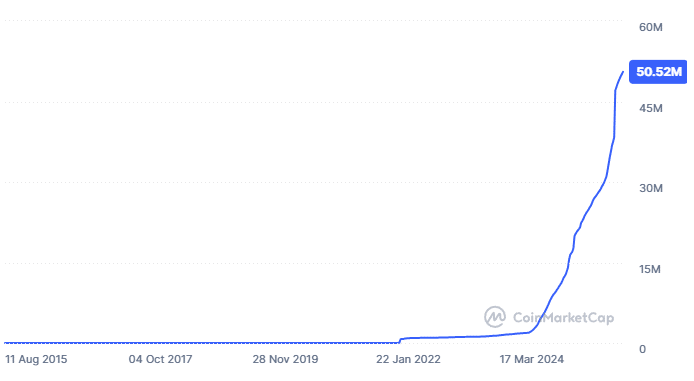
Total Cryptos Created
Last 24h: 57,747
Last 7d: 333,080
Last 30d: 1,800,090
Yearly Performance
Yearly High was on Mar 19, 2026, 7,681,147
Yearly Low was on May 13, 2026, 8
CoinMarketCap recorded the highest daily count on 8 July, 2025, when a whopping 1.3 million coins were created.
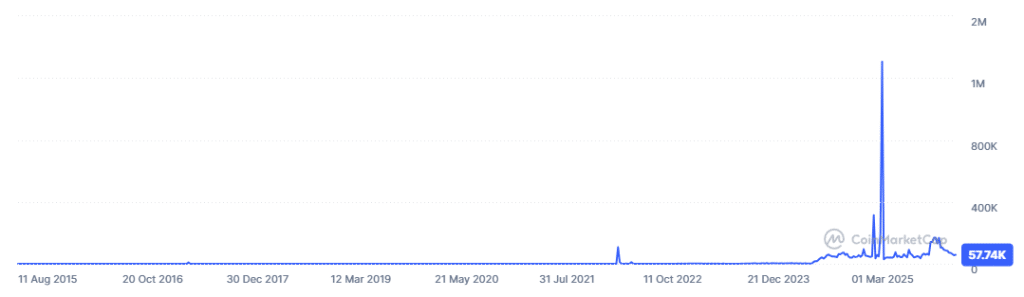
Most of these tokens were never meant to last. Plenty exist to ride a meme for an afternoon, or to test an idea that wasn’t ready for a final product.
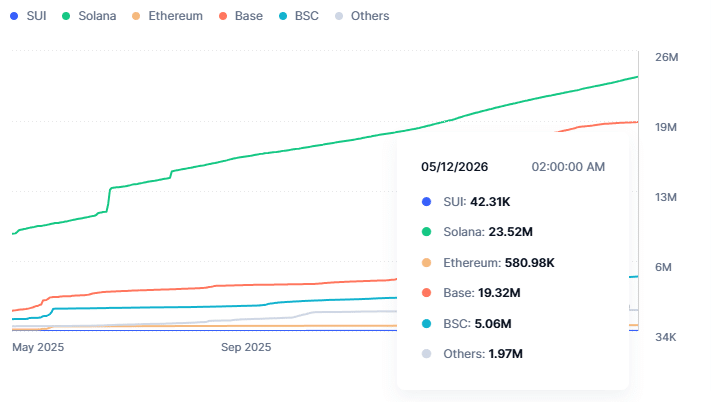
Looking at chains, from most to least, in the past year Solana takes the lead with around 65%, followed by Base, BSC, Ethereum, and a number of others grouped together.
Solana has grown significantly since October 2024, with millions of coins created on this chain. The spike can be linked to a single product, called Pump.fun. It runs a launchpad that lets users deploy a token on Solana quickly, without coding experience and with a cost of under two dollars. The rest of the memecoin economy followed its lead.
CoinGecko’s more general numbers support the rule. In 2021, GeckoTerminal listed 428,383 projects in total. By late 2025, that had grown to around 20.2 million. Cheap launchpads turned token creation into a simple process.
Why so many new coins keep appearing
Creating a cryptocurrency has never been easier or cheaper. On Solana or BNB Smart Chain, launching a token takes minutes. Pump.fun and similar launchpads handle the smart contract, the liquidity pool, the trading interface, and the rest of the technical know-how, and the only thing left for the developer to do is pay gas and click deploy. In regulated finance, licensing alone takes years.
Then there’s the fact that a coin doesn’t even need a roadmap or a working product to attract buyers. All it needs is momentum. Memecoins, in particular, run on attention. Tons of launches exist purely to chase a 24-hour window of hype. Add the low cost of failure and the math gets ugly. If launching costs $2 and a hit can mint millions, you only need to be right once.
2025: a record year for dead coins
Crypto has never seen a year like 2025 for failures. The headline numbers are bleak.
GeckoTerminal data
Between 2021 and end of 2025
Number of listed projects: 4,608% increase
Number of failed projects: 449,102% increase
Between 2024 and end of 2025
Number of listed projects: 565% increase
Number of failed projects: 740% increase
The study tracks every coin and token ever listed on GeckoTerminal, grouping them by the year of their last active trade. Anything no longer trading counts as “dead.”
By CoinGecko’s latest count, 53.2% of all cryptocurrencies that ever made it onto GeckoTerminal are now dead. The tilt toward last year is brutal, as 11.6 million of those failures happened in 2025 alone. This is 86.3% of every project death since 2021, squished into 12 months.
The fourth quarter was the worst stretch, when about 7.7 million tokens collapsed between October and December.
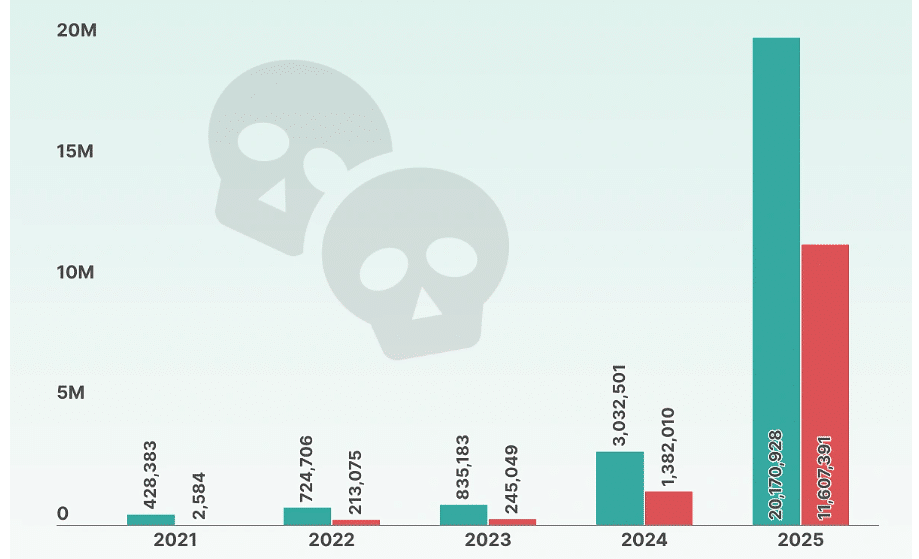
In second place is 2024, when nearly 1.4 million projects died and just over 3 million launched. That’s also the year Pump.fun came online. Before the launchpad’s debut, total annual failures stayed in the low six digits. Combined deaths across 2021, 2022, and 2023 add up to just 3.4% of the five-year total.
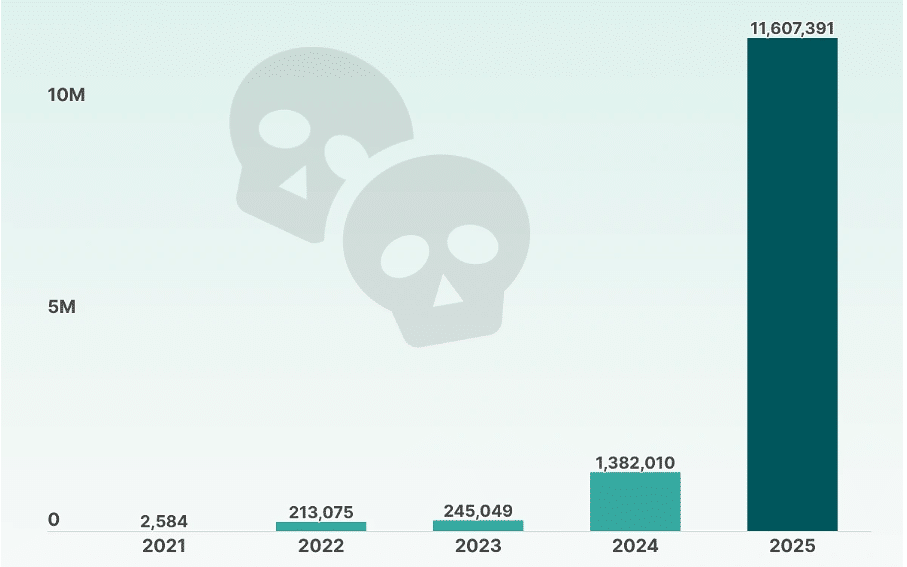
Most of the late-2025 damage traces back to the October 10 liquidation cascade. In a single 24-hour stretch, $19 billion in leveraged positions got wiped out in the largest one-day deleveraging crypto has ever recorded. Memecoins took the worst of it, and once liquidity drained, the long tail of speculative tokens had nothing holding them up.
What 2026 looks like from here
Two forces keep the floor pressed down for 2026. The first is sheer saturation. With more than 50 million coins on the books, anything new has to fight for attention in a market that already can’t keep track of what’s there and what isn’t anymore. A lot of new launches were designed for a quick hype cycle and abandoned the moment the chart cools.
The second is regulatory pressure. Governments across the US, EU, UK, and Asia have tightened the rules around token issuance, marketing, and exchange listings. Projects that can’t meet the new standards get delisted or simply shut down. Compliance costs have squeezed the marginal operations that were already running on fumes.
Total failure counts probably won’t match last year’s headline number, but only because the pool of speculative launches has thinned. The percentage of new launches that die fast will stay high.
99% of Web3 projects don’t earn a cent
A separate CoinGecko report earlier this year, citing Token Terminal data, found that 99% of Web3 projects generate no revenue. The remaining 1% account for almost all the cash flow in the sector.
Instead, the survival funding comes from token sales and treasury burn-downs, and most projects have never sold a product or service in the traditional sense. The industry has a name for the timeline these teams are looking at. It calls it a “runway,” which relates to the months a project can keep paying things like salaries and server bills before the funds run out.
Per Token Terminal’s count, only about 200 projects around the globe managed to pull in even ten cents of revenue across the previous 30 days. The other 99% can’t cover their own operating costs from sales and they’re funded purely by belief (Bitcoin shows zero here because transaction fees go directly to miners, not to a protocol treasury).
And it’s nothing unheard of before. Many Web3 projects launch on vision alone, with the product still in the slide deck. Billion-dollar valuations keep showing up for projects with zero customers because the structure of Web3 funding makes a fast exit easier than building a full-fledged company, and plenty of teams build for the exit.
What counts as a dead coin?
A dead coin is a token whose project has been abandoned, scammed, underfunded, or starved out of existence. The trickier question is when, exactly, you call it like it is.
CoinMarketCap uses a simple rule. If a cryptocurrency has less than $1,000 in total trading volume across a three-month window, it gets flagged as dead. Around 60% of all listed projects sit at or near that threshold, which means a huge part of the supposedly active market is just one bad quarter away from running into the ground.
Beyond volume, a few other patterns are visible in the post-mortems. Funding runs out before the product ships, which kills about 3.6% of dead projects at the outset. Or the token does nothing the market actually wants. Or the whole thing was a scam from day one, with guaranteed-return promises and exit liquidity drained the second retail buyers piled in.
Security failures take care of the rest. Smart contract bugs, social engineering, wallet exploits, the occasional bridge hack, one false step. Once a meaningful amount of funds drains from any of these, trust rarely comes back.
Famous dead coins
These haven’t faded away silently, they exploded or imploded loudly, causing massive impact to the entire market and damage to the industry for months afterwards.
BitConnect (BCC): The biggest Ponzi in crypto history, this project ran a “trading bot” that supposedly generated guaranteed daily returns by trading BCC for Bitcoin. UK regulators flagged it in late 2017 and Texas authorities called it a Ponzi in January 2018. The platform shut down within days. BCC crashed 90%, and Carlos Matos’s manic “BitConneeeeeeeeectttt!” shouts at a 2017 conference became one of crypto’s lasting memes.
Terra (LUNA) and TerraUSD (UST): The 2022 collapse of UST and its sister token LUNA sank $40 billion in under a week. UST, an algorithmic stablecoin, was supposed to hold its peg to the dollar through a mint-and-burn relationship with LUNA. When UST depegged, LUNA’s supply hyperinflated in an attempt to defend it, and both tokens dropped to zero together.
OneCoin: Launched in 2014, OneCoin was marketed as a revolutionary cryptocurrency. Except it wasn’t. There was no blockchain and no verifiable transactions. Founder Ruja Ignatova vanished in 2017 and is still on the FBI’s most wanted list. Investors lost an estimated $4 billion.
FTX Token (FTT): FTT was the exchange token for FTX, the platform that collapsed in November 2022 after a CoinDesk report exposed how heavily Alameda Research relied on FTT as collateral. Once confidence broke, the token crashed and the exchange filed for bankruptcy. Founder Sam Bankman-Fried got 25 years for fraud.
The rise and fall of meme and political coins
Memecoins dominated the crypto narrative for most of 2024 and into early 2025. MarketWatch put it bluntly when it argued that most of these coins had no economic purpose, but outperformed plenty of tokens that did, including ETH. Then the sector peaked in August 2024 at $137.19 billion in total market cap, and by May 2026 it had collapsed to $38.69 billion, less than a third of its high.
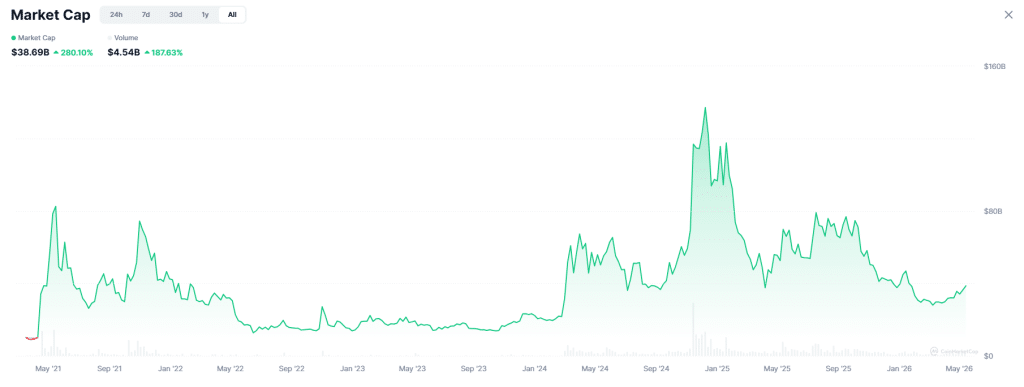
Alice Liu, research lead at CoinMarketCap, told MarketWatch the appetite died for a specific reason. “People are getting tired because they think the game is rigged,” she said. The original pitch was that memecoins were the most democratic among all cryptos.
“Everyone has an opportunity and everyone can participate,” Liu said. “You can still get that 10x, potentially 100x opportunity even if you don’t [have] any resources in crypto or insider knowledge. That is often not the case any more.”
Three high-profile launches did most of the damage to that pitch.
LIBRA: Argentine President Javier Milei endorsed the LIBRA token in a February post on X. The coin rallied briefly, then Milei deleted the post a few hours later. LIBRA lost more than 90% of its value almost immediately. Insider wallet allegations followed.
TRUMP and MELANIA: On January 17, just days before his inauguration, Donald Trump launched his own namesake memecoin. Two days later, Melania Trump launched hers. Both rallied hard, then sold off as insiders cashed out. According to Liu, the losses pushed many first-time crypto buyers out of the market entirely, deterring them from exploring the rest of the Solana ecosystem.
NYC Token: The most recent failure and the cleanest example of a suspected rugpull in 2026 is NYC Token, the Solana-based memecoin launched in January 2026 with promotion from former NYC Mayor Eric Adams. It briefly hit a market cap close to $600 million. But within 30 minutes, wallets linked to the project allegedly pulled $2.5-3 million in liquidity, and the price crashed 60-80%. The team blamed “market maker operations” during volatility. But on-chain analysts weren’t convinced, as none of it looked accidental, not the speed of the collapse, the concentrated holdings, the lack of transparency, or the absence of any concrete project structure.
Key takeaways
The crypto market spews out more coins each week than the traditional financial system produces public companies in a year, and most of them die. Those 11.6 million failures in 2025 were the natural result of a system that lets anyone launch a token for spare change.
There are three things to watch through the rest of 2026. First is where new launches concentrate. Solana hosts about 65% of all token creation at the moment, with Pump.fun as the engine. If a competing launchpad on Base or another L2 starts pulling traffic, the failure vector will shift with it.
Second is what regulators do with political memecoins. The LIBRA, TRUMP, MELANIA, and NYC Token episodes have created a political need for stricter rules, especially around endorsements and undisclosed insider holdings. Third is the handful of projects pulling actual revenue that look more interesting every quarter as the noise around them clears. Token Terminal is the place to watch.
One rule holds across every cycle. If you can’t tell what a project earns and who pays for it, take a very skeptical approach. The crypto cemetery is full of tokens that never had an answer to either question.
How do you rate this article?
Subscribe to our YouTube channel for crypto market insights and educational videos.






Join our Socials
Briefly, clearly and without noise – get the most important crypto news and market insights first.

Most Read Today
1
Binance’s Bitcoin Reserves Plunge — Are Late Buyers Finally Feeling FOMO?
2These US Data Releases Could Set Crypto’s Direction This Week
3Crypto Keeps Outperforming Stocks and Commodities: The Numbers Tell the Story
4Gold Falls to a Seven-Week Low as Markets React to Changing Rate Expectations
5Sui Is Preparing Something Big — Basecamp 2026 Could Reveal It All
Latest





8
Also read
Similar stories you might like.

Crypto News
Binance’s Bitcoin Reserves Plunge — Are Late Buyers Finally Feeling FOMO?
Azeez | 2026-09-28

Crypto News
Crypto Keeps Outperforming Stocks and Commodities: The Numbers Tell the Story
Azeez | 2026-09-28

Crypto News
Bitcoin Repeats a Rare Q3 Pattern — Could Q4 Bring Another Explosive Rally?
Azeez | 2026-09-27

Crypto News
Chainlink Reserve Crosses 6 Million LINK — What This Means for the Token
Azeez | 2026-09-26

Crypto News
Altcoin Season Indicators Jump as Bitcoin Dominance Stalls: What Changed?
Azeez | 2026-09-26

Crypto News
Bitcoin’s $18B Options Expiry Is Coming — A Major Market Move Could Follow
Azeez | 2026-09-24

Crypto News
Most Altcoin Holders Are Still Losing — Why This Cycle May Have Room to Run
Azeez | 2026-09-23

Crypto News
Crypto Open Interest Is Surging — Ethereum Stands Out
Azeez | 2026-09-22

Crypto News
Something Is Changing on Avalanche: Network Fees Just Hit a Weekly High
Azeez | 2026-09-22

Crypto News
One of Bitcoin’s Oldest Wallets Wakes Up — What Could Be Behind the Move?
Azeez | 2026-09-22