









Tokenization is gaining traction. Source: TechGaged/Shutterstock
JPMorgan, Mastercard, and Ripple: Could This Alliance Unlock Tokenization’s Next Breakout?
In Brief
- • JPMorgan, Mastercard, and Ripple tested near-instant cross-border settlement.
- • The pilot links blockchain with traditional banking for faster transactions.
- • If scaled, it could cut risk and boost tokenized asset adoption.

For years, tokenized assets have promised to transform global finance, but one problem kept standing in the way: settlement. Now, JPMorgan Chase & Co., Mastercard, and Ripple are backing technologies that could finally close that gap and bring trillions of dollars in real-world assets on-chain.
The Settlement Gap Holding Back Tokenized Assets
For years, banks and asset managers have promoted tokenization as the next major evolution in finance. The idea is simple: convert assets such as stocks, bonds, and real estate into digital tokens that can be transferred instantly and traded around the clock.
Settlement has long been the main obstacle. While tokenized assets can move in seconds on a blockchain, the cash used to pay for them still relies on traditional banking systems that operate only during business hours and may take days to settle. This “settlement gap” has been a major barrier to scaling tokenized assets beyond pilot programs.
Latest Stories
ADA ETF Decision Nears — One SEC Date Could Trigger a Market Shakeup

Chainlink Reserve Crosses 6 Million LINK — What This Means for the Token

HBAR Goes After the $5T Tokenization Narrative With Major Stocks
Without a reliable way to move both assets and money at the same time, institutions face counterparty risk, liquidity inefficiencies, and operational delays. Solving this problem is essential if tokenized markets are to handle the trillions of dollars currently locked in conventional financial infrastructure.
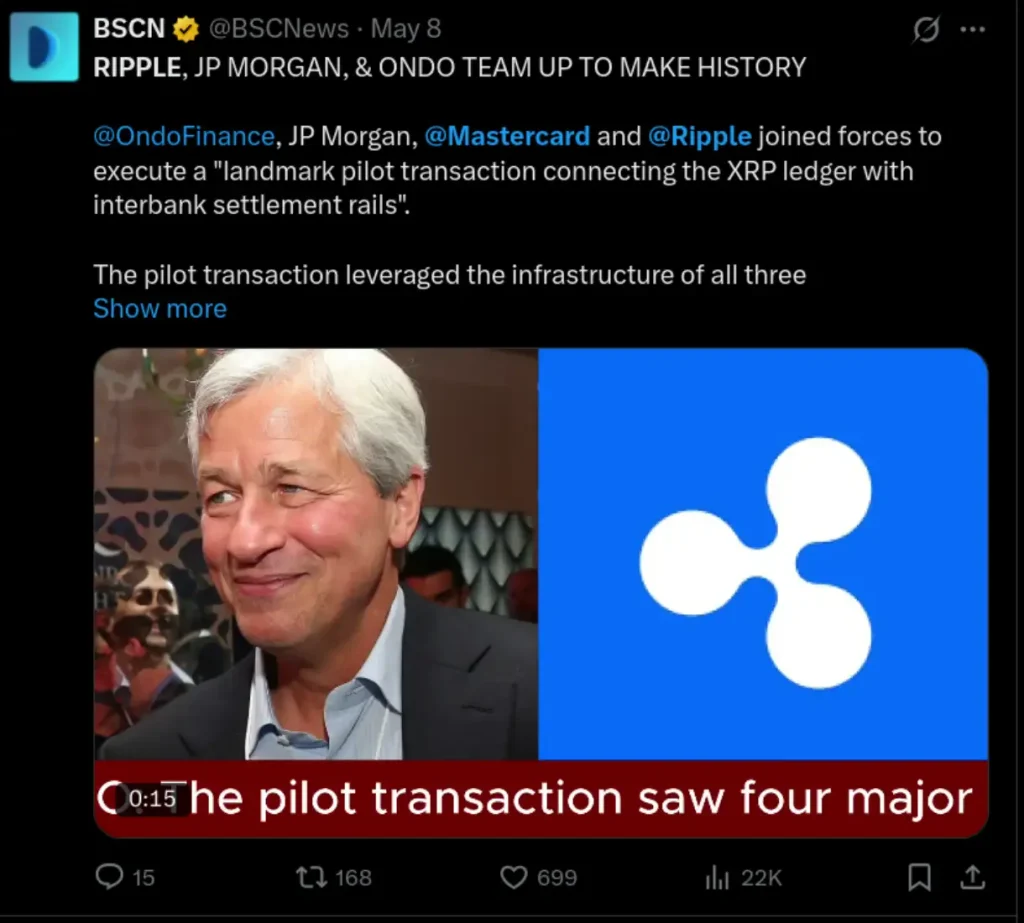
The Real Story: A 5-Second Settlement Test That Could Replace the 3-Day Wait
The breakthrough came when Ondo Finance, working with JPMorgan Chase & Co.’s Kinexys platform, Mastercard, and Ripple, completed what they described as the first near real-time, cross-border, cross-bank redemption of tokenized U.S. Treasuries. In practical terms, a process that normally takes one to three business days was coordinated in seconds—even outside traditional banking hours.
Ripple redeemed part of its holdings in Ondo Finance’s OUSG tokenized Treasury fund on the XRP Ledger.
Mastercard’s Multi-Token Network then sent settlement instructions to JPMorgan Chase’s Kinexys platform. Kinexys transferred the U.S. dollar proceeds through the banking system to Ripple’s account in Singapore.
The blockchain portion was completed in under five seconds, while the banking transfer was executed within the same integrated workflow. The pilot’s importance is not that banks have fully moved on-chain. Rather, it proved that public blockchains and traditional banking infrastructure can work together in a single transaction flow.
This hybrid model could enable 24/7 settlement of tokenized assets, reducing delays and counterparty risk while giving investors faster access to liquidity.
Implications and Benefits for Investors
If this model moves beyond the pilot stage, it could transform global settlement by replacing multi-day processes with near-instant transfers. For investors, the benefits are substantial.
Transactions that settle almost immediately reduce settlement and counterparty risk. Capital also becomes more efficient, as funds are freed up faster for reuse.
Fewer intermediaries can lower cross-border transaction costs, creating significant savings for large institutions.
Most importantly, the pilot boosts confidence in blockchain-based settlement and highlights growing institutional adoption. That trend could support digital assets and fintech platforms focused on payments, liquidity, and financial infrastructure.
Key Takeaway
This development highlights a clear trend toward real-time global settlement, reducing risk, cutting costs, and improving liquidity efficiency. For investors, it signals growing institutional confidence in blockchain-based payment infrastructure and a potential shift in how global financial transactions are processed and valued.
Disclaimer:
This article is for informational purposes only and does not constitute financial, investment, or trading advice. The views expressed are based on publicly available data, market observations, and the author’s interpretation at the time of writing. Cryptocurrency markets are highly volatile and unpredictable, and past performance or current technical setups do not guarantee future results. Readers should conduct their own research and consult with a qualified financial advisor before making any investment decisions. TechGaged does not accept liability for any losses incurred based on the information presented.
How do you rate this article?
Subscribe to our YouTube channel for crypto market insights and educational videos.






Join our Socials
Briefly, clearly and without noise – get the most important crypto news and market insights first.
Most Read Today
1
Bitcoin May Soon Have Private Transfers Without Changing Its Core Rules
2ETH Is Leaving Exchanges at a Record Pace — Here’s Where the Supply Is Going
3$ZCSH Hits $1B AUM as Grayscale Doubles Down on Zcash Exposure
4BCH Jumps Before CME Futures Go Live — Institutional Money or Something Else?
5Bitcoin’s $18B Options Expiry Is Coming — A Major Market Move Could Follow
Latest





8
Also read
Similar stories you might like.

Crypto News
HBAR Goes After the $5T Tokenization Narrative With Major Stocks
Azeez | 2026-09-26
Crypto News
XRP Breaks a Seven-Month Barrier as Whale Activity Hits a Fresh High
Azeez | 2026-09-23
Crypto News
XRP Takes Center Stage in a Gold-and-Oil Sovereign Reset Scenario
Azeez | 2026-09-21
Crypto News
XRP Whale Activity Is Picking Up — The Next Price Move Could Be Significant
Azeez | 2026-09-16
Crypto News
Ali Martinez Spots an XRP Breakout Setup as Investors Watch
Azeez | 2026-09-14
Crypto News
XRP Joins Bitcoin, Ethereum and Solana in a Major U.S. Listing Framework
Azeez | 2026-09-10

Crypto News
The Real World Assets (RWA) Race Has Taken a New Turn
Azeez | 2026-09-07
Crypto News
XRP Trading Volume Surges to a February High — Something Is Changing
Azeez | 2026-09-07
Crypto News
500 Million XRP Leaves Binance: A Major Supply Shift Unfolds
Azeez | 2026-09-02

Crypto News
Tokenized Gold Is Flowing Into DeFi — Tether Gold Crosses $100M
Azeez | 2026-09-02