






Photo by <a href="https://unsplash.com/@kevinache?utm_source=WP+Agent&utm_medium=referral">Kevin Ache</a> on <a href="https://unsplash.com/?utm_source=WP+Agent&utm_medium=referral">Unsplash</a>
Celestia’s SP1 Blobstream Deployments Are No Longer Maintained — Some Rollups Need a New Verification Path


Celestia has quietly moved Blobstream into legacy status, and the change has a practical consequence for rollups that depended on the Succinct-operated SP1 deployments for dispute verification.
According to Celestia’s current documentation, those SP1 Blobstream deployments are no longer maintained and no longer receive new commitments as of September 2026. Celenium has also stopped providing its Blobstream explorer.
This does not mean Celestia data availability itself is offline. It means one specific verification bridge between Celestia and EVM environments is no longer being operated as a maintained service.
Latest Stories
Polkadot Adds New Emergency and Technical Governance Tracks in Runtime v2.5.0

Scroll Completes OpenVM 2.0 Upgrade With New SWIRL Proof System

Cosmos Community Weighs Return of 1.227 Million ATOM Recovered After Neutron Exploit
The distinction matters for rollup security
Blobstream was designed to let EVM chains verify that data had been published to Celestia. It relayed commitments to Celestia data roots into contracts on another chain, where rollups could prove that their transaction data was actually available.
That mechanism is especially relevant for integrations such as Arbitrum Nitro with Celestia DA. Celestia’s own Nitro integration documentation now warns operators not to rely on the old SP1 Blobstream deployment for new commitments.
Teams using that architecture must establish another working Blobstream verification path if they want dispute proofs to remain dependable.
Data availability and verification are separate dependencies
The episode is a useful reminder that modular blockchain stacks contain multiple layers of trust and operations. A rollup may successfully post data to Celestia while still depending on another service to prove that publication inside a dispute system.
If the verification layer stops receiving new commitments, the underlying data can still exist while the rollup’s fraud-proof pathway becomes incomplete.
Celestia has retained legacy proof-query documentation, meaning operators can still query inclusion proofs directly from consensus full nodes. But infrastructure teams now need to own or source the verification pathway rather than assuming the old hosted deployment will continue indefinitely.
For modular rollups, that is not a cosmetic documentation change. It is an operational dependency that needs to be reviewed.
How do you rate this article?
Subscribe to our YouTube channel for crypto market insights and educational videos.





Join our Socials
Briefly, clearly and without noise – get the most important crypto news and market insights first.
Most Read Today
1
AI Traces $387M Bitget Heist to North Korea as 2026 Losses Cross $1B
2Tokenization firm VerifyMe Rebrands to OpenWorld After NASDAQ Debut
3BlackRock Bitcoin Trust Gains Allie Family Office Investment
4Most explosive Bitcoin signal just appeared on the monthly chart
5ADA ETF Decision Nears — One SEC Date Could Trigger a Market Shakeup
Latest






8
Also read
Similar stories you might like.

Blockchain
Polkadot Adds New Emergency and Technical Governance Tracks in Runtime v2.5.0
TechGaged | 2026-10-04

Blockchain
Scroll Completes OpenVM 2.0 Upgrade With New SWIRL Proof System
TechGaged | 2026-10-04
Crypto News
Cosmos Community Weighs Return of 1.227 Million ATOM Recovered After Neutron Exploit
TechGaged | 2026-10-04

Blockchain
Hedera Is Removing Smart Contract Calls From Atomic Batches — Developers Have Until March 2027
TechGaged | 2026-10-04
Crypto News
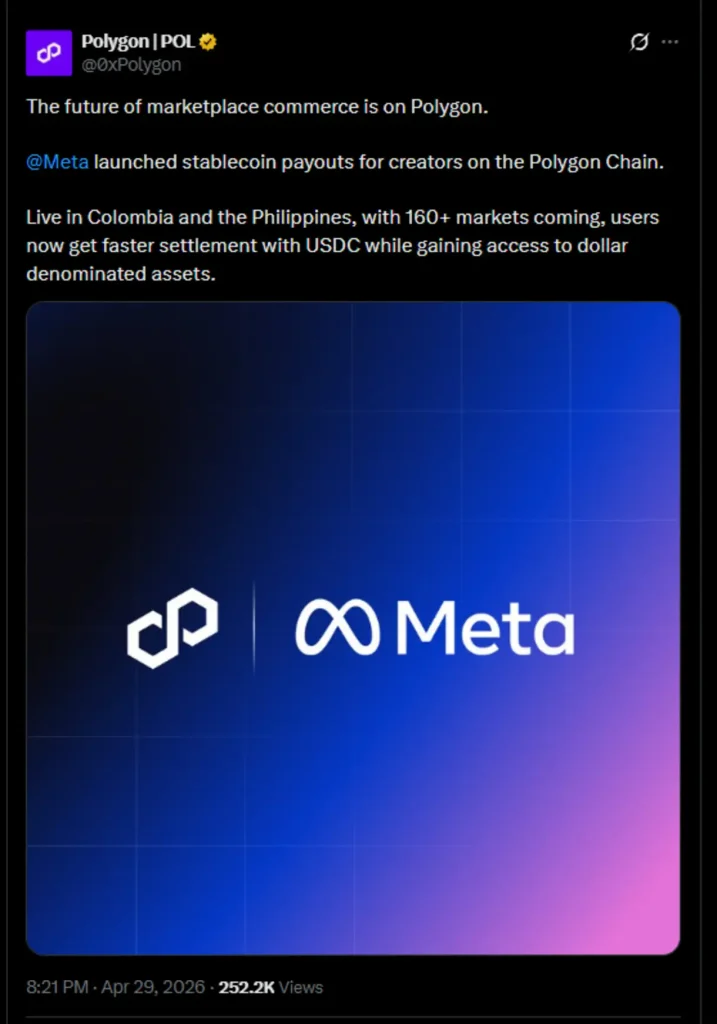
Polygon Updates POL’s MiCA White Paper as EU Trading Access Expands
TechGaged | 2026-10-04
Blockchain
Hedera Moves Its Bridgeless Cross-Ledger Protocol Into the Linux Foundation
TechGaged | 2026-10-04
Blockchain
South Korea’s KOMSCO Tests Full Local-Currency Settlement on the OP Stack
TechGaged | 2026-10-04
Blockchain
Polygon Ships Bor v2.10.2 With Faster State-Root Processing and New Witness Messaging
TechGaged | 2026-10-04
Blockchain
Hedera Quietly Completes v0.77.5 Mainnet Upgrade — Here’s What Changed
TechGaged | 2026-10-04
Market
BlackRock Bitcoin Trust Gains Allie Family Office Investment
Rokas | 2026-10-03