














UAE Blocks Stablecoin Salaries – Why Digital Nomads Are Affected. Source: TechGaged / Shutterstock
UAE Blocks Stablecoin Salaries – Why Digital Nomads Are Affected
In Brief
- • The UAE reportedly doesn't recognize crypto income as salary, making crypto-paid workers ineligible for digital nomad visas.
- • This policy contrasts with the country’s broader push to position itself as a global crypto hub.
- • Despite regional tensions, much of the local crypto community has remained in place.

If you’re a digital nomad paid in crypto, the UAE may not be a good place for your work.
According to recent reports, the UAE does not allow workers paid in any crypto to receive that salary while in the country. The rule reportedly includes stablecoins. This is a clear contradiction to its efforts to become an ever-growing crypto hub, welcoming local and foreign industry-related investment.
Semafor reported that workers paid in cryptocurrency are not even eligible for a digital nomad visa. “Even if that is in a US dollar-denominated stablecoin and like triple the minimum threshold, [cryptocurrency] is not recognized as a salary,” said Alex Scott, who leads community development for Solana in the Middle East.
Latest Stories
ADA ETF Decision Nears — One SEC Date Could Trigger a Market Shakeup

Chainlink Reserve Crosses 6 Million LINK — What This Means for the Token

HBAR Goes After the $5T Tokenization Narrative With Major Stocks
The crypto-friendly hub(?)
As noted above, this exclusion is highly surprising given the UAE’s efforts to attract this exact community. What’s more, marrying the digital nomad visa system with the crypto industry is bound to attract a high number of these individuals, potentially even collectives.
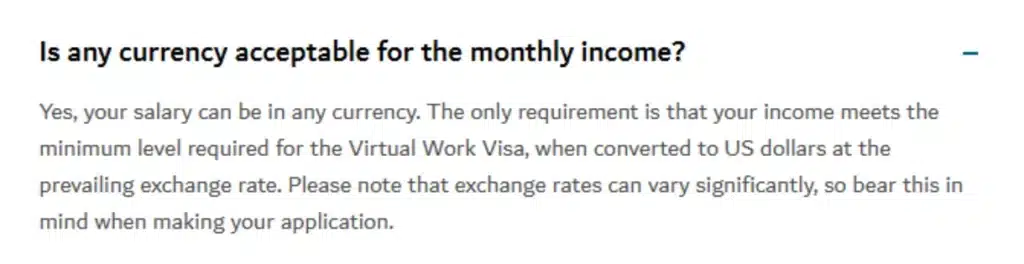
The official website doesn’t specify any crypto-related details. It only notes that the visa application requires proof of salary of at least US $3,500 per month “or equivalent”.
Also, in February, the Central Bank of the United Arab Emirates (CBUAE) granted regulatory approval for the nation’s first USD-backed stablecoin, USDU. This move placed the UAE among the earliest major jurisdictions to approve a central bank-recognized USD-pegged stablecoin, indicating a regulatory commitment to integrating digital settlement assets into the financial system.
Various companies are expanding in the region as well. Just recently, Ripple announced the Dubai International Financial Centre (DIFC) as its new Middle East and Africa (MEA) regional headquarters. This push deeper into the UAE, with a goal to expand the team even further, shows a growing appetite for regulated blockchain-based payments in the region.
Moreover, the UAE is working to attract those escaping the Iran war, says the report, describing the crypto community in the UAE as “highly mobile, being overwhelmingly young, low on obligations, and able to work from anywhere.”
Yet, Solana’s Scott told the news outlet that most of this community of around 90 blockchain and crypto entrepreneurs decided to stay despite the conflict.
How do you rate this article?
Subscribe to our YouTube channel for crypto market insights and educational videos.






Join our Socials
Briefly, clearly and without noise – get the most important crypto news and market insights first.

Most Read Today
1
Bitcoin May Soon Have Private Transfers Without Changing Its Core Rules
2ETH Is Leaving Exchanges at a Record Pace — Here’s Where the Supply Is Going
3$ZCSH Hits $1B AUM as Grayscale Doubles Down on Zcash Exposure
4BCH Jumps Before CME Futures Go Live — Institutional Money or Something Else?
5Bitcoin’s $18B Options Expiry Is Coming — A Major Market Move Could Follow
Latest





8
Also read
Similar stories you might like.

Crypto News
Altcoin Season Indicators Jump as Bitcoin Dominance Stalls: What Changed?
Azeez | 2026-09-26

Crypto News
Bitcoin Passes a Major Historical Test — A New Phase May Be Emerging
Azeez | 2026-09-21

Crypto News
Ethereum Breaks Its January High: Whales Are Waking Up
Azeez | 2026-09-19

Crypto News
Bitcoin Loses the True Market Mean — The Next Move Could Be Crucial
Azeez | 2026-09-17

Crypto News
Nearly $100M of Bitcoin Just Moved Into MARA: The Timing Matters
Azeez | 2026-09-16

Crypto News
Avalanche’s NYC Summit Hits Capacity — The Ecosystem Numbers Tell a Bigger Story
Azeez | 2026-09-13

Crypto News
Crypto Sentiment Flips — Another Major Market Shift May Be Underway
Azeez | 2026-08-22

Crypto Guides
What Is a Rug Pull in Crypto, and What Should You Do Right Now?
Rokas | 2026-08-21
Crypto News
Bitcoin Volatility Hits A Rare Extreme — A Bigger Move Could Be Coming
Azeez | 2026-08-18

Crypto News
Chainlink Holders Hit A Record High — Could Price Finally Catch Up?
Azeez | 2026-08-15