











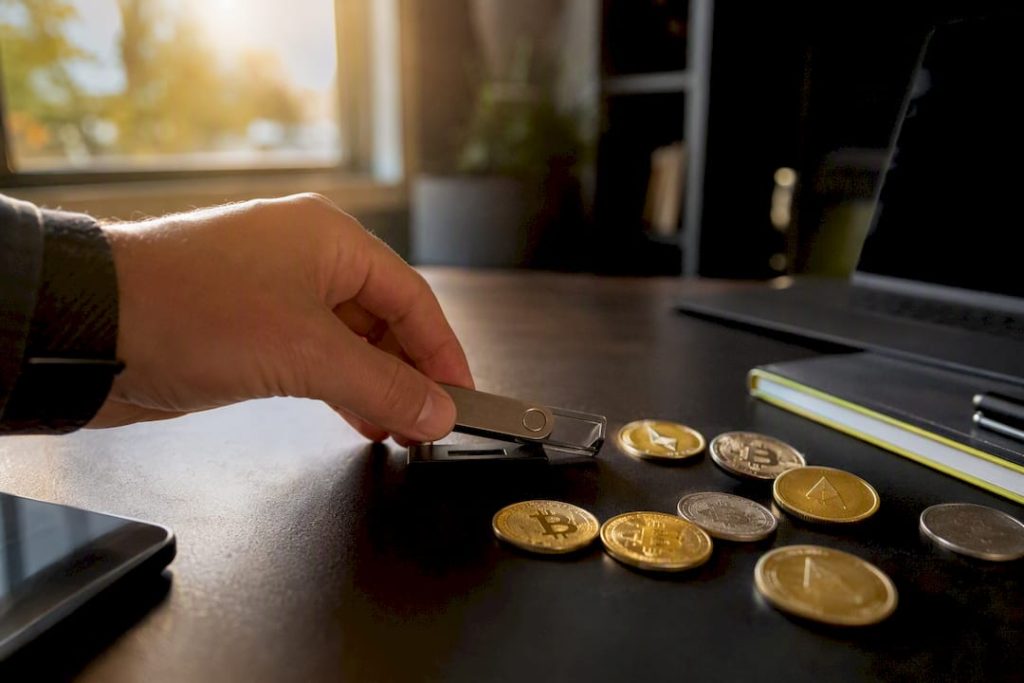
Hand placing hardware crypto wallet near tokens

Impermanent loss is the value gap between holding two tokens in an automated market maker pool versus holding them in your wallet, caused by the pool rebalancing as prices move. It is called “impermanent” because the gap can shrink back to zero if prices return to where they started; it only becomes a real, locked-in loss the moment you withdraw. The verdict for anyone thinking about liquidity providing: it can still be a profitable strategy, but only if the trading fees and any incentive rewards you collect outweigh the IL a given pair generates.
- IL is structural, not a bug: it comes from how constant-product AMMs price trades.
- It’s reversible on paper until withdrawal, then it’s locked in.
- The ETH/USDC math below works out to roughly 5.72% IL on a simple price-doubling scenario.
Key Takeaways
Impermanent loss is a mathematically predictable cost of AMM liquidity provision, and it only becomes profitable to accept when fees and incentives outweigh it.
Latest Stories

Bitcoin Dominance Holds at 59% as Capital Concentrates Rather Than Rotating Into Altcoins
XRP Is Up 51% This Week — Its Biggest Weekly Gain in 21 Months

Fed Rate Hike Probability Climbs to 42% — What It Means for Markets
| Point | Details |
|---|---|
| IL comes from arbitrage | Arbitrageurs rebalance pool prices to match markets, which is the actual mechanism behind IL. |
| The formula is fixed | IL = 2√(price_ratio)/(1+price_ratio) − 1, giving 5.72% IL on a 2x ETH/USDC move. |
| IL isn’t linear | A — move costs —, while a 5x move costs —, per the curve above. |
| Withdrawal locks it in | IL stays reversible until you exit the pool; price reversion can erase it entirely. |
| Correlated pairs cut risk | Stablecoin or correlated pairs like ETH/stETH keep price ratios near 1 and IL near zero. |
What Is Impermanent Loss and Why Does It Happen?
Impermanent loss happens because liquidity pools use a pricing formula that forces automatic rebalancing every time someone trades against the pool. That mechanism is the constant-product formula, written as x*y=k, where x and y are the quantities of the two tokens in the pool and k is a constant the pool tries to preserve after every swap.
When the external market price of one token moves, the pool’s internal price lags until a trader profits from the gap. That trader is an arbitrageur, and their trade pulls the pool’s ratio back in line with the broader market. In doing so, they buy the pool’s temporarily undervalued asset and sell it the overvalued one, which means the pool itself ends up holding more of whichever asset dropped in value and less of whichever asset rose. Chainlink’s breakdown of this mechanism frames arbitrage as the actual engine of IL, not a side effect.
Volatility doesn’t cause impermanent loss directly. It just creates the wider price gaps that make arbitrage more frequent and more lucrative, which pulls more value out of the pool over time.
- Constant-product AMMs (Uniswap, and most forks) all share this exposure by design.
- The bigger the price swing between deposit and any point in time, the larger the unrealized IL.
- Arbitrageurs aren’t adversaries; they’re the reason pool prices stay roughly accurate.
That volatility history is a rough proxy for how much arbitrage activity, and therefore IL, you should expect.*
How Do You Calculate Impermanent Loss?
The standard formula liquidity providers use is:
IL = 2 × √(price_ratio) / (1 + price_ratio) − 1
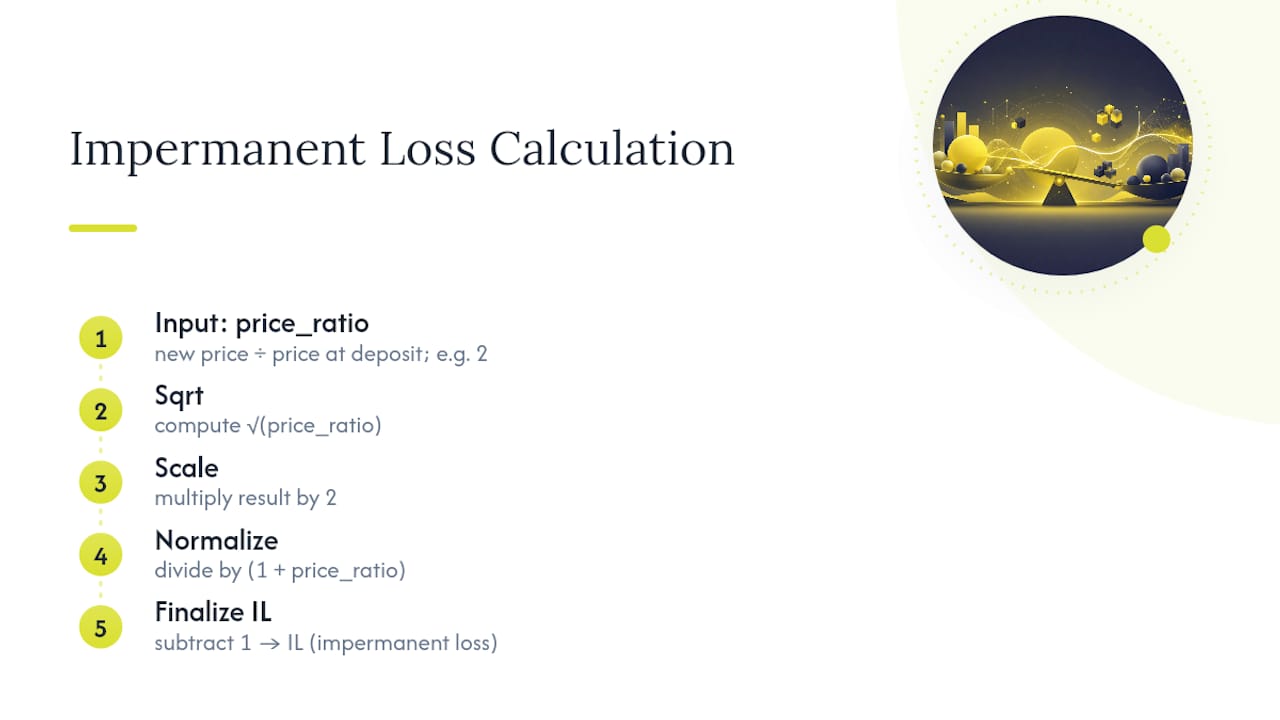
Here, price_ratio is the new price divided by the price at deposit. If a token doubles in price relative to its pair, the price ratio is 2.
How big is the ETH/USDC example?
Say you deposit into an ETH/USDC pool when ETH trades at $2,000, contributing $1,000 in ETH and $1,000 in USDC. If ETH then doubles to $4,000, the price ratio is 2. Plugging that into the formula gives roughly a 5.72% loss compared with simply holding the original ETH and USDC separately, a figure both Chainlink and Kraken’s learning resources reproduce with the same numbers. In dollar terms on a $2,000 position, that is roughly $114 of relative underperformance versus holding.

The loss scales with how far the price ratio drifts from 1, and it isn’t linear. Coinbase’s glossary lays out the curve at a few common checkpoints:
Small moves barely register. Large ones compound fast, which is exactly why pools holding volatile, low-correlation pairs carry the sharpest IL exposure.
When Does Impermanent Loss Become a Real Loss?
Impermanent loss stays a paper calculation for as long as your tokens sit in the pool. It only crystallizes into an actual, realized loss the moment you withdraw your liquidity position. If the price ratio drifts back toward 1 before you exit, the loss shrinks or disappears entirely, which is the entire reason the “impermanent” label exists in the first place, as Uniswap’s own support documentation confirms.
IL is also not the only risk on the table. A few others deserve equal attention:
- Depegging risk: a “stable” or pegged asset in a pool can lose its peg, causing losses that have nothing to do with IL math.
- Smart contract risk: bugs or exploits in the AMM protocol itself can drain funds regardless of price behavior.
- Range risk: on concentrated liquidity designs, prices can move entirely outside your set range, stopping fee accrual while you still carry the IL exposure.
- Counterparty risk: bridged or wrapped tokens inside a pair introduce dependency on a separate custodian or protocol.
One nuance matters here: IL measures your position against holding the same tokens outside the pool. That’s a relative comparison. A pool position can post a positive absolute dollar return while still underperforming a simple buy-and-hold strategy, and both facts can be true at once.
What Are the Best Ways to Reduce Impermanent Loss?
Reducing impermanent loss starts with pool selection, not clever timing. Here’s a practical order of priority:
- Choose stablecoin or highly correlated pairs first. A USDC/USDT pool or an ETH/stETH pool moves in near lockstep, which keeps the price ratio close to 1 and IL close to zero, a strategy Binance Academy lists as the most reliable starting point for risk-averse LPs.
- Understand what concentrated liquidity actually trades off. Uniswap v3 and v4 let you concentrate capital inside a narrow price band, which boosts fee income per dollar deposited, but Uniswap’s own documentation notes this raises IL risk because the position gets fully exposed to whichever side of the pair is currently outperforming, once price exits the range.
- Consider single-sided liquidity products. Some protocols now let you deposit one asset only, with the protocol managing the pairing and, in some cases, offering IL protection funded by protocol reserves or insurance-style mechanisms.
- Stack incentives against expected IL. Yield farming rewards, paid on top of trading fees, exist specifically to offset IL on newer or more volatile pairs, but token rewards carry their own price risk.
- Build a short checklist before depositing: pair correlation, historical volatility, current pool APY, range width if using concentrated liquidity, and whether the token is newly launched, since new or thinly traded tokens tend to produce the sharpest price discovery swings and deepest IL.
Pro Tip: If you’re new to providing liquidity, start with a stablecoin pair for a month to learn the mechanics before touching a volatile pair. The fee income will be lower, but so will the tuition cost of your first mistake.
Will Fees Cover Your Impermanent Loss?
The only question that matters before depositing: will fees plus incentives outrun the IL this pair is likely to generate? Run the math before, not after.
Using the curve from the calculation section above, a 2x move costs 5.72%. If your expected fee income over the same window is below that, you’re likely underperforming simple holding.
- Model at least three price scenarios, not just the current trend.
- Use an IL calculator to sanity check your own math before depositing.
- Treat incentive tokens as a bonus, not a guaranteed offset, since their price can fall independently.
- Re-run the comparison whenever pool APY drops meaningfully, since fee income compresses as more liquidity enters a pool.
How Should You Monitor Impermanent Loss in 2026?
Managing impermanent loss is an ongoing job, not a one-time calculation at deposit. Dashboard tools built into major AMM front ends, along with third-party IL calculators, now let you simulate outcomes before committing capital rather than reacting after the fact.
Pools built around volatile, newly launched tokens demand tighter attention than blue-chip pairs, because the price discovery swings that drive early trading are exactly what widens the IL gap fastest.
Techgaged tracks the market moves, from ETH’s relative resilience during broader sell-offs to shifting altcoin volatility, that feed directly into how much IL risk a given pool carries at any given moment.
An Editorial Take on Impermanent Loss
The conventional advice tells people to “just avoid volatile pairs,” as if impermanent loss were a mistake rather than a built-in cost of the AMM model. That framing undersells the real skill involved, which is pricing the trade-off correctly rather than avoiding it entirely. Arbitrage isn’t an attack on liquidity providers; it’s the mechanism keeping pool prices honest, and pretending otherwise leads people to either avoid LPing altogether or dive in blind.
What gets underweighted in most explainers is range risk on concentrated liquidity. Everyone quotes the capital-efficiency upside of Uniswap v3 and v4, far fewer walk through what happens when price exits your range and fee income stops cold while IL exposure stays live. Readers should prioritize modeling scenarios before deposit, not chasing the highest advertised APY. A pool with modest, steady fees on a correlated pair usually beats a flashy incentive program on a volatile one, once IL gets subtracted honestly.
— Justinas
Sources
- Impermanent loss explained — Chainlink
- Concentrated liquidity — Uniswap Docs
- What is impermanent loss? — Kraken
FAQ
Is Providing Liquidity in a Pool Risky?
Yes. Beyond impermanent loss, liquidity providers face smart contract risk, depegging risk on pegged assets, and range risk on concentrated positions, so risk varies significantly by pool type and pair.
Is a Liquidity Pool Profitable?
It can be, but only when trading fees plus any incentive rewards exceed the impermanent loss the pair generates over your holding period, which is why modeling scenarios before depositing matters more than chasing the highest posted APY.
Why Is It Called Impermanent Loss If Money Is Actually Lost?
The loss stays unrealized and reversible as long as tokens remain in the pool; it only becomes permanent the moment you withdraw at an unfavorable price ratio.
Does Impermanent Loss Mean I Lost Money Overall?
Not necessarily. IL measures your position against simply holding the same tokens, so a pool position can still show a positive absolute return while underperforming a buy-and-hold approach.
Which Pools Have the Lowest Impermanent Loss?
Stablecoin pairs and highly correlated assets, such as ETH and stETH, keep the price ratio close to 1, which keeps IL close to zero compared with volatile, uncorrelated pairs.
Recommended
How do you rate this article?
Subscribe to our YouTube channel for crypto market insights and educational videos.






Join our Socials
Briefly, clearly and without noise – get the most important crypto news and market insights first.
Most Read Today
1
What Is a Funding Rate in Crypto Trading?
2Tokenized Assets Hit New Highs — US Treasuries Dominate the Growth
3Fed Rate Hike Probability Climbs to 42% — What It Means for Markets
4Bitcoin Dominance Holds at 59% as Capital Concentrates Rather Than Rotating Into Altcoins
5XRP Is Up 51% This Week — Its Biggest Weekly Gain in 21 Months
Latest





8
Also read
Similar stories you might like.
Crypto News
Bitcoin Dominance Holds at 59% as Capital Concentrates Rather Than Rotating Into Altcoins
Azeez | 2026-08-24
Crypto News
XRP Is Up 51% This Week — Its Biggest Weekly Gain in 21 Months
Azeez | 2026-08-24
Crypto News
Fed Rate Hike Probability Climbs to 42% — What It Means for Markets
Azeez | 2026-08-24

Crypto News
Tokenized Assets Hit New Highs — US Treasuries Dominate the Growth
Azeez | 2026-08-24

Beginners
What Is a Funding Rate in Crypto Trading?
Rokas | 2026-08-24

Crypto News
Institutional Crypto Demand Is Surging As ETF Inflows Hit Multi-Month Highs
Azeez | 2026-08-23
Crypto News
Zcash Has Delivered A 121% Rally Since June — Social Interest Is Finally Returning
Azeez | 2026-08-23

Beginners
Can You Still Harvest Crypto Losses on Your 2026 Taxes?
Rokas | 2026-08-23

Crypto News
Crypto Sentiment Flips — Another Major Market Shift May Be Underway
Azeez | 2026-08-22

Crypto News
Public Blockchains Are Quietly Winning The Institutional Tokenization Battle
Azeez | 2026-08-22