







Robert Kiyosaki. TechGaged.com
Inverse Kiyosaki Strategy Explained: The Cost of Sitting Out
In Brief
- • What happens if you do the exact opposite of what a finfluencer says.
- • In Robert Kiyosaki’s case, you get Inverse Kiyosaki, an investment concept with meme-like qualities that ultimately shows the cost of sitting on the sidelines.
- • The ‘Rich Dad Poor Dad’ author has spent decades telling the world that the financial sky is falling.

What happens if you do the exact opposite of what a finfluencer says?
In Robert Kiyosaki’s case, you get Inverse Kiyosaki, an investment concept with meme-like qualities that ultimately shows the cost of sitting on the sidelines.
The ‘Rich Dad Poor Dad’ author has spent decades telling the world that the financial sky is falling. The narrative that the global financial system is a fraudulent house of cards on the verge of total collapse became a trademark of sorts, urging followers to abandon stocks and “fake” currency in favor of gold, silver, and eventually, Bitcoin.
By analyzing 25+ years of market data, we uncovered a startling truth:
The greatest risk in the modern era wasn’t the great crash Kiyosaki kept promising, but the wealth you failed to build while waiting for it.
What is the Inverse Kiyosaki?
In simple terms, the Inverse Kiyosaki is a financial philosophy built on the premise of staying in the market when Kiyosaki tells you to run. It’s a strategy built on the observation that permabears like Kiyosaki are indeed good (even great) at identifying systemic flaws but terrible at accounting for systemic adaptability.
The philosophy originated in the late 2010s across message boards and trading groups. Here, users began to chart Kiyosaki’s most dire warnings against the subsequent performance of the S&P 500. With plenty of material, the concept gained traction during the pandemic-era investing boom when more retail investors began questioning financial gurus.

And while Kiyosaki often made (and still does) valid points about debt and inflation, his timing has become a legendary counterindicator.
The Inverse Kiyosaki philosophy argues that the global economy, which is driven by technology, labor productivity, and central bank intervention, has a certain bias for growth that far outweighs the structural debts Kiyosaki focuses on. It mandates that being right about the existence of a bubble is worthless if you exit the market a decade before the bubble actually pops.
So, Inverse Kiyosaki is largely about recognizing that the global economy is more resilient than a single doomsday narrative suggests. Where the famed author sees a death spiral, the IK investor sees a cycle. Where Kiyosaki sees fake money, the IK investor sees a tool for growth.
It’s almost an art of betting on human ingenuity and institutional adaptation over systemic collapse.
The math behind missed gains
To understand the sheer scale of the wealth lost by following doomsday advice, we have to look at the permabear “tax”. This is the compounded gain an investor sacrifices when they sit in “defensive” assets like gold or cash while the broader market accelerates.
Therein lies the biggest problem with following a permabear.
Eventually, they’ll be right, as they can’t always be wrong. The tax you pay in the meantime is what actually hurts.
Between 2011 and 2026, the S&P 500 underwent a transformation led by the Magnificent Seven (Apple, Microsoft, Alphabet, Amazon, Meta, Nvidia, and Tesla) and later the AI revolution. So, an investor who exited the market in 2011 based on Kiyosaki’s “greatest crash ever” warnings would have paid a massive tax on their future net worth.
For instance, Kiyosaki spent much of the early 2010s claiming that the “fake money” printing by the Fed would lead to immediate hyperinflation and a stock market wipeout. Yet, from January 2011 to January 2021, the S&P 500 returned roughly 260%. This means an initial $100,000 investment would have grown to over $360,000.
In the same period, gold (Kiyosaki’s primary recommendation) and silver remained fairly stagnant as safety nets. They finished the decade with significantly lower returns and higher volatility relative to tech-heavy equities. Those who moved into these assets saw their purchasing power remain relatively flat while being eaten away by the very inflation Kiyosaki warned about.
Here’s a look at some of the specific Kiyosaki predictions and how they panned out from an IK perspective:
📊 Kiyosaki Prediction Accuracy (1990–2026)
-
✓
Correct predictions: 3 / 7 (~43%) -
✕
Short-term forecasting reliability: Low -
✓
Macro direction: Often correct -
✕
Timing accuracy: Unreliable
Overall accuracy: Low to Moderate (~43%) — strong macro insight, weak timing precision
Based strictly on 7 confirmed predictions from TechGaged dataset (1990–2026). One prediction remains ongoing.
Now, let’s take a closer look at Robert Kiyosaki’s predictions.
2020 Greater Depression
In mid-2020, as the pandemic shuttered businesses, Kiyosaki warned that a “Greater Depression” was inevitable and told followers to buy gold and lead. He argued the stimulus-fueled rally would lead to a catastrophic 80% wipeout by year-end.
Investors who stayed in the NASDAQ-100 or S&P 500 rode a historic rally. From June 2020 to late 2021, the market gained over 50%. The Inverse Kiyosaki move was to realize that the so-called fake money (stimulus checks) was going directly into tech equities, not into gold bars sitting in a safe.
2022 Everything crash
In 2022, as interest rates rose, Kiyosaki claimed the “Everything Bubble” was popping and that
the S&P 500 was going to zero. He told followers to exit all “paper assets.”
However, next year witnessed the birth of the generative AI boom. Those who opted for the inverse strategy and stayed in Microsoft, NVIDIA, and Meta saw triple-digit gains in 2023 and 2024.
Following Kiyosaki meant sitting out on what is arguably the single most productive technological shift of the decade.
2024 Bitcoin
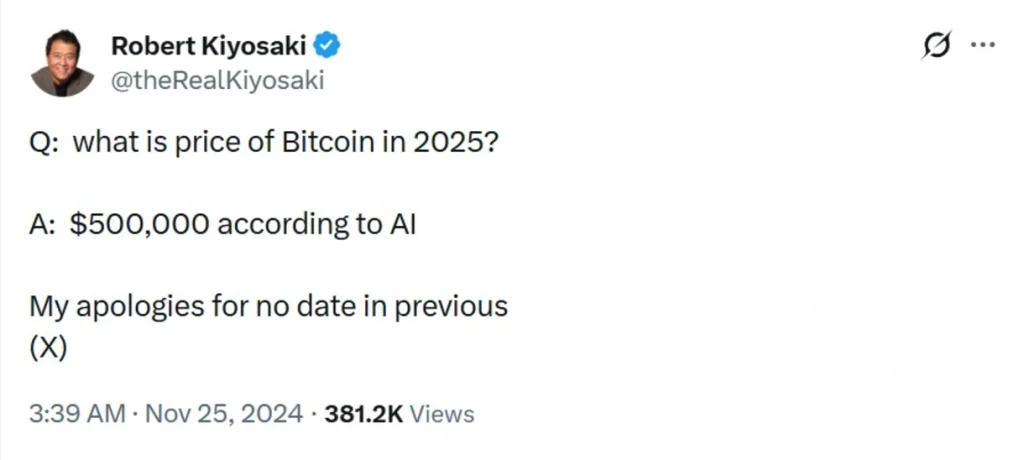
The 2020s marked Kiyosaki’s full pivot into a Bitcoin evangelist. Nevertheless, his timing was front and center once more, creating a unique Inverse signal. Kiyosaki often issues his most aggressive ‘buy Bitcoin’ tweets when the asset is experiencing peak retail FOMO.
Such was the case in November 2024, when his rhetoric about Bitcoin hitting new highs coincided with a $130 billion market cap wipeout. He even suggested that 2025 would be the year Bitcoin reaches $500,000 because AI says so.
2025 Historical crash
Kiyosaki spent much of 2024 and 2025 claiming that a crash of “historical proportions” would occur by early 2026 due to the death of the petrodollar.
We’re now in mid-April 2026, and the S&P 500 hit record highs, with institutional Bitcoin ETFs and AI-integrated manufacturing as key growth drivers. The Inverse investor capitalized on the transition from a petrodollar to a data-dollar economy.
2026 $750,000 Bitcoin
In what is probably his most aggressive forecast to date, Robert Kiyosaki has once again identified the “biggest bubble” in history, claiming that a total systemic reset is now a matter of when, not if. Though he didn’t mention the exact catalyst, he maintained that the global markets have reached a breaking point where any single event could act as the pin.
Kiyosaki predicts that one year after the initial collapse, capital will flee traditional paper assets at a record pace, driving Bitcoin to $750,000, Ethereum to $95,000, gold to $35,000 per ounce, and silver to $200 per ounce.
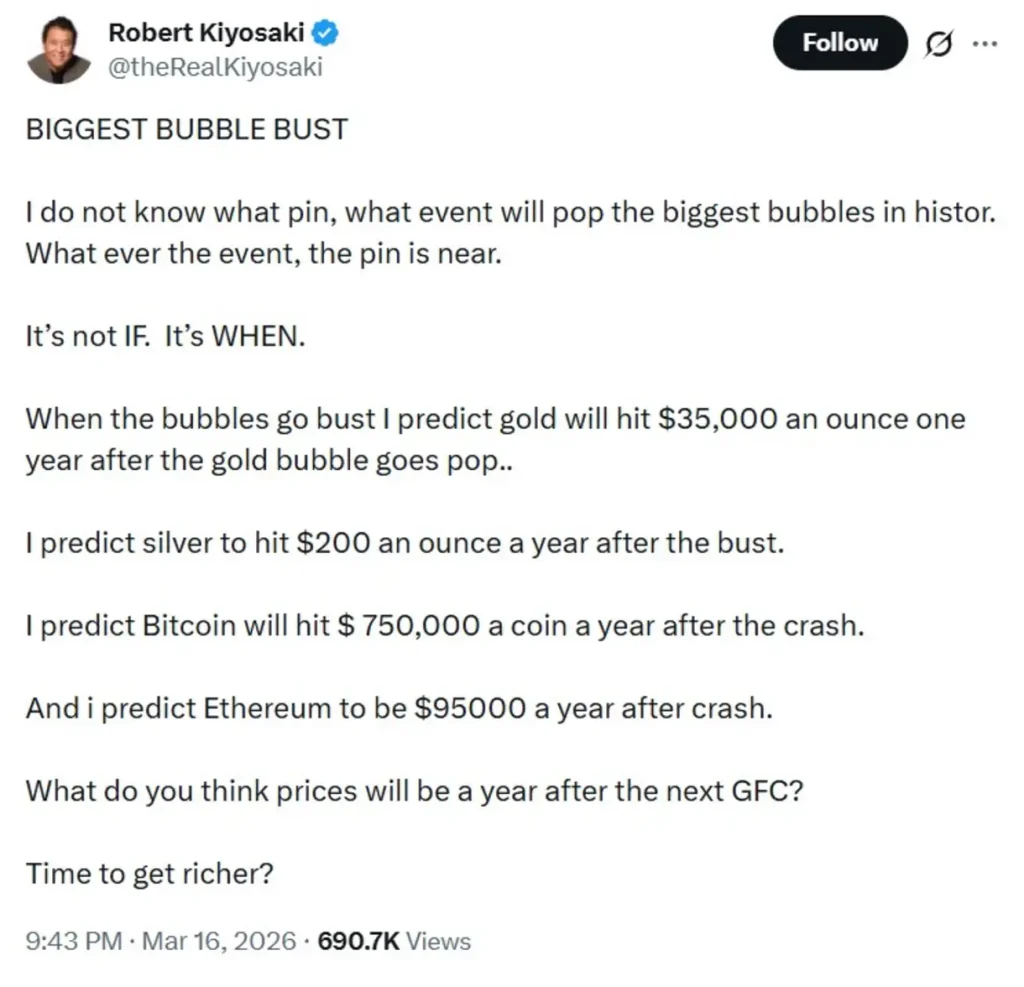
As with most predictions, this one is a double-edged sword.
While it supports the long-term bullish case for decentralization, it also serves as a critical sentiment indicator. By forecasting a 1,000% gain within twelve months of a total economic wipeout, Kiyosaki is betting on a recovery powered by extreme currency devaluation.
From an IK point of view, the reality is much more grounded. To be fair, the direction may be correct. Still, the timeline assumes a total lack of institutional intervention, which hasn’t occurred once in the last 26 years.
If we look at Kiyosaki’s abundant history of intense (and seemingly improbable) forecasts, it largely signals that the market has reached a state of peak speculation. While his long-term bullishness on Bitcoin aligns with institutional trends, his prediction of a total systemic collapse ignores the resilience we’ve already seen in 2026.
So, the Inverse move here would be to stay focused on the tech infrastructure actually driving the economy, rather than liquidating everything in anticipation of a doomsday that keeps moving its arrival date.
This brings us to:
Inverse Kiyosaki is not always accurate
Like any contrarian strategy, Inverse Kiyosaki and any other Inverse variant carry their own set of blind spots. These can lead to considerable financial ruin if followed blindly.
It’s because the strategy operates on the assumption that the permabear in question is always wrong about timing. However, at the same time, it ignores the possibility that the underlying structural concerns are entirely accurate.
As a result, relying solely on the Inverse signal creates a dangerous form of recency bias. In this scenario, an investor assumes that because a crash hasn’t happened in the last X years, it simply can’t or won’t happen.
Here are reasons why and when the Inverse Kiyosaki fails:
Risk of a broken clock
The most obvious flaw in the Inverse Kiyosaki philosophy is the broken clock syndrome. If an alarmist predicts a crash every single day for twenty years, they will eventually be right.
For the Inverse investor, this means you may successfully capture 15 years of gains by ignoring the warnings, but if the eventual black swan event is deep enough (e.g., a total collapse of the banking sector or a massive geopolitical shock), it could wipe out a decade of Inverse gains in a matter of weeks.
Ignoring valid tail risks
Yes, Kiyosaki often shouts about the doomsday scenarios in the economy and finance worlds. And while his timeline for these events is heavily criticized and ridiculed, the tail risks (rare, extreme investment outcomes that lie far outside the predictions of traditional risk models) he identifies are often rooted in legitimate economic shifts.
As we are currently witnessing the global shift toward data-dollars and AI-driven currency protocols, an investor who completely ignores Kiyosaki might find themselves over-leveraged in traditional fiat-backed assets just as the world transitions to something new.
In other words, the Inverse move fails when it becomes blind optimism and the belief that the system is invincible simply because it hasn’t failed up to that point.
Management of volatility
Kiyosaki’s primary recommendations (particularly silver and Bitcoin) are rather volatile. That said, the Inverse investor tends to stay heavily concentrated in tech equities (like the aforementioned Magnificent Seven). So, during periods of stagflation or unexpected interest rate hikes, both tech stocks and hard assets can plummet simultaneously.
In these instances, the Inverse investor doesn’t win. They simply lose in a different way. Following the Inverse strategy without proper diversification is a bet on perpetual growth, not quite a sound strategy.
Early predictions are not necessarily wrong
In the world of finance, being early is sometimes indistinguishable from being wrong. It’s no secret that the Inverse Kiyosaki strategy profits from this distinction.
But there are moments where Kiyosaki’s warnings about a specific sector were directionally correct years before the peak. A great example is the 2008 subprime mortgage crisis. It resulted in a $13 trillion mortgage market implosion, which Kiyosaki predicted in his 2002 book ‘Rich Dad’s Prophecy’.
Thus, an Inverse investor who doubled down on housing in 2006 because Kiyosaki is Kiyosaki would have been financially ruined. The strategy fails (and quite spectacularly, too) when it treats a long-term shift as a cyclical blip.
| Where Inverse Kiyosaki wins | Where Inverse Kiyosaki loses |
| Capturing bull markets: By ignoring the exit calls, investors stay in for rallies like the 2024–2026 AI boom, avoiding the massive opportunity cost of sitting in cash. | Black swan events: If a true systemic collapse occurs (like a total credit freeze), the Inverse investor is fully exposed, while the Kiyosaki follower has hard assets (gold, silver) as a safety net. |
| Superior asset growth: Historically, broad-market index funds (S&P 500/NASDAQ) have notably outperformed physical silver and gold over 5, 10, and 20-year periods. | Broken clock moment: Eventually, a permabear is right. The IK strategy fails if you don’t take any profits at the top, leaving you vulnerable when a correction finally hits. |
| Lower risk profile: Kiyosaki often suggests using heavy debt to buy real estate, while IK focuses on equity growth without the risk of bankruptcy. | Inflation protection: If hyperinflation truly hits, the Inverse investor holding paper assets or cash might see their purchasing power vanish faster than the stock market can grow. |
| Strategic liquidity: By not dumping all cash into physical metals, IK investors keep high-yield savings to buy real dips rather than theoretical ones. | Getting the right timing: Kiyosaki isn’t always wrong about direction, just timing. If you inverse his Bitcoin buy calls, you might miss out on a legitimate long-term institutional rally. |
So, what’s the deal with Inverse Kiyosaki?
The Inverse Kiyosaki philosophy/strategy works because it aligns with the primary engine of the stock market: optimism. Let’s face it – betting on the end of the world is a low-probability game. Even if you are right once every decade or two, the wealth you lost during the years of growth in between is extremely difficult (perhaps even impossible) to recover.
It’s important to note that the Inverse Kiyosaki method is not accurate by default. Yes, the man is repeatedly early or wrong with his predictions, but he is right once every so often. His base advice, which is investing in real estate, avoiding bad debt, and focusing on financial education, is widely accepted and on point.
When all is said and done, Kiyosaki is a marketer and merchant of fear as opposed to a traditional financial advisor. His advice is best taken as a general preference for hard assets, not as a specific, actionable investment strategy.
So, what’s the lesson here?
Don’t ignore the risks Kiyosaki points out.
Debt is real. Inflation even more so.
He’s a good choice to follow when it comes to awareness about the “fake” money system (inflation) and encouragement to learn about finance. But when he goes into fear-driven timing of buying/selling and hyper-leveraged debt strategies, it might be best to inverse him.
In the end, the Inverse Kiyosaki should be used as a sentiment barometer, not a replacement for fundamental analysis. At the very least, use his alarmism to check your own hubris. Or, use it to remind yourself to rebalance your portfolios, take some profits at the top, and ensure you have enough liquidity to survive if the broken clock finally strikes the correct hour.
Disclaimer: The information provided in this article is for educational and informational purposes only and is based on documented public facts. This is not financial advice. Techgaged does not provide investment recommendations, and the historical performance of any individual mentioned in this piece is not a guarantee of future market results.
FAQs
What is the “Inverse Kiyosaki” strategy?
The Inverse Kiyosaki is a contrarian investment approach that involves doing the opposite of Robert Kiyosaki’s short-term market calls—particularly his crash warnings. It’s based on the idea that while his macro concerns may be valid, his timing is often early or inaccurate.
Why do investors follow the Inverse Kiyosaki approach?
Investors use it to avoid the opportunity cost of sitting out long bull markets. Historically, staying invested in indices like the S&P 500 has significantly outperformed defensive assets during periods when Kiyosaki predicted imminent collapse.
Does Inverse Kiyosaki always work?
No. Like any contrarian strategy, it has risks. If a real systemic crash occurs, blindly staying invested can lead to heavy losses. The strategy works best when used as a sentiment indicator—not a standalone investment rule.
Is Robert Kiyosaki completely wrong about markets?
Not entirely. Kiyosaki is often directionally correct about issues like debt, inflation, and monetary policy. However, his forecasts tend to lack timing precision, which is why his advice can be costly if followed too literally.
How do you rate this article?
Subscribe to our YouTube channel for crypto market insights and educational videos.


Join our Socials
Briefly, clearly and without noise – get the most important crypto news and market insights first.
Most Read Today
1
Is Bitcoin a CIA Project? New Claims Spark Fresh Debate
2BNB Burn Signals Potential Price Shift — Here’s What Traders Are Watching
3Bitcoin Inflows Spike as $75K Caps Rally
4951 BTC Move Sparks Questions: Is Tether Quietly Accumulating Bitcoin?
5Tokenized Real-World Assets Already Reached $27B — Why This Still Matters for Crypto’s Future
Latest





8
Also read
Similar stories you might like.

Altcoins
New Record: Ethereum Hits 200M Transactions as Network Activity Breaks Out
Rokas | 2026-04-17
Bitcoin
Bitcoin to $0? Nobel Physicist’s Quantum Warning Jolts Crypto Again
Rokas | 2026-04-17
Bitcoin
Bitcoin Inflows Spike as $75K Caps Rally
Ana | 2026-04-16
Altcoins
BNB Burn Signals Potential Price Shift — Here’s What Traders Are Watching
Azeez | 2026-04-16
Bitcoin
951 BTC Move Sparks Questions: Is Tether Quietly Accumulating Bitcoin?
Azeez | 2026-04-16

Bitcoin
Bitcoin Core Developers Push Emergency Plan as Quantum Threat Escalates
Ana | 2026-04-16

Altcoins
X Introduces Cashtags and Market Charts in Push Toward Trading
Ana | 2026-04-16
Blockchain
Morgan Stanley Signals Major Shift to Tokenized Assets for Client Wealth
Rokas | 2026-04-16

Bitcoin
Is Bitcoin a CIA Project? New Claims Spark Fresh Debate
Rokas | 2026-04-16
Altcoins
Crypto Market Drops $40B as Bitcoin Loses Momentum
Ana | 2026-04-16