









Masked figure symbolizing crypto scams. Source: TechGaged / Shutterstock
Beware: Ethereum Address-Poisoning Scams Accelerate; How to Stay Safe?
In Brief
- • Address-poisoning scams on Ethereum are rising sharply.
- • Attackers send dust transfers from lookalike wallet addresses.
- • Users should verify full addresses before sending funds.

Ethereum (ETH) users are facing a sharp rise in address-poisoning scams following the network’s recent Fusaka upgrade. The attacks rely on small “dust” transfers sent from lookalike wallet addresses designed to trick victims into copying the wrong destination. Analysts warn that the surge highlights a growing threat tied to lower transaction costs on the Ethereum network.
Address-poisoning attacks increasing
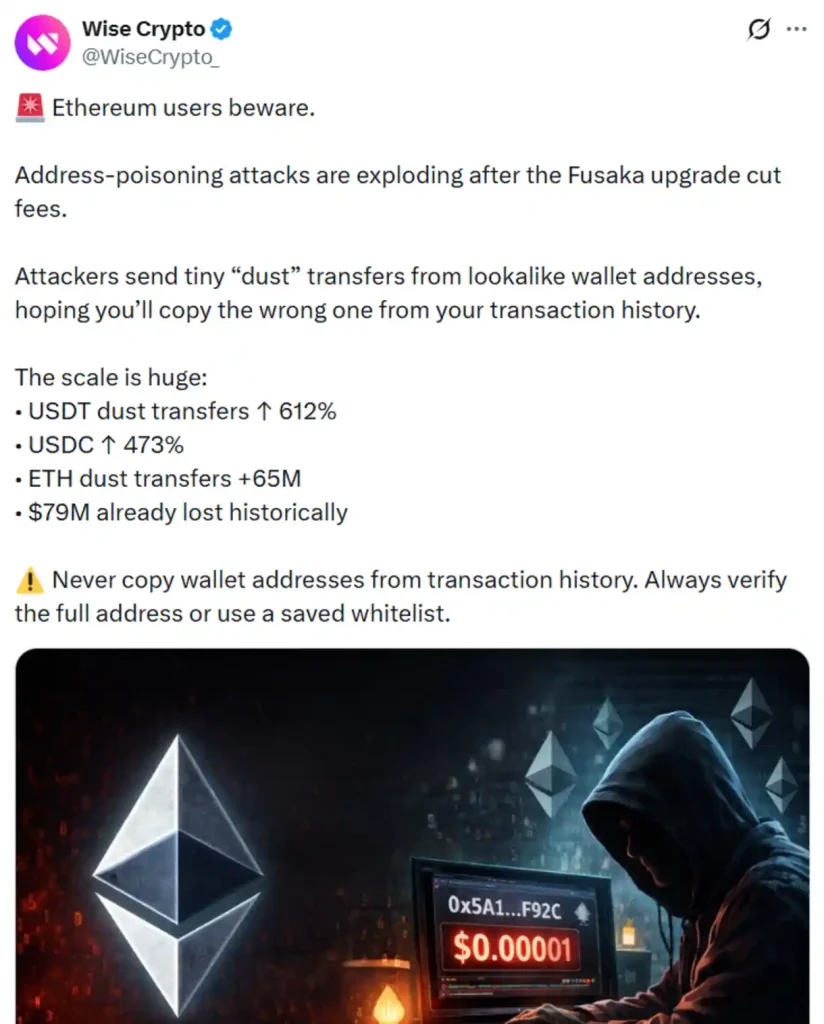
According to blockchain tracking shared by Wise Crypto in an X post on March 13, address-poisoning attacks have escalated significantly in recent weeks.
These scams typically involve sending a tiny cryptocurrency transfer, known as a dust transaction, from a wallet address that closely resembles a legitimate one.
The goal is to insert the fraudulent address into a user’s transaction history, where it may later be copied accidentally during a transfer. If the victim sends funds to the spoofed address, the assets are permanently lost.
Dust transfers surging across tokens
Data shared by analysts shows a sharp increase in dust transactions across several major assets on Ethereum. USDT-related dust transfers have reportedly risen 612%, while similar transfers involving USDC have increased 473%.
Meanwhile, ETH dust transfers have surged by more than 65 million transactions, indicating a broad rise in automated attack activity. Historically, address-poisoning schemes have already resulted in roughly $79 million in losses, according to estimates cited in the analysis.
Lower fees may be driving the trend
The spike in attacks comes shortly after the Fusaka upgrade, which reduced transaction costs on the Ethereum network.
Lower fees make it significantly cheaper for attackers to distribute large numbers of small transactions, allowing them to target many wallets at once.
Security researchers say this change may have unintentionally lowered the barrier for scammers to run automated poisoning campaigns.
Users urged to verify wallet addresses
Analysts say the most effective defense against address poisoning is careful verification of wallet addresses before sending funds.
Experts warn users not to copy addresses directly from transaction history, where poisoned entries may appear.
Instead, users are advised to confirm the full wallet address manually or rely on saved whitelists or trusted contacts when sending cryptocurrency.
More Must-Reads:
How do you rate this article?
Subscribe to our YouTube channel for crypto market insights and educational videos.






Join our Socials
Briefly, clearly and without noise – get the most important crypto news and market insights first.

Most Read Today
1
US Crypto Bill Nears Vote – Markup Could Force Final Decisions
2BTC Dips to $75,000, Market Resumes Consolidation as Fed ‘Holds Steady’
3Ripple Doubles Down On Dubai – What Investors Should Know
4Smart Money Doesn’t Wait for Confirmation — Bitmine’s 5 Million ETH Treasury Is the Signal
5Tether Plots Bitcoin Empire, Backs Mega Merger – What Users Gain From Deal
Latest




8
Also read
Similar stories you might like.
Altcoins
Whales Bought 10 Million Cardano (ADA) in 3 Days — Smart Money Positioning Early?
Azeez | 2026-05-01
Crypto News
Five Things That Will Define Crypto in May 2026
Azeez | 2026-05-01

Crypto News
US Crypto Bill Nears Vote – Markup Could Force Final Decisions
Rokas | 2026-04-30

Altcoins
Meta Launches USDC Payments for Colombian and Filipino Creators, More Coming
Rokas | 2026-04-30

Altcoins
Smart Money Doesn’t Wait for Confirmation — Bitmine’s 5 Million ETH Treasury Is the Signal
Azeez | 2026-04-30
Bitcoin
BTC Dips to $75,000, Market Resumes Consolidation as Fed ‘Holds Steady’
Sead | 2026-04-30
Altcoins
Rakuten Makes XRP Spendable for Millions — Why Is That Both Exciting and a Warning?
Azeez | 2026-04-30
Bitcoin
Tether Plots Bitcoin Empire, Backs Mega Merger – What Users Gain From Deal
Sead | 2026-04-30
Altcoins
Ripple Doubles Down On Dubai – What Investors Should Know
Sead | 2026-04-30
Altcoins
Why This Phase of Crypto Feels Different
Azeez | 2026-04-29