













Hooded figure walking along train tracks with briefcase. Source: TechGaged / Shutterstock
Arbitrum Freezes $71M ETH Linked To Kelp Hack
In Brief
- • Arbitrum froze $71M in ETH tied to the Kelp exploit.
- • Funds were moved to a governance-controlled wallet, blocking the attacker.
- • Highlights fast response, but also governance vs decentralization trade-offs.

Arbitrum froze 30,766 Ethereum (ETH) tied to the Kelp DAO exploit, securing about $71 million just hours after the attack escalated. The funds were moved to a governance-controlled wallet on April 20 at 11:26 p.m. ET, cutting off access from the exploiter. The move shows how quickly Layer 2 governance can step in to limit damage during active exploits.
Emergency action locks down stolen funds
According to the company’s X post on April 21, the Arbitrum Security Council executed the freeze with input from law enforcement, following identification of the attacker. The funds are now held in an intermediary wallet that cannot be accessed without further governance approval.
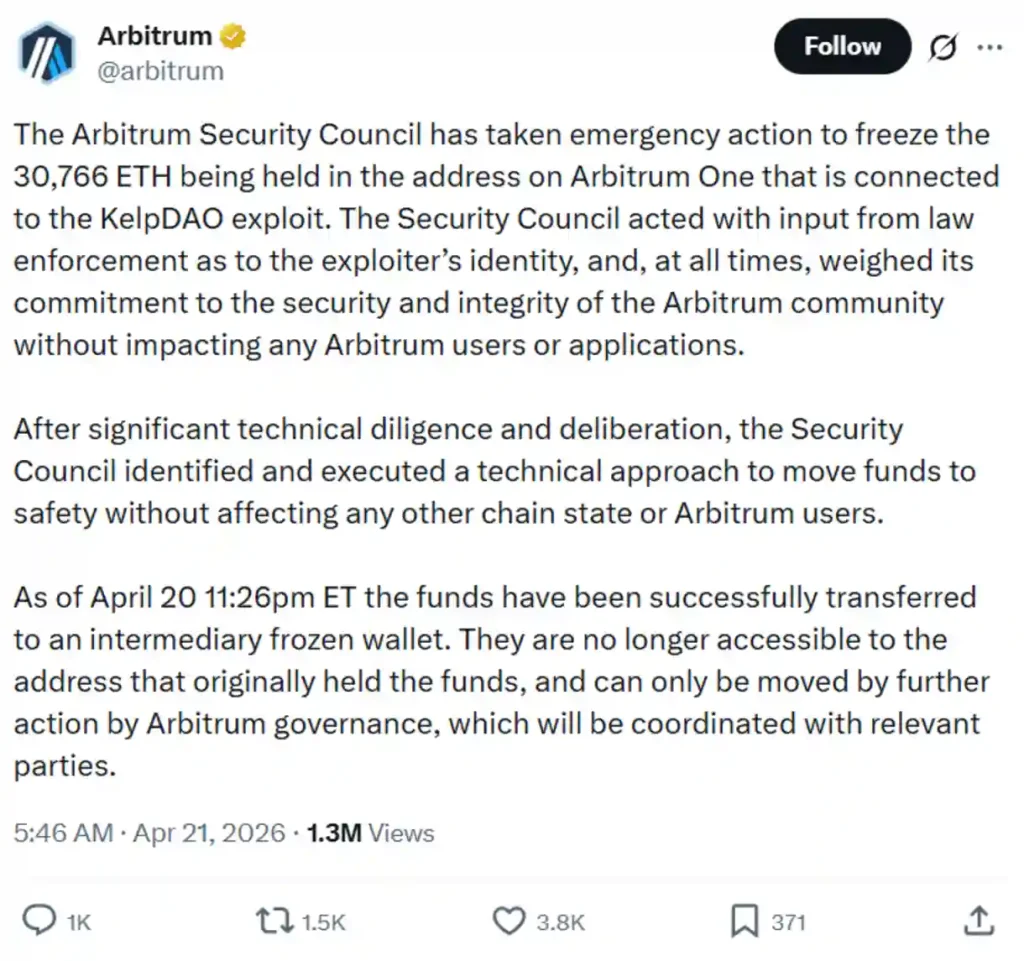
Importantly, the intervention didn’t affect other users or applications on Arbitrum. The blockchain continued operating normally and the targeted action isolated only the compromised assets.
The frozen amount represents about a quarter of the estimated $292 million drained from Kelp DAO’s rsETH system. The exploit itself traces back to a failure in cross-chain verification tied to LayerZero infrastructure. Early assessments point to a compromised validator setup, with both Kelp DAO and LayerZero disputing responsibility.
Governance steps into the spotlight
This kind of intervention is rare, and it cuts straight into a long-running tension in crypto. Systems are built to be permissionless, yet moments like this show that governance layers can act as a circuit breaker when something breaks.
For traders and users, the takeaway is practical. A portion of the stolen funds is no longer in motion, which improves recovery odds and reduces immediate sell pressure tied to the bridge hack. That alone changes how markets absorb events like this.
At the same time, the incident puts bridge security back under the microscope. A single point of failure in verification was enough to trigger a nine-figure exploit. That risk hasn’t gone away.
What has changed is the response. Arbitrum showed that intervention is possible without shutting down the network. Whether that becomes expected behavior across other chains is the question now.
How do you rate this article?
Subscribe to our YouTube channel for crypto market insights and educational videos.






Join our Socials
Briefly, clearly and without noise – get the most important crypto news and market insights first.






8
Also read
Similar stories you might like.

Beginners
Inverse Cramer Strategy Explained: The Cost of Overconfidence
Sead | 2026-04-20

Altcoins
XRP Signals 35% Move As Bitcoin Struggles
Ana | 2026-04-20

Market
Is It a Good Time to Buy Crypto Right Now?
Sead | 2026-04-20

Bitcoin
Nakamoto Inc. Moves Toward Public Offering With SEC Filling
Ana | 2026-04-20

Altcoins
Kelp DAO’s $293M Loss — A Wake-Up Call for LayerZero Users
Azeez | 2026-04-20

Bitcoin
Bitcoin Gets a New Rallying Cry From Tether CEO Paolo Ardoino
Ana | 2026-04-20

Bitcoin
Jon Stewart vs. Bitcoin Debate Takes Unexpected Turn
Rokas | 2026-04-20

Blockchain
$290M Exploit Hits Kelp DAO via Bridge Attack
Rokas | 2026-04-20

Altcoins
Safe or Suspect? What Wealthsimple’s Partnership with X Means for DOGE
Azeez | 2026-04-19

Bitcoin
Hormuz Reclosure: This Could Fuel the Next Bitcoin Short Squeeze
Azeez | 2026-04-19