









Learn how to spot crypto scams and prevent a disaster.
How to Avoid Crypto Scams: Types, Red Flags, and Examples
In Brief
- • Identifying common deceptive tactics is essential for protecting digital assets in an evolving market. Implementing a strict no-trust policy and verifying all platforms helps mitigate the risk of sophisticated cyberattacks. Maintaining constant vigilance and double-checking transaction details are the most effective defenses against financial loss.

There always seems to be a high-profile scam making the rounds in crypto. Problem is – not all scams involve a cabal of hackers. Rather, crypto crime often uses your own inattention as the attack vector.
It’s also quite scary that many traders actually lost money by downloading apps that were available on Apple’s or Microsoft’s official app stores.
Reactions to these news are often split: some scoff and say victims should know better, and those familiar with the state of the crypto market (and particularly the rampant scams) get their fears justified as everyone on the chain is a viable target, regardless of their experience.
So, is there a way to avoid becoming a victim of a crypto scam in 2026?
Quick checklist: Common scams you’ll encounter
Before diving deeper into the mechanics of each crypto fraud, here’s a straightforward way to avoid all the common attack vectors.
| Scam type | Potential risk | How to avoid |
| Fake apps | Losing assets in your wallet | Never enter your seed phrase |
| Fake exchanges | “Withdrawal fees” that clean out your funds | Check the validity of the FinCEN registration; look for typos in the URL, never agree to paying withdrawal fees |
| Liquidity mining | Smart contracts that grant “infinite approval” to cybercriminals | Never sign mining certificates or transactions to “unlock” gains. |
| Address poisoning | Sending funds to a cloned address | Verify all characters of the address or copy from verified sources |
| Pig-butchering | Financial manipulation | Block contacts that ask for money or suggest unverified investment protocols |
Key Red Flag for Novices
Most of these scams are riddled with red flags. If you encounter any of the following, stop immediately:
- The Seed Request: Digital interfaces that ask you to enter your recovery phrase are a no-no.
- The Urgency Trap: Anyone or anything trying to urge you to act quickly to unlock funds is most likely a scam.
- The Fee Barrier: If you receive a message that you must pay a tax or a fee before withdrawing your assets, it should ring alarm bells instantly.
- The Secret New Opportunity: Anyone offering a “guaranteed” high-yield opportunity or pushing a “secret” product is most likely trying to scam you.
- The “Approval” Trap: If a site or service is asking for “Unlimited Spend Limit” or “Permission to Access All Assets,” it’s a glaring red flag.
How Fake Apps and Extension Scams Work
Stealing funds through fake apps has at this point become somewhat of a “greatest hits” strategy for crypto cybercriminals.
Much so that in 2026 alone, shady individuals practically cleaned out $600,000 worth of BTC through a counterfeit Ledger Live application available on Microsoft’s app store. This is unfortunately a systemic issue as Microsoft is not the only tech giant who had their official app outlet compromised.
Slipping through Apple’s or Microsoft’s review processes is actually relatively easy. For instance, developers can submit a simple, harmless-looking app for review, and once it gets a green light from the store, they’ll switch it to a completely different interface that impersonates a Ledger app.
The methods can vary, and what matters more is how to avoid these seemingly safe apps that often drown out any scam warnings with farmed reviews (or keyword squatting that pushes their counterfeit apps above the actual ones).
On April 11 2026, singer G. Love (Garett Dutton) lost his retirement savings in Bitcoin, valued at $420,000, through a malicious application (likely published by the developer “Lava Heal Limited”) that closely resembled a legitimate Ledger App from the official Apple App Store.
After the installation, he followed the on-screen prompts and made the fatal mistake of entering his 24-word seed phrase.
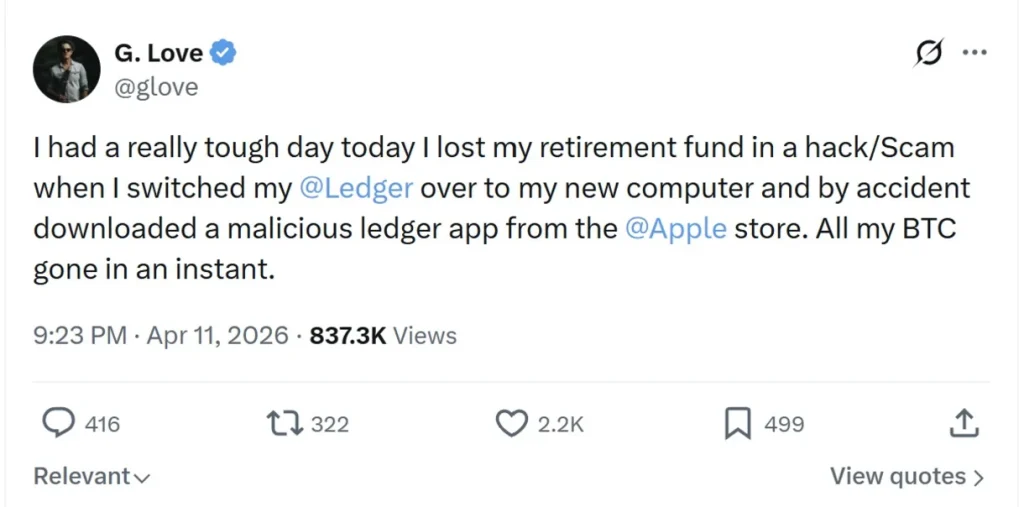
From there, the attackers drained the wallet, routing the funds through various KuCoin deposit addresses, according to ZachXBT.
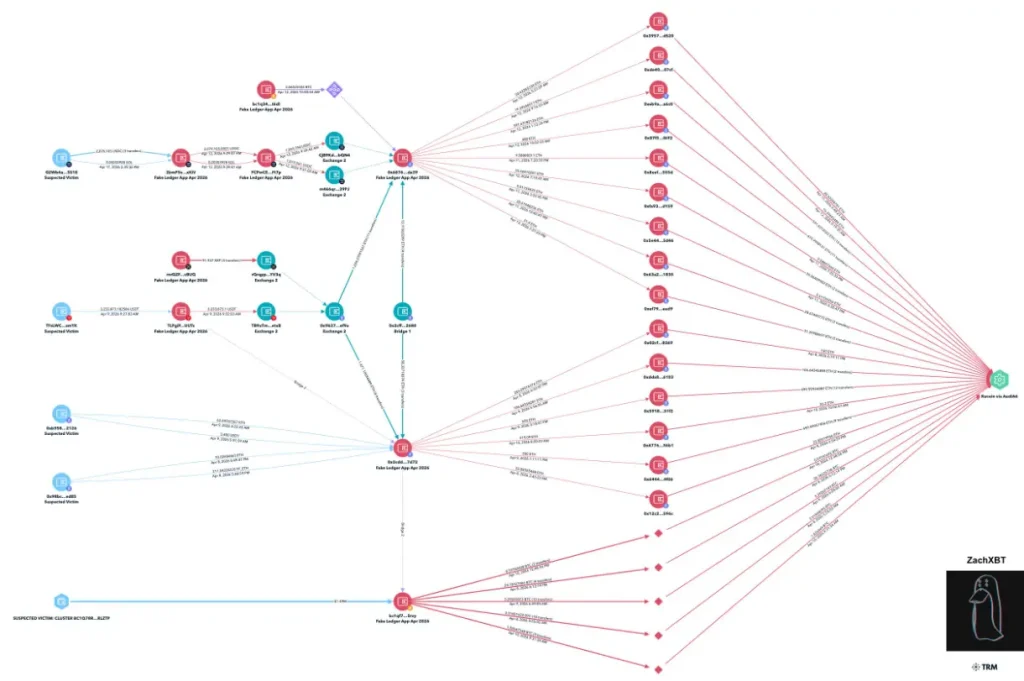
Learn from this example. The best way to avoid turning yourself into the next cautionary tale of the season is to remember that no legitimate service (not even the Ledger app, as stated by the CTO of Ledger) will ever ask for your 24-seed phrase.
Apply a personal no-trust policy and never enter your keys anywhere on an internet-connected device, and more importantly, treat any message urging you to download or update your wallet software as a scam until you ultimately verify the legitimacy of the “warning.”
Beware of the Fake Exchanges
Nowadays it is very easy to create a website that, on the surface, looks like a well-established, reputable cryptocurrency exchange. Exercise caution whenever clicking on any links, anywhere.
It doesn’t take much effort in 2026 to “vibe code” a website that can pass for an established trading platform. In fact, while doing research, I’ve found dozens of GitHub repositories that accurately copy Binance’s and Coinbase’s front-ends.
Their bag of tricks is quite deep: a cybercriminal could throw in a small typo into the address that many tired traders running on Monster Energy drinks will overlook. A good example of this is tasttytrade.com, which impersonated the legitimate TastyTrade website.
Homoglyph attacks are a much sneakier version of this trick, as they may include replacing Latin characters with non-Latin ones that look the same (Cyrillic and Latin “a” are practically indistinguishable from each other).
Whether you’re landing on fake Binance or an untested platform, the scam often involves similar steps:
You log in or create an account, and once you try to withdraw funds, you’ll be hit with a warning about a tax or a withdrawal fee, or even a verification fee.
In the case of the fake TastyTrade catastrophe, as per DFPI Tracker, a trader started trading on the fraudulent platform, utterly convinced he was on the right address. After making bank (their account seemingly pumped to $450,000), they tried to withdraw the funds and the platform demanded a 10% commission.
For those familiar with crypto scams, this is a red flag #1 (withdrawal fees are, as a rule, automatically deducted from the withdrawal amount), but for this individual, the alarm bells sadly didn’t go off, and he ended up losing over $5,000.
To circumvent any cyberattacks related to fraudulent platforms, double or triple-check the address to ensure it’s the right one. If you’re dealing with an untested name, you can quickly verify if the exchange is legitimate using FinCEN’s website.
Steer Clear of Anything That’s “Too Good To Be True”
If it’s too good to be true, it’s probably a scam should be your motto. Fraudulent exchanges aren’t the only platforms you’ll encounter in the “trenches”, and in 2026, many scammers are using the promise of massive gains to hook in investors.
One such hook is the promise of passive income.
Liquidity mining scams, for instance, may involve you connecting your wallet to a fake yield protocol. Because in many cases you won’t need to send any money directly, many traders are easily lulled into a false sense of security.
To make matters worse, the scammers may require you to sign a small transaction or deploy a node for nothing but the Ethereum gas fee. In many cases, scammers even show a cool web dashboard that tracks your mega profits.
Yet, by the time you start tracking your gains, your money is most likely already gone.
How did they pull it off?
Simple. By opting for a small gas fee and the mining certificate, you practically signed a smart contract that gave the scammers free rein over your wallet. And those profits that you made? Fake, of course.
The advent of AI actually makes these scams more potent. Not only are scammers riding the AI trend hard (Chainalysis 2026 report shows that AI scams are 4.5 times more lucrative than traditional ones), but the mention of the “AI-powered” buzzword may also convince traders that impossible gains are possible, no matter how ridiculous.
A platform by the name of Glidz, for instance, promised daily returns of 2.2% to 2.7% through AI-based trading. One trader saw their balance “grow” to $75,000.
As expected from any serious scam, the threat actors eventually demanded a $200,000 deposit. After some strong-arm action by the “platform” (even asking for a photo of the trader’s government identification), the victim lost $55,000.
In addition to going through more rounds of DYOR if something too good to be true pops out, the rule of the game remains the same: never sign a transaction or pay any fees to unlock your funds. Plus, no legitimate platform will EVER resort to mafia boss tactics to secure a fee.
Don’t Fall for Address Poisoning
Address poisoning is often the most invisible and damaging threat you could encounter in crypto. Here, attackers “poison” your wallet history by injecting fake transactions that appear similar to legitimate ones.
Since contract addresses are long, most traders simply skim the very first and last few characters of the address before doing the good old copy and paste.
The most common version of address poisoning involves scammers using address generators to come up with something that closely resembles your actual address by matching its first and last characters. Then, they send “dust” transactions from the fake address to your wallet.
Scammers are banking on a moment of carelessness, waiting patiently for you to copy the fake address they injected. The moment you hit send – boom, your money is gone.
Ethereum’s Fusaka upgrade made the problem much worse. While the 6x lower transaction fees are a godsend, they also lowered the barrier of entry to address poisoning. So as a result, these instances climbed from 628,000 in November to 3.4 million by January 2026, according to Blockaid.
Blockaid also shared an incident report about an Ethereum whale who lost 4,556 ETH (valued at $12.4 million at the time of the attack), where attackers bombarded the wallet for over two months (persistent with a capital T).
Their patience paid off. The malicious address eventually found its way to the top of the transaction history, the whale completed the transaction with a copy-and-paste maneuver, and lost his ETH in the process.
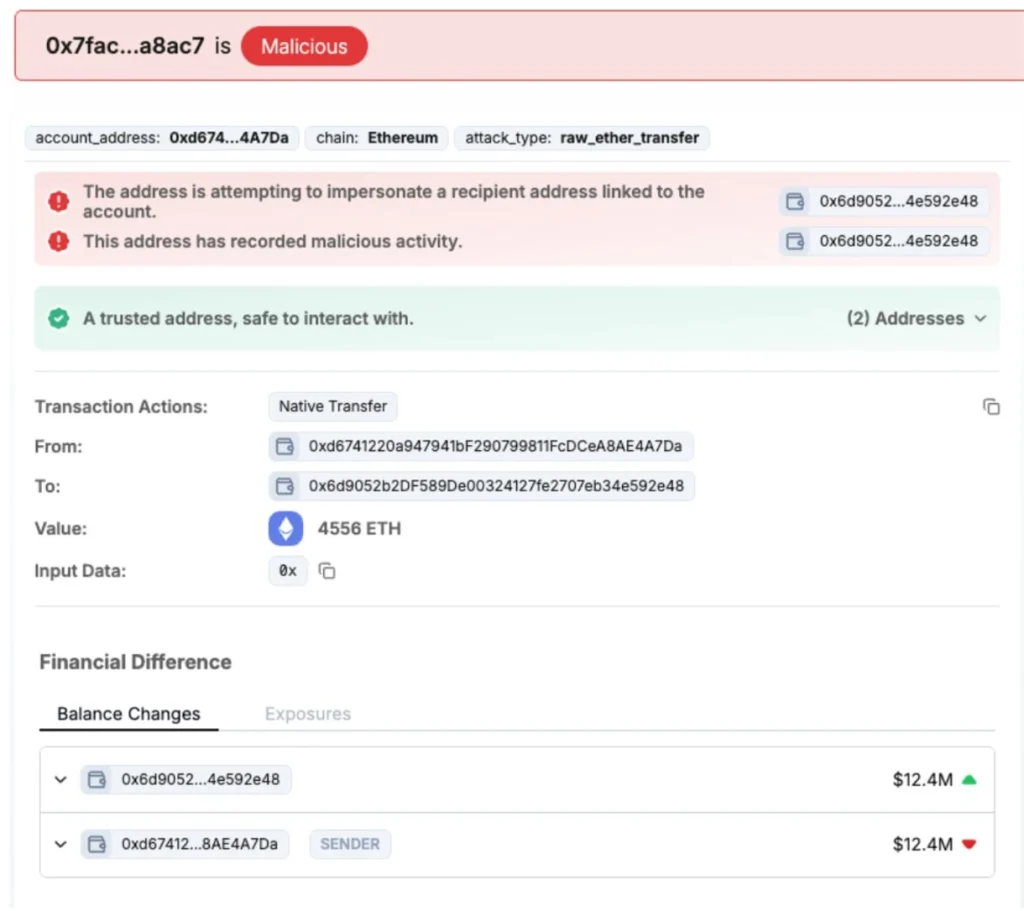
To minimize your chances of being featured in a similar incident report, never copy your address from the transaction history. Instead, copy from a verified source, as this eliminates the biggest attack vector.
Similarly, if you have frequent recipients, save their addresses in your wallet’s address book.
You can also send smaller test transactions ahead of large transfers, and in cases where you absolutely have to copy the address, make sure to verify the characters in the middle.
Remember, if it can happen to a $12M whale, it can certainly happen to any of us traders blasting transactions in the middle of the night while running on nothing but sheer conviction and Monster Energy Zero.
Beware of the Pig-Butchering Scams
‘Pig Butchering’ scams can go on for months, tricking unsuspecting victims into giving away more and more money, until the moment they decide to withdraw. Even then, the scam persists, with fake customer support agents demanding “fees” and “taxes” to release the funds.
While you may laugh at millennials who lost their life savings to someone posing as Brad Pitt or Jennifer Aniston (Braniston forever), crypto traders have also fallen for a fair share of pig butchering scams.
The endearing name refers to the threat actors luring in traders, gaining their trust, and making them invest more and more money, before a final snag that makes all that “fattening up” worth it.
Although everyone may think they’re too smart to bite the bait, pig butchering often starts inconspicuously. A DM on X from a fellow trader, perhaps, or a friend request on Discord.
From there, they’ll work hard on building intimacy over time, becoming a friend, sharing relatable memes about the pain of trading, long before they even attempt to sell you on a platform that promises 100x gains overnight.
As you can expect, AI once made pig butchering even more dangerous. Scammers can now accurately replicate voices. And as a result, even a trust-building Telegram voice call or a Discord session could be faked by an AI script and a convincing voice clone.
So, if you thought losing money to a fake Jason Momoa was funny, it’s also possible for traders to fall for a deepfaked Michael Saylor.
It actually isn’t that far from reality, as scammers already ran fraudulent ads on Meta platforms, showing a deepfaked video of the Romanian central bank Governor, Mugur Isărescu, and Bitdefender CEO, Florin Talpeș.

FBI’s Internet Crime Report from 2026 warned that AI-fueled scams were responsible for over $11B in losses in 2025, so your best course of action is to raise your criteria on what and who you should trust online.
Making crypto friends is all fine and well. Yet, the moment they ask you for money to cover their losses after top-blasting a bundled coin (or share a link to this insane new protocol no one has ever heard of), do yourself a favor: hit that block button.
Final Words: Being Paranoid Pays
Companies are already working on making the blockchain more secure. Yet, even though modern wallets now routinely introduce whitelisting features and all sorts of safety bells and whistles, you’re actually the most important piece of the overall security puzzle.
All of the scams we mentioned, from fake apps to AI-cloned Michael Saylors, are banking on you letting your guard down for a split second before they make a move at your wallet. Thus, approaching all crypto dealings with a healthy dose of paranoia is actually the best (and only) way to avoid becoming a crypto cybercrime statistic.
Double and even triple-checking may seem annoying at first, but it surely beats losing your hard-earned cash in a split second.
FAQ
How can an app on an official store be a scam?
Fraudsters often bypass store reviews by submitting a harmless app and later switching the interface to a malicious one once approved. These fake apps use “keyword squatting” and fabricated reviews to appear at the top of search results and look legitimate.
Is it safe to enter my 24-word seed phrase if the app asks for it?
No. Legitimate hardware or software wallet services will never ask you to enter your 24-word recovery phrase on an internet-connected device. This phrase is for your eyes only and should only ever be entered directly into a physical hardware device.
What is “address poisoning” and how do I avoid it?
This scam involves attackers sending tiny amounts of crypto to your wallet from an address that looks nearly identical to one you frequently use. To avoid accidentally copying the scammer’s address, never copy from your transaction history; always use a saved address book or verify every single character.
How can I tell if a trading platform or exchange is fake?
Scammers use “homoglyph attacks,” replacing letters with visually identical characters from different alphabets (like a Cyrillic “a” instead of a Latin “a”). Always double-check the URL for tiny typos and be wary of any platform that asks for a “withdrawal fee” or “tax” to unlock your funds.
Can AI be used to make crypto scams more convincing?
Yes, scammers now use AI to create deepfake videos of well-known figures or clone voices for social engineering. These “AI-powered” scams often promise unrealistic daily returns to lure investors into fraudulent protocols—if a high-profile endorsement seems suspicious, it likely is.
How do you rate this article?
Subscribe to our YouTube channel for crypto market insights and educational videos.






Join our Socials
Briefly, clearly and without noise – get the most important crypto news and market insights first.






8
Also read
Similar stories you might like.