














Bitcoin (BTC) Tokens wiith regulatory symbols. Source: TechGaged/Shutterstock.
New Crypto Rules Are Reshaping Bitcoin — And Markets Are Watching
In Brief
- • New rules from the SEC and CFTC bring clarity, but the market response remains weak.
- • Delays around the Clarity Act and broader macro trends are keeping Bitcoin under pressure.
- • Institutional interest, including from BlackRock, is growing, but technicals still lean bearish.

For over a decade, crypto markets operated under a cloud of regulatory uncertainty. This week, that cloud finally lifted.
On March 17, the SEC and CFTC jointly released a 68-page guidance document officially classifying most crypto assets as non-securities for the first time. Sixteen tokens—including Bitcoin, Ethereum, Solana, and XRP—were explicitly identified as digital commodities.
The market’s reaction? Bitcoin dropped to $69,370.
The paradox—a landmark regulatory win followed by a price decline—tells us something important. The rules are now written, but the capital has not yet arrived.
What Changed
The new guidance introduces a formal token classification system and an “attach-and-detach” principle: a token may be a security during early financing but can shed that status once the project becomes sufficiently decentralized.
SEC Chair Paul Atkins underscored the shift: “We’re not the securities and everything commission anymore.”
This clarity opens the door for compliant funds that had remained on the sidelines. Yet the market’s muted reaction reflects three converging factors.
Why Bitcoin Didn’t Rally
First, macro conditions are dominating. The Fed held rates steady this week and signaled only one possible cut in 2026. Geopolitical tensions pushed Brent crude to $119 intraday Thursday. The S&P 500 broke below its 200-day moving average for the first time since May.
Second, the legislative catalyst is stalling. While the SEC-CFTC guidance is executive action, the market-structure bill known as the Clarity Act remains stuck in the Senate. Citi analysts cut their 12-month Bitcoin target to $112,000 from $143,000, noting that “the window of opportunity for U.S. legislation this year is narrowing.”
Third, on-chain data shows selling pressure. Lookonchain reported that at least two long-term holders dumped over 1,650 BTC worth $117 million early Thursday, coinciding with the drop below $70,000.
Veteran whale Owen Gunden, who previously offloaded an 11,000 BTC holding, has sold an additional 650 BTC (about $46 million) on Kraken—his first major disposal in five months.

At the same time, another early investor, who accumulated 5,000 BTC over 13 years ago, partially exited by selling 1,000 BTC valued at roughly $71 million.
What the Charts Are Saying
The longer-term technical picture reinforces the market’s hesitation.
On the weekly chart (Coinbase), Bitcoin currently trades near $71,200. The Parabolic SAR remains above price, signaling that the dominant trend is still bearish on this timeframe.
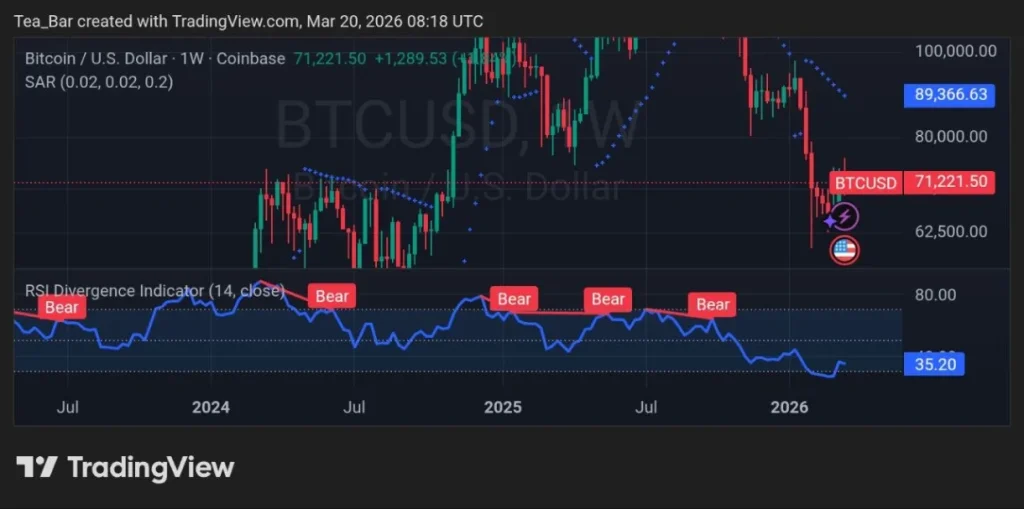
More telling is the RSI divergence indicator, which has been marking “Bear” divergences for over a year. While price made higher highs in late 2024 and early 2025, the RSI failed to follow—a classic bearish divergence that often precedes sustained downside.
The monthly chart tells a similar story. The same RSI divergence indicator has flashed repeated bearish signals since 2024. After the November 2025 peak near $100,000, the monthly RSI rolled over from overbought territory.
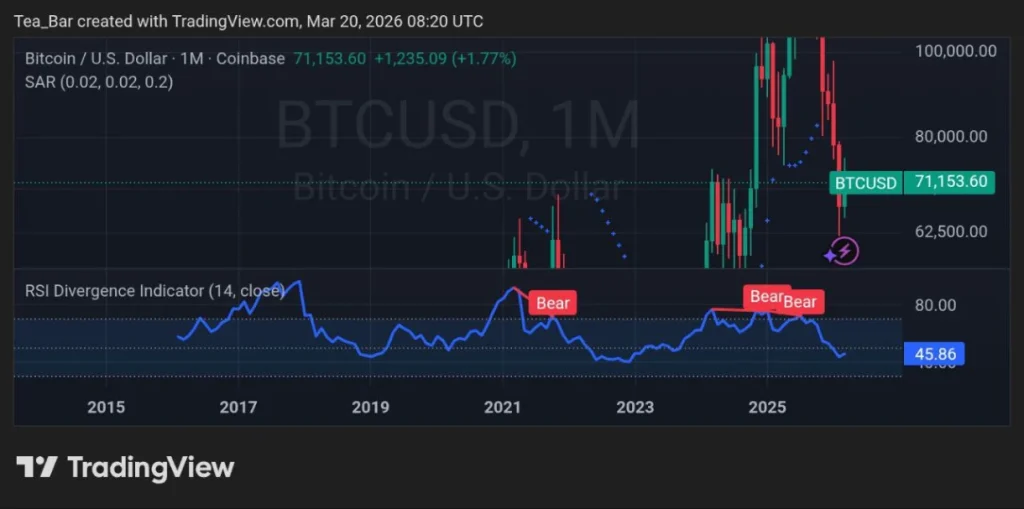
At 45.86 currently, momentum has decisively turned neutral-to-bearish. The Parabolic SAR on the monthly timeframe also sits above price, reinforcing that the multi-year uptrend has been broken.
Taken together, these charts suggest that even with regulatory clarity, Bitcoin faces heavy overhead resistance. Until the weekly and monthly structures flip bullish—likely requiring a reclaim of $80,000 and a sustained move above the SAR dots—the path of least resistance remains lower.
The Bigger Picture
While markets focus on price, a structural shift is underway. Tokenization of real-world assets has grown from roughly $5 billion in 2022 to over $24 billion today. Major institutions like BlackRock and Franklin Templeton are already issuing tokenized products on public blockchains.
The Clarity Act, if passed, would codify the new classification rules and could unlock trillions in institutional capital. One widely circulated analysis points to $40 trillion in U.S. pensions, $30 trillion in corporate treasuries, and $100 trillion in RIA-managed assets that could gain compliance clearance.
But for now, the bill remains stalled, macro headwinds are blowing hard, and the technicals suggest sellers are still in control.
The Question That Remains
Regulatory clarity has finally arrived. Sixteen tokens are officially classified. The infrastructure for institutional entry is largely complete.
Yet capital hasn’t moved. Retail sentiment is cautious. And the charts show that the bulls still have work to do.
If a 68-page regulatory guidance document that answers a decade of legal uncertainty isn’t enough to move the market, what will be?
More Must-Reads:
How do you rate this article?
Subscribe to our YouTube channel for crypto market insights and educational videos.






Join our Socials
Briefly, clearly and without noise – get the most important crypto news and market insights first.






8
Also read
Similar stories you might like.

Bitcoin
Strategy Skips BTC Buys – What To Watch This Week
Sead | 2026-05-04

Market
Is It a Good Time to Buy Crypto Right Now?
Sead | 2026-05-04

Research
6 in 10 Top Blockchains Are Unprepared for Quantum Attacks; Bitcoin and Hyperliquid Most Exposed, Cardano Safest
Jastra | 2026-05-04

Altcoins
BlackRock’s Crypto ETFs Break $60B — What Institutions Aren’t Saying
Azeez | 2026-05-03

Bitcoin
America’s Debt Now Exceeds GDP — Is This the Silent Catalyst Bitcoin Was Waiting For?
Azeez | 2026-05-03

Altcoins
Ripple Re-Locks 700M XRP Amid CLARITY Act Progress — Preparing for a Regulated Future?
Azeez | 2026-05-03

Crypto News
Five Things That Will Define Crypto in May 2026
Azeez | 2026-05-01

Crypto News
US Crypto Bill Nears Vote – Markup Could Force Final Decisions
Rokas | 2026-04-30

Bitcoin
BTC Dips to $75,000, Market Resumes Consolidation as Fed ‘Holds Steady’
Sead | 2026-04-30

Altcoins
Bitcoin Holds $77K Ahead of FOMC as Altcoins Turn Green
Ana | 2026-04-29