





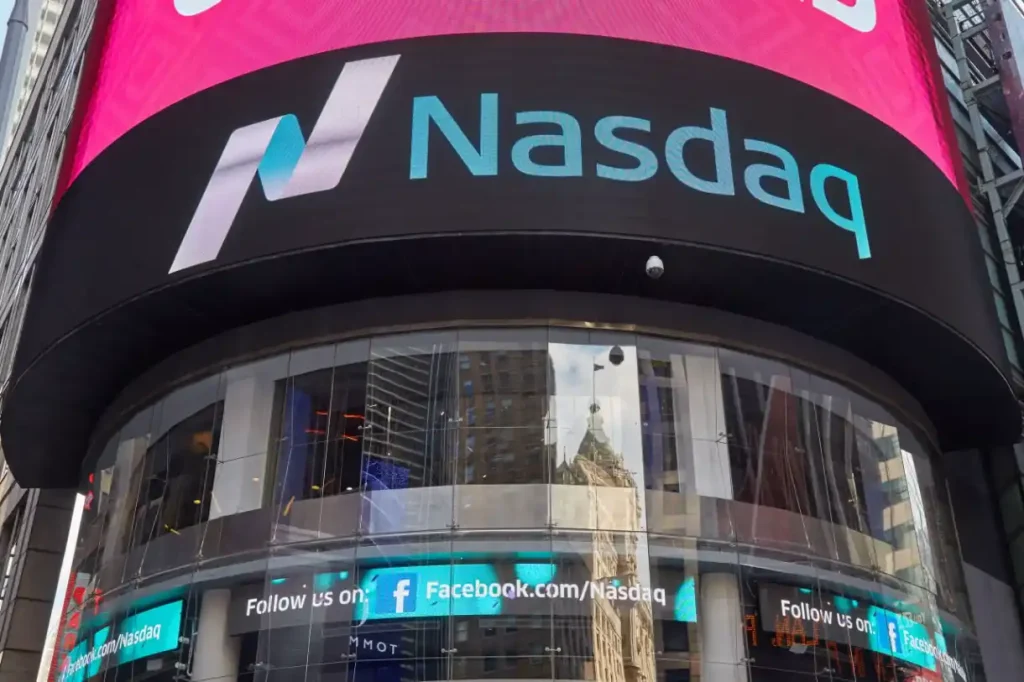
Nasdaq building display in New York. Source: TechGaged / Shutterstock
SEC Opens Door for Tokenized Stocks on Nasdaq – A Major Shift for Wall Street
In Brief
- • The SEC has approved Nasdaq to launch a pilot for trading tokenized stocks and ETFs within regulated markets.
- • Tokenized securities will mirror traditional shares, maintaining identical rights, pricing, and market structure.
- • The rollout begins with select large-cap assets under strict regulatory oversight, marking a shift toward real-world adoption.

The U.S. Securities and Exchange Commission (SEC) has approved Nasdaq’s proposal to enable the trading of tokenized securities, marking a major step toward integrating blockchain-based assets into traditional markets. The approval allows select equities and exchange-traded funds (ETFs) to be represented and settled in tokenized form under a controlled pilot program.
Tokenized stocks cleared for trading
According to the SEC order from March 18, Nasdaq can now support “the trading of securities on the Exchange in tokenized form” as part of a pilot tied to the Depository Trust Company (DTC).
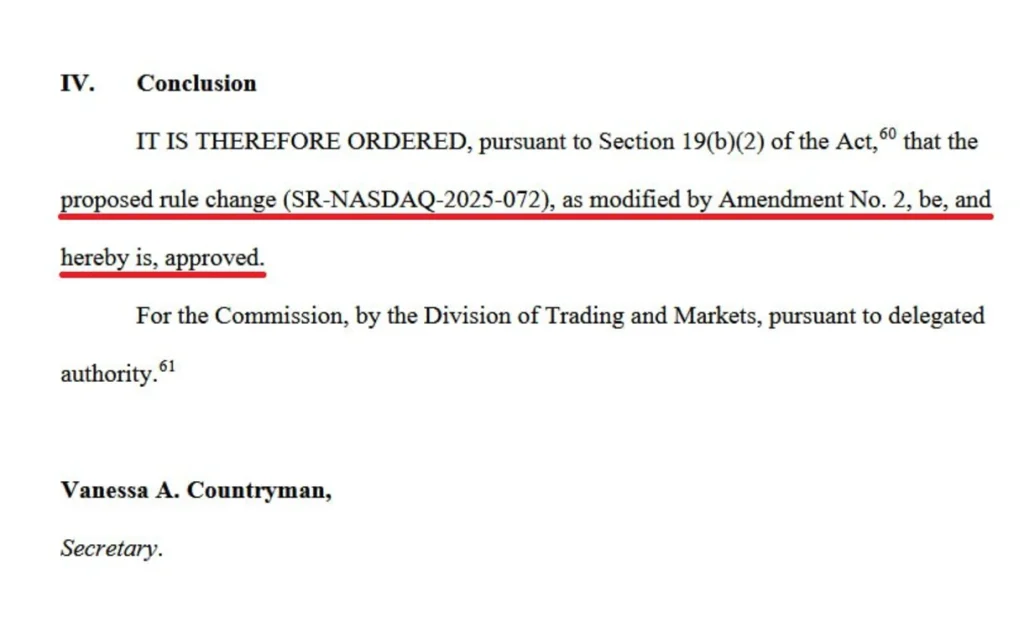
The framework allows eligible participants to trade tokenized versions of stocks and ETFs, at the same time maintaining the same core market structure weeks after U.S. regulators clarified capital rules for tokenized securities. Crucially, tokenized shares will function identically to traditional ones from a trading perspective.
The SEC emphasized that tokenized securities must remain fully equivalent to their traditional counterparts. A tokenized share must be “fungible with, share the same CUSIP number with and trading symbol, and afford its shareholders the same rights and privileges” as the original stock.
That means no difference in ownership rights, voting, or dividends. On Nasdaq, both versions will trade together on the same order book with identical execution priority.
How tokenization works on Nasdaq
Eligible traders can request tokenized settlement by selecting a specific flag when placing orders. After execution, DTC takes over that preference, and then handles whether the trade settles as a token or in traditional form.
If tokenization cannot be completed for any reason, the system defaults back to standard settlement. Importantly, Nasdaq itself does not verify eligibility at order entry. DTC handles the process under its pilot framework.
The SEC made clear that tokenization will not alter how Nasdaq’s market operates.
Order types, routing, fees, and trading sessions remain unchanged. Market data will not distinguish between tokenized and traditional shares, and surveillance systems will treat both identically.
Trades will also continue to settle on a T+1 basis, which refers to finalizing transactions one business day after execution. In practice, if a trade is executed on Monday, ownership and payment are completed on Tuesday. This reflects the current U.S. market standard and indicates that, for now, tokenization does not yet introduce instant settlement within regulated exchanges.
Limited rollout under pilot
The initial rollout integrates exclusively large-cap equities and major ETFs, including securities in the Russell 1000 and index-tracking funds.
The SEC noted the proposal aims to “remove impediments to and perfect the mechanism of a free and open market” as it maintains investor protections.
Though some commenters raised concerns around market structure and risks, the Commission concluded the existing regulatory framework addresses those issues.
The approval signals that tokenization is no longer theoretical on Wall Street, but moving into live market infrastructure under regulatory oversight.
Elsewhere, the SEC issued new guidance clarifying how federal securities laws apply to cryptocurrency assets, released alongside the Commodity Futures Trading Commission (CFTC) with an aim to resolve long-standing uncertainty around how digital assets are classified.
How do you rate this article?
Subscribe to our YouTube channel for crypto market insights and educational videos.






Join our Socials
Briefly, clearly and without noise – get the most important crypto news and market insights first.

Most Read Today
1
Whales Bought 10 Million Cardano (ADA) in 3 Days — Smart Money Positioning Early?
2Exclusive: Dr. Persichetti Challenges Key Claims in Cointelegraph’s Quantum Crypto Analysis
3Robert Kiyosaki Predicts 2026 Crash, Says Assets Will Go Cheap
4Dogecoin Awakens After Seventy-Three Days as SpaceX Eyes June IPO
5The 3 Hidden Catalysts Deciding the Bitcoin vs. Gold Winner This Month
Latest





8
Also read
Similar stories you might like.
Altcoins
BlackRock’s Crypto ETFs Break $60B — What Institutions Aren’t Saying
Azeez | 2026-05-03
Bitcoin
America’s Debt Now Exceeds GDP — Is This the Silent Catalyst Bitcoin Was Waiting For?
Azeez | 2026-05-03
Altcoins
Beyond Price: Accenture’s Hedera Move Could Redefine Enterprise Crypto in 2026
Azeez | 2026-05-03
Altcoins
Ripple Re-Locks 700M XRP Amid CLARITY Act Progress — Preparing for a Regulated Future?
Azeez | 2026-05-03
Altcoins
Whale Watch: Smart Money Is Silently Accumulating These Altcoins
Azeez | 2026-05-02
Altcoins
Bitcoin Cash (BCH) May 15 Upgrade: Can CashVM Actually Steal Ethereum’s DeFi Crown?
Azeez | 2026-05-02

Altcoins
Zcash (ZEC) Soars as Privacy Flywheel Locks In On-Chain Growth
Azeez | 2026-05-02
Altcoins
Hyperliquid vs. Solana: Which Layer-1 Will Dominate the May Derivatives Surge?
Azeez | 2026-05-02

Bitcoin
The 3 Hidden Catalysts Deciding the Bitcoin vs. Gold Winner This Month
Azeez | 2026-05-01
Altcoins
Dogecoin Awakens After Seventy-Three Days as SpaceX Eyes June IPO
Azeez | 2026-05-01