













Bitcoin dissolving into particles on digital background. Source: TechGaged / Shutterstock
Quantum Threat: Experts Say Bitcoin Encryption May Not Last a Decade
In Brief
- • Experts see rising odds of quantum threats within 10–15 years.
- • New research is accelerating expected timelines.
- • Crypto networks may need upgrades sooner than expected.
A new survey of 26 quantum computing experts puts the odds of a cryptographically relevant quantum computer emerging within 10 years at 28% to 49%. That jumps to 51% to 70% within 15 years, pointing to a potential tipping point around the mid-2030s. For crypto markets, this shifts quantum risk from a distant theory to something that needs planning now.
The timeline just got tighter
The data tracks expectations for when quantum machines could break RSA-2048, a widely used encryption standard. The midpoint estimate sits at 38% within 10 years and climbs to 61% by year 15. Longer-term projections rise further to 77% at 20 years and 87% by 30 years.
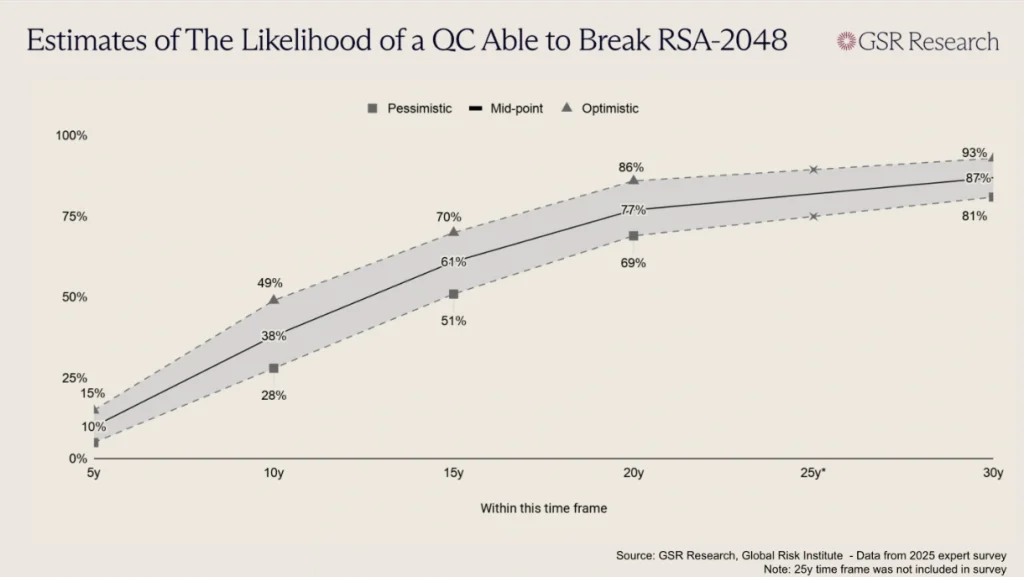
What stands out is the jump between years 10 and 15. That five-year window shows the sharpest increase in probability, suggesting experts expect a breakthrough phase rather than slow, linear progress.
Uncertainty is also narrowing, which signals more confidence in these timelines compared to previous surveys.
Separate research adds pressure to that outlook. Teams from Google Quantum AI and academic groups in the U.S. reported major reductions in the resources needed to break elliptic curve cryptography, which underpins Bitcoin (BTC), Ethereum (ETH), and most other blockchains.
Some estimates now fall below 500,000 qubits, with alternative approaches suggesting even lower thresholds.
Earlier in March, Bitcoin security researcher Justin Drake said new quantum computing research has increased the chances that powerful machines could break crypto security within the next decade, estimating a 10% possibility of a so-called “Q-day” happening by 2032.
However, Binance CEO Changpeng Zhao doesn’t see the need for panic in the crypto industry, arguing that the infrastructure can upgrade, and that’s what matters for its long-term survival. Back in February, CoinShares said the real threat is far smaller than assumed.
What this means for Bitcoin and Ethereum
Both Bitcoin and Ethereum rely on elliptic curve signatures, which might be vulnerable to Shor’s algorithm on a sufficiently powerful quantum machine. Although the issue isn’t exactly immediate, the timeline seems to be moving closer.
Ethereum is already working toward post-quantum upgrades, with a roadmap targeting the end of the decade. Bitcoin faces a slower path due to its governance model, with proposals still in early stages and migration timelines measured in years.
The gap between preparation and potential capability is narrowing. Even if quantum hardware is not ready today, the window to upgrade core cryptography is limited.
How do you rate this article?
Subscribe to our YouTube channel for crypto market insights and educational videos.






Join our Socials
Briefly, clearly and without noise – get the most important crypto news and market insights first.
Most Read Today
1
Crypto’s ‘Middle Class’ Is Shrinking Fast — Mid-Priced Tokens Down 32%
2Robert Kiyosaki Prediction Accuracy: Full Report (1990–2026)
3Bitcoin Rejects $70K as Geopolitical Tensions Rise
4XRP Whales Buying Rises Ahead of Major Ripple XRPL Japan Event
5AIxCrypto (NASDAQ: AIXC) Stock Jumps After On-Chain AI Agent Progress, Enterprise Testing Begins
Latest






8
Also read
Similar stories you might like.

Altcoins
Bitcoin Jumps to Three-Week High as Crypto Adds $100B
Ana | 2026-04-08

Bitcoin
10K BTC at $50 Got Zero Bids, Now It’s Worth Hundreds of Millions
Rokas | 2026-04-08

Market
Jim Cramer Prediction Accuracy: Full Report (2000–2026)
Sead | 2026-04-08

Bitcoin
Exclusive: $250M Asset Manager Breaks Down Morgan Stanley’s Bitcoin ETF Impact
Sead | 2026-04-08

Bitcoin
Bitcoin Rejects $70K as Geopolitical Tensions Rise
Ana | 2026-04-07

Blockchain
JPMorgan Projects Massive Growth in Tokenized Markets This Decade
Ana | 2026-04-07

Market
Crypto’s ‘Middle Class’ Is Shrinking Fast — Mid-Priced Tokens Down 32%
Jastra | 2026-04-07

Defi
Korea and France Rush Into Crypto Talks as Regulatory Changes Loom
Ana | 2026-04-07

Altcoins
XRP Whales Buying Rises Ahead of Major Ripple XRPL Japan Event
Rokas | 2026-04-07
Altcoins
Solana Builds Real-Time Threat Detection and Response Network
Rokas | 2026-04-07