













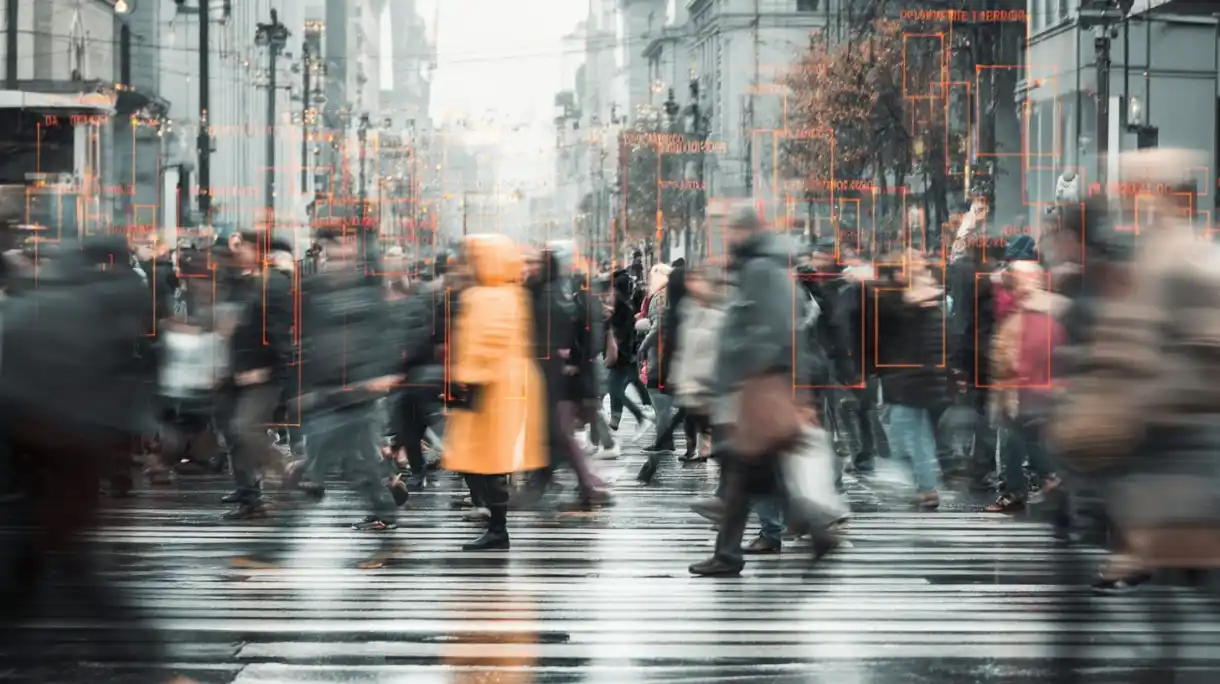
Breakthrough AI Predicts Pedestrian Behavior With Alarming Accuracy
Breakthrough AI Predicts Pedestrian Behavior With Alarming Accuracy
In Brief
- • A new AI system can predict pedestrian behavior with unusual accuracy.
- • It uses multimodal reasoning to anticipate human actions in real time.
- • Early tests show it outperforming existing autonomous-safety models.
A new artificial intelligence (AI) system is raising eyebrows in the self-driving world, not because it sees better than existing models, but because it predicts pedestrian behavior in a way machines never have.
Ad
Researchers at Texas A&M University and the Korea Advanced Institute of Science and Technology have unveiled OmniPredict, an AI designed to anticipate what pedestrians are about to do next. And early tests show a level of accuracy that borders on unsettling.
Unlike traditional computer-vision systems that simply detect objects, OmniPredict uses a multimodal large language model (LLM), the same class of AI that powers cutting-edge chatbots, and applies it to human movement.

By combining visual cues with contextual signals, it can make real-time predictions about whether a person will step into the street, hesitate, turn around, or act unpredictably. According to project lead and director of the Center for Autonomous Vehicles and Sensor Systems, Dr. Srikanth Saripalli:
Ad
“Our new model is a glimpse into a future where machines don’t just see what’s happening, they anticipate what humans are likely to do, too.”
New Era of ‘Street Smarts’ for Autonomous Systems
That shift changes everything. Instead of reacting to danger, self-driving cars could begin avoiding it before it forms. Saripalli describes a world where crosswalk tensions ease, near-misses decline, and traffic flows more smoothly because vehicles understand not just motion, but motives.
“It opens the doors for safer autonomous vehicle operation, fewer pedestrian-related incidents, and a shift from reacting to proactively preventing danger. (…) Fewer tense standoffs. Fewer near-misses. Streets might even flow more freely. All because vehicles understand not only motion, but most importantly, motives.”
The psychological impact could be significant, too. A future pedestrian may no longer need to make eye contact with a driver to feel safe. The car’s AI will already know what that person is planning to do.
The system’s applications extend well beyond city streets. Saripalli notes that AI capable of reading posture changes, stress signals, or hesitation could become a powerful tool in military, emergency, or security environments.
A system that detects threatening cues before they escalate could provide critical seconds of awareness without replacing humans, but enhancing them with a partner that ‘thinks’ ahead.

Besides intelligence, what makes OmniPredict remarkable is its adaptability. While traditional models depend on massive libraries of labeled images and struggle when conditions change, OmniPredict approaches scenes more like a human would, interpreting them rather than memorizing.
When tested against the notoriously difficult JAAD and WiDEVIEW pedestrian behavior datasets, the AI achieved 67% accuracy, outperforming leading systems by 10%. It held up even when the researchers introduced complications like partially hidden pedestrians or subjects looking indirectly at vehicles.
OmniPredict also reacted faster, generalized more effectively across different road environments, and made more stable decisions, all of which are traits essential for real-world deployment.
Saripalli says these results point toward a future where autonomous vehicles rely less on visual brute force and more on behavioral reasoning, moving closer to a shared intelligence between humans and machines.
More Must-Reads:
How do you rate this article?
Subscribe to our YouTube channel for crypto market insights and educational videos.






Join our Socials
Briefly, clearly and without noise – get the most important crypto news and market insights first.
Most Read Today
1
Peter Schiff Warns of a U.S. Dollar Collapse Far Worse Than 2008
2Samsung crushes Apple with over 700 million more smartphones shipped in a decade
3Dubai Insurance Launches Crypto Wallet for Premium Payments & Claims
4XRP Whales Buy The Dip While Price Goes Nowhere
5Luxury Meets Hash Power: This $40K Watch Actually Mines Bitcoin
Latest






8
Also read
Similar stories you might like.

Bitcoin
Why Bitcoin Looks Weak Today But Strong Long-Term
Ana | 2026-01-29

Altcoins
Dogecoin Bulls vs. Bears? One Key Line Decides Everything
Ana | 2026-01-29
Altcoins
Crypto Mirrors 2020 as a 2021-Style Rally Looms
Ana | 2026-01-28

Bitcoin
Bitcoin’s Four-Year Cycle Is “Dead,” Claims the World’s Smartest Man
Ana | 2026-01-28

Altcoins
Buckle Up: DOGE Bulls and Bears Collide at Critical Chart Level
Ana | 2026-01-26

Altcoins
XRP Forms Triple Bottom; Here’s What’s Next, According to Analysts
Ana | 2026-01-26

Altcoins
Downside Risk Looms for Ethereum, Warns Bloomberg Analyst
Ana | 2026-01-26

Altcoins
Solana Price Compresses, Big Move Incoming
Ana | 2026-01-23

Altcoins
Why Extreme Fear On XRP Could Signal A Rally
Ana | 2026-01-23

Altcoins
Dogecoin Is Waking Up And The Chart Looks Explosive
Ana | 2026-01-22