














A hooded, faceless figure sits at a laptop with cascading blue binary code background. Source: TechGaged / Shutterstock.
Kelp DAO’s $293M Loss — A Wake-Up Call for LayerZero Users
In Brief
- • A single compromised validator enabled a $293M exploit with no code bug involved.
- • Weak 1-of-1 verification setups expose LayerZero-based apps to major risks.
- • Users should prioritize protocols with multi-validator security to reduce attack chances.

On April 18, 2026, an attacker sent a forged message to Kelp DAO’s LayerZero-powered cross-chain bridge. The bridge accepted it as legitimate and released 116,500 rsETH — worth roughly $293 million and 18% of the token’s entire circulating supply — conjured out of thin air.
The stolen rsETH was never sold. Instead, it was deposited into Aave V3 and V4 as collateral to borrow over $236 million in real WETH.
Within 46 minutes, Kelp’s emergency multisig froze its contracts, but the damage had already cascaded across lending protocols.
Who Was Really at Fault?
No code was exploited. The root cause was Kelp’s “1-of-1” DVN (Decentralized Verifier Network) configuration, which required only a single validator node to approve cross-chain messages.
That node was compromised. As Ledger’s CTO noted, a single-signer architecture allowed one forged signature to mint hundreds of millions in unbacked tokens.
The attacker was later identified by LayerZero as North Korea’s Lazarus Group, which poisoned the network’s RPC infrastructure.
Why This Is a Wake-Up Call for LayerZero Users
This incident is a stark warning for any protocol relying on LayerZero — and for the users who trust them.
LayerZero’s security is only as strong as the configuration choices of each application.
Kelp chose the most permissive setting, and $293 million vanished in under an hour.
Many whales have already rushed to withdraw their $ETH from Aave. Users can no longer assume that “powered by LayerZero” means safe.
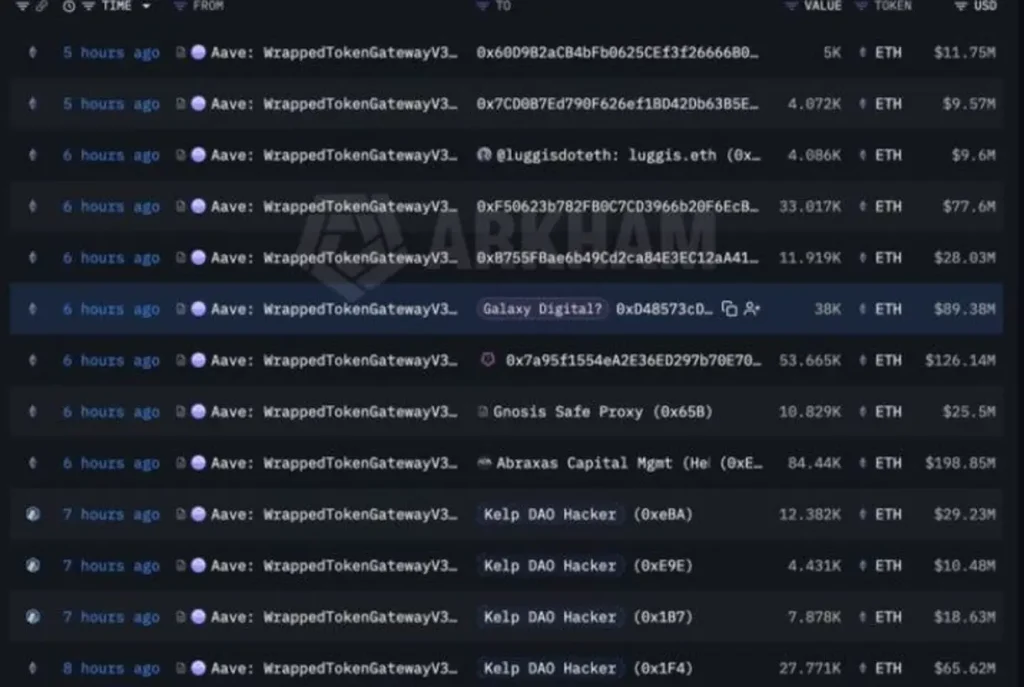
LayerZero has since suspended support for 1-of-1 configurations and is urging all single-DVN applications to migrate to multi-DVN architectures immediately.
For DeFi users, the lesson is clear: before depositing funds into any bridge-linked protocol, demand to know its verification thresholds.
A 2-of-3 or 5-of-9 setup offers redundancy that a single compromised node cannot bypass.
So here’s the question that should keep every DeFi user awake tonight: if a single validator node was enough to steal $293 million in 46 minutes, how many other protocols are still running on the same fragile configuration — and how long before the next domino falls?
Disclaimer:
This article is for informational purposes only and does not constitute financial, investment, or trading advice. The views expressed are based on publicly available data, market observations, and the author’s interpretation at the time of writing. Cryptocurrency markets are highly volatile and unpredictable, and past performance or current technical setups do not guarantee future results. Readers should conduct their own research and consult with a qualified financial advisor before making any investment decisions. TechGaged does not accept liability for any losses incurred based on the information presented.
How do you rate this article?
Subscribe to our YouTube channel for crypto market insights and educational videos.






Join our Socials
Briefly, clearly and without noise – get the most important crypto news and market insights first.
Most Read Today
1
Hormuz Reclosure: This Could Fuel the Next Bitcoin Short Squeeze
2Safe or Suspect? What Wealthsimple’s Partnership with X Means for DOGE
3Smart Money Rotation: HBAR Volume Spike Points to a Deeper Move
4How THORChain is Making Monero More Accessible Than Ever
5$290M Exploit Hits Kelp DAO via Bridge Attack
Latest





8
Also read
Similar stories you might like.

Altcoins
XRP Signals 35% Move As Bitcoin Struggles
Ana | 2026-04-20

Blockchain
$290M Exploit Hits Kelp DAO via Bridge Attack
Rokas | 2026-04-20

Altcoins
Glamsterdam Upgrade: Can a 100K TPS Breakthrough Push ETH Back to $4,000?
Azeez | 2026-04-18

Altcoins
New Record: Ethereum Hits 200M Transactions as Network Activity Breaks Out
Rokas | 2026-04-17

Altcoins
Crypto Market Drops $40B as Bitcoin Loses Momentum
Ana | 2026-04-16

Altcoins
Crypto Market Adds $100B as Bitcoin Leads Rally
Ana | 2026-04-16

Bitcoin
The Calm Before the Storm? What Low Stablecoin Activity Means for ETH
Azeez | 2026-04-17

Altcoins
Crypto Loses $70B as Macro Pressure Builds; This Is Driving It
Ana | 2026-04-16

Altcoins
‘Aave Will Win’: DAO Chooses Execution Over Optics in New Vote
Ana | 2026-04-13

Uncategorized
1B DOT Minted on Ethereum in Bridge Exploit; What Happened?
Rokas | 2026-04-13