









XRP logo on smartphone screen. Source: TechGaged / Shutterstock
SEC Rule Change Might Be Huge for XRP; Here’s Why
In Brief
- • SEC guidance may ease rules for certain crypto interfaces.
- • XRPL’s built-in DEX appears to fit the non-broker model.
- • data-start="124" data-end="183" data-is-last-node="">This could give XRP developers a clearer compliance path.

The U.S. Securities and Exchange Commission (SEC) has introduced new guidance that could quietly benefit the XRP ecosystem, particularly developers building on the XRP Ledger. The agency’s latest statement draws a clearer line between crypto trading platforms and simple user interfaces, potentially reducing regulatory pressure on certain frontend tools. For XRP supporters, it may represent an unexpected regulatory tailwind.
SEC draws a line between interfaces and brokers
Indeed, in its April 13 staff statement, the SEC clarified that not all crypto-related tools fall under broker-dealer rules. Specifically, interfaces that simply help users prepare and submit transactions from self-custodial wallets may not require registration, provided they meet strict conditions.
These include not holding user funds, not executing or routing trades, avoiding investment advice, and charging only fixed, transparent fees. The guidance is part of a broader push to define how existing securities laws apply to crypto infrastructure.
This distinction separates backend execution from frontend access, effectively carving out a potential safe zone for developers building user-facing tools.
XRPL’s built-in DEX may already fit the model
According to community contributors, the XRP Ledger appears to align closely with the SEC’s framework. Its native decentralized exchange operates directly at the protocol level, handling order books, liquidity, and execution without relying on external smart contracts or intermediaries.
That means interfaces built on XRPL often act purely as access points rather than active participants in trade execution. As one validator noted, this setup allows developers to offer trading access without holding funds or controlling transaction flow, which matches the SEC’s outlined conditions.
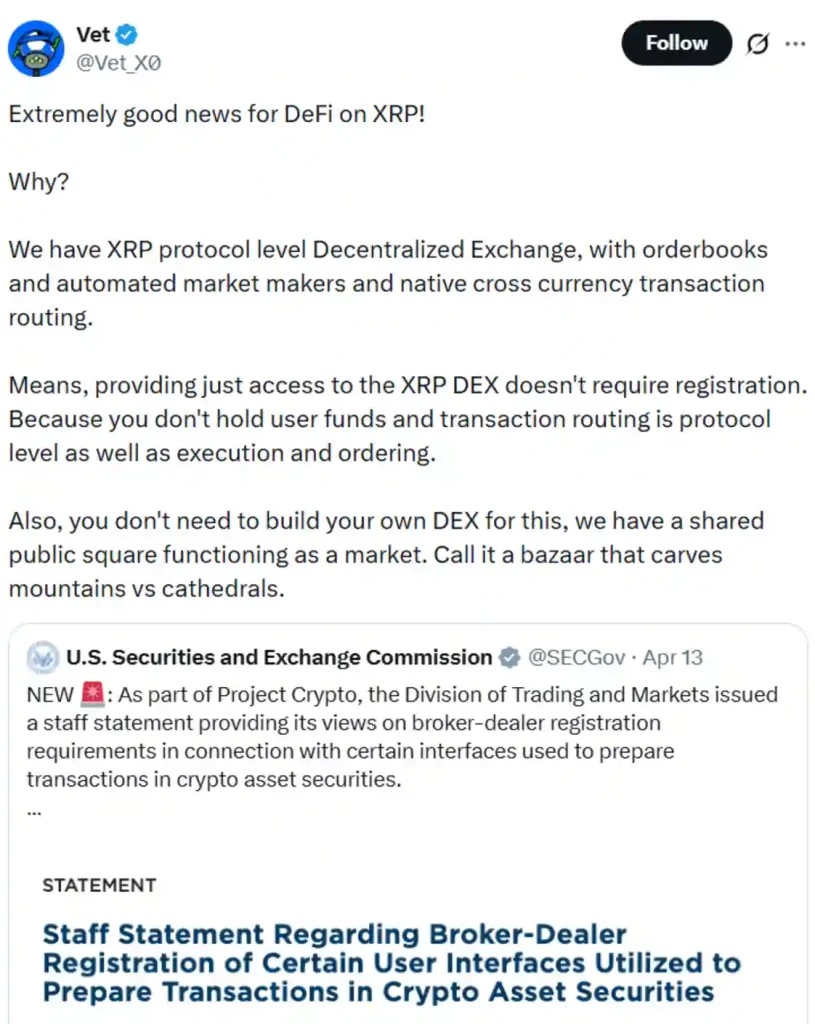
The result is a clearer compliance path for US-based builders working on XRPL frontends. The guidance doesn’t eliminate all regulatory risk, but it provides a more defined framework for operating within existing laws, something the crypto industry has long been pushing for.
How do you rate this article?
Subscribe to our YouTube channel for crypto market insights and educational videos.






Join our Socials
Briefly, clearly and without noise – get the most important crypto news and market insights first.
Most Read Today
1
Bittensor (TAO) Extends Losses—Why Smart Money Is Watching Closely
2Donald Trump’s Actions Cost Bitcoin $240B Since 2019 — Report
3Is It a Good Time to Buy Crypto Right Now?
4Exclusive: Dr. Persichetti Challenges Key Claims in Cointelegraph’s Quantum Crypto Analysis
5The Calm Before the Storm? What Low Stablecoin Activity Means for ETH
Latest







8
Also read
Similar stories you might like.

Altcoins
Crypto Market Drops $40B as Bitcoin Loses Momentum
Ana | 2026-04-15

Altcoins
Tokenized Real-World Assets Already Reached $27B — Why This Still Matters for Crypto’s Future
Azeez | 2026-04-15

Bitcoin
Bitcoin Developers Work on Post-Quantum Security Upgrade
Ana | 2026-04-15

Altcoins
Virginia Law Now Protects Unclaimed Crypto Assets
Rokas | 2026-04-15

Altcoins
Dogecoin Goes Live on Rakuten: Can 44 Million Japanese Users Influence DOGE?
Azeez | 2026-04-15
Altcoins
Ripple CEO Says SEC-CFTC Move Ended Crypto ‘Lawfare’ Era
Rokas | 2026-04-15

Altcoins
Crypto Market Adds $100B as Bitcoin Leads Rally
Ana | 2026-04-14
Industry
Extortion Attempt Targets Kraken After Internal Access Misuse
Ana | 2026-04-14
Blockchain
SEC Clarifies When Crypto Interfaces Avoid Broker-Dealer Registration
Ana | 2026-04-14
Blockchain
X Exec Nikita Bier Drops Crypto Tease Amid Rough Year
Rokas | 2026-04-14