









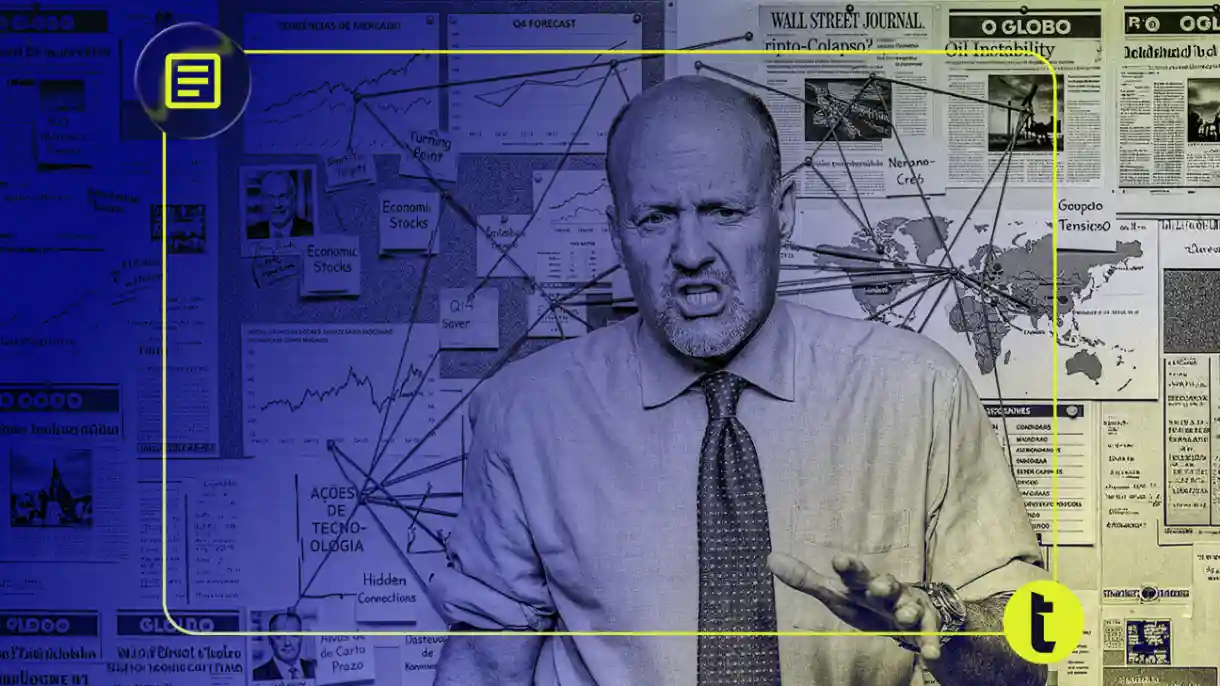
Jim Cramer. Source: TechGaged/Shutterstock
Jim Cramer Prediction Accuracy: Full Report (2000–2026)
In Brief
- • Cramer mixes notable long-term hits with frequent, mistimed calls.
- • High-volume predictions amplify both successes and high-profile misses.
- • His advice reflects Wall Street sentiment more than reliable signals.
📊 Jim Cramer Prediction Accuracy (2000–2026)
-
✓
Correct predictions: 3 / 8 (37.5%) -
✕
Short-term forecasting reliability: Low -
✓
Long-term trend spotting: Sometimes strong -
✕
Timing accuracy: Unreliable
Overall accuracy: Low (~37.5%) — occasional big-picture wins, but weak consistency and poor timing
Based strictly on 8 confirmed predictions from TechGaged dataset (2000–2026).
As the host of CNBC’s Mad Money, Jim Cramer has spent over two decades dispensing financial advice at a lightning-fast pace. With on-screen antics like slamming buttons with sound effects and high-energy rants, he draws on his former hedge fund manager knowledge to offer tips and recommendations on the stock market and investing.
Yet, much like his fellow advice giver Robert Kiyosaki, he’s far more wrong than he’s right. In fact, Cramer is known for being routinely wrong on numerous predictions to the point of the Internet’s ridicule.
It’s called the Inverse Cramer strategy, and it’s fairly simple. Whatever the host tells you to buy, you should sell, and whatever he trashes, you should go all-in on. This approach has become such a cultural staple that 2023 saw the launch of actual ETFs designed to track the opposite of his picks.
Our analysis of nine major calls shows Jim Cramer was right just 37.5% of the time.
But is he truly a reliable counter indicator, or a TV personality who simply catches more flak for his misses than credit for his hits?
What Cramer got right
Yes, the online world loves to highlight his failures, but Cramer’s longevity on Wall Street isn’t a fluke. His hits stem from his background in finance and industry connections, which enable him to spot industrial trends before they hit the retail market.
Pro-Apple in the early 2000s
Cramer has long defended his record by reminding critics that he was a champion of Apple when it was trading at a split-adjusted $5.
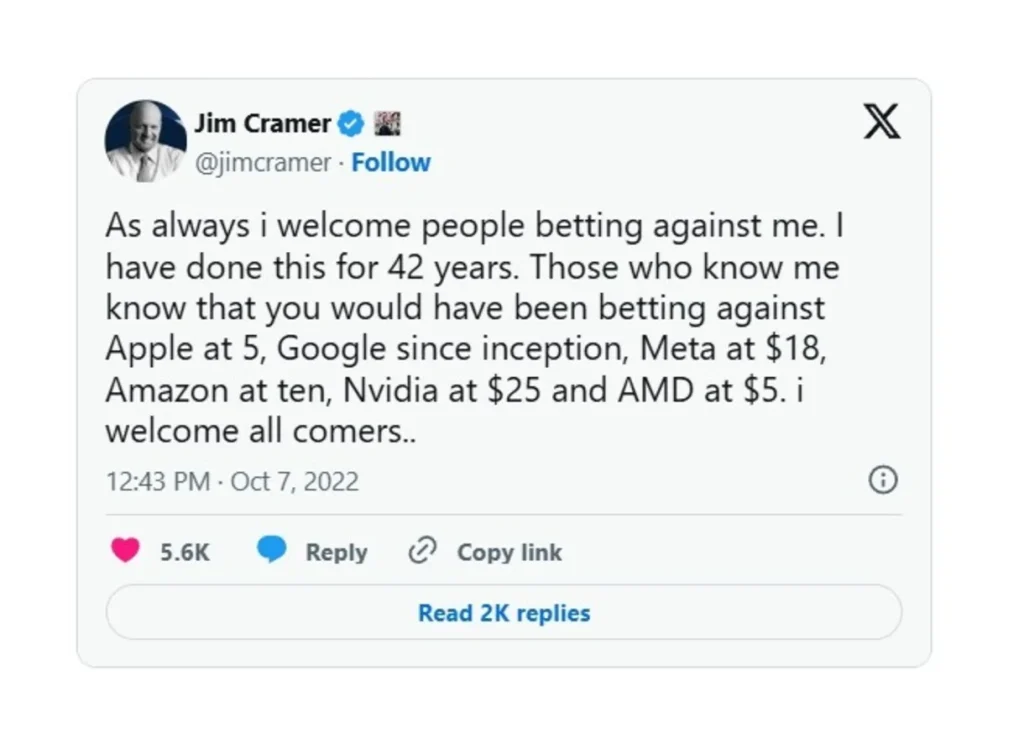
During the post-dot-com stagnation, Apple was largely seen as a niche computer company that struggled to compete with Microsoft. However, Cramer was one of the few mainstream voices telling retail investors to treat it as a consumer staples brand.
As a result, his relentless support of Apple (and his famous “own it, don’t trade it” mantra) helped a generation of Mad Money viewers ride the iPhone revolution to generational wealth.
2007 ‘TODAY show’ warning
Ironically, one of Cramer’s best calls was actually a sell signal. In late 2007, just as the subprime mortgage crisis was beginning to bubble, he appeared on the TODAY show with a rare moment of sobriety.
He urged any investors who need money in the next five years to sell. It was a hauntingly accurate warning. Those who ignored him and stayed in the market saw their portfolios halve in the infamous 2008 crash. Cramer often points to this as proof that he isn’t just a perma-bull but a realist who knows when the party is over.
FANG in 2013
In the early 2000s and 2010s, Cramer made a few “career-defining” calls that laid the foundation for his TV career and overall reputation. Arguably, his most famous contribution is the coining of the FANG acronym (Facebook, Amazon, Netflix, Google).
In 2013, Cramer argued that these four stocks were the only ones that mattered in a low-growth world. He told his audience to stop looking at traditional metrics and start looking at so-called platform dominance.
Since he coined the term, the FANG portfolio (which eventually became FAANG with the addition of Apple) has fundamentally rewritten the S&P 500. Investors who bought and held these in 2013 saw returns that notably outperformed gold, cash, and bonds by a staggering margin over the next decade.
2024 NVIDIA
Long before the general public understood the scale of the AI revolution, Jim Cramer was beating the drum for NVIDIA.
In late 2024, when many analysts warned that NVIDIA was overextended and too expensive, Cramer famously doubled down. For him, the company was the gateway to the AI era, arguing that building the future without paying Jensen Huang (NVIDIA’s President and CEO) isn’t possible.
As of April 2026, NVIDIA has maintained its dominance, which means that those who followed Cramer’s recommendation saw their portfolios quadruple while the skeptics sat on the sidelines.
What Cramer got wrong
Unfortunately for him, Cramer’s misses are the stuff of financial legend. Because he provides hyper-specific, high-volume advice, his failures are often spectacular and somehow, perfectly timed for the worst possible outcome.
Here are some of those predictions:
2000 dot-com tech stocks
It’s not a stretch to say that Jim Cramer is behind the perhaps most catastrophic list in financial media history. In February 2000, just weeks before the tech bubble burst, Cramer published a selection of technology stocks, featuring companies like 724 Solutions, Ariba, Exodus Communications, Inktomi, and five others.
You’ll be excused if those names don’t ring a bell, as this top 10 list of the “only stocks to own” (Cramer’s own words) saw disastrous losses by 2002. Most of the stocks had lost 90% to 95% of their value, and several eventually went bankrupt, like Exodus Communications in late 2001.
2008 Bear Stearns
One cannot simply talk about Cramer without mentioning March 11, 2008, and everyone’s favorite cautionary/disaster tale of Bear Stearns. When a viewer asked if he should move his money out of the company due to liquidity fears, Cramer yelled that Bear Stearns is fine and urged him not to take money out.
Five days later, Bear Stearns collapsed and was sold for $2 a share in a fire sale to JPMorgan. This remains the foundational event for the Inverse Cramer concept.
2012 Hewlett-Packard
In the early 2010s, Cramer became a vocal defender of HP, arguing that the company was a “deep value” play with a legendary legacy that couldn’t fail.
So, he repeatedly urged viewers to buy the dip as the stock slid, dismissing concerns about HP’s disastrous acquisition of knowledge management software firm Autonomy (which turned out to be a multibillion-dollar accounting cover-up) and its lack of a mobile strategy.
Still, HP’s stock continued to crater, eventually losing more than half its value in a single year. It became a textbook example of a stock that looks cheap but is actually a dying business.
2021 endorsement of ARK Innovation
As examples of companies Cramer is bullish on go, this is as good as any. At the height of the post-pandemic speculative frenzy, Cramer frequently interviewed Cathie Wood, CEO and CIO of ARK Invest, praising the ARK Innovation ETF (ARKK) as the gold standard for disruptive innovation.
He fervently championed the high-growth, zero-profit tech names within the fund (like Teladoc and Zoom) right as the Federal Reserve began signaling interest rate hikes. But as rates rose in 2022, ARKK plummeted over 70% from its highs. Cramer’s pivot from the ETF being a disruption king to selling it took place only after the majority of the damage was done, leaving retail followers trapped at the top.
2024 Bitcoin reversal
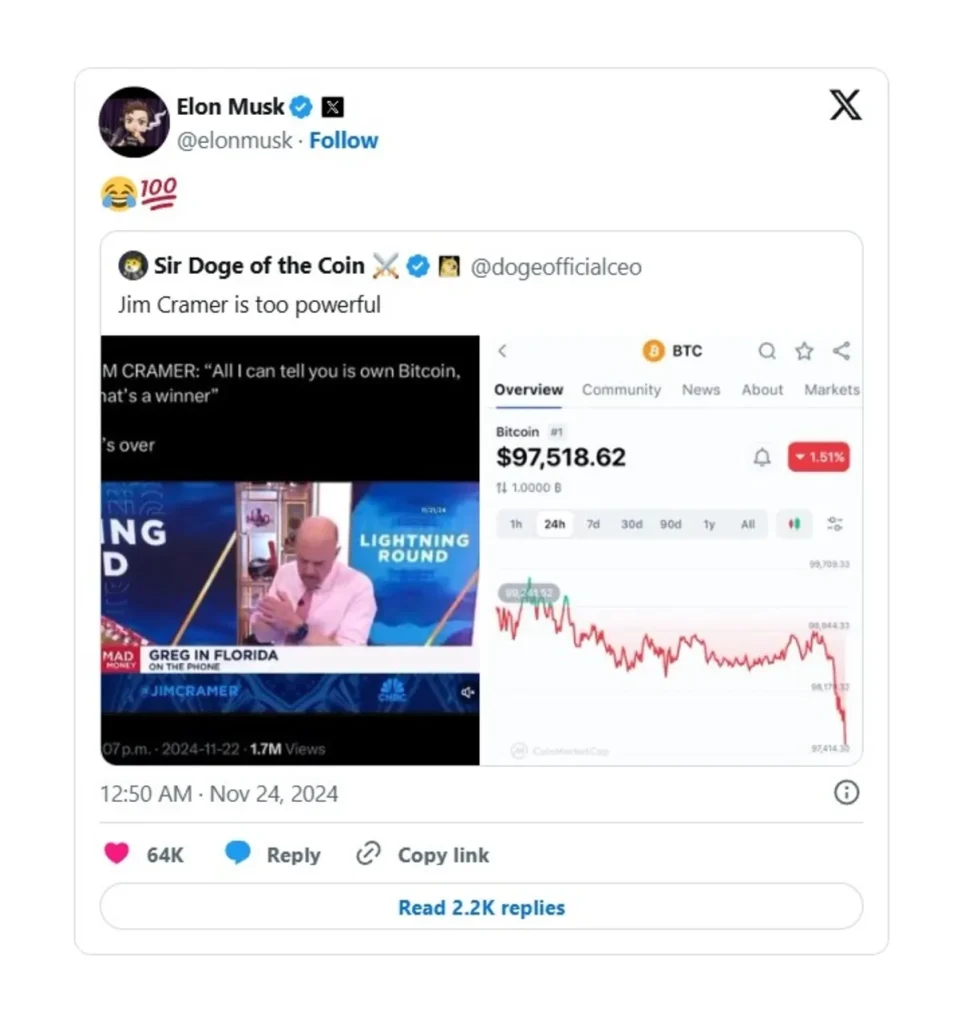
In November 2024, Cramer officially declared Bitcoin a winner and encouraged his audience to jump in.
Within weeks of his endorsement, the Inverse Cramer effect kicked in. The crypto market experienced a massive liquidity rug pull, and Bitcoin’s market cap declined by $130 billion. The timing was so precise that Inverse Cramer trackers saw a 60% gain in late 2025 by simply doing the opposite of his crypto pivots. Even Elon Musk found the Cramer curse highly amusing.
Cramer’s stance on cryptocurrency
A love-hate relationship at best, Cramer and crypto is a rollercoaster that leaves even seasoned traders dizzy. Unlike Robert Kiyosaki, who views Bitcoin as a moral exit from a corrupt system, Cramer views it strictly as a speculative asset class.
For years, he dismissed Bitcoin as an outlaw currency and warned that it was a giant Ponzi scheme. This view likely originates from Cramer’s time as a former hedge fund manager who values cash flow and dividends. The TV host even told viewers to “sell your crypto while you still can” during the 2022 FTX collapse. At one point, he revealed that he had sold a significant portion of his Bitcoin to pay off his mortgage.
But, as Bitcoin Spot ETFs were approved, Cramer’s tone shifted. By January 2024, as Bitcoin crossed $45,000, he pivoted hard. He could no longer ignore the institutional money entering the space, so he began treating Bitcoin like a tech stock.
He began advising his audience to include it in their portfolios (roughly 5%) as a hedge against the ballooning $39 trillion (then $35 billion) US national debt.
By early 2026, when Bitcoin broke below the psychological $80,000 barrier, Cramer shifted back to his tough love stance. He questioned the fragility of investor support and challenged major holders like Michael Saylor and his Bitcoin strategy to push the price to $82,000 in order to prove the market wasn’t just a house of cards.
While Bitcoin is his trading vehicle, Cramer has shown a more consistent, albeit quieter, respect for Ethereum. Because it powers DeFi and NFTs, Cramer sees Ethereum as the industrial infrastructure of the internet. Even when he is bearish on Bitcoin’s price, he often speaks of Ethereum’s use case as something Wall Street can eventually understand through a SaaS lens.
To Cramer, crypto isn’t a revolution but merely another ticker symbol. If it’s going up, he’s a fan. If it’s going down, he’s the first to tell you it was obvious it would fail.
Which brings us to:
What Jim Cramer really is
There is a case to be made that Jim Cramer is a salesman first and foremost.
The thing is, he’s a Wall Street guy at his core. His background as a hedge fund manager was far more than merely crunching numbers. It was about the high-stakes art of the pitch, convincing wealthy clients that his vision was the only one worth backing.
| Event | Cramer’s prediction | Actual Outcome | Verdict |
| 2000 dot-com stocks | Nominated 10 stocks as the only ones to own for the future. | By 2002, the list lost approximately 90% of its value, with some companies going bankrupt | Miss |
| Apple at $5 (early 2000s) | Championed Apple when it was seen as a struggling niche player. | Apple became the first $3 trillion company, rewarding “own it, don’t trade it” believers with generational wealth. | Hit |
| Bear Stearns 2008 | Was adamant that Bear Stearns is fine in response to a viewer’s liquidity fears. | Five days later, the firm collapsed and was sold for $2 per share in a fire sale to JPMorgan. | Miss |
| 2012 Hewlett-Packard | Argued that the company was a “deep value” play with a legendary legacy that couldn’t fail, urging viewers to buy the dip as the stock slid | HP’s stock lost more than half its value in a single year | Miss |
| FANG 2013 | Coined the FANG acronym, identifying Facebook, Amazon, Netflix, and Google as the market’s new engine | These platforms dominated the next decade, consistently outperforming the broader S&P 500. | Hit |
| NVIDIA 2024 | Labeled NVIDIA as the essential link for the AI revolution during a period of market doubt. | NVIDIA stock surged through 2025, becoming a cornerstone of the 2026 AI-driven economy. | Hit |
| 2021 ARK Innovation endorsement | Praised the ARK Innovation ETF (ARKK) as the gold standard for disruptive innovation | ARKK plummeted over 70% from its highs as rates rose in 2022 | Miss |
| Bitcoin “winner” 2024 | Officially declared Bitcoin a winner and suggested it was time for retail to jump in | Within weeks, the market saw a $130 billion liquidity rug pull, marking a local top for the asset. | Miss |
He has successfully translated this history to TV (and the Internet), which also explains his trademark intensity. What the audience sees as financial insight is often a meticulously honed sales technique developed during his years at Goldman Sachs and his own firm.
As such, Cramer doesn’t invent market trends like some of his peers. Rather, he curates the work of Wall Street’s research army. Because he is effectively a high-decibel aggregator of existing data, his accuracy naturally mirrors the hit-and-miss nature of the industry itself.
Granted, the internet treats his takes as opposite to truth, largely because he refuses to hide behind the dignified, quiet failure typical of most Wall Street suits. In reality, he isn’t more or less accurate than other voices in the financial world (Wall Street included); he’s simply the one loud and visible enough to be a target.
Should you listen to Jim Cramer?
When you strip away the showmanship and the online feuds, what remains is a high-volume market narrator.
Jim Cramer is neither a prophet nor a fraud, as some like to call him. His career is the purest example of how Wall Street operates in the sense that being a great salesman is often more profitable than being an excellent analyst.
So when it comes to crypto philosophy, it’s probably best to use Cramer as a barometer for what the old guard at Wall Street is currently thinking about it.
When he talks about platforms, it’s okay to listen. After all, his track record with Apple, NVIDIA, and the original FANG stocks proves he has talent for spotting companies that fundamentally change how we live. Our analysis shows he’s right about one-third of the time when it comes to big calls.
On the other hand, any talk of momentum is a signal to steer clear. Cramer has a bad habit of getting swept up in the euphoria of the new, shiny thing in the market. From the dot-com era to numerous Bitcoin calls, there are plenty of misses that often marked the exact moment money was leaving the building. After all, the Inverse Cramer concept is there for a reason.
Despite everything, there is one piece of advice that has staying power. Every time, ‘Mad Money’ ends with the same message:
“There’s always a bull market somewhere, and we promise to try to find it just for you.”
That quote is a reminder that the market is always changing shape. In any economic climate, there is an opportunity for those willing to do the homework. Just remember that in the stock and crypto market, the only person truly responsible for your money is you.
Methodology
This article analyzes the accuracy of Jim Cramer’s financial predictions spanning from 2000 to early 2026. The timeframe was selected to capture his earliest predictions regarding a distinct economic cycle (the dot-com crash) to the latest, AI-driven market of the mid-2020s. We selected specific hits and misses based on three criteria:
- Impact: predictions involving major market-cap leaders or entire sectors
- Visibility: calls made on national broadcasts or viral social media posts
- Specificity: calls with clear entry or exit signals
Please note: while this analysis uses a broad data set, it by no means represents an exhaustive catalog of every relevant mention Jim Cramer made across his 40+ year career.
Disclaimer: The information provided in this article is for educational and informational purposes only, based on documented public facts. This is not financial advice. Techgaged does not provide investment recommendations, and the historical performance of any individual mentioned in this piece is not a guarantee of future market results.
FAQs
How accurate are Jim Cramer’s stock predictions?
Based on TechGaged’s analysis of eight major market calls between 2000 and 2026, Jim Cramer was correct approximately 37.5% of the time. While he has identified several long-term winners, his overall accuracy is limited by inconsistent timing and frequent short-term misses.
Is the Inverse Cramer strategy actually effective?
The Inverse Cramer strategy—doing the opposite of Jim Cramer’s recommendations—has gained popularity due to several well-timed misses. In some cases, especially around major market tops, this approach has delivered strong returns, but it should not be treated as a guaranteed or systematic investment strategy.
What are Jim Cramer’s most successful predictions?
Jim Cramer’s most notable successful calls include early support for Apple in the 2000s, identifying the FANG stocks in 2013, and backing NVIDIA ahead of the AI boom. These long-term trend calls significantly outperformed the broader market over time.
Why do investors still follow Jim Cramer?
Despite mixed accuracy, Jim Cramer remains influential due to his Wall Street background, strong communication style, and ability to highlight major market narratives. Many investors view him as a reflection of broader institutional sentiment rather than a precise timing tool.
How do you rate this article?
Subscribe to our YouTube channel for crypto market insights and educational videos.





Join our Socials
Briefly, clearly and without noise – get the most important crypto news and market insights first.
Most Read Today
1
Crypto’s ‘Middle Class’ Is Shrinking Fast — Mid-Priced Tokens Down 32%
2Robert Kiyosaki Prediction Accuracy: Full Report (1990–2026)
3Bitcoin Rejects $70K as Geopolitical Tensions Rise
4AIxCrypto (NASDAQ: AIXC) Stock Jumps After On-Chain AI Agent Progress, Enterprise Testing Begins
5XRP Whales Buying Rises Ahead of Major Ripple XRPL Japan Event
Latest





8
Also read
Similar stories you might like.

Bitcoin
Quantum Threat: Experts Say Bitcoin Encryption May Not Last a Decade
Ana | 2026-04-08
Bitcoin
10K BTC at $50 Got Zero Bids, Now It’s Worth Hundreds of Millions
Rokas | 2026-04-08

Bitcoin
Exclusive: $250M Asset Manager Breaks Down Morgan Stanley’s Bitcoin ETF Impact
Sead | 2026-04-08
Bitcoin
Bitcoin Rejects $70K as Geopolitical Tensions Rise
Ana | 2026-04-07
Blockchain
JPMorgan Projects Massive Growth in Tokenized Markets This Decade
Ana | 2026-04-07
Market
Crypto’s ‘Middle Class’ Is Shrinking Fast — Mid-Priced Tokens Down 32%
Jastra | 2026-04-07
Altcoins
XRP Whales Buying Rises Ahead of Major Ripple XRPL Japan Event
Rokas | 2026-04-07
Altcoins
Solana Builds Real-Time Threat Detection and Response Network
Rokas | 2026-04-07

Bitcoin
Bitcoin Spikes On War Headlines While Debate Heats Up
Ana | 2026-04-06
Bitcoin
Bitcoin Block 666666 Hides Message That’s Hard To Ignore
Ana | 2026-04-06