








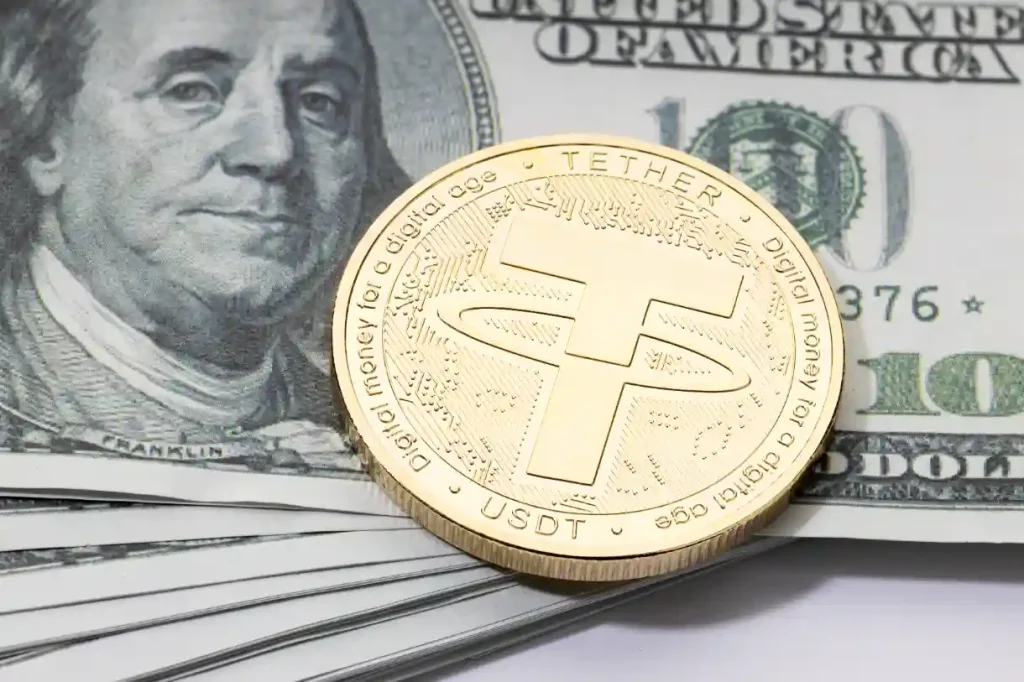
A USDT Coin lying on top of a background made of cash
Digital Cash: Stablecoins Real-Life Utility
In Brief
- • Stablecoins provide a way to use crypto for everyday payments, and transfers without worrying about volatility.
- • From remittances and freelancing to shopping and budgeting, stablecoins already function as practical digital cash worldwide.
- • Choosing established fiat-backed stablecoins helps to reduce risk while gaining real-world crypto experience.
Ad
Cryptocurrency often feels too volatile for those who still doubt its value in real-life scenarios. Prices rise and fall quickly, making everyday spending something that seems unreliable. However, stablecoins address this hurdle, as they’re pegged to the US Dollar, making them suitable for everyday transactions.
Moreover, stablecoins are already being used by millions of people worldwide for payments, savings, and transfers. Their stability makes them a bridge between traditional finance and the crypto ecosystem.
Beginners who want to explore crypto ecosystems without the volatility risk often start with stablecoins because they seem like digital versions of cash.
Instant Payments to Anyone
One of the simplest everyday uses of stablecoins is peer‑to‑peer payments. Traditionally, you might rely on a bank transfer or a payment app to send funds to your friends or family. These methods often involve delays, fees, or restrictions. However, by sending stablecoins, the process is usually immediate.
Essentially, you open your wallet app, enter the recipient’s address, select the network, and send coins like USDC or USDT. Within seconds, the funds arrive.
The value remains stable, so the recipient receives exactly what you intended. Beginners often start here because it feels familiar, like using a payment app, but faster and cheaper.
This everyday scenario shows how stablecoins simplify life. They remove friction from small transactions, making digital money as easy as sending a text message.
Covering Jobs & Subscriptions
Stablecoins are increasingly accepted for everyday payments. Online services now allow subscriptions to be paid directly in USDC. Moreover, freelancers all across the globe accept them as payment methods from international clients to perform a certain job.
For beginners, this demonstrates how stablecoins connect local life to global platforms. Indeed, you no longer need a credit card or bank account to access some international services. Stablecoins act as a universal payment method, bridging gaps between countries and currencies.
These funds can also be used to pay rent, buy groceries, and saving or investing money. Stablecoins make freelancing smoother and more accessible.
Considering the multiple uses that currently exist with stablecoins, users experience instant transactions without the risk of declined cards or international fees. This utility shows members of the space how stablecoins can replace traditional payment methods in everyday life.
Sending Money Across Borders
Remittances are one of the most powerful everyday uses of stablecoins. Furthermore, millions of people send money to family members across borders, given how traditional services charge high fees and take days to process.
This is one of its most innovative use cases, as it allows for fast, cheap, and reliable international payments. Also, stablecoins are particularly valuable in countries with unstable currencies, because holders can preserve value by exchanging to stablecoins instead of their local currency.
This perk also benefits merchants, with many retail shops in these unstable countries accepting stablecoin payments to avoid high inflation rates that affect their sales income.
However, it’s important to understand the laws and regulations of each country to make sure transacting with stablecoins is well within their accepted methods to avoid issues later on.

Saving & Budgeting in Digital Wallets
Stablecoins are ideal for saving because you can store funds in a wallet and know they will hold value as long as the pegged currency holds it as well. As mentioned above, this is especially powerful within regions with high inflation.
Budgeting becomes easier too, given the possibility to set aside income in stablecoins, track expenses digitally, and manage savings without worrying about devaluation. For beginners, this feels like using a modern savings account, but with the flexibility of crypto.
Setting aside part of your monthly income in USDC may allow you to budget your expenses and also have capital available for quick market entries.
Moreover, you can track expenses through your wallet app, knowing your savings will not lose value overnight. This everyday routine makes stablecoins practical for financial planning.
Stablecoins Still Carry Risks
Stablecoins are practical, but traders should understand some of the risks behind them, especially during these “early” stages of the market.
Regulations are constantly evolving in crypto, and issuers must be trusted to hold reserves honestly to avoid catastrophic outcomes that the industry has experienced in the past. Furthermore, some stablecoins are centralized, meaning companies can still freeze accounts.
On the other hand, the underlying technology might be vulnerable, and the stablecoin might lose its peg. Furthermore, the stablecoin’s reserve may not be liquid enough to cover all redemptions.
This is why many seasoned investors recommend that everyone focus on established fiat‑backed coins like USDC or USDT. By choosing reliable stablecoins, you can substantially reduce risk while enjoying stability and peace of mind.
Crypto’s Biggest Utility
Stablecoins are becoming more integrated into daily life, with merchants adopting them and many people and services using them for payments, savings, and many other transactions.
Governments are still exploring regulations, but stablecoins remain the most practical form of digital money today. However, for novice investors, they stand as the easiest way to step into crypto, not to be considered a speculative asset, but more as a practical means of payment.
Even though Bitcoin and Ethereum often take the spotlight, stablecoins have been largely responsible for crypto’s latest adoption within traditional systems.
Frequently Asked Questions
What are stablecoins and why are they used as digital cash?
Stablecoins are cryptocurrencies pegged to fiat currencies like the US dollar, making them useful for everyday payments, savings, and transfers without exposure to price volatility.
How do stablecoins make everyday payments easier?
They allow users to send money instantly through a wallet app, often with lower fees and fewer restrictions than banks or traditional payment services.
Why are stablecoins popular for international transfers and remittances?
Stablecoins enable fast, cross-border payments and help users in high-inflation countries preserve value compared to local currencies.
Can beginners safely save and budget using stablecoins?
Yes, many beginners use stablecoins to store funds, track expenses, and budget digitally, as long as they choose established fiat-backed options.
What risks should users understand before relying on stablecoins?
Stablecoins can face regulatory changes, account freezes, or peg instability, so users should focus on reputable fiat-backed stablecoins and understand local regulations.
How do you rate this article?
Subscribe to our YouTube channel for crypto market insights and educational videos.






Join our Socials
Briefly, clearly and without noise – get the most important crypto news and market insights first.

Most Read Today
1
Chainlink’s 499% Social Volume Spike: Why Attention is Outpacing Price
2Cardano (ADA) Price Analysis: Quiet Accumulation as Technical Signals Begin to Strengthen
3Digital Silver’s Silent Strength: Litecoin (LTC) Fundamental and Technical Dive
4Mantle’s $1B Milestone: Why MNT is the Next Layer 2 Powerhouse to Watch
5The Pi Day Pivot: Can Polkadot’s Massive Supply Cut Fuel a DOT Breakout?
Latest







8
Also read
Similar stories you might like.

Blockchain
Wells Fargo Files ‘WFUSD’ Trademark for Crypto and Payment Services
Ana | 2026-03-11

Market
Exclusive: Crypto Trader Josh Rager Says Bitcoin’s 4-Year Cycle “Isn’t What It Used To Be”
Sead | 2026-03-11
Altcoins
Tether Freezes $4.2B in USDT, Here’s Why
Rokas | 2026-02-28

Industry
Morgan Stanley Moves to Launch a Crypto Trust Bank
Patrick | 2026-03-01

Altcoins
Crypto Whale Transfers Spike Ahead of Clarity Act Decision; Here’s Why
Ana | 2026-02-27
Blockchain
This Deal Pushes USDT Beyond Exchanges
Patrick | 2026-02-26

Industry
Regulator Drafts GENIUS Act Implementation Proposal, Seeks Public Comment
Ana | 2026-02-26

Industry
The First GENIUS Act ETF Is Here – And It’s Built for Stablecoins
Patrick | 2026-02-19
Bitcoin
Charles Schwab Raises Strategy (MSTR) Stake in Latest 13F Filing
Patrick | 2026-02-17
Industry
Circle Says Stablecoin Regulation Has Reached an Inflection Point
Patrick | 2026-02-17