












Shiny Monero coin stands in a dark setting while glowing. Source: TechGaged.
As Qubic Shifts to DOGE and AI, Monero’s Hashrate Faces a Rebalancing—What’s Next for XMR?
In Brief
- • Qubic’s exit reduces centralization in Monero but introduces short-term hashrate volatility.
- • XMR shows mixed technical signals, with consolidation and early signs of relative strength vs BTC.
- • Network data indicate ongoing rebalancing, potentially strengthening Monero’s long-term resilience.
Qubic’s decision to phase out Monero mining in favor of Dogecoin and its Aigarth AI engine marks a significant shift in the privacy coin landscape.
After dominating over 51% of Monero’s hashrate in 2025 — mining more than 27,000 XMR blocks and generating $3.5 million in revenue — Qubic began its four-week transition to DOGE mining on April 1, 2026.
The move frees CPU and GPU resources for full-time AI training while outsourcing mining to dedicated ASICs, triggering an immediate rebalancing in Monero’s network hashrate.
Is Qubic’s Exit from Monero a Security Crisis or a Decentralization Win?
The shift is strategic rather than sudden. Qubic’s Useful Proof-of-Work model proved effective but split resources between mining and AI training.
By fully committing to DOGE mining with dedicated ASICs, the network can now run AI workloads at 100% capacity while still generating revenue.
For Monero, the loss of a single dominant contributor reduces centralization risk, even as it creates short-term hashrate volatility.
XMR’s Weekly Technical Picture: Diverging Signals in USD and BTC Pairs
The XMRUSD weekly chart, captured at 06:45 UTC on April 6, 2026, shows price at $330.09 after a modest 0.25% decline—hardly a panic move, but the lack of buying conviction is telling.
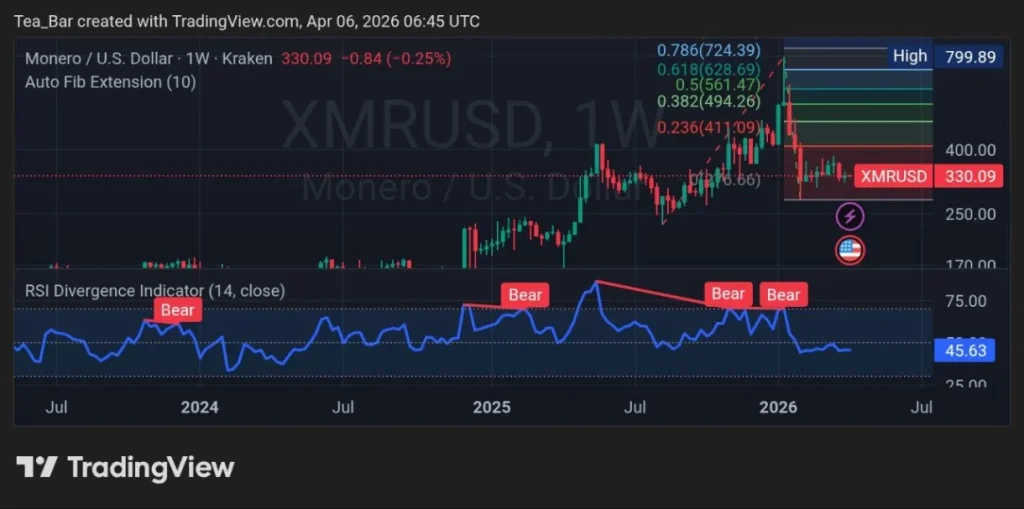
Auto Fib Extension levels highlight stubborn resistance near $494–$628, with price currently consolidating below the 0.236 Fib at $411, meaning any meaningful rally would first need to clear that psychological ceiling.
Meanwhile, the RSI Divergence Indicator (14) reads 45.63 and has printed repeated “Bear” signals throughout 2025–2026, reflecting ongoing distribution pressure that has yet to exhaust itself.
The XMRBTC weekly pair, timestamped 06:47 UTC, trades at 0.004798 (-0.17%)—modest but holding above critical support.
Bollinger Bands (20, SMA, close, 2) are expanding after a period of contraction, often a precursor to increased volatility, so traders should brace for a potential breakout in either direction.
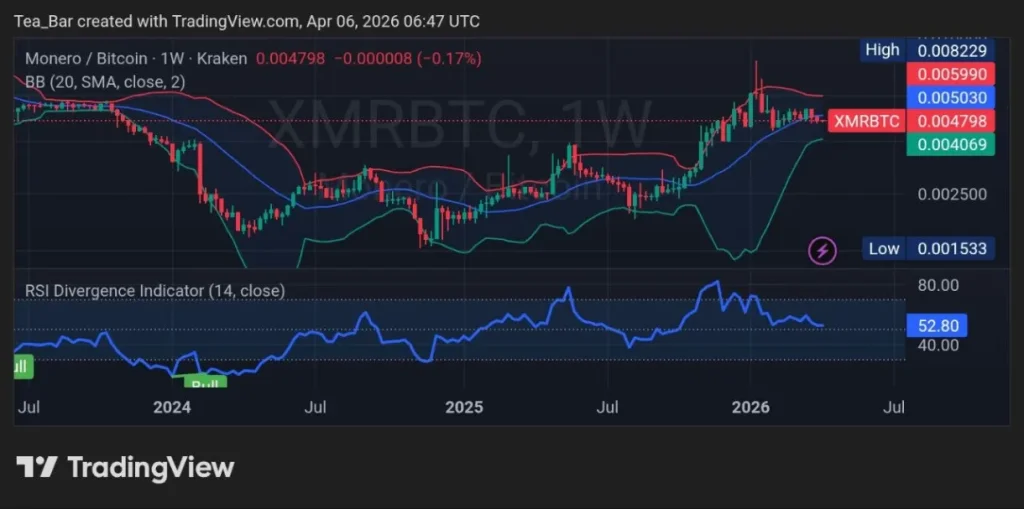
Most notably, the RSI Divergence Indicator sits at 52.80 and shows a recent “Bull” tag in early 2026, a subtle but important shift from the bearish sequence seen in USD terms.
These setups indicate XMR is absorbing near-term pressure relative to Bitcoin while holding key support zones as the hashrate finds its footing post-Qubic.
Network Hashrate Rebalancing in Real Time
Recent data from CoinWarz and Minerstat, gathered at 06:30 UTC on April 6, 2026, place Monero’s global hashrate at 5.25–5.41 GH/s with difficulty near 650 G.
Daily averages have fluctuated between 5.26 GH/s (April 6) and 5.40 GH/s (April 5) as the Qubic transition progresses.
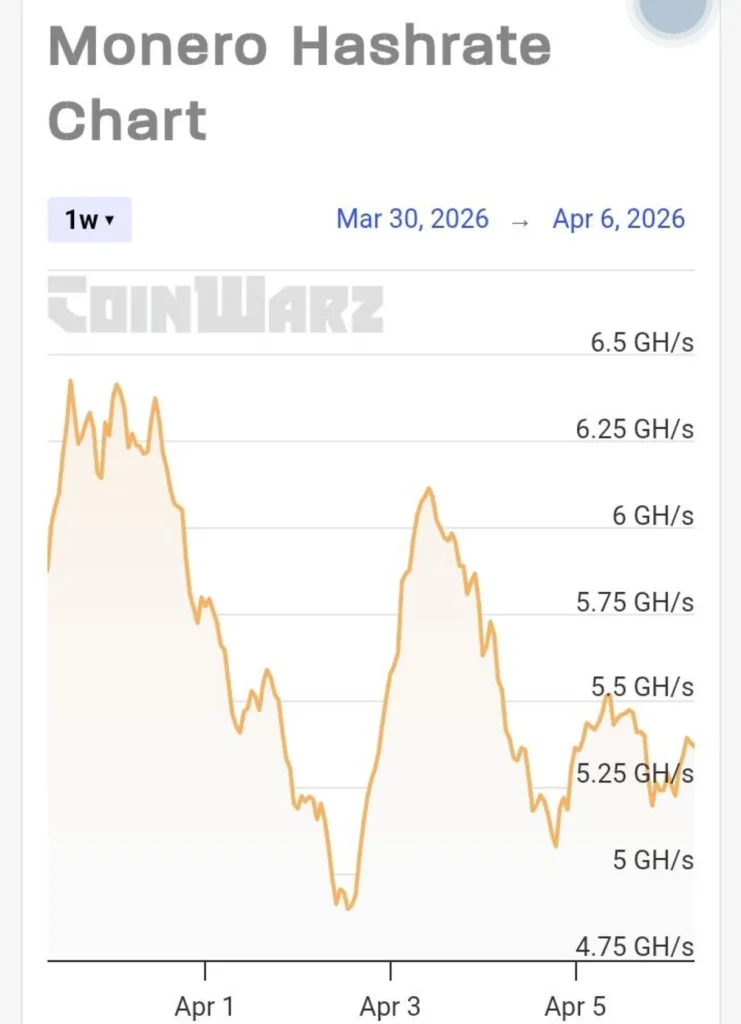
The network is already showing signs of rebalancing, removing the concentrated hashrate that previously exceeded 51%.
The Key Date to Watch
All eyes on April 15–20, 2026, when Qubic’s second phase concludes and Monero-related tasks are fully removed.
If the hashrate finds a new, more decentralized equilibrium by then, the narrative could shift from “security crisis” to “successful decentralization stress test.”
For now, Monero’s price remains in a wait-and-see pattern—but beneath the surface, the network’s true believers are quietly turning up their CPUs.
Will Hashrate Rebalancing Strengthen Monero Long-Term?
Technically, XMR shows constructive consolidation with mixed RSI signals.
Network data confirm normalization is underway, and the fundamental backdrop is shifting toward a more distributed mining ecosystem.
Qubic’s exit reduces single-entity dominance while preserving Monero’s core privacy value proposition.
The charts reflect a market absorbing the transition, on-chain metrics show healthy rebalancing, and the broader privacy narrative remains intact.
One question remains for investors: will this hashrate rebalancing create a cleaner, more resilient foundation for XMR — or will short-term selling pressure dominate as the market digests the shift?
More Must-Reads:
How do you rate this article?
Subscribe to our YouTube channel for crypto market insights and educational videos.






Join our Socials
Briefly, clearly and without noise – get the most important crypto news and market insights first.
Most Read Today
1
BCH Liquidation Shock: Where Smart Traders Are Positioning Next
2Ethereum’s Institutional Advantage in 2026: Why Smart Money Still Chooses ETH
3How Accurate Are Robert Kiyosaki’s Predictions?
4HBAR ETFs Secure a Top 5 Spot in Inflows—Breakout Imminent?
5Cardano Foundation Slashes ADA Holdings From 76.7% to 51.6% — Bearish Signal?
Latest






8
Also read
Similar stories you might like.
Bitcoin
Circle Combines Wrapped Bitcoin Launch With Quantum-Ready Arc Blockchain
Rokas | 2026-04-06

Bitcoin
Analyst Sees Bitcoin Flat for Years Before Multi-Million Breakout
Rokas | 2026-04-06

Altcoins
Toncoin’s Defining Moment: Can Telegram’s 1 Billion Users Trigger a Breakout in April?
Azeez | 2026-04-05

Altcoins
BCH Liquidation Shock: Where Smart Traders Are Positioning Next
Azeez | 2026-04-05
Altcoins
HBAR ETFs Secure a Top 5 Spot in Inflows—Breakout Imminent?
Azeez | 2026-04-05
Altcoins
Ethereum’s Institutional Advantage in 2026: Why Smart Money Still Chooses ETH
Azeez | 2026-04-05

Altcoins
Cardano Foundation Slashes ADA Holdings From 76.7% to 51.6% — Bearish Signal?
Azeez | 2026-04-04

Altcoins
BNB Chain’s Staking Rewards Jump Nearly 10x — Can Surging Yields Reverse the 3-Week Slide?
Azeez | 2026-04-04

Altcoins
Ripple Launches the First Treasury Management System — What This Means for XRP’s Enterprise Utility
Azeez | 2026-04-04

Altcoins
Can Bitcoin Hold $65k as ETF and CME Flows Go Offline for the Holiday Weekend?
Azeez | 2026-04-04