













Quantum surprise: Scientists uncover how matter enables ultrastrong photon coupling
Quantum surprise: Scientists uncover how matter enables ultrastrong photon coupling
As advances in the quantum realm continue, scientists have found a new way for photon coupling – using matter as the middleman – helping to unlock faster, more energy-efficient technologies for quantum computing and communications.
Ad
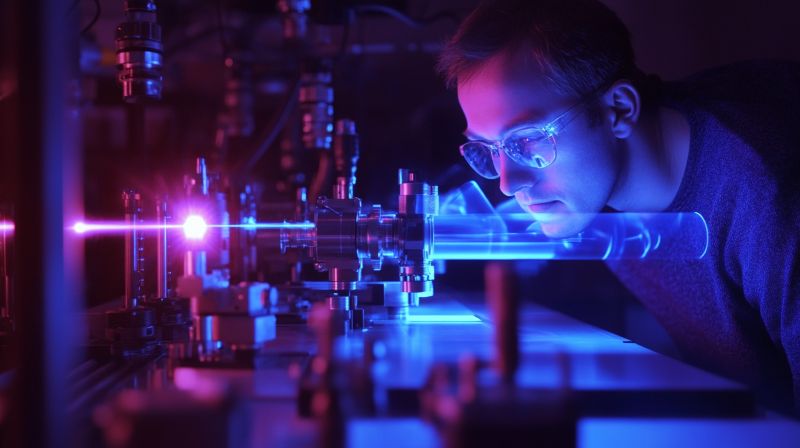
Specifically, the team at Rice University has created a special 3D structure called a photonic-crystal cavity, which traps light between tiny reflective surfaces, making it bounce around in particular ways, and allowing them to study how light behaves when interacting with electrons, per a recent study.
Light, electrons, and a little bit of quantum magic
Typically, photons don’t interact with each other. However, in this setup, when light bounced around inside the cavity and passed through a thin layer of free-moving electrons exposed to a magnetic field, something new happened – the light and matter became so closely linked that they formed hybrid states, called polaritons.
As Junichiro Kono, the Karl F. Hasselmann Professor in Engineering, professor of electrical and computer engineering and materials science and nanoengineering, and the study’s corresponding author, explained:
Ad
“It is well known that electrons strongly interact with each other, but photons do not. (…) This cavity confines light, which strongly enhances the electromagnetic fields and leads to strong coupling between light and matter, creating quantum superposition states — so-called polaritons.”
These polaritons let photons interact indirectly – essentially ‘talking’ to one another through the electrons. This kind of interaction, known as ultrastrong coupling, is so intense that energy bounces back and forth between light and matter before it can escape, creating a deeply entangled state.
What’s more, the study has shown that the way the photons interact depends on polarization – the direction in which the light waves oscillate. In some cases, the light modes remained separate, but in others, they merged into entirely new patterns.
Stronger photon coupling as a step toward quantum tech of the future
With this discovery, the scientists have opened up the possibility of developing new materials where light modes can be controlled through electron interactions – a big deal for quantum computers, which rely on strange quantum states to work.
By exploring how matter can mediate light interactions, the Rice team may have laid the groundwork for the next generation of quantum technologies and, as Kono said, it “can lead to new protocols and algorithms in quantum computation and quantum communications.”
Elsewhere, scientists have developed a breakthrough method to more easily identify diamonds with certain optically active defects for highly sensitive sensors called qubits, which store quantum data in the electron spin state of the color centers for use in quantum computers.
How do you rate this article?
Subscribe to our YouTube channel for crypto market insights and educational videos.






Join our Socials
Briefly, clearly and without noise – get the most important crypto news and market insights first.
Most Read Today
1
Samsung crushes Apple with over 700 million more smartphones shipped in a decade
2Peter Schiff Warns of a U.S. Dollar Collapse Far Worse Than 2008
3Dubai Insurance Launches Crypto Wallet for Premium Payments & Claims
4XRP Whales Buy The Dip While Price Goes Nowhere
5Cathie Wood: $28 Billion Bitcoin Deleveraging Drove Recent Pullback
Latest





8
Also read
Similar stories you might like.

Industry
Google Searches for “How to Buy Gold” Explode Globally, Hitting a Two-Decade High
Rokas | 2026-01-26

Industry
Businesses now use crypto as operational capital, CoinGate data reveals a structural shift
Rokas | 2026-01-21

Bitcoin
$455 Billion in Bitcoin Exposed to Quantum Attack Risk via Address Reuse, Up 16% Since 2020
Jastra | 2026-01-20

Altcoins
Iran’s Crypto Activity Surges During Protests; Here’s Why
Ana | 2026-01-16

Industry
Stablecoin Market Share Hits an All-Time High of 10.19%
Jastra | 2026-01-14
No image

Bitcoin
Only Three Governments Increased Bitcoin Holdings in 2025 – U.S. Leads Following 130,000 BTC Seizure
Jastra | 2026-01-05
Industry
Solana Tokens Lose $157B in 2025, The Largest Dollar-Value Drop in the Chain’s History
Jastra | 2025-12-30

Artificial Intelligence
New Epstein Disclosures Collide With an AI Project Built Months Earlier
Ana | 2025-12-22

Industry
Bitcoin Vs Quantum Computing: A True Threat?
Patrick | 2025-12-22