














Wall Street sign with pedestrian. Source: TechGaged / Shutterstock
Wall Street Meme Coin Push: Canary Capital Files for Spot PEPE ETF
In Brief
- • Canary Capital filed for a spot PEPE ETF.
- • The proposal brings meme coins into traditional markets.
- • It raises new concerns around risk and regulation.
Canary Capital has filed an S-1 with the U.S. Securities and Exchange Commission (SEC) for a spot PEPE exchange-traded fund (ETF), aiming to offer direct exposure to the meme coin through a traditional brokerage structure. The filing outlines a fund that would hold PEPE and track its market price. The move pushes crypto ETFs further beyond Bitcoin and Ethereum into high-volatility assets.
A meme coin enters the ETF pipeline
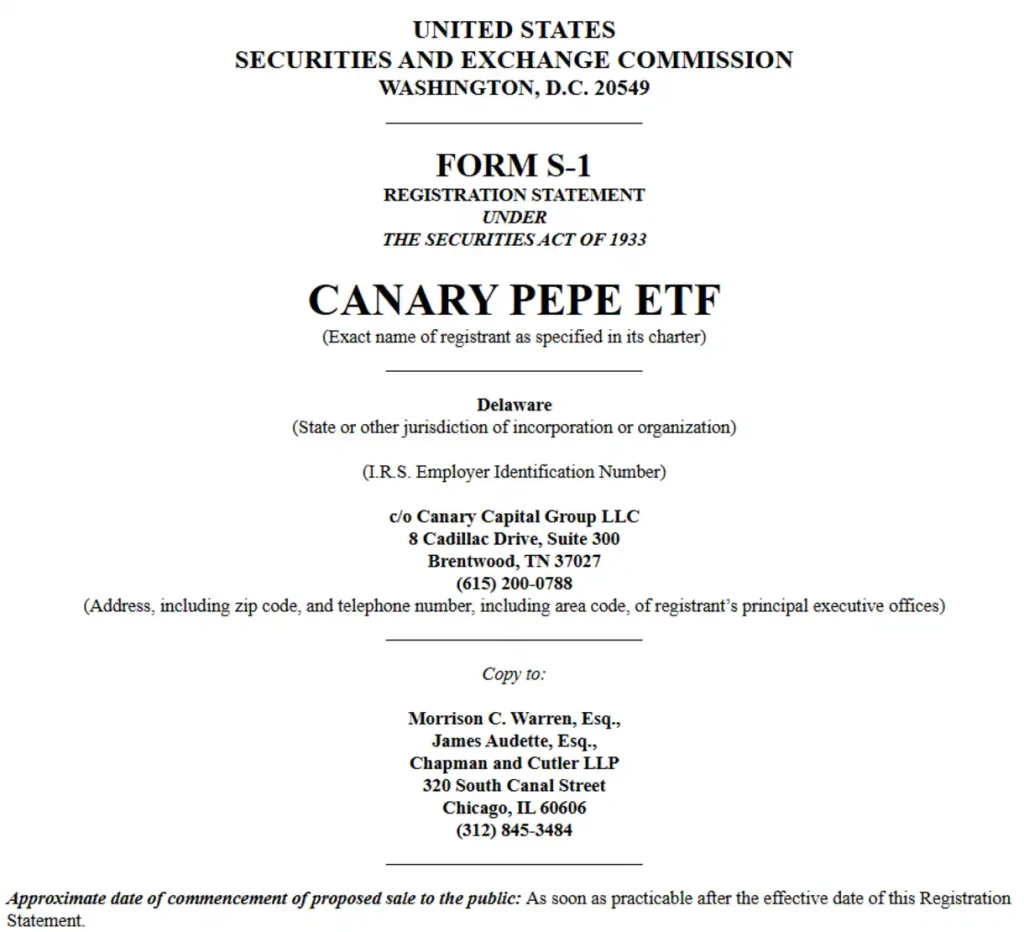
According to the filing dated April 8, the proposed product, called the Canary PEPE ETF, is designed to hold PEPE directly and calculate its value using a pricing benchmark based on trading activity across major platforms.
Like other spot crypto ETFs, shares would be created and redeemed in large blocks, with authorized participants delivering cash or PEPE in exchange. The structure is familiar, but the asset is not.
PEPE is an ERC-20 token built on Ethereum (ETH), with no underlying utility beyond its cultural and social traction. The filing itself makes that clear, stating that its value is driven primarily by online sentiment and community engagement and not fundamentals.
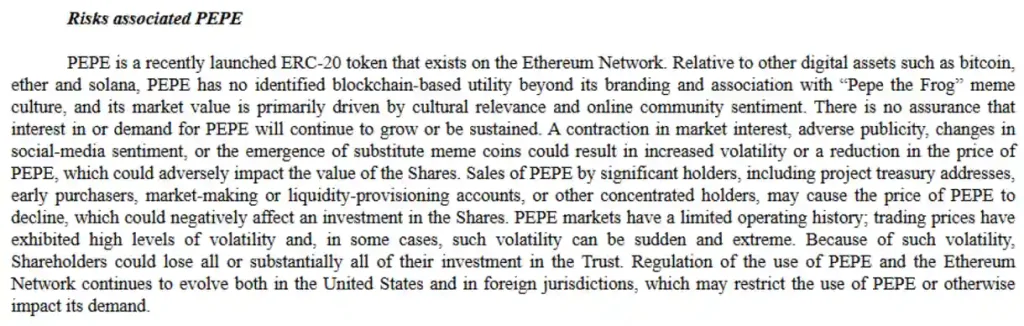
That makes this one of the most speculative ETF proposals to reach the SEC so far.
What this means for the ETF market
So far, ETF approvals have focused on assets with deeper liquidity and clearer market structure, like Bitcoin (BTC). A PEPE ETF challenges that. It introduces questions around market manipulation and investor protection, both of which regulators have flagged in previous decisions.
At the same time, it reflects how demand is evolving. Meme coins command large trading volumes and global attention, even without traditional fundamentals. Wrapping that demand into an ETF gives institutional and retail investors a familiar access point, without handling wallets or tokens directly.
Approval remains unlikely in the near term. The risks are spelled out clearly in the filing, including extreme volatility and the potential for total loss.
However, one thing is clear: ETF issuers are no longer limiting themselves to core crypto assets. They are starting to package culture-driven tokens into financial products, pushing the edge of what public markets might accept next.
How do you rate this article?
Subscribe to our YouTube channel for crypto market insights and educational videos.






Join our Socials
Briefly, clearly and without noise – get the most important crypto news and market insights first.
Most Read Today
1
Jim Cramer Prediction Accuracy: Full Report (2000–2026)
2Exclusive: $250M Asset Manager Breaks Down Morgan Stanley’s Bitcoin ETF Impact
3XRP Whales Buying Rises Ahead of Major Ripple XRPL Japan Event
4Bitcoin Jumps to Three-Week High as Crypto Adds $100B
5Crypto’s ‘Middle Class’ Is Shrinking Fast — Mid-Priced Tokens Down 32%
Latest






8
Also read
Similar stories you might like.

Altcoins
Crypto Market Loses $50B After Bitcoin Rejection
Ana | 2026-04-09

Altcoins
Massive Fartcoin Long Ends in $3M Loss, Shorts Benefit
Ana | 2026-04-09

Bitcoin
Bitcoin Pioneer Adam Back Rejects Satoshi Identity Claims
Ana | 2026-04-09

Bitcoin
Subversive Bitcoin SPAC Registers With SEC to Go Public
Rokas | 2026-04-09

Altcoins
XRP Enters Make-or-Break Phase as CLARITY Act Advances in April
Azeez | 2026-04-09

Blockchain
FBI Warning: Crypto Losses Hit $11B as Scams Surge
Ana | 2026-04-08

Altcoins
Bitcoin Jumps to Three-Week High as Crypto Adds $100B
Ana | 2026-04-08

Bitcoin
Quantum Threat: Experts Say Bitcoin Encryption May Not Last a Decade
Ana | 2026-04-08

Bitcoin
10K BTC at $50 Got Zero Bids, Now It’s Worth Hundreds of Millions
Rokas | 2026-04-08

Market
Jim Cramer Prediction Accuracy: Full Report (2000–2026)
Sead | 2026-04-08