














Bitcoin digital dissolve. Source: TechGaged / Shutterstock
Quantum Breakthrough Sparks Fresh Fear for Bitcoin Security
In Brief
- • New research raises concerns about quantum threats to Bitcoin.
- • A potential “Q-day” could arrive within the next decade.
- • The risk remains theoretical but is advancing faster than expected.
Ad
Bitcoin (BTC) security researcher Justin Drake says new quantum computing research has increased the chances that powerful machines could break crypto security within the next decade. He now estimates a 10% chance of a so-called “Q-day” by 2032, when quantum computers could crack widely used encryption like the one behind Bitcoin. In simple terms, this would mean a machine could figure out someone’s private key from their public key, something that is currently considered practically impossible.
What changed with the new research
According to Drake’s X post on March 31, two new research papers made improvements to a well-known quantum method called Shor’s algorithm, which aims to break modern encryption.
One paper (linked to Google researchers) shows it might take far fewer “logical qubits” than previously thought. Another paper suggests a different type of quantum machine could do the same job with about 40x fewer physical resources
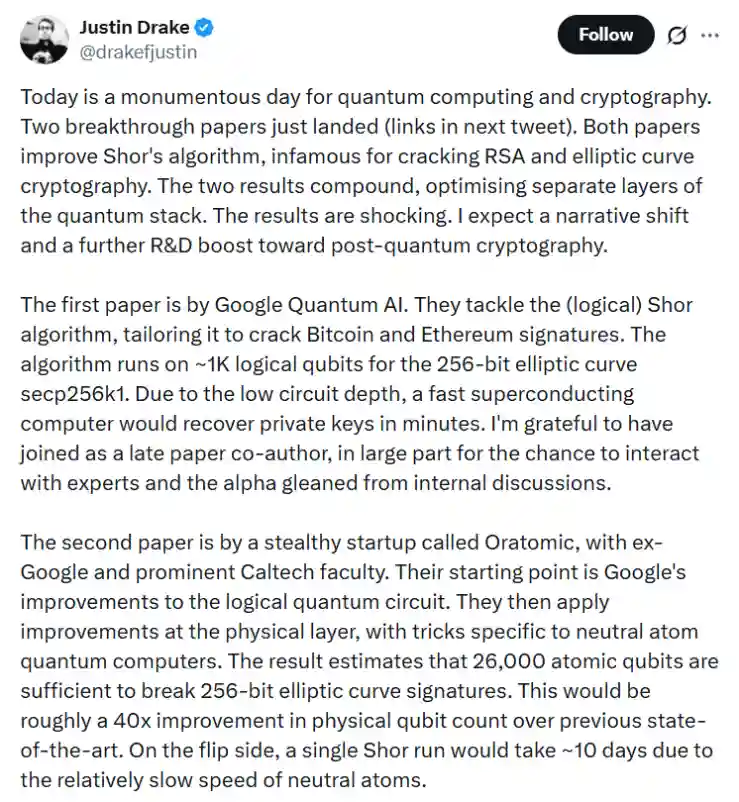
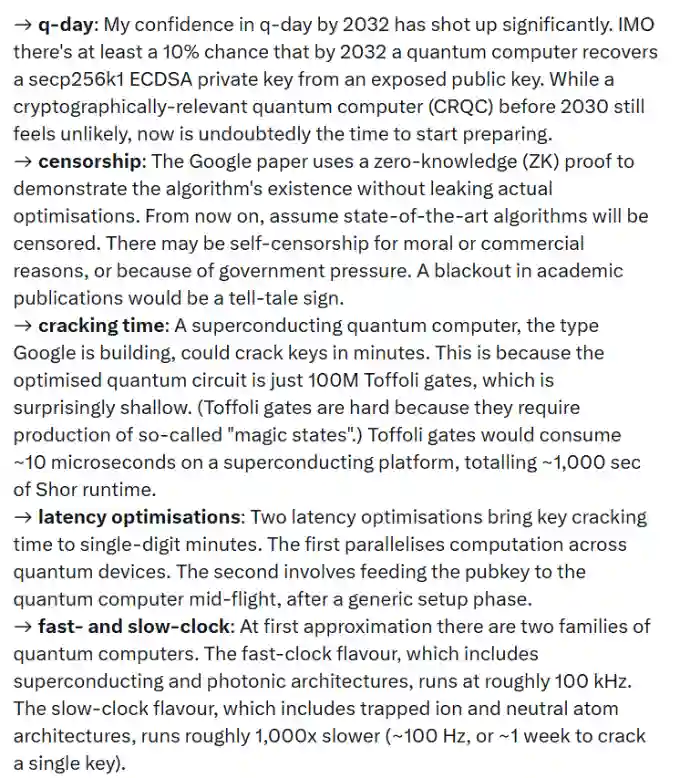
In best-case scenarios, a powerful quantum computer could crack a key in minutes, while slower versions might take around 10 days. That is still theoretical, but the gap between “impossible” and “possible” just got smaller.
Why this matters for crypto
As it happens, Bitcoin and many other cryptocurrencies rely on a type of cryptography (called elliptic curve cryptography) to keep wallets secure. Right now, even the best classical computers would take billions of years to break it. Quantum computers, however, could change that.
That said, only exposed public keys (for example, after you send a transaction) would be at risk. Funds sitting in unused addresses are much harder to target.
Now, this isn’t an immediate threat, at least not yet, as today’s quantum computers are still far from being able to truly break Bitcoin. However, the direction is what’s worrying researchers.
Drake’s takeaway is that progress is happening faster than expected, even basic improvements are making a difference, and AI hasn’t even been fully used yet to optimize these systems. That suggests the timeline could accelerate.
Meanwhile, the crypto industry is already working on post-quantum cryptography, which would protect against these future attacks. For now, this is more of a “prepare early” warning than a crisis.
But if progress continues at this pace, the conversation around Bitcoin security could shift from theoretical to practical much sooner than many expected.
How do you rate this article?
Subscribe to our YouTube channel for crypto market insights and educational videos.






Join our Socials
Briefly, clearly and without noise – get the most important crypto news and market insights first.






8
Also read
Similar stories you might like.

Bitcoin
New U.S. Bill Backs Domestic Bitcoin Mining Industry
Ana | 2026-03-31

Blockchain
Crypto Apps Exposed to Risk After Malicious Axios Versions Go Live
Rokas | 2026-03-31

Research
How Accurate Are Robert Kiyosaki’s Predictions?
Sead | 2026-03-31

Bitcoin
Bitcoin Miners Turn to AI as Profits Collapse
Ana | 2026-03-30

Bitcoin
Mystery Deepens as $400M ‘Lost’ Bitcoin Suddenly Moves
Rokas | 2026-03-30

Altcoins
Kiyosaki Warns of Inflation Crisis, Lists 6 Safest Investments for 2026
Rokas | 2026-03-30

Altcoins
Sui Approaches 800K Users as Token Unlock Nears — Can Price Stay Resilient?
Azeez | 2026-03-29

Altcoins
Ethereum ETFs Post 7 Days of Outflows; Tom Lee Says $250,000 Is Coming. Who’s Right?
Azeez | 2026-03-28

Bitcoin
Bitcoin FUD Is Everywhere Right Now And That May Be Bullish
Ana | 2026-03-27

Bitcoin
Gold Drops But Bitcoin Isn’t Taking Over Yet; Here’s Why
Ana | 2026-03-27