












Ethereum logo and Vitalik Buterin. Source: TechGaged / Shutterstock
Ethereum Eyes BitTorrent-Style Block Building; Here’s What It Brings
In Brief
- • Ethereum plans ePBS to limit builder centralization.
- • FOCIL adds multi-party transaction inclusion safeguards.
- • Encrypted mempools aim to curb toxic MEV.

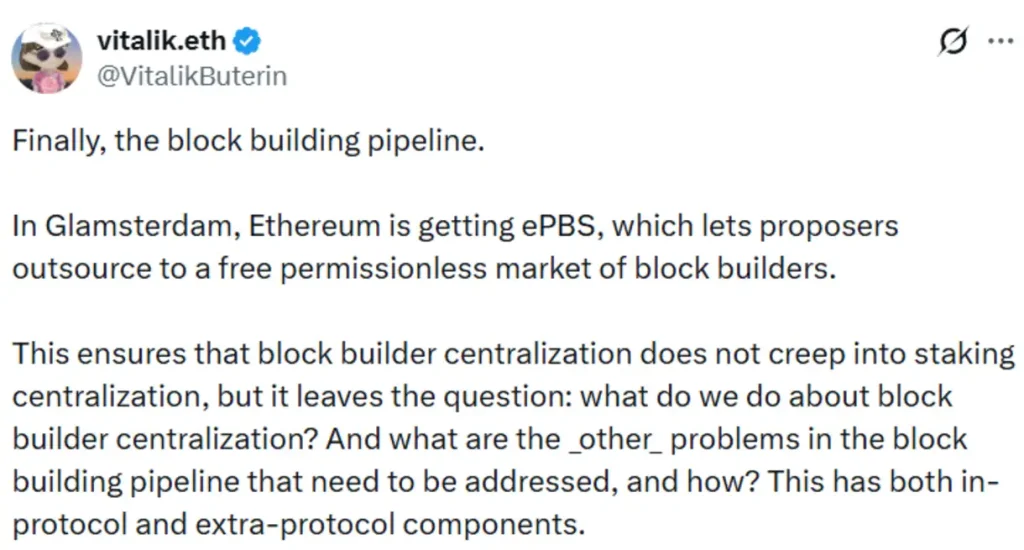
Ethereum (ETH) is preparing structural changes to how blocks are built and who controls them. In a detailed post, Vitalik Buterin explained that the upcoming ‘Glamsterdam’ upgrade introduces ePBS (enshrined Proposer-Builder Separation). The goal is to prevent block builder centralization from creeping into validator centralization.
As it happens, proposers can outsource block construction to a permissionless builder market, protecting staking decentralization. But that does not solve builder concentration itself, according to Buterin’s post shared on March 2.
FOCIL: A Censorship Backstop
To address this, Buterin highlighted FOCIL, a system that introduces multi-participant block building directly into the protocol. Under FOCIL, 16 randomly selected attesters each choose transactions that must be included in a block. If those transactions are excluded, the block is rejected.
This creates a safeguard. Even if a single builder dominates block production, they cannot fully censor transactions. Inclusion power becomes partially distributed.
A more ambitious idea, dubbed ‘Big FOCIL,’ could expand this model further, potentially reducing builders’ roles mainly to MEV-related ordering and state execution. As Buterin explains:
“We avoid duplication by having the i’th FOCIL’er by default only include (i) txs whose sender address’s first hex char is i, and (ii) txs that were around but not included in the previous slot. So at the cost of one slot delay, only censored txs risk duplication. Taking this to its logical conclusion, the builder’s role could become reduced to ONLY including ‘MEV-relevant’ transactions (eg. DEX arbitrage), and computing the state transition.”
Encrypted Mempools And Toxic MEV
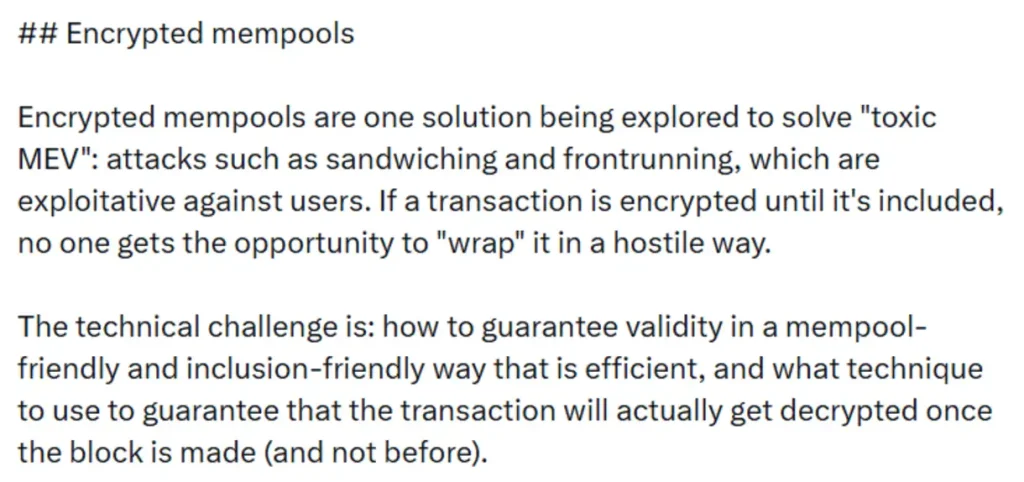
Another focus is toxic MEV, including sandwich attacks and frontrunning.
The team is exploring encrypted mempools as a defense. If transactions remain encrypted until inclusion, malicious actors can’t see and exploit them before finalization. The technical challenge is ensuring transactions remain valid and decrypt reliably at the right time.
The Network Layer Problem
Buterin also stressed one thing that many people often overlook: that the transaction ingress layer. Between sending a transaction and block inclusion, users remain exposed to surveillance and manipulation.
Proposals include Tor routing, Ethereum-specific mixnets, latency-optimized non-mixnet privacy networks like Flashnet, and the like.
The Long-Term Vision
Ultimately, Buterin described a broader goal: more distributed block building. One idea is creating transaction categories that don’t require full global synchronization, allowing Ethereum to scale without concentrating power in a single ordering actor.
“There is a dream, that we can make Ethereum truly like BitTorrent: able to process far more transactions than any single server needs to ever coalesce locally. The challenge with this vision is that Ethereum has (and indeed a core value proposition is) synchronous shared state, so any tx could in principle depend on any other tx. This centralizes block building.”
The direction is clear: reduce hidden centralization, limit MEV abuse, and strengthen censorship resistance at the protocol level, all part of new and expanded plans for the blockchain’s future.
Earlier, Ethereum Foundation (EF) introduced a new long-term roadmap called the ‘strawmap,’ outlining an ambitious vision for the network’s future, including multiple upgrade ideas stretching toward the end of the decade, sparking discussion about Ethereum’s long-term direction.
More Must-Reads:
How do you rate this article?
Join our Socials
Briefly, clearly and without noise – get the most important crypto news and market insights first.
Most Read Today
1
Inverse Kiyosaki Strategy Explained: The Cost of Sitting Out
2Bitcoin to $0? Nobel Physicist’s Quantum Warning Jolts Crypto Again
3Bitcoin Rallies as Oil Drops on Hormuz Reopening
4New Record: Ethereum Hits 200M Transactions as Network Activity Breaks Out
5Billionaire Tim Draper Doubles Down on $250K Bitcoin Target; Here’s Why
Latest





8
Also read
Similar stories you might like.

Altcoins
3 Key Reasons RaveDAO (RAVE) Skyrocketed into the Top 25 Cryptocurrencies This Week
Azeez | 2026-04-17

Altcoins
Bitcoin Rallies as Oil Drops on Hormuz Reopening
Ana | 2026-04-17

Bitcoin
Billionaire Tim Draper Doubles Down on $250K Bitcoin Target; Here’s Why
Ana | 2026-04-17

Bitcoin
Top Crypto Investor Maps Bitcoin’s Path Through AI Shock and War Risk
Ana | 2026-04-17

Altcoins
New Record: Ethereum Hits 200M Transactions as Network Activity Breaks Out
Rokas | 2026-04-17

Bitcoin
Bitcoin to $0? Nobel Physicist’s Quantum Warning Jolts Crypto Again
Rokas | 2026-04-17
Beginners
Inverse Kiyosaki Strategy Explained: The Cost of Sitting Out
Sead | 2026-04-17

Bitcoin
Bitcoin Inflows Spike as $75K Caps Rally
Ana | 2026-04-16

Altcoins
BNB Burn Signals Potential Price Shift — Here’s What Traders Are Watching
Azeez | 2026-04-16

Bitcoin
951 BTC Move Sparks Questions: Is Tether Quietly Accumulating Bitcoin?
Azeez | 2026-04-16