











Copper-toned Ripple coin featuring a world map design and Ripple logo. Source: TechGaged / Pixabay.
Ripple Just Expanded Escrow Beyond XRP – Here’s What That Could Unlock
In Brief
- • XLS-85 extends native escrow from XRP to all trustline tokens and MPTs.
- • Institutional use cases expand: RWAs, stablecoins, treasury locks, automated settlement.
- • Long-term XRP value depends on increased network utility and asset issuance growth.
Ad
RippleX has launched Token Escrow (XLS-85) on the XRP Ledger mainnet. The update allows trustline-based tokens (IOUs) and Multi-Purpose Tokens (MPTs) to be locked, scheduled, and conditionally released natively on-chain. A shift that expands how stablecoins, RWAs, and institutional assets can operate within the network.
The feature is now live following the formal specification under XLS-0085, marking another incremental but meaningful upgrade to XRPL’s evolving infrastructure stack.
What’s Actually Changing on XRPL
XRPL’s escrow functionality has always applied only to XRP, enabling time-based or condition-based release of funds without third-party smart contracts.
As of today, XLS-85 extends that native logic to issued tokens and MPTs. Meaning that any asset built on XRPL can now use escrow primitives at the protocol level.
Technically, this introduces new ledger objects that allow token balances to be locked under defined conditions, including time locks or crypto-condition fulfillment.
Moreover, it operates within XRPL’s core transaction engine and not via external smart contracts. Therefore, it preserves the network’s deterministic execution model and low-cost settlement design.
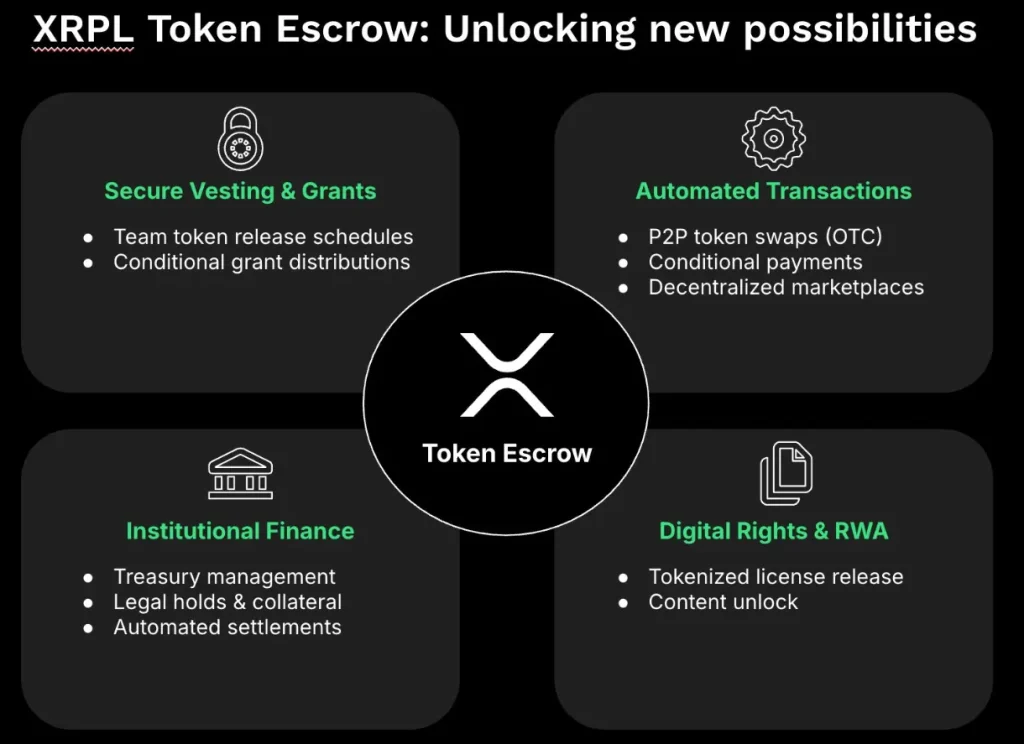
Importantly, this development is relevant for stablecoins such as RLUSD and tokenized real-world assets. With XLS-85, issuers can structure conditional releases, vesting schedules, collateral locks, and treasury operations directly on XRPL.
The update also supports institutional-grade use cases like automated settlement flows, escrow-backed OTC trades, programmable grant distributions, and tokenized debt instruments.
Ripple’s Expanding Institutional Toolkit
XLS-85 doesn’t exist in isolation. It builds on a broader series of XRPL upgrades, including MPTs, AMM integration, sidechain experimentation, and tokenization initiatives.
Therefore, it seems like Ripple is positioning itself as a specialized settlement layer for tokenized assets rather than a general-purpose DeFi chain.
By enabling native escrow for IOUs and MPTs, XRPL strengthens its appeal for financial institutions that require predictable execution, conditional settlement, and compliance-friendly asset management tools.
The more these primitives are extended beyond XRP, the more XRPL evolves into a neutral asset settlement rail rather than a single-asset network.
Indeed, it’s a shift that’s crucial to attract capital flows that prioritize operational certainty.
What It Could Mean for XRP in the Long Term
Protocol upgrades like XLS-85 are not short-term catalysts on their own. However, long-term value for XRP could be based on network usage, settlement volume, and institutional onboarding.
If escrow functionality materially increases token issuance and RWA activity on XRPL, transactional demand for XRP as a bridge asset and fee token could gradually expand.
Athough price reaction in the short-term might still be sentiment-driven, every extension of XRPL’s institutional solutions supports XRP’s value proposition.
Indeed, it’s now tied to settlement infrastructure rather than speculative cycles.
XRP Price Today
More Must-Reads:
How do you rate this article?
Subscribe to our YouTube channel for crypto market insights and educational videos.






Join our Socials
Briefly, clearly and without noise – get the most important crypto news and market insights first.

Most Read Today
1
Sui Approaches 800K Users as Token Unlock Nears — Can Price Stay Resilient?
2Could SpaceX’s IPO Be the Catalyst That Sends Dogecoin Above $0.10?
3Mystery Deepens as $400M ‘Lost’ Bitcoin Suddenly Moves
4Bitcoin Miners Turn to AI as Profits Collapse
5TRON Moves Toward Institutions: How Anchorage Support Could Influence TRX Price
Latest





8
Also read
Similar stories you might like.

Industry
Trump Backs Bitcoin, Stablecoins In New Pro-Crypto Push
Ana | 2026-03-30

Industry
Canada Proposes Ban on Crypto Political Donations
Ana | 2026-03-30

Altcoins
Ethereum Foundation Makes Record ETH Staking Move
Ana | 2026-03-30

Bitcoin
Bitcoin Miners Turn to AI as Profits Collapse
Ana | 2026-03-30

Bitcoin
Mystery Deepens as $400M ‘Lost’ Bitcoin Suddenly Moves
Rokas | 2026-03-30

Altcoins
Kiyosaki Warns of Inflation Crisis, Lists 6 Safest Investments for 2026
Rokas | 2026-03-30
Altcoins
TRON Moves Toward Institutions: How Anchorage Support Could Influence TRX Price
Azeez | 2026-03-29

Altcoins
Gold Enters DeFi: Tether’s XAUt Expansion to BNB Chain Could Shift Market Dynamics
Azeez | 2026-03-29

Altcoins
Sui Approaches 800K Users as Token Unlock Nears — Can Price Stay Resilient?
Azeez | 2026-03-29

Altcoins
Could SpaceX’s IPO Be the Catalyst That Sends Dogecoin Above $0.10?
Azeez | 2026-03-29