












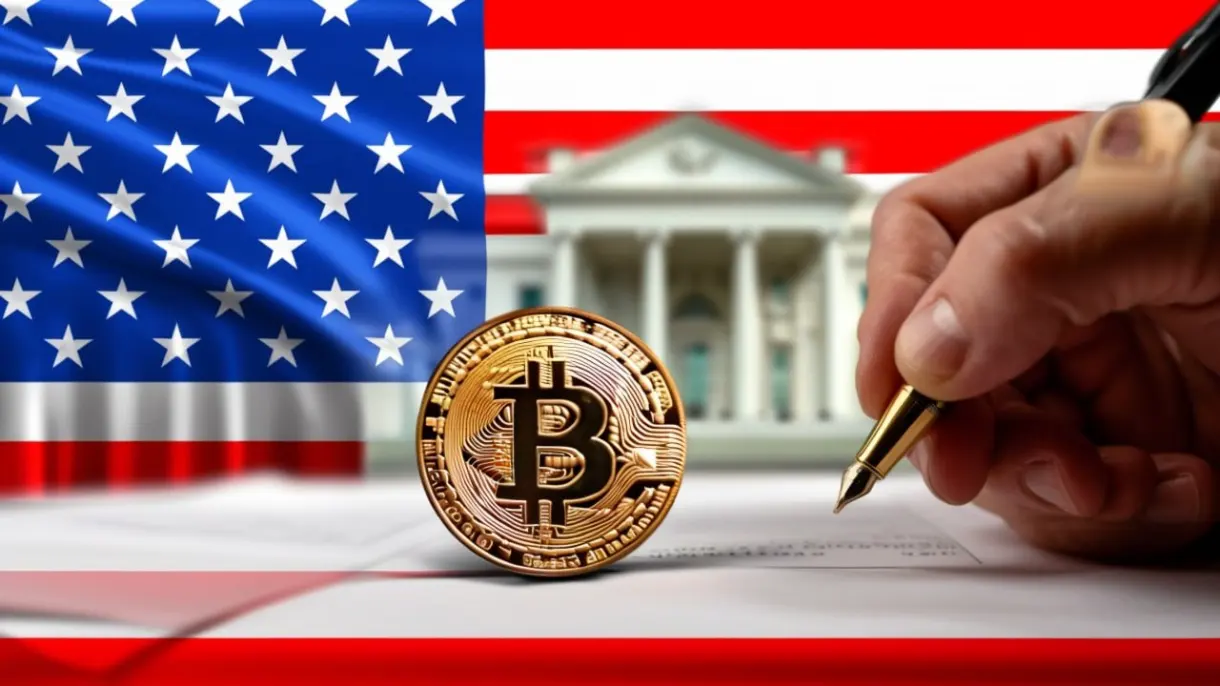
Bitcoin stands in a setting with the US flag colors and a hand signs an executive order

The U.S. government’s approach to crypto regulation may be nearing a turning point, with potential implications far beyond price action. David Sacks said banks are expected to get fully into crypto once market structure legislation is in place, signaling a possible shift in how tradfi interacts with digital assets.
The remarks come as lawmakers and regulators continue to work on clarifying how crypto markets should be supervised, traded, and integrated into the existing financial system.
Rather than framing crypto as an external risk, the comments suggest it’s progressively being treated as an asset class that requires clear rules to enable broader institutional participation.
Unlocking Bank Participation
Speaking from Davos, White House AI and Crypto Czar David Sacks’ statement centers on market structure. A long-running issue in U.S. crypto regulation.
At its core, market structure legislation aims to define how digital assets are classified. Also, which regulators oversee them, and how trading, custody, and settlement should function.
Without those definitions, banks stay on the sidelines, constrained by compliance uncertainty, although the interest is there.
Moreover, the Financial Stability Oversight Council emphasized that regulatory clarity is essential for safely integrating crypto activities into the banking system.
Similarly, the Basel Committee on Banking Supervision indicates that global regulators are preparing for deeper institutional involvement.
Therefore, Sacks’ comments imply that banks will have the regulatory confidence needed to expand crypto services. However, U.S. market structure rules need to first be finalized.
Crypto’s Broader Outlook
Looking beyond the immediate news, the potential entry of banks into crypto at scale would mark a structural shift for the market. Additionally, digital assets could increasingly move through regulated financial channels. As a result, liquidity dynamics and risk distribution might change.
From a long-term perspective, this could support greater stability. Moreover, banks operate under strict capital, reporting, and risk frameworks. Which may reduce some of the excess leverage that has amplified volatility in past cycles.
At the same time, broader institutional access could deepen liquidity and expand participation beyond retail-driven flows.
However, integration doesn’t necessarily mean rapid adoption. Indeed, banks tend to move deliberately, especially when new regulatory regimes are involved.
Official signals from U.S. policymakers, combined with existing international banking standards, suggest crypto is being prepared for massive inclusion. Therefore, if legislation delivers the clarity banks are waiting for, crypto’s next phase may be defined by integration into the global financial system.
Bitcoin Price Today
More Must-Reads:
How do you rate this article?
Subscribe to our YouTube channel for crypto market insights and educational videos.






Join our Socials
Briefly, clearly and without noise – get the most important crypto news and market insights first.





8
Also read
Similar stories you might like.

Altcoins
Why This Phase of Crypto Feels Different
Azeez | 2026-04-29

Altcoins
Bitcoin Holds $77K Ahead of FOMC as Altcoins Turn Green
Ana | 2026-04-29

Beginners
How Accurate Are Financial Experts?
Sead | 2026-04-29
Altcoins
Judge Rejects Sam Bankman-Fried’s New Trial Request
Ana | 2026-04-29
Bitcoin
Czech Central Bank Explores Bitcoin as Reserve Asset
Ana | 2026-04-29

Altcoins
U.S. Cracks Down on Iran’s Crypto and Oil Revenues
Rokas | 2026-04-29

Altcoins
CME Futures Coming May 4 – Avalanche (AVAX) About to Explode or Implode?
Azeez | 2026-04-29
Altcoins
Ripple CEO Says XRP Remains Company’s “North Star”
Rokas | 2026-04-29
Altcoins
Bitcoin Fails at $79.5K, Triggers Market Pullback
Ana | 2026-04-28

Altcoins
The Consensus Countdown Has Started — Here’s What Miami’s Monster Week Means for Crypto
Azeez | 2026-04-28